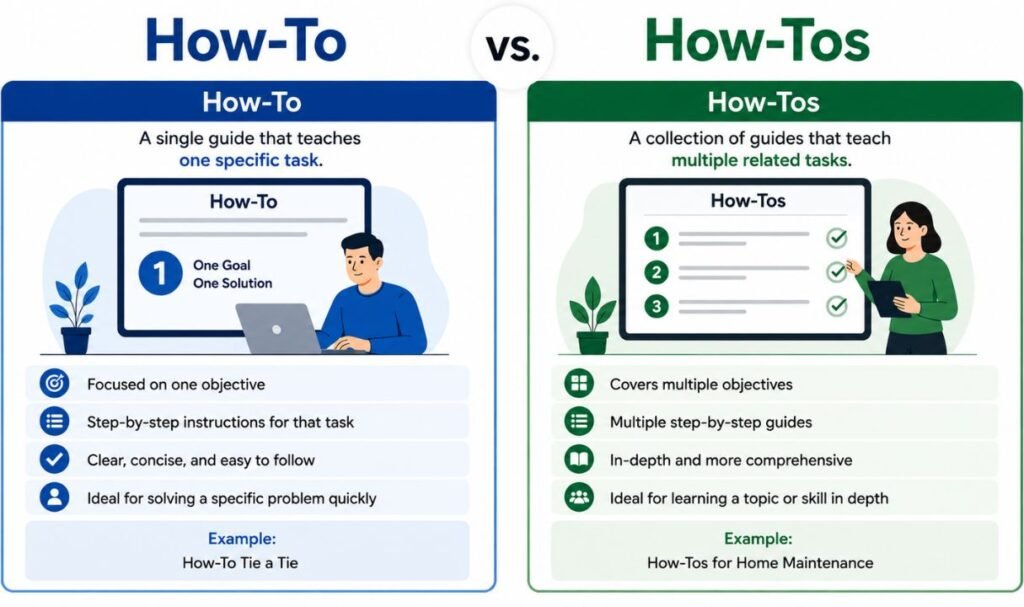

You’ve typed it a hundred times and second-guessed it a hundred and one. Is it “how-to” or “how to”? And once you need more than one, does it become “how-tos,” “how to’s,” or something else entirely?
This little phrase trips up bloggers, editors, marketers, and students alike. Part of the problem is that “how-to” changes shape depending on the job it’s doing in a sentence. Add a plural into the mix, and even confident writers start second-guessing their punctuation.
Below, you’ll find a complete breakdown: what “how-to” means, when to hyphenate it, why “how-tos” beats “how to’s” every time, and how to avoid the mistake altogether if you’d rather sidestep it. By the end, you won’t need to pause and Google this again.
Understanding What “How-To” Really Means
“How-to” isn’t one fixed word. It’s a compound that shifts between two roles: a noun and an adjective. Knowing which role it’s playing tells you instantly whether it needs a hyphen.
As a noun
When “how-to” stands in for a thing — a guide, a tutorial, a set of instructions — it acts as a noun. In this role, it’s always hyphenated.
- She wrote a how-to on refinishing furniture.
- The channel is full of quick how-tos for home cooks.
- I bookmarked that how-to for later.
Here, “how-to” is the subject or object of the sentence, doing the same job a word like “guide” or “tutorial” would do.
As an adjective (noun modifier)
“How-to” can also describe another noun, sitting in front of it the way “quick” or “helpful” might.
- We filmed a how-to video for the new espresso machine.
- Check out our how-to guide before assembling the desk.
- The site publishes how-to articles every week.
In both roles, the hyphen stays. The confusion mostly starts when “how to” appears without a following noun and without the intent of naming a thing — more on that next.
You May Like: 31st or 31th: The Complete Guide to Getting It Right Every Time
When You Should Hyphenate “How-To”
The rule is simpler than most grammar guides make it sound. It comes down to one question: is “how to” functioning as a single descriptive or naming unit, or is it just two ordinary words strung together in a sentence?
You hyphenate “how-to” when:
- It functions as a noun (a how-to, the how-tos, this how-to)
- It modifies a noun directly (how-to video, how-to blog, how-to session)
- It’s used as a label or title (“Beginner’s How-To for Sourdough”)
You don’t hyphenate when:
- “How” and “to” are simply part of a verb phrase describing an action
- “To” is followed by a verb, not a noun
Examples:
- I don’t know how to swim.
- She taught me how to bake bread.
- Learn how to fix a leaky faucet.
Notice that in every “don’t hyphenate” example, “how to” is immediately followed by a verb (swim, bake, fix). That’s your signal. If a verb comes right after “to,” skip the hyphen. If a noun comes right after “how-to,” or “how-to” itself is standing in for a noun, hyphenate it.
Quick Reference Chart
| Sentence Pattern | Hyphenate? | Example |
|---|---|---|
| how-to + noun | Yes | how-to guide, how-to video |
| how-to used alone as a noun | Yes | Read this how-to. |
| how to + verb | No | Learn how to cook. |
| how to + verb, no following noun | No | I forgot how to spell it. |
| Title or heading naming a guide | Yes | “5 How-Tos for New Parents” |
The Plural Problem: “How-Tos” vs. “How To’s”
Once “how-to” is doing noun duty, you’ll eventually need more than one of it. That’s where the real disagreement starts. Should the plural be “how-tos,” “how to’s,” or maybe even “how-to’s”? Writers have argued over this for years, and search results are genuinely split — but the grammar itself isn’t actually ambiguous.
Why “How-Tos” Is the Correct Plural Form
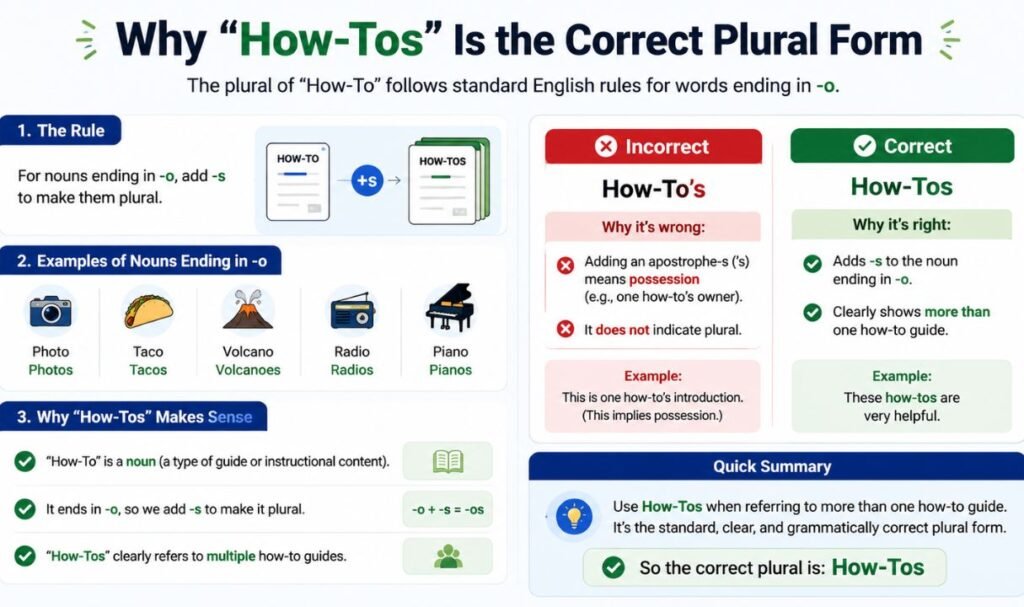
“How-to” is a compound noun. Standard English pluralizes compound nouns by adding “s” to the end of the unit, without inserting an apostrophe. Compare it to similar compounds:
- one add-on → several add-ons
- one grown-up → several grown-ups
- one runner-up → several runners-up (an exception, but still no apostrophe)
- one how-to → several how-tos
Why “how-tos” is the preferred form
An apostrophe followed by “s” signals possession or a contraction — never a plain plural. “The dog’s bone” shows ownership. “It’s raining” is short for “it is.” Neither use applies when you’re simply counting more than one how-to. Slapping an apostrophe onto “how-to’s” borrows a grammatical signal that means something else entirely, which is exactly why style authorities including AP and Chicago point writers toward the apostrophe-free form.
Simple rule to memorize
If you can replace “how-to” with “guide” and the sentence still reads naturally, pluralize it the same way you’d pluralize “guide” — just add “s,” no apostrophe.
- I found five helpful guides. → I found five helpful how-tos.
That mental swap works almost every time and settles the debate in about two seconds.
- How to vs how tos examples
- Right: The blog has dozens of how-tos on gardening.
- Wrong: The blog has dozens of how to’s on gardening.
2. How to vs how tos in a sentence
- I need to know how to change a tire before reading more how-tos.
3. How to vs how tos grammar
The grammar rule: hyphenate when it’s a noun or noun modifier; drop the hyphen when “to” leads into a verb; pluralize by adding “s,” never an apostrophe.
How-tos or how-tos — since both sides of that phrase look identical without an apostrophe, this is really just people searching to confirm the spelling is consistent. It is: always how-tos, no apostrophe, hyphen intact.
How to plural — the plural of the noun “how-to” is “how-tos.”
How tos examples — cooking how-tos, coding how-tos, DIY how-tos, makeup how-tos.
Go-tos or go-tos — the same logic applies to “go-to.” The plural is “go-tos” (as in “these are my go-tos for weeknight dinners”), never “go-to’s.”
Why “How To’s” Creates Confusion
Adding an apostrophe doesn’t just break a grammar rule — it muddies the meaning. Readers momentarily wonder whether you mean plural or possessive, which slows down comprehension even if only for a second. Multiply that across a whole article full of “how to’s,” and you’ve quietly made your writing harder to trust.
Incorrect vs. Correct Examples
| Incorrect | Correct |
|---|---|
| We shared some how to’s on social media. | We shared some how-tos on social media. |
| Check out these how-to’s for beginners. | Check out these how-tos for beginners. |
| Our how to’s page gets the most traffic. | Our how-tos page gets the most traffic. |
| She loves reading how to’s before bed. | She loves reading how-tos before bed. |
Using “How-To” as a Noun Modifier (Adjective Position)
When “how-to” sits in front of another noun, it behaves like a compound adjective. The hyphen links the two words so readers instantly parse them as one descriptive unit rather than two separate ideas.
Table: Correct vs. Incorrect Usage
| Correct | Incorrect |
|---|---|
| how-to video | how to video |
| how-to blog post | how to blog post |
| how-to guide | how-to’s guide |
| a step-by-step how-to | a step by step how to’s |
| how-to tutorial series | how-tos tutorial series |
Notice the last row: once “how-to” modifies “tutorial series,” it stays singular. You wouldn’t say “guides tutorial series,” so you shouldn’t say “how-tos tutorial series” either.
Common Misunderstandings About “How-To” and Its Plural
Misunderstanding #1: Treating “how to” as a noun
Some writers hyphenate every instance of “how to,” even when it’s leading into a verb. “I learned how-to cook” is incorrect — “cook” is a verb, so no hyphen belongs here. The hyphen only appears when “how-to” replaces a noun or sits directly before one.
Misunderstanding #2: Putting the plural “s” in the wrong place
Because “how-to” is a single compound unit, the “s” always goes at the very end: how-tos, not hows-to. There’s no internal word to pluralize separately, unlike “runners-up” or “mothers-in-law,” where the main noun sits in the middle.
Misunderstanding #3: Thinking apostrophes make things look ‘cleaner’
Writers sometimes add an apostrophe purely out of habit, the same instinct that produces mistakes like “CD’s” or “1990’s” instead of “CDs” and “1990s.” It might look tidy at a glance, but formal style guides treat it as an error, not a stylistic choice.
You May Like: Kindergartner or Kindergartener: Which Spelling Is Correct
How Punctuation Changes the Whole Meaning
Punctuation isn’t decoration here — it changes what the sentence actually says.
Examples
- The how-to’s instructions were confusing. (Possessive: the instructions belonging to one specific how-to.)
- The how-tos were confusing. (Plural: multiple guides, none of them clear.)
- How to’s this? (Awkward and nonstandard — avoid entirely.)
Only in a genuine possessive situation does the apostrophe belong. If you’re not describing something that the how-to owns, drop the apostrophe.
Quote to remember
“Apostrophes tell you who owns something or what letters got dropped. They never tell you how many of something there are.”
Workarounds: Avoiding the Need to Pluralize “How-To”
If the plural still feels awkward on the page, you’re not obligated to use it. Several alternatives carry the same meaning without any punctuation debate.
Useful Alternatives
- guides
- tutorials
- instructions
- walkthroughs
- step-by-step articles
Examples
- Instead of: “Browse our how-tos.” → “Browse our step-by-step guides.”
- Instead of: “These how-tos will help beginners.” → “These tutorials will help beginners.”
- Instead of: “Our site has 50+ how-tos.” → “Our site has 50+ instructional guides.”
This is especially handy in headlines, where “how-tos” can look visually cluttered next to other hyphenated words.
Practical Usage: “How-Tos” in Real-World Context
Examples from different fields
- Cooking: “This channel posts weekly how-tos for weeknight dinners.”
- Software: “The documentation includes how-tos for API integration.”
- Home improvement: “We compiled our best how-tos for small apartment renovations.”
- Beauty: “Her page is full of how-tos for everyday makeup looks.”
- Education: “Teachers shared how-tos for setting up a virtual classroom.”
Case Study: Publishing Industry
Content publishers rely on “how-to” formatting constantly, since instructional posts consistently perform well in search results. Editorial teams at major how-to sites generally follow one internal rule: hyphenate when naming the content type, skip the hyphen in narrative instructions, and never use an apostrophe for plurals. Style sheets at these outlets typically flag “how to’s” the same way they’d flag a misspelling — it’s treated as a correction, not a preference. That consistency is part of why their instructional content reads cleanly across hundreds of articles written by different authors.
Frequently Asked Questions
Is it correct to say “go to’s” or “go tos”?
Neither. The correct plural is “go-tos,” following the same rule as “how-tos” — hyphen kept, no apostrophe.
Is it “how to” or “how-to”?
Both exist. Use “how to” before a verb (how to cook); use “how-to” as a noun or noun modifier (a how-to guide).
How do I know if the apostrophe goes before or after the s?
For plurals, skip the apostrophe entirely. Only add one for possession: singular owner gets ‘s (“the how-to’s title”), plural owner gets s’ (“the how-tos’ popularity”).
How tos meaning?
“How-tos” means multiple sets of instructions or guides — plural of the noun “how-to.”
Conclusion
Once you separate the noun from the verb phrase, “how-to” stops being confusing. Hyphenate it when it names or describes a guide. Leave it unhyphenated when “to” is simply pointing toward a verb. And when you need more than one, add a plain “s” — “how-tos,” no apostrophe required.
Keep that mental shortcut handy: if “guide” fits in the sentence, “how-to” follows the exact same rules. Master that swap, and you’ll never have to second-guess this phrase again.