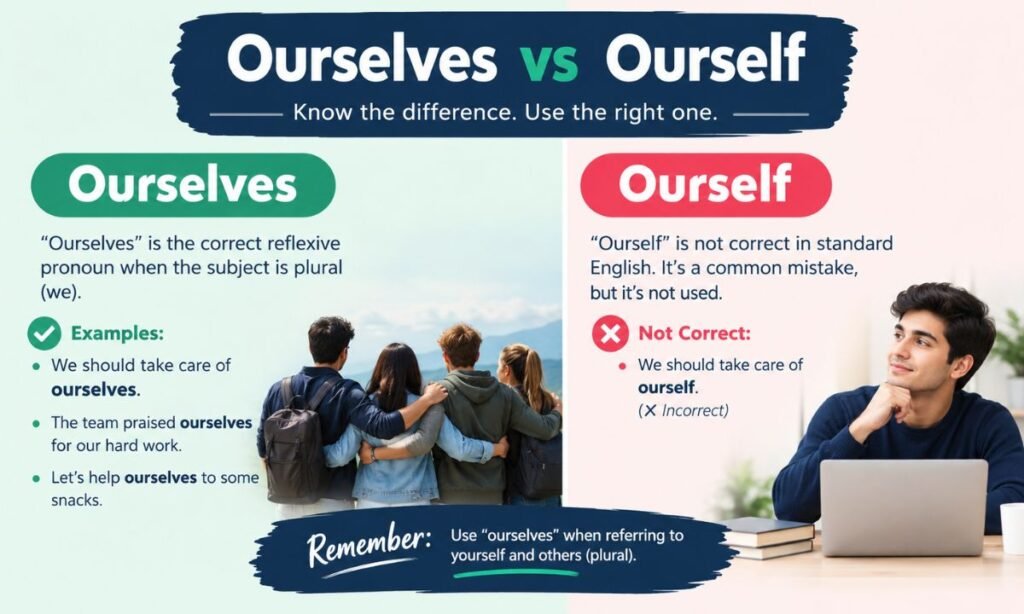

“Ourselves” is the correct form in almost every sentence you will write. “Ourself” is a rare singular variant, used mainly when one person speaks as “we,” as a monarch does. For any group of people, choose “ourselves.”
That short answer settles most doubts. The longer story is more interesting, though. “Ourself” has a real history, a place in Shakespeare, and a few modern appearances that trip up careful writers.
Definition of “Ourselves” and “Ourself”
“Ourselves” is the plural reflexive pronoun that matches “we.” It points back to a group that includes the speaker, as in “We taught ourselves to bake.” It also adds emphasis, as in “We painted the fence ourselves.”
“Ourself” is a singular reflexive form of “we.” Dictionaries describe it as the word a single person uses when saying “we” instead of “I,” the way a sovereign might. Merriam-Webster traces it to the 14th century.
Here are the two words in action:
- Ourselves (reflexive): We blamed ourselves for the delay.
- Ourselves (intensive): We ourselves had never seen the place.
- Ourselves (normal state): We were not ourselves that morning.
- Ourself (royal “we”): We shall keep ourself in the garden until supper.
The Core Difference Between “Ourselves” and “Ourself”
The core difference is number. “Selves” is plural and “self” is singular. If your “we” means two or more real people, the plural ending is the only logical match. If “we” stands for one person, “ourself” becomes possible.
That logic mirrors other pairs. You say “myself” for one speaker and “ourselves” for several. You say “yourself” for one listener and “yourselves” for a group. “Ourself” breaks that tidy pattern, which is why most readers see it as a mistake.
Four points keep the difference clear:
- Number: “ourselves” is plural, while “ourself” is singular.
- Speaker: “ourselves” fits any group, while “ourself” fits one person using “we.”
- Frequency: “ourselves” is everywhere, while “ourself” is rare.
- Safety: “ourselves” is safe in any setting, while “ourself” can look like a typo.
Comparison Table: “Ourselves” vs “Ourself”
| Feature | Ourselves | Ourself |
|---|---|---|
| Number | Plural | Singular |
| Typical speaker | Any group | One person using “we” |
| Status today | Standard | Rare, traditional |
| Example | We helped ourselves. | We will rest ourself. |
| Professional use | Always safe | Rarely advised |
Historical Evolution of “Ourself” and “Ourselves”
Both words grew out of a long process in which English learned to build reflexive pronouns. The story runs from early English emphasis words to the royal court and then to the quiet decline of the singular form.
Old English Roots
Early English did not form reflexives the way we do now. A plain pronoun often did the job, and “self” worked as an emphasis word that agreed with the noun it described. Speakers could say “I self” for emphasis.
Over the Middle English period, “self” began to attach firmly to pronouns. Wiktionary lists the ancestor of “ourself” as Middle English “oure-selfe,” built from “our” plus “-self.” That compound pattern is the seed of every form in this article.
The Singular Reflexive “Ourself”
Once “ourself” existed, it found a natural home with rulers. A king who called himself “we” needed a reflexive that matched one body, not many. Merriam-Webster cites a line from Shakespeare’s Macbeth as its example: “we will keep ourself till supper-time alone.”
Writers used it beyond the throne. In 1838, Charles Dickens wrote an editorial-style sentence about “committing ourself upon this point,” as Wiktionary records. A single author spoke as “we,” so a singular reflexive felt right.
The plural “ourselves” arrived in the 15th century, according to Merriam-Webster, and quickly became the everyday form. The two words then lived side by side, each with its own job.
Modern Decline
Today “ourself” survives as a fossil. Scribbr calls it rarely used and old-fashioned, and usage guides describe the royal singular reflexive as very rare. Most editors treat it as an error unless the context clearly justifies it.
Several forces pushed it out. Monarchs mostly stopped using the royal “we.” Style guides pushed single authors toward “I.” And spell checkers learned to flag “ourself,” so even careful writers rarely meet it in print.
You may still see it in older books, in dialogue meant to sound regal, and in casual writing where someone mistakes it for a correct singular. Only the first two are intentional.
Linguistic Insight: Reflexive Pronouns in English
A reflexive pronoun shows that the subject and the object of a verb are the same. In “She hurt herself,” “herself” points back to “she.” English has a full set, and each one ends in “-self” or “-selves.”
| Person | Singular | Plural |
|---|---|---|
| First | myself | ourselves |
| Second | yourself | yourselves |
| Third | himself, herself, itself | themselves |
| Generic | oneself | n/a |
The table reveals a pattern. First and second person forms are built on possessives: “my,” “our,” “your.” Third person forms use object pronouns: “him,” “them.” That is why “ourselves” is built on “our” and not on “us.”
Reflexive pronouns have a second job. As intensive pronouns, they add emphasis and can be dropped without breaking the sentence. “We wrote the report ourselves” still works as “We wrote the report.” Quillbot describes the same two roles for “ourselves.”
One more rule matters. A reflexive needs a matching subject earlier in the clause. You cannot write “Ourselves finished the report.” You can write “We ourselves finished the report,” because “we” supplies the subject.
The Royal “We”: Why Monarchs Say “Ourself”
The royal “we” is the old custom of a monarch using “we” to mean “I.” Scholars call it the pluralis majestatis. The idea was that a ruler spoke for the whole kingdom, or for the crown itself, and not only for a private person.
When a monarch says “we,” the singular reflexive follows naturally. A ruler who announces “We will rest ourself” is speaking about one body. The plural “ourselves” would suggest a crowd, which is not what the speaker means.
Queen Victoria is often credited with “We are not amused,” and the line is a favorite example of royal phrasing. Historians question whether she said it, so treat it as a famous attribution and not a verified quote.
Modern monarchs have largely dropped the habit. One usage reference calls the royal “we” virtually obsolete. Even so, the custom lingers in jokes. Margaret Thatcher once announced “We have become a grandmother,” and the remark drew years of teasing.
If you write a fantasy novel or a historical drama, “ourself” can add period flavor to a king’s speech. Use it sparingly and keep it to the ruler’s lines.
The Editorial and Institutional “We”
Writers and organizations also use “we” for a single voice. Newspaper editorials say “we believe.” Researchers write “we found.” Companies say “we reserve the right.” Each of these “we” forms can involve one author or many.
Does that mean “ourself” belongs there too? In practice, no. Most editors prefer “ourselves” in these settings, because readers hear “we” as a group. “In this study, we limit ourselves to two cases” reads naturally.
| Type of “we” | Who speaks | Usual reflexive |
|---|---|---|
| Royal | One monarch | Ourself (rare) |
| Editorial | Writer or newsroom | Ourselves |
| Authorial | Researcher or team | Ourselves |
| Institutional | A company or agency | Ourselves |
| Inclusive | Speaker plus audience | Ourselves |
Dickens’s 1838 sentence shows the older editorial habit. A lone writer called himself “we” and chose “ourself” to match. Modern style guides generally steer single authors toward “I,” which removes the problem entirely.
If you must keep an editorial “we,” treat it as a group voice and use “ourselves.” That choice is the one your readers will expect.
Modern English Usage: When Only “Ourselves” Works
In current English, “ourselves” is the only form that works for real groups. That covers family, teams, companies, friends, and any crowd you belong to. If more than one person acts, the plural reflexive is mandatory.
Examples
These sentences show “ourselves” in its usual jobs:
- Direct object: We reminded ourselves to double-check the numbers.
- Indirect object: We bought ourselves a new sofa.
- After a preposition: We spoke to ourselves in the mirror.
- Emphasis: We ourselves paid for the repairs.
- Alone or unaided: We finished the project by ourselves.
- Normal condition: After the long trip, we were not ourselves.
Idioms also demand the plural. People say “enjoy ourselves,” “help ourselves,” “pride ourselves on,” “find ourselves in trouble,” and “keep to ourselves.” None of these ever takes “ourself.”
Grammar Tip
Count the people. If the “we” involves two or more, write “ourselves.” That one habit prevents nearly every error, and it works whether you are drafting an email or an essay.
A second check helps with “by ourself” or “by ourselves.” The phrase means “alone” or “without help,” and a group that acts alone is still a group. “By ourselves” is the correct choice.
When “Ourself” Still Appears: Rare but Real
“Ourself” is not extinct. It appears in a handful of settings, and recognizing them keeps you from correcting something that was written on purpose. These settings explain nearly every modern sighting.
- Royal or ceremonial speech: a sovereign speaking as “we.”
- Historical fiction and drama: dialogue meant to sound old.
- Single-author editorial writing: a lone writer using “we.”
- Generic “we”: a sentence where “we” means “people in general,” so “ourself” acts like “oneself.”
- Caregiver talk: a nurse or parent asking, “Did we wash ourself this morning?”
- Dialect: Wiktionary notes that some varieties of English, including African American English, use it as a plural.
- Typos: the most common cause of all.
Wiktionary also records a 1962 alumni magazine using “see for ourself” with a plural “we.” That sentence reads as an ordinary slip, and an editor today would correct it to “ourselves.”
Modern Example from Official Context
Modern official documents rarely need a reflexive at all. Proclamations and formal instruments written in the royal style lean on “We” and “Our,” and a sentence seldom turns back on the speaker.
When the reflexive does appear in ceremonial language, it looks like this illustration:
“We will present ourself at the opening of the assembly.”
That line is invented to show the style, not quoted from a real document. A real sovereign’s office would follow its own house rules, which can differ from one reign to the next.
“Ourselves” and “Ourself” in Literature and Speech
Literature gives us the best-known “ourself.” Shakespeare’s Macbeth uses it when the king declares he will keep to himself until supper. The line is short, and it shows how naturally the singular form sat beside the royal “we.”
“Ourselves” has a rich record too. The 1970s health guide Our Bodies, Ourselves made the word a title, and the plural fit its message of shared experience. Speeches also lean on it: “We must believe in ourselves” is a stock line.
Spoken English shows the split clearly. In everyday talk, nobody says “ourself” and most listeners would hear it as a slip. In film or theater, though, a character who says it instantly sounds like royalty.
That contrast is useful for writers. If you want a voice to sound ordinary, use “ourselves.” If you want it to sound crowned, one well-placed “ourself” does the work.
Common Misconceptions and Grammar Myths
Several myths surround these two words. Some are half true, which makes them harder to spot. Here are four worth clearing up.
Myth 1: “Ourself” Is Always Incorrect
This is only partly right. Dictionaries list “ourself” as a real word with a defined meaning. It is correct in the royal “we” and in a few other narrow uses. It is wrong when a group is acting.
Myth 2: “Ourselves” Can Be Singular
No. “Ourselves” is plural in both form and meaning. A single person who uses “we” in the royal sense traditionally takes “ourself,” and a group takes “ourselves.” Mixing them up confuses the reader about who is acting.
Myth 3: They’re Interchangeable
They are not. Swapping them changes the number of people involved. “We enjoyed ourselves” describes a group having fun. “We enjoyed ourself” describes one royal speaker, or a mistake.
Myth 4: “Ourself” Is Old English Only
The singular form belongs to Middle English, not Old English, and it never fully disappeared. Merriam-Webster dates it to the 14th century, and it still turns up in royal style, generic “we,” and caregiver talk.
How to Choose the Right Form Every Time
A short routine settles every case. Work through these four steps in order:
- Count the speakers. If the “we” includes two or more people, write “ourselves.”
- Check for a royal voice. If one sovereign speaks as “we,” “ourself” is traditional.
- Think about your reader. Most readers will treat “ourself” as an error unless the setting is clearly regal or historical.
- Default to the plural. When in doubt, “ourselves” is never wrong for a group.
A quick decision table helps on mobile:
| Situation | Choose |
|---|---|
| A team or family | ourselves |
| An editorial or report | ourselves |
| A king in a novel | ourself |
| An unsure writer | ourselves |
Quick Mnemonic
“Selves for shared, self for sovereign.”
Say it once and it sticks. If the action is shared among people, use “selves.” If one ruler is speaking, “self” is possible.
Practical Grammar Tips
These habits keep your writing clean and save time during editing.
- Never use “ourselves” as a subject. Write “We ourselves finished,” not “Ourselves finished.”
- Do not swap it for “us.” Write “between us,” not “between ourselves,” unless the subject truly matches.
- Keep it one word. “Our selves” appears only when “selves” is a separate noun, as in “our younger selves.”
- Check your spell checker. If a tool flags “ourself,” it is usually right.
- Watch the “and ourselves” trap. Write “She invited my team and us,” not “and ourselves,” because the subject is “she.”
- Reread your idioms. “Pride ourselves,” “help ourselves,” and “keep to ourselves” all need the plural.
A last point concerns tone. Some writers think reflexives sound more formal and use them where a plain pronoun works. Resist that urge. A plain “us” is often cleaner than a showy “ourselves.”
Case Study: Real-World Application
Here is a composite scenario built for illustration, based on a common kind of editing job. A small nonprofit sent its volunteer newsletter to an editor for a quick proofread before publishing.
The draft had four reflexive slips. Each one is shown below with the fix and the reason.
| Original | Corrected | Reason |
|---|---|---|
| We challenge ourself every year. | We challenge ourselves every year. | A group is speaking. |
| Join the team and ourselves. | Join the team and us. | “Ourselves” needs a matching subject. |
| We did it by ourself. | We did it by ourselves. | Plural “we” needs the plural form. |
| Ourselves organized the drive. | We ourselves organized the drive. | “Ourselves” cannot be a subject. |
After the edit, the newsletter read more smoothly, and a board member noted that the errors had been the first thing she noticed on the earlier draft. That small reaction shows why these slips matter: readers notice them quickly.
The lesson is practical. A single wrong reflexive can pull attention away from your message, so a two-minute check pays off.
Self-Assessment Quiz
Choose “ourselves” or “ourself” for each blank. Answers follow the list.
- We reminded ______ to arrive early.
- The queen announced, “We will seat ______ by the fire.”
- My friends and I made dinner by ______.
- We ______ chose the design.
- After the exam, we were not ______.
- The nurse asked, “Did we brush ______ this morning?”
Answers:
- ourselves (a group acts on itself)
- ourself (royal “we,” one speaker)
- ourselves (a group acts alone)
- ourselves (intensive use after “we”)
- ourselves (normal condition)
- ourself (caregiver “we” for one person, though “yourself” is more standard)
If you scored five or six, you have the rule. If you missed some, reread the section on choosing the right form.
Summary Table: Quick Reference
| Context | Correct form | Example |
|---|---|---|
| Group acts on itself | ourselves | We trusted ourselves. |
| Emphasis | ourselves | We ourselves agreed. |
| Alone or unaided | ourselves | We went by ourselves. |
| Royal “we” | ourself | We shall rest ourself. |
| Professional writing | ourselves | We limit ourselves to two cases. |
Frequently Asked Questions
What is the difference between “ourselves” and “ourself”?
“Ourselves” is the plural reflexive for a group using “we,” while “ourself” is a rare singular form used when one person says “we,” as a monarch does.
Is “ourself” grammatically correct?
It is correct only in narrow cases such as the royal “we.” For a group, it is an error, and editors will usually change it to “ourselves.”
Can I use “ourselves” for a singular subject?
No. “Ourselves” is plural, so it fits a group. A single speaker using the royal “we” traditionally takes “ourself.”
Why do monarchs use “ourself”?
Monarchs speak as “we” to represent the crown, so the reflexive stays singular to match one person: “We will rest ourself.”
Which form should I use in professional writing?
Use “ourselves.” It is standard, safe in every setting, and matches how readers expect a group voice to sound.
Final Thoughts
The choice between “ourselves” and “ourself” is simpler than it looks. For any real group, “ourselves” is correct, and it is the form editors, teachers, and readers expect. “Ourself” is a historical curiosity with a few narrow uses.
Keep the mnemonic close: selves for shared, self for sovereign. Count the people, trust the plural, and save “ourself” for a crown or a stage. Your writing will read cleaner, and your readers will not stumble.