

You are about to publish a landing page, send a newsletter, or write a quick email. Then you stop and stare at two words. Is it “signup” or “sign up”? Maybe it is “sign-up” with a hyphen. Spellcheck says nothing, and every website seems to do something different.
The good news is that the rule is short. “Sign up” is a verb. “Signup” and “sign-up” are the noun and adjective. The details only get tricky because dictionaries, style guides and tech companies do not all agree on how to spell that second form.
This guide settles it. You will get a quick answer, clear definitions, tables, real example sentences, and advice for the places where this word shows up most: Gmail, online forms, SignUpGenius, and buttons on your own site. To write it, I checked the Merriam-Webster entry, the AP style guidance reported by Writing Explained, Google’s own Gmail Help page, and UX writing advice from interface designers. Where those sources disagree, I say so instead of pretending there is one winner.
Quick Answer
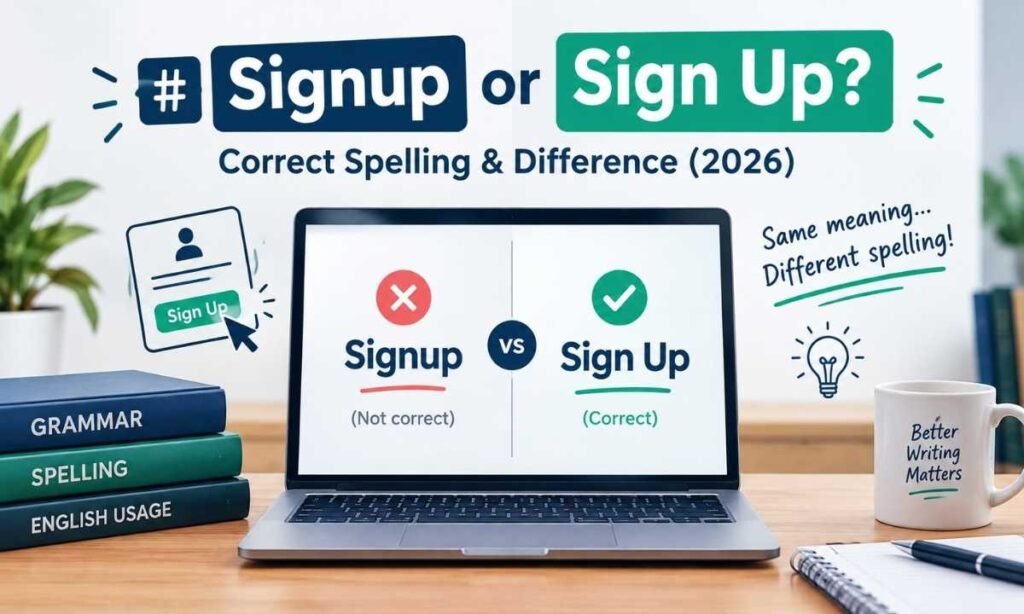
Use “sign up” (two words) when someone is doing something. Use “signup” or “sign-up” when you are naming a thing.
- Sign up is a verb: Please sign up before Friday.
- Signup is a noun or adjective: The signup form is on the next page.
- Sign-up is the hyphenated version of that same noun or adjective, and most dictionaries list it this way.
If you can swap the word for “register” and the sentence still works, write two words. If you can swap it for “registration” or “enrollment,” write one word or add a hyphen.
Meaning and Definition of Each Word
The two spellings come from the same root, but they do different jobs. One describes an action. The other describes the page, list or process where that action happens.
Sign Up
“Sign up” is a phrasal verb. It means to put your name down in order to join, receive or take part in something. Merriam-Webster defines it as signing one’s name, as to a contract, in order to get, do or join something, and it traces the first known use to 1875. That makes it a much older expression than any website.
Because “sign up” is a verb, it behaves like one. It takes tenses, and it takes an object when you add a person: you can sign up for a class, or you can sign someone else up.
- I want to sign up for the pottery workshop.
- Over two hundred readers signed up last week.
- She is signing up for a gym membership.
Online, the meaning shifts slightly. To sign up for a website usually means to create an account. The core idea is the same, though: you are registering your name or email so you can take part.
Signup
“Signup” (one word) is the closed compound noun. It names the registration itself, or the form, page, sheet or process connected to it. It is also used as a modifier, which means it can sit in front of another noun: a signup page, a signup bonus, a signup link.
You will see this spelling everywhere in software, marketing and product design. Developers name files and functions “signup.” Product teams track “signup rate.” Writers on tech blogs tend to treat the one-word form as standard.
- The signup took less than a minute.
- Our signup rate doubled after the redesign.
- Send me the signup link.
Here is the honest catch. Some traditional dictionaries and style guides do not list “signup” as a standalone entry. They list “sign-up” instead. So one-word “signup” is widely used and widely understood, but it is the more informal and tech-flavored spelling. More on that in the next section.
Sign-Up (Hyphenated): Noun or Adjective
The hyphenated “sign-up” is the traditional dictionary spelling for the noun and the adjective. Merriam-Webster lists “sign-up” as a noun or adjective under the entry for the verb “sign up.” Writing Explained reports that AP style calls for the hyphen too, and says you should not see the one-word form in AP-edited copy.
Used as a noun, sign-up means the act or event of enrolling:
- Sign-up for the spring league opens Monday.
- Soccer sign-ups close at the end of the day.
Used as an adjective, it modifies a noun, usually something connected to registering:
- Please add your name to the sign-up sheet.
- The sign-up deadline is March 3.
The most important habit is consistency. Pick one form for the noun and adjective, then use it across your whole site and every document.
Key Differences Between the Words
Here is what actually separates the three spellings.
- Part of speech. “Sign up” is a verb. “Signup” and “sign-up” are nouns or adjectives.
- Spacing. Two words for the action. One word or a hyphenated word for the thing.
- Conjugation. Only the verb changes form: signs up, signed up, signing up. The noun does not conjugate, though it can take a plural.
- Sentence position. The verb usually follows a subject (“We sign up”). The noun or adjective follows “the,” “a,” or “your,” or sits before another noun (“the signup page”).
Signups or Sign-Ups: Which Spelling Is Correct?
Both are correct, as plural nouns. The only wrong version is the one that splits the word and adds an “s” to the wrong place.
| Spelling | Correct? | Example |
|---|---|---|
| signups | Yes | We got 400 signups this week. |
| sign-ups | Yes (traditional) | Sign-ups are open until June. |
| sign ups | No, when used as a noun | We got 400 sign ups. |
| signs up | Yes, but only as a verb | She signs up every year. |
Why is “sign ups” a problem? It mixes the verb phrase with a plural ending. A reader sees “sign” and “up” as two separate words, so the plural “s” lands on “up” and the phrase reads like a typo. If you mean the plural noun, join the word or hyphenate it.
Comparison Table
This table covers all three forms at a glance. It is also the part most people bookmark.
| Feature | Sign up | Signup | Sign-up |
|---|---|---|---|
| Part of speech | Verb (phrasal verb) | Noun, adjective | Noun, adjective |
| Number of words | Two | One | One, joined by a hyphen |
| Core meaning | To register or enroll | The registration, form or process | The registration, form or process |
| Can it be conjugated? | Yes | No | No |
| Example | Please sign up today. | The signup page loads fast. | The sign-up sheet is full. |
| Common in | Everyday speech, all writing | Tech, apps, marketing | Dictionaries, news, AP style |
| Plural | Not applicable | signups | sign-ups |
| Works after “to”? | Yes (to sign up) | No | No |
Verb Forms Table: Sign Up, Signed Up, Signing Up
Only the word “sign” changes when you conjugate this verb. The word “up” stays put every time. That is the case in every tense, as the table shows.
| Form | Spelling | Example sentence |
|---|---|---|
| Base form | sign up | I will sign up tonight. |
| Third person singular | signs up | She signs up for every race. |
| Past tense | signed up | We signed up last month. |
| Past participle | signed up | They have signed up already. |
| Present participle / gerund | signing up | Signing up takes two minutes. |
Examples in Sentences
Seeing the words in context makes the rule stick faster than any definition. Here are plenty of examples for each form.
Using Sign Up (Verb)
- You can sign up for the newsletter at the bottom of the page.
- Have you signed up for the conference yet?
- If you want a spot, sign up early.
- She decided to sign them up before the deadline passed.
- Sign up with your work email to get the team discount.
Pay attention to the “sign them up” example. When an object sits in the middle, the verb phrase splits around it. You would never write “signup them.” That quirk is one of the clearest signs that “sign up” is a verb.
Using Signup (Noun/Adjective)
- The signup was quick, and I got my confirmation email right away.
- Please fill in the signup form.
- Our signup page needs a clearer headline.
- Check the signup sheet outside the gym.
- Signups rose by twenty percent after the campaign.
The hyphenated version works in each of these. For a news story or a formal document, swap “signup” for “sign-up” and the sentences stay correct.
Signup or Sign Up Gmail
For Gmail, the correct phrase when you mean the action is “sign up.” Google’s own Help page says that to sign up for Gmail, you create a Google Account. Notice that the verb is two words in that sentence.
- You can sign up for Gmail in a few minutes.
- I need to sign up for a new Gmail address.
Now flip it around. When you talk about the page, the noun form fits:
- Open the Gmail signup page.
- The signup screen asks for your name and a username.
Google’s guidance adds that a Gmail address belongs to a Google Account, so one registration also opens YouTube, Drive and other Google products.
Signup or Sign Up Online
Online, the same rule applies without exception. When you describe the action of creating an account, join a list or register for an event, write two words. When you name the form, page or process, write one word or hyphenate.
A “signup deadline” is not truly wrong in digital writing. It becomes a mistake only when one page says “signup” and another says “sign-up.” Consistency keeps a site looking polished.
Signup or Sign Up Genius
SignUpGenius is a brand name, so its spelling is whatever the company chooses. It is written as one word with capital letters on S, U and G: SignUpGenius. Write it that way every time, and do not split it.
The company’s own buttons use a two-word phrase such as “Create a Sign Up,” which is a brand choice and not a rule for everyone else. For your own writing:
- Brand name: SignUpGenius (always one word, mixed capitalization).
- The action: Ask parents to sign up through SignUpGenius.
- Your own sheet: I made a signup sheet on SignUpGenius.
Do not change a brand’s spelling to fit your grammar preferences.
Signup vs Sign In vs Log In
These three phrases get tangled constantly. They describe different steps in a user’s journey.
| Phrase | Meaning | Who uses it | Part of speech |
|---|---|---|---|
| Sign up | Create a new account or register | New visitors | Verb |
| Sign in / Log in | Enter an existing account | Returning users | Verb |
| Signup | The registration page or process | Anyone describing it | Noun/adjective |
| Login / Sign-in | The credentials, page or screen | Anyone describing it | Noun/adjective |
The pattern repeats. Verb phrases take two words (“log in,” “sign in,” “sign up”). The noun or adjective takes one word or a hyphen (“login,” “sign-in,” “signup”). So you log in to your account using your login details. The grammar logic is identical to the signup rule.
There is also a design problem hiding here. Interface designers warn that placing “Sign in” and “Sign up” next to each other causes mistakes, because the two labels look almost identical. UX Movement’s advice is to pair “Sign up” with “Log in,” or to pair “Sign in” with something like “Create account” or “Join.” Another guide suggests avoiding label pairs that differ by only a couple of letters.
Signup Button or Sign Up Button?
Here you are labeling a click, and a click is an action. So the button text should usually be the verb: Sign up.
Writers of interface copy generally agree that button labels should tell people what happens when they press them. Words like “Create account,” “Register” and “Sign up” all work. Vague labels like “Submit” or “Click here” do not.
That gives you a few clear rules:
- Use “Sign up” for the button label. It is an action, so it is a verb.
- Use “signup” in the surrounding nouns. Say “signup form,” “signup page” and “signup link.”
- Match the label to its partner. If the other button says “Log in,” “Sign up” pairs well. Avoid “Sign in” next to “Sign up.”
- Consider a more specific label. “Start free trial,” “Join the community” or “Create account” often tell users more than a generic phrase.
- Keep capitalization consistent. Title case (“Sign Up”) or sentence case (“Sign up”) are both fine. Pick one and never mix them across the site.
Common Mistakes
Most errors fall into the same few patterns. Here are the ones that appear most often.
Mistake 1: Writing “signup” as a verb.
- Wrong: Please signup for the event.
- Right: Please sign up for the event.
- Why: One-word “signup” is a noun, so it cannot act as a command.
2: Writing “sign up” as a noun or modifier.
- Wrong: Complete the sign up form.
- Right: Complete the signup form. (or sign-up form)
- Why: The phrase modifies “form,” so it needs the one-word or hyphenated version.
3: Putting an “s” in the wrong place.
- Wrong: We had 50 sign ups.
- Right: We had 50 signups. (or 50 sign-ups)
- Why: The plural noun should stay joined.
4: Hyphenating the verb.
- Wrong: I will sign-up tomorrow.
- Right: I will sign up tomorrow.
- Why: The hyphen belongs only to the noun and adjective forms.
Mistake 5: Mixing styles. A page that says “signup” in the header and “sign-up” in the footer looks sloppy.
Tips to Remember the Difference
You do not need to memorize grammar terms. A few mental shortcuts do the job.
- The “register” test. Replace the word with “register.” If it fits, use two words. I will register tomorrow works, so I will sign up tomorrow is correct.
- The “registration” test. Replace the word with “registration.” If it fits, use one word or a hyphen. The registration form works, so the signup form is correct.
- The “them” test. You can say “sign them up,” but you can never say “signup them.” If a pronoun fits in the middle, it is a verb.
- The “the” test. If “the” or “a” can go in front, it is a noun, so use one word.
- The one-line memory trick. Two words is what you do. One word is what it is.
Is Sign Up Hyphenated?
It depends on the part of speech.
- As a verb: no hyphen. I’ll sign up.
- As a noun: a hyphen in traditional style, or one closed word in tech style. The sign-up opens at noon.
- As an adjective before a noun: a hyphen in traditional style, or one closed word. The sign-up form is below.
So “I’ll sign up” has no hyphen, while “the sign-up form” does, according to dictionary and AP convention. The hyphen acts as a visual clue that the words are working together as a single unit.
When to Use Each Word
This section turns the rules into quick decisions based on where you are writing.
- Use “sign up” (two words) when:
- You are telling someone to take action.
- You are describing something a person did, does or will do.
- You are writing a call to action on a button or a link.
- The sentence has a subject performing the registration.
2. Use “signup” (one word) when:
- You are writing for a tech product, app, startup or marketing audience.
- You are naming the form, page, link or process.
- Your company style guide prefers the closed compound.
- You are writing code, URLs or file names.
3. Use “sign-up” (hyphenated) when:
- You are writing for news, publishing, academic or formal audiences.
- You follow AP style or a dictionary-based house style.
- You want the most traditional spelling for the noun or adjective.
Grammar Rules
Let’s put the grammar into plain rules you can apply to any sentence.
Rule 1: A verb phrase stays open. “Sign up” is a phrasal verb. The word “up” is a particle that completes the meaning of “sign.” Phrasal verbs are written as separate words.
Rule 2: A compound noun or adjective closes or takes a hyphen. When the phrase becomes a name for a thing, English often joins it: “backup,” “checkout,” “login,” “signup.” Others, like “sign-up” and “check-in,” keep a hyphen. The same logic applies to “back up” (verb) and “backup” (noun).
Rule 3: Only the first word conjugates. The verb changes as “sign” becomes “signs,” “signed” or “signing.” The word “up” never takes an ending.
Rule 4: The phrase is separable. You can put the object in the middle: sign me up, sign them up, sign your team up. Compounds do not split like that.
Rule 5: The noun takes regular plurals. Add “s” to the end of the whole word: signups, sign-ups.
Watch out for the same pattern with related words. “Set up” (verb) and “setup” (noun), “log in” and “login,” “check out” and “checkout,” “back up” and “backup.” Once you see the pattern in one pair, you see it in all of them.
Synonyms or Related Words
Sometimes the cleanest fix is to avoid the question and use a different word. These alternatives also add variety to your writing.
Synonyms for the verb “sign up”: register, enroll, join, subscribe, enlist, opt in, apply.
Related nouns: registration, enrollment, subscription, membership, application, roster.
Signup or sign up Gmail
Quick reference: write “sign up for Gmail” when you mean the action, and “Gmail signup page” when you mean the page. For the action itself, Google’s help page says you create a Google Account, which also gives you access to other Google services.
Signup or sign up genius
Quick reference: write the brand as SignUpGenius, one word, with capitals on S, U and G. For ordinary sentences, use “sign up” for the action and “signup sheet” for the thing you create.
Summary
Here is everything in one place.
- Sign up (two words) is a verb. It means to register, enroll or join.
- Signup (one word) is a noun or adjective. It is common in tech and digital writing.
- Sign-up (hyphenated) is the traditional dictionary and AP spelling for the same noun or adjective.
- Only the first word conjugates: signs up, signed up, signing up.
- The plural noun is signups or sign-ups, never “sign ups.”
- Buttons usually say Sign up, because a click is an action.
- Gmail, online forms and SignUpGenius all follow the same rule. The brand name stays as SignUpGenius.
- Pair “Sign up” with “Log in” to keep buttons from looking alike.
- Choose one style for your noun form and keep it everywhere.
If you remember only one thing, remember this: two words is what you do, and one word is what it is.
Frequently Asked Questions
Is it signup or sign up?
Both are correct, but they are different parts of speech. Use “sign up” as a verb and “signup” as a noun or adjective.
Is signup one word or two?
As a noun or adjective, it is one word (or hyphenated as “sign-up”). As a verb, it is always two words: “sign up.”
Is sign-up with a hyphen correct?
Yes. “Sign-up” with a hyphen is the traditional dictionary and AP spelling for the noun and adjective. Never use the hyphen for the verb.
What’s the plural of signup?
The plural is “signups” or “sign-ups.” Avoid “sign ups” when you mean the noun.
Should a button say sign up or signup?
Use “Sign up,” since a button label is an action. One-word “Signup” is understood but is the weaker choice.
Is signup or sign up right for Gmail?
Use “sign up” for the action, as in “sign up for Gmail.” Use “signup” when naming the page, as in “Gmail signup page.”