
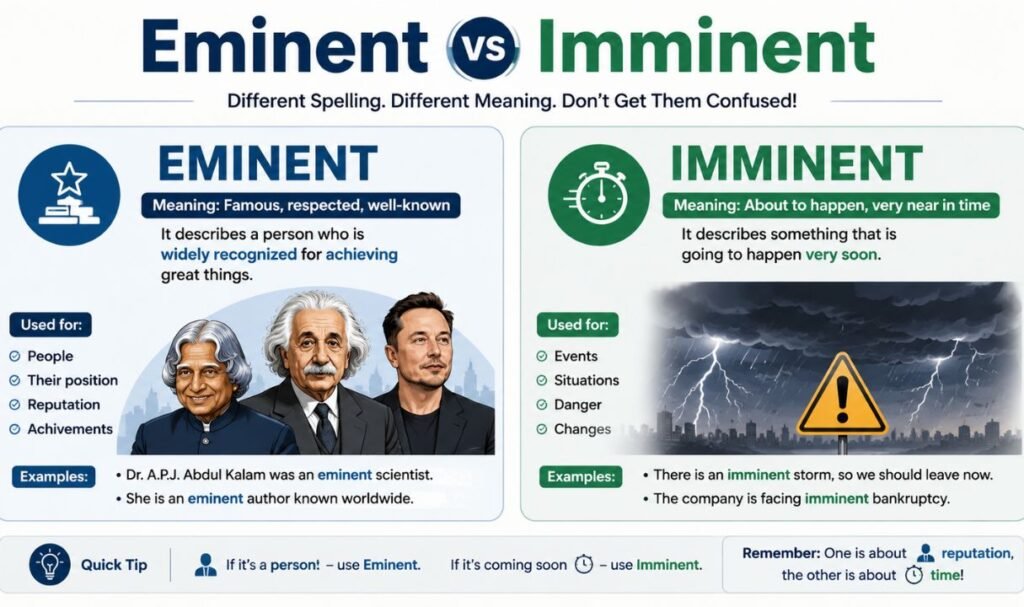

Eminent vs imminent trips up even confident writers because the two words differ by a single letter. Eminent describes a person of high distinction, while imminent describes an event about to happen. Mixing them changes your sentence’s meaning entirely, and readers notice.
This guide breaks down the definitions, word origins, grammar patterns, and real sentence examples for both words. You’ll also find the noun and adverb forms, a third look-alike word many guides skip, and a quick decision test you can use while writing.
Quick Answer: Eminent vs Imminent at a Glance
Eminent means well-known, respected, or outstanding in a field. Imminent means about to occur very soon. One is about reputation; the other is about timing.
| Word | Meaning | Describes | Example |
|---|---|---|---|
| Eminent | Distinguished, prominent | People, careers, achievements | “an eminent cardiologist” |
| Imminent | About to happen | Events, risks, deadlines | “an imminent recall” |
Takeaway: If you’re praising someone’s standing, use eminent. If you’re describing a countdown, use imminent.
What Does Eminent Mean?
Eminent is an adjective meaning notably superior, distinguished, or high-ranking within a profession or field. It signals that a person (or occasionally their work) has earned wide recognition through skill or achievement.
The word comes from the Latin eminere, meaning “to stand out” or “project upward.” That root explains the core image: an eminent person rises above their peers in reputation.
How Eminent Is Used
Eminent almost always modifies a noun describing a person, a title, or a body of work tied to that person’s standing.
- She consulted an eminent immunologist at Johns Hopkins.
- The panel included three eminent economists.
- His eminent reputation in constitutional law spans four decades.
- The eminent architect I. M. Pei designed the building.
Related Forms of Eminent
Eminent has a noun and an adverb form that appear often in formal writing.
| Form | Part of Speech | Example |
|---|---|---|
| Eminent | Adjective | An eminent surgeon led the team. |
| Eminence | Noun | Her eminence in genetics is well documented. |
| Eminently | Adverb | He is eminently qualified for the role. |
Note the phrase “eminently qualified,” which is one of the most common collocations with this word family in professional and academic English.
What Does Imminent Mean?
Imminent is an adjective meaning likely to happen at any moment, with no meaningful delay expected. It applies to events, risks, and outcomes rather than to people.
Imminent traces back to the Latin imminere, “to overhang” or “threaten from above.” The original sense carried a note of looming danger, which is why imminent still pairs so naturally with words like threat, danger, and collapse.
How Imminent Is Used
Imminent typically pairs with a noun describing a future event, action, or condition.
- Forecasters say landfall is imminent within six hours.
- The board expects an imminent decision on the merger.
- Engineers flagged the bridge as facing imminent structural failure.
- Her retirement is imminent after 32 years with the firm.
Related Forms of Imminent
| Form | Part of Speech | Example |
|---|---|---|
| Imminent | Adjective | The storm’s arrival is imminent. |
| Imminence | Noun | The imminence of the deadline pressured the team. |
| Imminently | Adverb | The update will roll out imminently. |
Takeaway: Eminent grows from “standing out”; imminent grows from “hanging over.” The roots alone explain why one flatters and the other warns.
Eminent vs Imminent: Main Differences
| Category | Eminent | Imminent |
|---|---|---|
| Core meaning | Distinguished, respected | About to happen |
| Word origin | Latin eminere (to stand out) | Latin imminere (to overhang) |
| Typical subject | Person, expert, professional | Event, risk, deadline, change |
| Time reference | None (describes status) | Very near future |
| Common collocations | eminent scholar, eminent physician, eminently suitable | imminent threat, imminent danger, imminently expected |
| Tone | Positive, formal, respectful | Neutral to urgent, sometimes cautionary |
Eminent vs Imminent vs Immanent: The Third Word Most Guides Miss
A third word, immanent, is often left out of eminent vs imminent comparisons, yet it causes real confusion in philosophy, theology, and academic writing. Immanent means existing or operating within something, rather than external to it.
| Word | Meaning | Sample Sentence |
|---|---|---|
| Eminent | Distinguished | An eminent theologian wrote the introduction. |
| Imminent | About to happen | The publication date is imminent. |
| Immanent | Inherent, existing within | The philosopher argued that meaning is immanent in language, not imposed on it. |
If you’re reading academic texts on religion, metaphysics, or critical theory, immanent is the word you’ll meet most, not eminent or imminent. Spelling it out here closes a gap most usage guides leave open.
Why Do People Confuse Eminent and Imminent?
The confusion is almost entirely visual and phonetic, not conceptual. Once you separate the two ideas, mixing them up becomes far less likely.
- Only one letter separates the spellings: e-m versus i-m.
- Both words carry three syllables and similar stress patterns.
- Both appear frequently in news, legal, and academic writing, so readers encounter them in similar settings.
- Spellcheck tools rarely flag either word, since both are valid English terms.
- Neither word is commonly used in casual speech, so readers get less everyday practice with them.
Pronunciation Guide
Saying the words aloud highlights the difference more clearly than reading them does.
| Word | IPA | Stressed Syllable |
|---|---|---|
| Eminent | /ˈɛm.ɪ.nənt/ | EM (first syllable) |
| Imminent | /ˈɪm.ɪ.nənt/ | IM (first syllable) |
The vowel sound in the first syllable is the only real audible difference: a short “eh” in eminent versus a short “ih” in imminent. Reading the word aloud before you type it can prevent the swap.
Eminent vs Imminent: Grammar Rules
Both words are adjectives, and English grammar treats them identically in sentence structure. The difference lies entirely in meaning, not in grammatical function.
Rule 1: Both Sit Before the Noun They Modify
Standard adjective placement applies to both words.
- an eminent historian
- an imminent verdict
Rule 2: Neither Word Takes a Comparative or Superlative Form
You won’t see “more eminent” replaced by “eminenter,” and native speakers rarely say “most imminent” in formal writing. Instead, writers use qualifiers.
- highly eminent (acceptable but rare; “eminent” already implies a high degree)
- increasingly imminent (common in news writing about developing situations)
Rule 3: Eminent Requires an Animate or Institutional Subject
Eminent almost never modifies inanimate objects or abstract dangers. “An eminent storm” is grammatically valid but semantically wrong, since storms have no reputation to be distinguished for.
Rule 4: Imminent Requires a Time-Bound Subject
Imminent needs a noun capable of “happening.” You cannot apply it to a fixed trait or permanent quality. “An imminent professor” fails because a professor’s title isn’t an event.
Takeaway: If the noun can win an award, use eminent. If the noun can appear on a calendar or a countdown clock, use imminent.
Common Mistakes Writers Make
| Incorrect | Correct | Why |
|---|---|---|
| The eminent hurricane is approaching Florida. | The imminent hurricane is approaching Florida. | Hurricanes are events, not reputations. |
| She is an imminent neurosurgeon. | She is an eminent neurosurgeon. | Career status, not timing. |
| The imminent panel discussed climate policy. | The eminent panel discussed climate policy. | A panel of experts is distinguished, not upcoming. |
| The eminent risk of default worries investors. | The imminent risk of default worries investors. | Risk is timing-based. |
Eminent Domain: A Special Legal Case
Eminent domain is a fixed legal term referring to a government’s power to seize private property for public use, with compensation required under the U.S. Fifth Amendment. It’s worth flagging because it’s the single most searched phrase containing “eminent,” and it has nothing to do with a person’s reputation.
- The city used eminent domain to acquire land for the new highway.
- Property owners challenged the eminent domain claim in court.
Because eminent domain is a fixed legal phrase, it never changes to “imminent domain,” even though the two words are commonly confused elsewhere in a sentence.
Which One to Use: A Simple Test
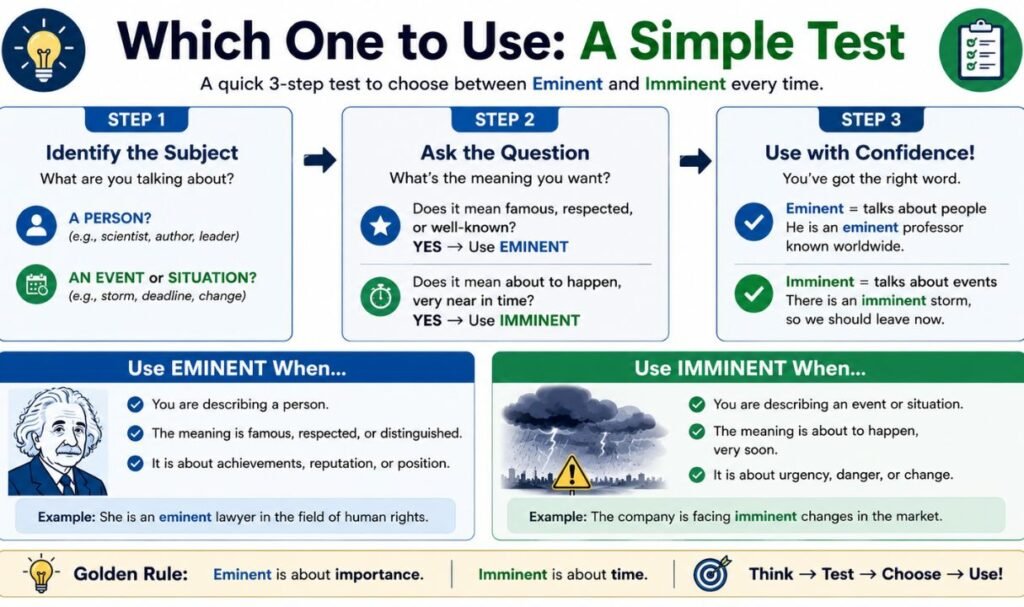
Ask two questions before choosing a word.
- Am I describing a person’s status or reputation? If yes, use eminent.
- Am I describing something about to happen? If yes, use imminent.
If both answers are no, neither word fits your sentence, and you likely need a different adjective entirely, such as “notable” or “upcoming.”
Decision Table
| Your Sentence Is About | Correct Word |
|---|---|
| A well-known surgeon | Eminent |
| A pending court ruling | Imminent |
| A respected novelist | Eminent |
| A software launch date | Imminent |
| A distinguished professor | Eminent |
| A weather warning | Imminent |
| A legal land seizure | Eminent (domain) |
| An approaching deadline | Imminent |
Synonyms and Antonyms
Knowing nearby words helps you choose the right term faster, especially in editing.
| Word | Synonyms | Antonyms |
|---|---|---|
| Eminent | prominent, distinguished, renowned, notable | obscure, unknown, undistinguished |
| Imminent | impending, forthcoming, near, close at hand | distant, remote, unlikely |
Real-World Sentence Examples
Eminent, across contexts:
- Medicine: An eminent oncologist published the study in The Lancet.
- Law: The eminent jurist served on the appeals court for 22 years.
- Business: An eminent economist forecasted the rate cut.
Imminent, across contexts:
- Weather: The National Weather Service warned that flash flooding was imminent.
- Finance: Analysts said an imminent rate decision would move markets.
- Technology: The company confirmed an imminent security patch after the breach.
FAQs
What is the easiest way to remember eminent vs imminent?
Link eminent to “excellence” since both start with E. Link imminent to “immediate,” since both start with “imm-.” The shared letters mirror the shared meaning.
Is eminent always a compliment?
Yes, eminent carries a positive connotation and is reserved for people or work recognized for genuine skill or achievement.
Does imminent always signal danger?
No. Imminent only signals nearness in time. It appears in neutral and even positive contexts, such as an imminent promotion or an imminent product launch.
Can imminent describe a person?
Rarely, and only indirectly, such as “her retirement is imminent.” Imminent describes the event happening to the person, not the person’s character.
What’s the difference between eminent and immanent?
Eminent describes a distinguished person; immanent describes something existing within a system or idea, common in philosophical and theological writing.
Final Thought
Eminent and imminent will keep sitting one letter apart on the page, but they never overlap in meaning. Once you connect eminent to standing and imminent to timing, the choice stops being a guess and becomes automatic, even under deadline pressure.