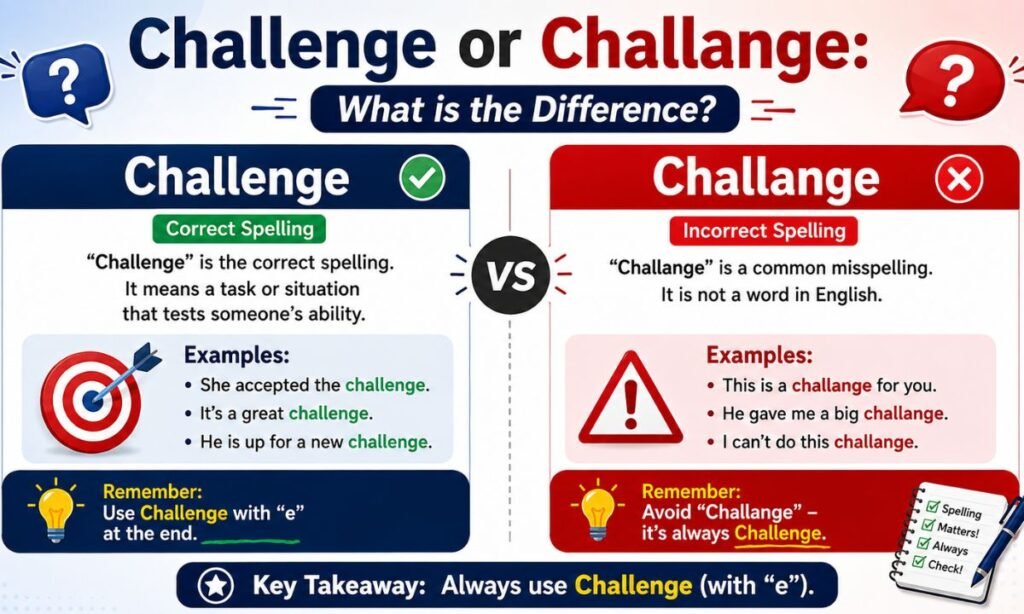

If you’ve ever paused halfway through typing this word and wondered whether it needs an “e” or an “a,” you’re not alone. Thousands of people search for this exact question every month. The good news is that the answer is short: challenge is correct, and challange is not a word in the English language.
This guide breaks down why that’s true, how the word is used in real sentences, and how you can stop second-guessing your spelling for good.
Comparison Overview
Before going deeper, here’s the short version.
- Challenge is a real English word. It works as both a noun and a verb.
- Challange is a misspelling. It has no dictionary entry, no grammatical function, and no accepted use in any form of English writing.
- The confusion usually comes from how the word sounds when spoken quickly, not from any real spelling rule that supports “challange.”
Once you understand where the mix-up starts, the correct spelling becomes much easier to remember.
Definition of Challenge
Challenge is an English word rooted in Old French and Latin, tracing back to a term meaning accusation or dispute. Over centuries, its meaning shifted into what we use today.
As a noun, challenge refers to a task, situation, or problem that tests someone’s ability, skill, or patience. For example: “Finishing the project on time was a real challenge.”
As a verb, challenge means to question, dispute, or invite someone to compete. For example: “She decided to challenge the referee’s decision.”
The word also has related forms, including challenged, challenging, and challenger, all built on the same base spelling.
You May Like: What Does Delegate Mean? Definition, Examples & Synonyms
Definition of Challange
There isn’t much to define here, because challange simply doesn’t exist as a standard English word. It carries no dictionary listing, no defined meaning, and no accepted grammatical role.
Most people who write “challange” mean to write “challenge.” The error usually happens for one of these reasons:
- The word is pronounced with a sound that can seem closer to “a” than “e”
- Fast typing or texting leads to a slipped letter
- Non-native speakers apply spelling patterns from other words that don’t actually match this one
Spell checkers and grammar tools will flag “challange” as incorrect every time, which confirms it has no place in formal or casual writing.
Main Differences Between Challenge and Challange
The core difference isn’t about meaning at all, since only one of these words carries meaning in the first place. The real difference is correctness versus error.
Key Comparison Table
| Feature | Challenge | Challange |
|---|---|---|
| Correct spelling | Yes | No |
| Found in dictionaries | Yes | No |
| Part of speech | Noun and verb | None |
| Used in formal writing | Yes | Never |
| Recognized by grammar tools | Accepted | Flagged as an error |
| Common cause | Standard English word | Typo or pronunciation confusion |
| Related word forms | Challenged, challenging, challenger | None |
Grammar Guide
How each term is used in sentences
Challenge fits naturally into everyday, academic, and professional writing. A few examples:
- Noun: “Learning a new language is a rewarding challenge.”
- Verb: “The lawyer plans to challenge the ruling next week.”
- Adjective form (challenging): “The exam was more challenging than expected.”
Challange, on the other hand, cannot be used correctly in any sentence, since it isn’t a recognized word to begin with.
Common mistakes learners make
Learners tend to repeat a small set of predictable errors:
- Writing “challange” instead of “challenge”
- Dropping the middle “e” to get “chalenge”
- Misspelling the -ing form as “challanging”
- Confusing the noun and verb forms in a sentence, even when the spelling is correct
Simple rules to remember
English has a small family of words that end in “-enge,” including revenge, avenge, and syringe. Challenge belongs to this same group. If you can remember that pattern, the correct ending becomes much easier to recall than trying to memorize the word in isolation.
Quick tips for writing and speaking
- Say the word slowly and focus on the middle syllable rather than rushing through it.
- Type the word a few times deliberately when you’re unsure; muscle memory helps more than most people expect.
- Turn on spell check for emails, resumes, and documents, since this is one error that automated tools catch reliably.
- When in doubt, search the word before sending anything formal, especially job applications or client emails.
Meaning, Synonyms, and Common Searches
People searching “challenge or challange” often have a few related questions in mind. Here’s a quick rundown.
Challenge or challange meaning The meaning belongs entirely to “challenge.” It refers to a demanding task or a call to compete, contest, or question something.
Challenge or challange synonym Common synonyms for challenge include test, obstacle, trial, and dare, depending on whether it’s used as a noun or a verb.
Challenge or challange examples “Balancing work and study was a constant challenge for her” is a correct example. A sentence using “challange” would simply be incorrect, regardless of context.
Challenge movie Several films and shows use the word “Challenge” in their titles, most notably competition-based reality series. None of them use the spelling “challange,” since that version isn’t recognized anywhere, including in media and entertainment titles.
Challenges This is simply the plural form of the noun: “The company faced several challenges during its first year.”
Challenge translate When translating this word into other languages, dictionaries and translation tools recognize only “challenge” as the source word. Searching a translation for “challange” typically returns results for “challenge” instead, since translation engines auto-correct the term.
How to pronounce challenge It’s pronounced roughly as “CHAL-inj,” with stress on the first syllable. The middle vowel sound is what causes most of the spelling confusion in the first place.
You May Like: Eminent vs Imminent: Grammar Rules, Meanings & Usage Guide
When to Use Each One
Use challenge whenever you need to describe a difficult task, a test of ability, or an invitation to compete. This applies to:
- Academic writing and essays
- Business emails and reports
- Resumes and cover letters
- Casual conversation and text messages
- Legal or formal documents where precision matters
There is no situation where challange should be used, because it doesn’t function as a word in any context, formal or informal.
When NOT to Use Each One
Avoid “challange” entirely — in emails, social media captions, school assignments, or anywhere else. It won’t pass a spell check, and readers who notice it may question the writer’s attention to detail.
Challenge itself has no restrictions on where it can appear, but it’s worth choosing it deliberately rather than substituting vaguer words when precision matters. For instance, swapping “challenge” for “problem” in a business report can slightly shift the tone from constructive to negative, so pick the word that matches your intended meaning.
Which One to Use (Decision Guide)
Here’s a simple way to decide, every single time:
- Are you referring to a difficult task, a test, or an invitation to compete? Use challenge.
- Are you unsure how to spell it because of how it sounds? Remember the “-enge” ending, not “-ange.”
- Did autocorrect or a keyboard app suggest “challange”? Ignore it and correct the spelling manually.
- Is there ever a case for using “challange”? No — treat it as a spelling error every time you see it.
Real-World Practical Examples
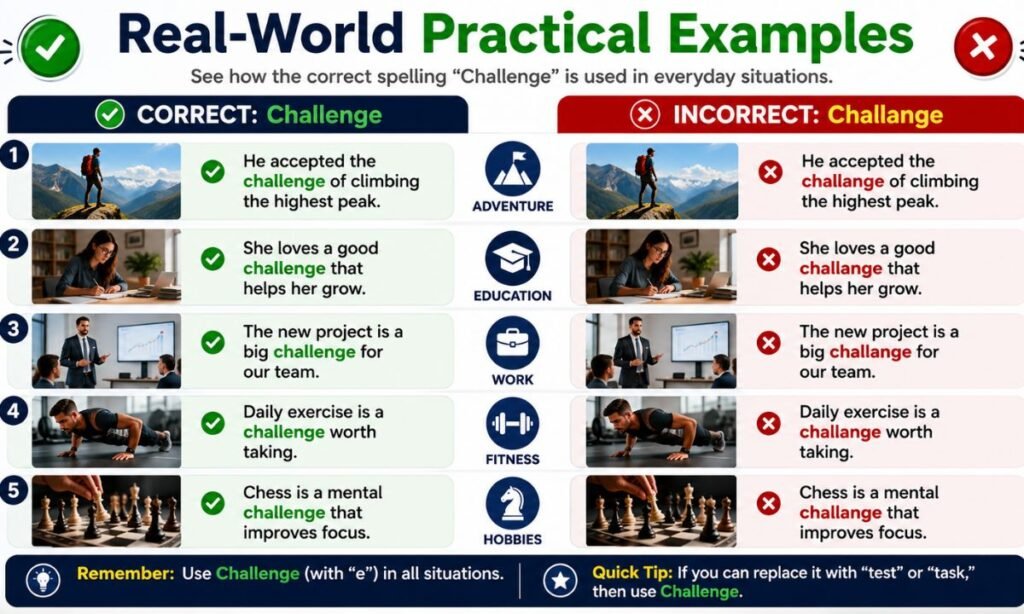
Challenge Examples
- “Public speaking remains a challenge for many professionals.”
- “The coach will challenge the team to improve their pace this season.”
- “Raising a toddler and working full-time is genuinely challenging.”
- “He accepted the challenge to run his first marathon.”
- “Teachers often challenge students to think beyond the textbook.”
Challange Examples
There are no correct examples of “challange” in any sentence, since the spelling itself is the error. Any sentence using it should be corrected to “challenge” instead.
Self-Assessment (Fill in the Blanks)
Test yourself with these short sentences. Choose the correct spelling for each blank.
- Learning to cook was a fun ______ for my sister.
- The team decided to ______ the final decision.
- Public speaking is often ______ for beginners.
- She loves a good ______ , especially in sports.
- His biggest ______ this year was learning to swim.
Answers
- Challenge
- Challenge
- Challenging
- Challenge
- Challenge
Frequently Asked Questions
What is the meaning of challenge?
Challenge refers to a difficult task or situation that tests someone’s skill or effort, and as a verb, it means to question or invite someone to compete.
How do you spell challenge correctly?
It’s spelled C-H-A-L-L-E-N-G-E, with an “e” after the “l,” not an “a.”
What is a challenge for someone?
A challenge for someone is any task, obstacle, or situation that requires extra effort, skill, or courage to overcome.
How do you spell chalenge?
That spelling is also incorrect. The correct form always includes both L’s and the “-enge” ending: challenge.
Conclusion
The spelling debate here has a clear winner. Challenge is the only correct form, backed by dictionaries, grammar tools, and everyday usage across business, education, and casual conversation. Challange, no matter how often it shows up in quick typing or spoken confusion, has no real standing as a word.
Once you connect the “-enge” ending to familiar words like revenge and avenge, the correct spelling tends to stick. The next time you type this word, you’ll likely do it right without a second thought.