
Type the word fast enough and your fingers might betray you. You mean to write “triple,” but “tripple” slips out instead, and suddenly you’re staring at the screen wondering which one is actually right. This mix-up happens more often than you’d think, especially since English is full of words that double their consonants for no obvious reason.
Here’s the short version: only one of these spellings exists in real dictionaries. The other one is a typo that has somehow become common enough to have its own search traffic. This article walks through where the word comes from, why the extra “p” never belonged there, and how to use “triple” correctly in emails, headlines, casual texts, and formal reports alike.
Triple
“Triple” is a real, dictionary-approved English word. It traces back to Latin and has meant “threefold” for centuries. You’ll find it in Merriam-Webster, Oxford, and Cambridge, and it works as an adjective, a noun, and a verb depending on the sentence.
Tripple
“Tripple” isn’t in any standard dictionary. It’s a misspelling, plain and simple, born from the way English readers expect certain sounds to come with doubled letters. No major style guide accepts it, and no publisher would print it on purpose.
Triple or Tripple: Quick Answer
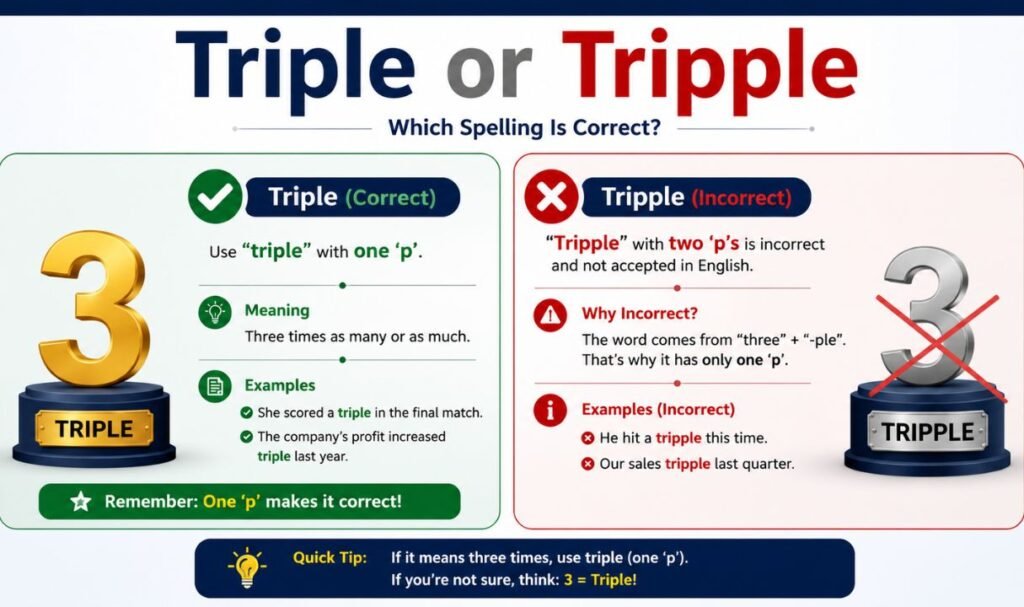
If you only remember one thing from this page, remember this: triple is correct, tripple is not.
- Correct: She ordered a triple scoop of ice cream.
- Incorrect: She ordered a tripple scoop of ice cream.
There’s no hidden exception, no British spelling variant, and no informal context where “tripple” becomes acceptable. It’s a spelling error every time it appears, whether in a text message, a resume, or a news headline.
The Origin of Triple or Tripple
“Triple” comes from the Latin word triplex, a combination of tri- (three) and plicare (to fold). That Latin term passed into Old French as triple, and English borrowed it directly during the Middle English period, somewhere around the 1300s. At no point in that journey did the word pick up a second “p.”
“Tripple,” by contrast, has no etymology of its own. It isn’t an old spelling that fell out of favor, and it isn’t a regional variant that survived in some corner of the English-speaking world. It’s simply a mistake that keeps getting repeated because it looks like it should follow the pattern of words such as “ripple,” “apple,” or “topple.”
That pattern is worth understanding, because it explains almost every case of this confusion. In English, a short vowel followed by a doubled consonant usually signals a particular pronunciation, one where the vowel stays short and clipped. Words like “ripple” and “supple” follow that rule closely. “Triple,” though, doesn’t need the extra letter to keep its vowel sound intact, so the spelling never doubled the “p” in the first place.
British English vs American English Spelling
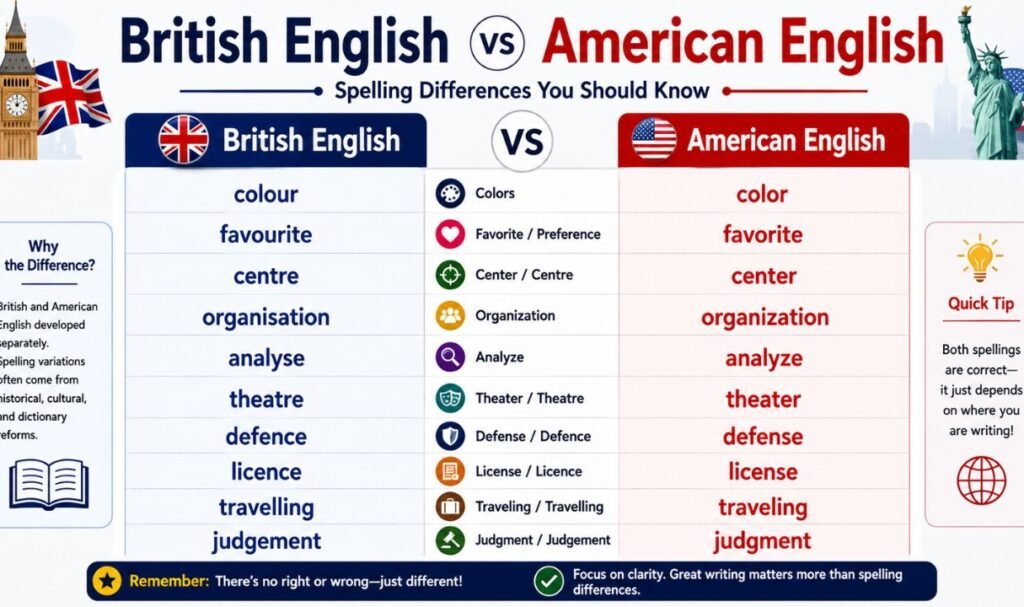
Unlike words such as “colour” and “color” or “organise” and “organize,” this one doesn’t split along regional lines. British English and American English agree completely here: the correct spelling is “triple,” full stop.
You won’t find “tripple” listed as a British variant in the Oxford English Dictionary, and you won’t find it accepted in Merriam-Webster’s American entries either. Whether you’re writing for a London newspaper or a New York blog, the spelling stays exactly the same.
Comparison Table
| Feature | Triple | Tripple |
|---|---|---|
| Dictionary status | Recognized (Oxford, Merriam-Webster, Cambridge) | Not recognized |
| British English | Correct | Incorrect |
| American English | Correct | Incorrect |
| Word origin | Latin triplex via Old French | None; a misspelling |
| Parts of speech | Adjective, noun, verb | Not applicable |
| Common in | Formal writing, sports, math, everyday speech | Typos, fast texting, autocorrect slips |
Triple or tripple meaning
“Triple” describes something made of three parts, something happening three times, or the act of multiplying a value by three. “Tripple” carries no meaning of its own since it isn’t a real word; whenever it shows up, the writer almost certainly meant “triple.”
Triple or tripple oxford dictionary
Oxford’s dictionaries list “triple” with full definitions across its adjective, noun, and verb forms. There is no separate entry for “tripple,” which confirms it holds no official standing in the language.
Triple as in 3
When people search “triple as in 3,” they’re usually confirming that “triple” relates directly to the number three, the same way “double” relates to two and “quadruple” relates to four. A triple crown, a triple threat, and a triple play in baseball all draw on that same core idea of three.
Triple pronunciation
“Triple” is pronounced /ˈtrɪp.əl/, with stress on the first syllable. Say it out loud a few times: TRIP-uhl. Nothing about the sound suggests a second “p” is missing, which is part of why the spelling can feel so counterintuitive to some writers.
Triple examples
- The gym offers a triple set of exercises for each muscle group.
- Sales tripled after the product launched nationally.
- He hit a triple in the seventh inning.
- The recipe needs triple the usual amount of flour for a large batch.
- Their triple-layer cake was the highlight of the party.
Triple meaning in English literature
In literary analysis, “triple” often describes patterns built around groups of three, such as triple rhyme schemes, triple repetition for rhetorical emphasis, or a triple structure in storytelling (setup, conflict, resolution). Writers and poets have leaned on threes for centuries because the pattern tends to feel complete and satisfying to a reader’s ear.
You May Like: How-To vs. How-Tos The Definitive Guide to Getting It Right
Which Spelling Should You Use?
Always use “triple.” There isn’t a context, a tone, or an audience where “tripple” becomes the right choice. If you’re writing a casual text to a friend, a formal business proposal, a news article, or a caption for social media, “triple” is the only spelling that will look correct to your reader and to any spell-checker worth using.
A simple way to lock this in: think of the word as tri (three) plus ple (fold), with nothing extra squeezed in between. If you can remember that the root word “tri” already carries the meaning of three, you won’t feel tempted to add a second “p” for emphasis.
How to Spell Triple (Common User Queries)
People land on pages like this one after typing all sorts of variations into a search bar. Here are a few of the most common:
- How do you spell triple?
- Spell triple correctly
- What is the correct spelling of triple
- Triple spelling check
- Is tripple a word
Every one of these questions has the same answer. T-R-I-P-L-E, one “p,” no exceptions.
Common Mistakes with Triple or Tripple
Most people don’t misspell this word out of ignorance. They misspell it out of habit, speed, or pattern-matching. A few of the usual culprits:
- Autofill and muscle memory. Typing quickly on a phone keyboard makes it easy to hit a letter twice without noticing.
- Pattern confusion with similar words. “Ripple,” “apple,” and “topple” all use double consonants, so the brain sometimes assumes “triple” should follow suit.
- Confusing “triple” with “treble.” In British English, “treble” is a separate word that also relates to multiplying by three, particularly in music and finance. It’s spelled correctly with one “b,” but writers sometimes blend the two words together and produce odd hybrids.
- Relying on sound instead of spelling. Since English pronunciation doesn’t always map cleanly onto spelling, guessing based on how a word sounds can lead you astray here.
A quick proofreading pass, or a glance from a spell-checker, catches almost every one of these slips before they reach a reader.
Triple or Tripple in Everyday Examples
Emails
Professional emails demand clean spelling, since a typo like “tripple” can quietly undercut your credibility even in an otherwise well-written message.
- “Please triple-check the figures before we send this to the client.”
- “We’re aiming to triple our output by the end of the quarter.”
News Writing
Journalists and editors have zero tolerance for spelling errors, and “triple” appears constantly in headlines about sports, finance, and crime statistics.
- “Local Team Wins Triple Overtime Thriller”
- “Company Reports Triple-Digit Growth in Q3”
Social Media
Casual doesn’t mean careless. Even a quick caption benefits from correct spelling, especially since misspellings tend to get pointed out in the comments.
- “Triple threat: new job, new city, new gym routine 💪”
- “This burger has a triple stack of cheese and I regret nothing.”
Formal Writing
Academic papers, legal documents, and business reports all require the standard spelling, since “tripple” would likely be flagged by an editor or automatically corrected before publication.
- “The study recorded a triple increase in participant engagement over six months.”
- “The contract specifies triple damages in the event of a breach.”
Triple or Tripple: Google Trends & Usage Data
Search interest for “tripple” shows up fairly consistently across search engines, largely because it’s a natural typing mistake rather than an intentional search. “Triple,” meanwhile, sees dramatically higher and steadier search volume, since it’s tied to countless everyday topics: sports scores, coffee orders, math problems, and financial reports. This pattern lines up with what dictionaries and style guides already confirm. People search “tripple” mainly to double-check a spelling they weren’t sure about, not because they believe it’s an alternate or regional form.
Comparison Table: Triple vs Tripple
| Category | Triple | Tripple |
|---|---|---|
| Spelling status | Correct | Incorrect |
| Search intent | Direct usage, definitions, examples | Spelling verification |
| Appears in dictionaries | Yes | No |
| Used in professional writing | Yes | Never |
| Grammar checkers flag it | No | Yes, as a misspelling |
| Regional variation | None | None |
Triple vs Tripple (Meaning, Usage & Confusion)
The confusion between these two spellings almost always comes down to one thing: English readers expect doubled consonants after short vowels in certain word families, and “triple” simply doesn’t belong to that family. Once you separate “triple” from look-alikes such as “ripple” and “supple,” the spelling becomes far easier to remember.
It also helps to remember that “triple” is a genuinely useful, flexible word. It works as an adjective (“a triple win”), a noun (“he hit a triple”), and a verb (“the company plans to triple its revenue”). “Tripple” can’t do any of that, because it isn’t recognized as a word to begin with. Anywhere you’d reach for the concept of three, “triple” is the spelling that will always be understood and accepted.
You May Like: Is It Color or Colour? Never Make This Mistake Again
Frequently Asked Questions
How do you spell triple or tripple?
The correct spelling is “triple,” with a single “p.” “Tripple” is a misspelling and isn’t recognized in standard English.
How do you spell triple as in 3?
It’s spelled T-R-I-P-L-E, the same way whether you’re talking about a triple play in baseball or tripling a number in math.
Is it spelt triple or tripple?
It’s spelt “triple.” “Tripple” doesn’t appear in any major dictionary and should be avoided in writing.
Why does triple only have one P?
Because it comes from the Latin triplex by way of Old French triple, and neither source spelling ever included a doubled “p.”
Conclusion
The rule here is refreshingly simple, especially compared to some of English’s messier spelling puzzles. “Triple” is correct in every context, every region, and every register of writing. “Tripple” is a typo, not a variant, and no dictionary or style guide gives it a pass. Next time your fingers try to sneak in that extra “p,” picture the root “tri” doing all the work it needs to do with just one.