
Open a British novel and a New York newspaper side by side, and you’ll spot it almost immediately: one spells it “colour,” the other “color.” Neither is wrong. Both describe the exact same thing — the reds, blues, and greens that make the world visually interesting.
This tiny spelling gap still trips up students, bloggers, and marketers. Pick the wrong version for the wrong audience, and your writing can look inconsistent or unprofessional.
This guide settles the confusion for good: when to use color, when to use colour, where each spelling comes from, and how to stay consistent no matter who’s reading.
Definition and Pronunciation of Color and Colour
Both words mean exactly the same thing: the property of light that lets our eyes distinguish red from yellow, blue from green. As a noun, it refers to a hue, shade, or pigment. As a verb, it means to apply that hue to something — “color the picture” and “colour the picture” work identically.
Pronunciation doesn’t change either. Say them out loud and you’ll hear the same two syllables: KUHL-er. The “u” in colour is silent — it changes the spelling, not the sound. That’s the whole story: one extra letter on the page, zero difference in speech.
What’s the Difference Between Color and Colour?
The difference has nothing to do with grammar, meaning, or correctness. It comes down to geography and spelling convention.
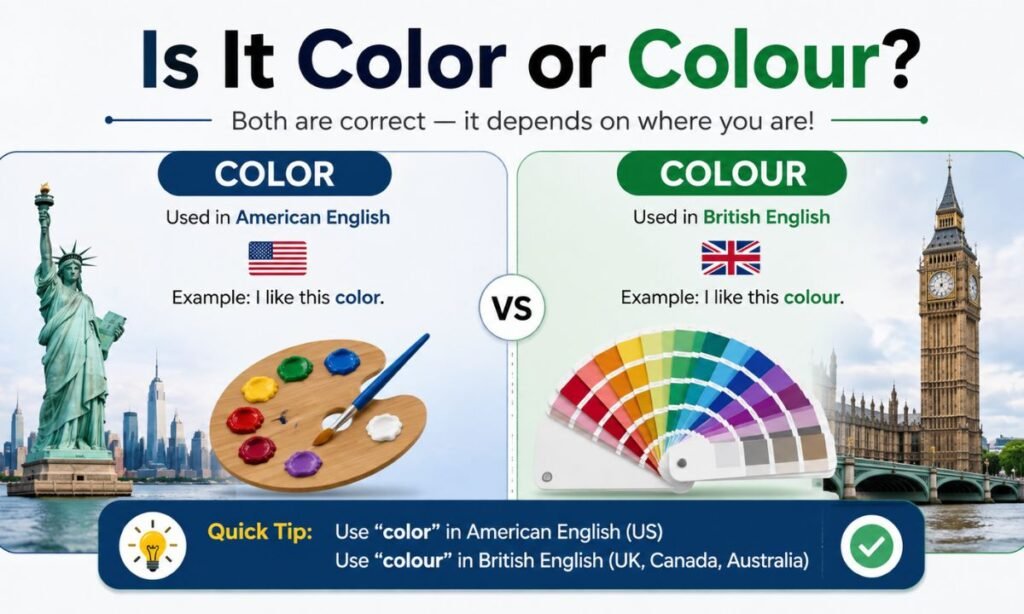
- Color is the standard spelling in American English.
- Colour is the standard spelling in British English, and it’s also used across Canada, Australia, New Zealand, South Africa, India, and most Commonwealth nations.
Neither word is a misspelling of the other. They’re regional variants, similar to how “theater” and “theatre,” or “organize” and “organise,” split along the same American-British line.
Why Are Color and Colour Spelled Differently?
The split traces back to the 18th and 19th centuries, when American lexicographer Noah Webster set out to simplify English spelling for American readers. He believed dropping “unnecessary” letters made written English more logical, and trimmed the “u” from a whole group of words — colour became color, honour became honor, favour became favor.
Britain never adopted these changes. It kept the older spelling pattern shaped centuries earlier by French influence after the Norman Conquest, when words like “couleur” entered English and kept their extra vowel. In short: Webster’s reforms created the American spelling, while Britain held onto the older, French-influenced version.
Is It Color or Colour?
Here’s the practical answer: both are correct, and neither one is universally “more correct” than the other. The right choice depends entirely on your audience.
- Writing for a US audience, an American company, or American publication? Use color.
- Writing for a UK, Canadian, Australian, or Commonwealth audience? Use colour.
- Unsure who’s reading? Pick one spelling and stay consistent throughout the entire piece.
The biggest mistake isn’t choosing color over colour, or vice versa — it’s mixing the two in the same document. A resume, blog post, or report that switches between “color” and “colour” looks careless, even if every individual sentence is grammatically fine. Set your language preference before you start writing, and stick to it from the first sentence to the last.
You May Like: Eminent vs Imminent: Grammar Rules, Meanings & Usage Guide
Table of Comparison: Color vs Colour
| Feature | Color | Colour |
|---|---|---|
| Region | American English | British English, Commonwealth |
| Countries | United States | UK, Canada, Australia, New Zealand, South Africa, India |
| Pronunciation | KUHL-er | KUHL-er (identical) |
| Word origin | Latin “color” via Webster’s reform | Latin “color” via French “couleur” |
| Verb form | colored, coloring | coloured, colouring |
| Adjective form | colorful | colourful |
| Related words | honor, favor, neighbor | honour, favour, neighbour |
| Used in | US media, US software, American businesses | UK media, Commonwealth publications, international brands |
Other Forms of Color and Colour
The “u” carries through related forms too. Once you decide which spelling system you’re using, apply it consistently across every variation of the word.
- Color / Colour (noun, verb)
- Colored / Coloured (past tense, adjective)
- Coloring / Colouring (present participle, noun)
- Colorful / Colourful (adjective)
- Colorless / Colourless (adjective)
- Colorist / Colourist (a person who works with color)
- Discolor / Discolour (to change or lose color)
- Multicolor / Multicolour (having many colors)
Examples of Color vs. Colour
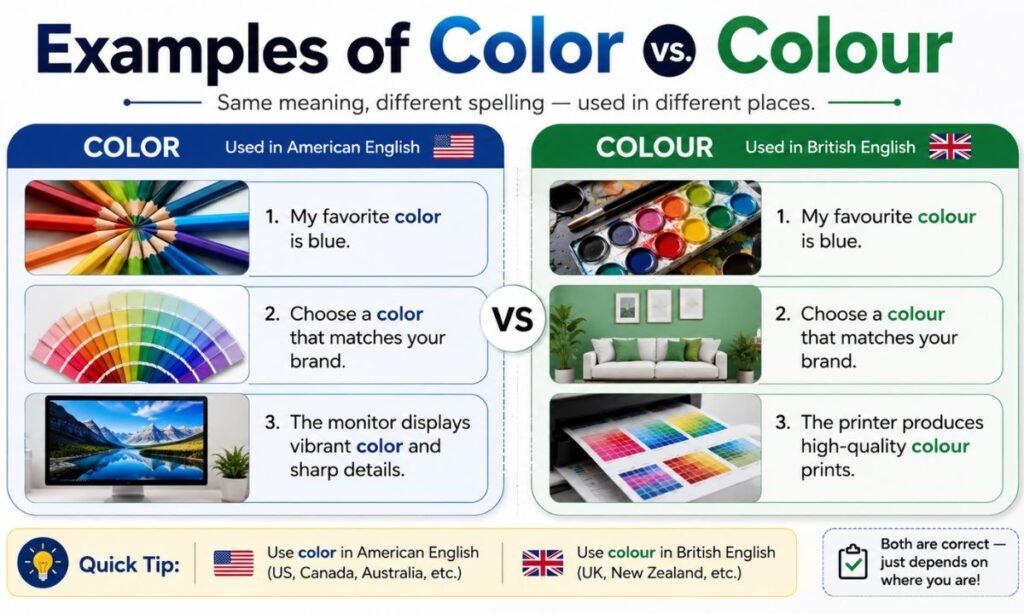
American English (color):
- She painted the fence a bright shade of color.
- His colorful personality made him easy to remember.
British English (colour):
- She painted the fence a bright shade of colour.
- His colourful personality made him easy to remember.
The sentence structure never changes — only the spelling shifts.
Historical Origin of Color and Colour
Both words trace back to the Latin noun color, meaning “hue” or “tint.” Latin passed the word into Old French as colur, and it entered English after the Norman Conquest of 1066, when French vocabulary flooded into English.
For centuries, English speakers on both sides of the Atlantic wrote “colour.” The split didn’t happen until Webster published his American dictionaries in the early 1800s, aiming to give American English a distinct identity in the decades following independence. His simplified spellings spread through American schoolbooks and became the national standard. Britain and its colonies kept the traditional French-derived spelling, which is why colour remains standard across the Commonwealth today.
Meaning and Concept in Simple Terms
Strip away the spelling debate, and the concept is simple: color/colour is what your eyes perceive when light of different wavelengths hits an object and bounces back to you. A red apple looks red because it reflects red wavelengths and absorbs the rest — that’s the entire science behind the word, regardless of spelling.
People often search for related angles on this topic:
- Color or colour quiz — short quizzes that test whether you can match the spelling to the correct region or sentence.
- Color or colour pronunciation — as covered above, the pronunciation is identical; only spelling differs.
- Color or colour spelling — determined by whether you’re using American or British English conventions.
- Color or colour in English — both are valid English; “English” itself has multiple regional standards.
- Color or colour in Europe — most of Europe, when writing English, follows British conventions and uses colour.
- Color vs colour history — rooted in Webster’s 19th-century American spelling reforms.
- Plural of colour — simply “colours” (or “colors” in American English); the word pluralizes normally by adding “s.”
Clear Rules for Choosing Color or Colour
Use these rules to settle the question every time you sit down to write:
- Identify your audience first. American readers expect color; British and Commonwealth readers expect colour.
- Match your publication’s style guide, even if it differs from your personal preference.
- Stay consistent within one document. Never switch spellings halfway through.
- Follow related word patterns. If you use “colour,” also use “favourite,” “honour,” and “neighbour.”
- Check your software’s language setting, since it can silently auto-correct your spelling.
You May Like: What Does Delegate Mean? Definition, Examples & Synonyms
Common Usage Patterns in Real Writing
In practice, spelling choice follows predictable patterns:
- US newspapers, tech companies, and software almost universally use color.
- UK newspapers, Commonwealth government documents, and academic journals use colour.
- International brands sometimes adjust by region — color on a US site, colour on a UK site.
- Academic writing typically follows the institution’s or journal’s convention, not the writer’s home country.
Spelling Patterns That Help You Remember
A few memory tricks make the choice easier to lock in:
- U for United Kingdom. “Colour” has a U, and so does UK — an easy visual link.
- No U, USA. “Color” has no U, and neither does “USA.”
- Group it with similar words. Color/colour follows the same pattern as honor/honour, favor/favour, and neighbor/neighbour. Learn one, and you’ve learned the rule for a dozen others.
Practical Writing Tips for Beginners
If you’re still building confidence with English spelling conventions, keep these tips handy:
- Set your word processor’s language/region setting before you start typing, so spellcheck flags the version you don’t want.
- Read your final draft once specifically checking for spelling consistency, separate from checking grammar or content.
- Keep a personal style sheet listing your chosen spellings for tricky words — color/colour, organize/organise, center/centre.
- If you genuinely don’t know your reader’s location, American English (color) is the more common default online, since much web content skews American.
- Don’t trust autocorrect blindly — it sometimes swaps one spelling for the other without you noticing, especially between documents with different language settings.
Common Confusions and How to Avoid Them
Several related mix-ups pop up alongside the color/colour debate:
- Plural confusion. The plural simply follows the singular spelling: colors or colours — never mixed within the same sentence.
- “Coloured” as a noun. In some regions this word has historically described race and is now considered outdated or offensive; when discussing color as a visual property alone, this isn’t a concern, but the sensitivity is worth knowing.
- Gray vs. grey. A similar regional pattern — gray is American, grey is British — but a separate word, not a form of color/colour.
- Mistaking spelling for grammar errors. Colour isn’t a mistake in a British context, and color isn’t a mistake in an American one. A spellchecker set to the wrong region is usually the real culprit.
Global English and Why Both Forms Matter
English isn’t owned by one country, and that’s exactly why two correct spellings can coexist. Hundreds of millions of people use English across dozens of countries, each with its own standardized variant. American and British English are the two dominant reference points, but neither is objectively “the” correct English.
Recognizing both forms matters for:
- Global business communication, where the wrong regional spelling can subtly signal you haven’t researched your audience.
- SEO and content marketing, where matching your audience’s spelling helps content read naturally to them.
- Localization work, where translators and copywriters routinely switch spelling systems based on the target market.
- Academic credibility, since consistent regional spelling is often part of formal style guides like APA, MLA, or Oxford style.
Quick Summary for Easy Understanding
- Color and colour mean the same thing and sound identical.
- Color is American English; colour is British and Commonwealth English.
- The difference exists because of Noah Webster’s 19th-century spelling reforms in the US.
- Related words (favor/favour, honor/honour) follow the same pattern.
- The only real “mistake” is mixing both spellings in one piece of writing.
Common Mistakes and Confusions
Even experienced writers slip up occasionally. Watch for these pitfalls:
- Starting an email in American English and switching to British spelling halfway through.
- Using “colour” but then writing “favorite” instead of “favourite” in the same paragraph.
- Assuming colour is “more formal” or “more correct” than color — neither outranks the other.
- Forgetting that compound words (colorblind/colourblind) need to match your chosen system too.
Linguistic Insight: American vs British Spelling Rules
The color/colour split is part of a larger pattern of American-British spelling divergence, largely shaped by Webster’s reforms:
- -our becomes -or: colour → color, favour → favor, labour → labor
- -re becomes -er: centre → center, theatre → theater, metre → meter
- -ise becomes -ize: organise → organize, realise → realize
- Doubled consonants simplify: travelled → traveled, cancelled → canceled
Understanding this bigger pattern makes individual choices, like color versus colour, much easier to predict without memorizing every case separately.
Expert Opinion on Correct Usage
Professional editors and style guides agree on one point: correctness here is contextual, not absolute. The Chicago Manual of Style, favored by American publishers, defaults to color. The Oxford Style Manual, used across the UK and Commonwealth, defaults to colour. Neither treats the other’s spelling as an error — they simply reflect different regional standards.
The practical takeaway: identify your target audience or publication first, then apply that region’s spelling rules consistently across the whole document, including derived words.
Real-Time Suggestions, Wherever You Write
Modern writing tools, browser extensions, and word processors can be set to a specific English variant (US, UK, Australian, Canadian) so spelling suggestions match your intended audience automatically. If you regularly write for both American and British readers, keeping separate language profiles saves you from manually catching every color/colour slip during editing.
Self Assessment
Test your understanding with these quick checks:
- Which spelling would a US-based marketing email typically use?
- Which spelling matches “favourite” and “neighbour” in the same document?
- Is the pronunciation of color and colour different?
- What 19th-century figure is responsible for the American spelling?
- Which spelling is standard in Australia and South Africa?
(Answers: 1. Color 2. Colour 3. No, they’re pronounced the same 4. Noah Webster 5. Colour)
Frequently Asked Questions
Which is correct, color or colour?
Both are correct. Color is standard in American English, and colour is standard in British and Commonwealth English.
Is it color gray or grey?
American English pairs with “gray,” while British English pairs with “grey” — the same regional pattern as color and colour.
How do you spell color in South Africa?
South African English follows British conventions, so it’s spelled “colour.”
Is “color” or “colour” the correct spelling in America?
“Color” is the correct and standard spelling throughout the United States.
Conclusion
Color and colour aren’t competing for the title of “correct” — they’re two regional expressions of the same word, shaped by history rather than grammar. Once you know your audience, the choice practically makes itself: color for American readers, colour for British and Commonwealth readers, and consistency for everyone in between. Keep that rule in mind, and you’ll never second-guess this spelling again.