
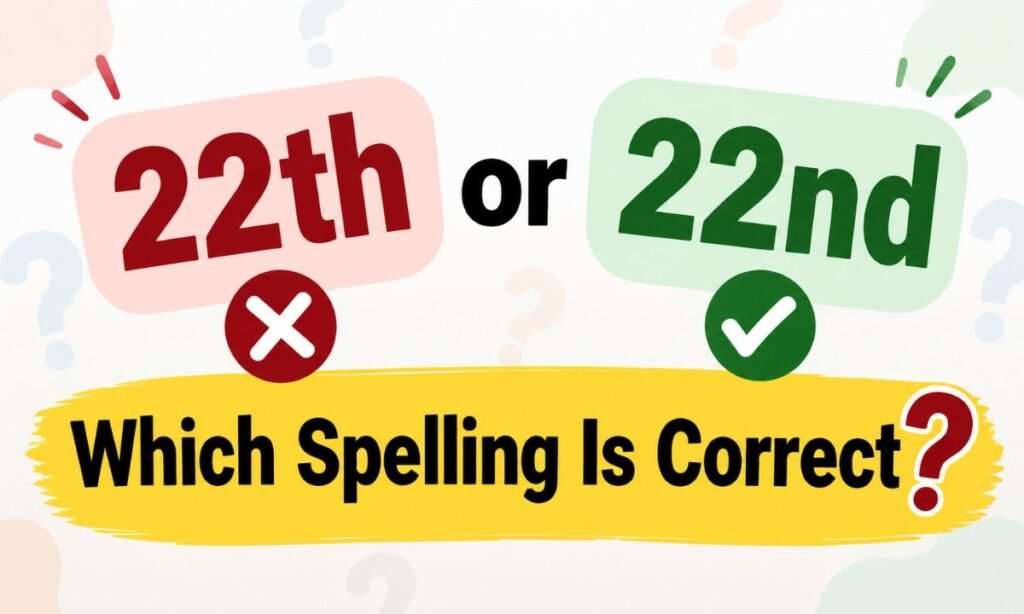

You are typing a birthday message, filling in a form, or setting up a calendar invite, and you pause. Does the date end in “th” or “nd”? It looks like it could go either way, and that tiny doubt is enough to send many people to a search engine.
Here is the short version. 22nd is correct. 22th is a spelling mistake. The number 22 ends in the digit 2, and the digit 2 always pulls in the “nd” ending, just as it does in 2nd and 32nd.
Quick answer: Write 22nd (twenty-second). Never write 22th.
22th or 22nd – Which Spelling Is Correct?
The correct spelling is 22nd. It is the written form of the ordinal number “twenty-second,” and the letters “nd” are the ordinal suffix that tells readers how to say it.
Ordinal numbers describe position in a sequence: first, second, third, and so on. Cardinal numbers, by contrast, describe amount: one, two, three. When you turn a cardinal like 22 into an ordinal, you add a two-letter ending to the numerals. That ending is chosen by the last digit.
The Rule in One Line
Look at the final digit of the number:
- Ends in 1: use st (1st, 21st, 101st)
- Ends in 2: use nd (2nd, 22nd, 132nd)
- Ends in 3: use rd (3rd, 23rd, 563rd)
- Everything else: use th (4th, 10th, 20th, 25th)
The only catch is the teens. Numbers ending in 11, 12, and 13 take “th” because their spoken forms are eleventh, twelfth, and thirteenth. So you get 11th, 12th, 13th, 111th and 112th.
Twenty-two is not a teen. It sits in the twenties, and the last digit is 2. That is the whole story.
Why the Ending Is “nd” and Not “th”
The suffix is not random decoration. It mirrors the last letters of the spoken word. Say “twenty-second” out loud and the word ends with “-ond.” The abbreviation keeps the final two letters of “second,” which are n and d.
That is the same logic behind 1st (first) and 3rd (third). The numerals borrow their endings from the words.
Now say “22th” in your head. There is no such word as “twenty-twoth.” Nobody pronounces it that way, which is a good hint that the spelling cannot be right.
A Simple Three-Second Test
Try this when you are unsure:
- Say the number as a word: “twenty-second.”
- Listen to the last syllable. It is “-ond.”
- Write the last two letters of “second”: nd.
Done. The same test works for 32nd, 42nd, 52nd, and every other number that ends in 2 and is not 12.
22th
“22th” is not a word or a valid ordinal. It is a typo, and a very understandable one.
You will not find it in any dictionary, style guide, or grammar reference as an accepted spelling. Editors treat it as an error, and most spell checkers will underline it, although some tools miss it because they read numerals differently from words.
Why People Write 22th
Most mistakes have a reason, and this one has several.
The “th” habit. The “th” ending is the default. It covers 4th through 20th, then 24th through 30th, and many other numbers. After a while the brain starts to apply it automatically.
The 20th trap. Twenty is spelled 20th, so 22th feels like a natural next step. People forget that the pattern changes as soon as the last digit becomes 1, 2, or 3.
The 12th confusion. Some writers remember that 12 becomes “12th” and wrongly assume 22 must follow suit. It does not. The twelve exception applies only to 12, 112, 212, and so on.
Speed. On a phone, autopilot takes over. People type quickly, skip the check, and hit send.
Learning English as an additional language. In many languages, ordinals are formed more simply, with a single marker used across the board. English has four endings, plus exceptions, and that takes practice.
Where You Might See “22th” in the Wild
It shows up in casual places more than formal ones:
- Social media captions for a “22th birthday”
- Hand-typed event posters
- Quick text messages and chat replies
- Machine-translated pages and low-quality web copy
- Date fields in forms that were typed in a hurry
The error is rare in published books, newspapers, and professional websites because editors catch it. If you spot it in a professional document, treat it as a proofreading miss.
Is “22th” Ever Acceptable?
No. There is no regional variant, dialect, or style guide that accepts it. American, British, Canadian, and Australian English all use 22nd.
A few people confuse this with abbreviated styles such as “22d.” That is a different form, and we will cover it below. It is not the same as “22th.”
The Same Mistake With Other Numbers
“22th” is part of a larger family of errors. If you understand why one is wrong, the others fall into place.
| Incorrect | Correct | Spoken form | Why |
|---|---|---|---|
| 21th | 21st | twenty-first | Ends in 1 |
| 22th | 22nd | twenty-second | Ends in 2 |
| 23th | 23rd | twenty-third | Ends in 3 |
| 31th | 31st | thirty-first | Ends in 1 |
| 32th | 32nd | thirty-second | Ends in 2 |
| 12nd | 12th | twelfth | Teen exception |
| 13rd | 13th | thirteenth | Teen exception |
| 11st | 11th | eleventh | Teen exception |
Notice the two types of error. One group uses “th” where a special ending is needed. The other group uses a special ending where “th” is needed. Both come from not checking the last two digits together.
How to Fix It Quickly
If you have written “22th” in a document, here is the fix:
- Use your editor’s find function and search for “22th.”
- Replace it with “22nd.”
- Run the same search for “21th,” “23th,” “32th,” and similar patterns.
- Read any dates aloud once. Your ear will catch what your eyes miss.
22nd
“22nd” is the standard way to write the ordinal for twenty-two in numerals. It is read aloud as “twenty-second.”
Here is how the pieces break down:
| Part | Meaning |
|---|---|
| 22 | The base number (cardinal) |
| nd | The ordinal suffix, taken from “second” |
| 22nd | The twenty-second item, day, or position in a series |
Writing 22nd: Formatting Options
You can write the ending in two ways.
- Standard text: 22nd
- Superscript: 22<sup>nd</sup>
Both are correct. Plain text is the safer choice online, in emails, and in text messages, since not every platform supports superscript. Word processors often convert the ending to superscript automatically, and some style guides ask you to switch that off.
Do not put a space between the numeral and the letters. “22 nd” looks wrong, and “22 nd” can break across lines.
You can also spell the word out: twenty-second. Many style guides prefer words for small numbers in running text and numerals for dates and rankings. A hyphen links the two parts.
Where You Use 22nd
Ordinals appear in more places than most people realize. Here are the most common.
22nd in Dates
Dates are the number one reason people look up this topic.
- Her appointment is on the 22nd.
- Tickets go on sale on March 22nd.
- The deadline is the 22nd of June.
- We arrive on 22nd September.
22nd in Birthdays and Anniversaries
Milestones call for correct spelling, especially when the text will be printed on a cake, a card, or a banner.
- Happy 22nd birthday!
- Today is our 22nd wedding anniversary.
- The company celebrates its 22nd year in business.
1. 22nd in Rankings and Positions
- She finished in 22nd place.
- Their team sits 22nd in the league table.
- He was the 22nd person in the queue.
2. 22nd in Names and Titles
- The 22nd Amendment to the US Constitution limits presidential terms.
- The 22nd Street bus stops here.
- The 22nd floor has a view of the harbor.
- The film is the 22nd entry in the series.
3. 22nd in Everyday Speech and Writing
- This is the 22nd time I have reread that email.
- It is the 22nd of the month already.
In every one of these sentences, “22th” would be marked wrong by a teacher, an editor, or a grammar checker.
Do You Need the “nd” in a Date at All?
Not always. This is something many people never learn.
Several style guides ask writers to drop ordinal endings from dates. The Australian Government Style Manual, for example, tells writers to use plain numerals in dates and gives “12 February 2020” as the model. GOV.UK takes the same approach, so a British government page would read “22 September 2026” rather than “22nd September 2026.”
American news style also writes dates with plain figures, as in “Sept. 22.” The ordinal ending is most common in informal writing, invitations, and speech.
So you have choices, and all of these are acceptable:
- September 22
- September 22nd
- 22 September
- 22nd September
- the 22nd of September
What is never acceptable is “22th.”
The Legal Shorthand: 22d
Here is a detail that explains some of the confusion. Certain legal citation styles in the United States shorten “second” and “third” to “d.” You may see 2d, 3d, 22d, or 23d in court documents and old statutes.
This is a deliberate convention in that field. It is not the same as “22th,” and it is not a general-purpose spelling. Outside of legal writing, stick with 22nd.
Which Is Used the Most?
22nd is used far more often, and it is the only form that is accepted. “22th” appears occasionally, but only as an error.
Several things push the numbers firmly in favor of 22nd:
- Edited sources use it. Newspapers, books, official websites, and academic papers all print 22nd.
- Spell checkers and autocorrect help. Phones and word processors frequently change 22th to 22nd, so many typos disappear before they are sent.
- Search tools correct it. Search engines usually show results for the right spelling even when someone enters the wrong one.
- Teachers and style guides reinforce it. The rule is taught early and repeated often.
I should be honest about one thing. There is no single official count that compares the two, and the exact ratio changes depending on the source you measure. What you can say with confidence is that 22nd dominates professional writing, and 22th survives mostly in rushed, unedited text.
Why Do So Many People Still Search for “22th”?
Searches for “22th or 22nd” are common for a simple reason: people are careful. They notice a flicker of doubt and check before publishing. That is a good habit.
The searches also spike around certain moments:
- Birthdays and anniversaries
- Dates near the 22nd of any month
- School exam seasons
- Wedding and event planning
If you are searching, you are in good company. It is a small question with a clear answer.
Usage Snapshot
| Form | Status | Typical use |
|---|---|---|
| 22nd | Correct | Dates, birthdays, rankings, titles |
| twenty-second | Correct | Formal writing, spelled-out style |
| 22d | Niche | US legal citations only |
| 22th | Incorrect | Typos and rushed typing |
A Quick Cheat Sheet for Ordinals 1st to 31st
Most date questions involve the days of a month. This table covers all of them in one place, so you can bookmark it.
| Day | Ordinal | Day | Ordinal |
|---|---|---|---|
| 1 | 1st | 17 | 17th |
| 2 | 2nd | 18 | 18th |
| 3 | 3rd | 19 | 19th |
| 4 | 4th | 20 | 20th |
| 5 | 5th | 21 | 21st |
| 6 | 6th | 22 | 22nd |
| 7 | 7th | 23 | 23rd |
| 8 | 8th | 24 | 24th |
| 9 | 9th | 25 | 25th |
| 10 | 10th | 26 | 26th |
| 11 | 11th | 27 | 27th |
| 12 | 12th | 28 | 28th |
| 13 | 13th | 29 | 29th |
| 14 | 14th | 30 | 30th |
| 15 | 15th | 31 | 31st |
| 16 | 16th |
Look at the pattern. Special endings appear only on 1, 2, 3, 21, 22, 23, and 31. Everything else is “th.” Once you see this, the whole system fits in your head.
How Ordinal Numbers Work (The Background)
A little context makes the rule easier to remember.
Ordinal vs. Cardinal Numbers
- Cardinal numbers count: one, two, twenty-two.
- Ordinal numbers rank: first, second, twenty-second.
When you write ordinals as numerals, you attach the suffix. When you write them as words, the word itself does the work.
Why English Has Four Endings
The first three ordinals, first, second, and third, are old words with their own shapes. They do not follow the pattern of the rest. Fourth, fifth, sixth, and the others simply add “-th” to the number word.
When people began abbreviating ordinals with numerals, they kept the last letters of each word. So “first” became 1st, “second” became 2nd, “third” became 3rd, and “fourth” became 4th. The practice spread, and the same endings were attached to larger numbers. That is why twenty-second is shortened to 22nd, since the final word is “second.”
The word “second” itself comes from the Latin secundus, meaning “following.” It is the one that follows the first. That detail is a nice reminder that the “nd” ending carries history.
The Teen Exceptions Explained
Eleventh, twelfth, and thirteenth are not built from “first,” “second,” or “third.” They have their own forms, ending in “-th.” So the numerals follow: 11th, 12th, 13th.
The key rule is that you look at the last two digits, not just the last one. If those two digits form 11, 12, or 13, the ending is “th.”
| Number | Last two digits | Ending | Result |
|---|---|---|---|
| 12 | 12 | th | 12th |
| 22 | 22 | nd | 22nd |
| 112 | 12 | th | 112th |
| 122 | 22 | nd | 122nd |
| 212 | 12 | th | 212th |
| 222 | 22 | nd | 222nd |
This table is useful because it shows how a number like 122 behaves differently from 112, even though they look so close.
Common Mistakes to Avoid
Even writers who know the basic rule slip now and then. Here are the errors that show up most.
Mistake 1: Using “th” for Everything
Writing 21th, 22th, and 23th is the most common slip. Fix it by checking the last digit.
Mistake 2: Forgetting the Teen Exceptions
Writing 11st, 12nd, or 13rd is the reverse problem. Keep in mind that eleven, twelve, and thirteen are special.
Mistake 3: Mixing Up Cardinal and Ordinal
“22” and “22nd” are different things. If you are describing quantity, use 22. If you are describing position, use 22nd.
- Correct: She has 22 books.
- Correct: She finished 22nd.
- Incorrect: She has 22nd books.
Mistake 4: Adding a Space
“22 nd” is wrong. The suffix sits directly next to the numeral.
Mistake 5: Doubling Up
Do not write “22nd, 2022” when you mean the year. Years never take ordinal suffixes.
Memory Tricks That Actually Work
If you want a lasting fix, try one of these.
Say it out loud. The sound of “twenty-second” gives it away. If you cannot say “twenty-twoth,” you should not write it.
Compare with 2nd. If you know “2nd,” you know 22nd, 32nd, and 42nd. Strip away the tens and the pattern is the same.
Remember the exceptions as a trio of teens. Only the teens 11, 12, and 13 break the pattern. Say them as a group and keep them separate.
Let the tool check you. A spell checker or grammar checker will catch most cases. Treat it as a safety net, not a replacement for knowing the rule.
Tips for Writers, Students, and Professionals
Different readers have different needs, so here is practical advice for each.
For Students
Teachers often mark ordinal errors in dates. Learn the pattern for 1, 2, 3, 21, 22, 23, 31, and the teen exceptions, and you will rarely lose marks. When writing formal essays, consider spelling out numbers below ten and using numerals for dates.
For Business Writers
Use the format your company style guide prefers. If none exists, a good default is “22 September 2026” or “September 22, 2026.” Both are clean and unambiguous. Avoid mixing styles inside the same document.
For Content Creators and Bloggers
Search intent matters. People who type “22th birthday” or “22th September” often want confirmation more than a lecture. Give the answer in the first sentence, then support it with examples. That is also the layout that tends to earn a featured snippet.
For Event Planners and Designers
Invitations, cakes, and banners are permanent. Proofread twice and ask a second person to look. A misspelled “22th” on a banner is the kind of thing guests photograph.
For Non-Native English Speakers
Start with the four endings and memorize the cheat sheet above. Practice with the dates of the current month. After a week of daily use, the pattern becomes automatic.
Date Format Reference
Since so many searches tie “22nd” to a calendar date, here is a short guide to the common styles.
| Style | Example | Common in |
|---|---|---|
| Month, day, year | September 22, 2026 | United States |
| Day, month, year | 22 September 2026 | United Kingdom, Australia, much of Europe |
| With ordinal | 22nd September 2026 | Informal British writing |
| With “the” and “of” | the 22nd of September | Speech and informal writing |
| Numeric (US) | 09/22/2026 | United States |
| Numeric (UK) | 22/09/2026 | United Kingdom |
| ISO format | 2026-09-22 | Technical and international use |
Numeric dates can cause real trouble. A date like 03/04/2026 means March 4 in the US and April 3 in the UK. Because the 22nd cannot be a month, 22/09/2026 is unambiguous, but it is still smart to write the month out in any document that crosses borders.
Frequently Asked Questions
Is it a 22th birthday or a 22nd birthday?
It is a 22nd birthday. “22th birthday” is a spelling error.
Is it 21st or 22th?
Neither pair is a match. 21st is correct for twenty-one, and 22nd is correct for twenty-two, while “22th” is always wrong.
Is 22nd grammatically correct?
Yes. 22nd is the standard written form of “twenty-second.”
Is it 22th or 22nd September?
It is 22nd September (or “September 22nd”). Many style guides also accept the plain “22 September” with no ending.
Conclusion
The answer to “22th or 22nd” is simple: 22nd is correct, and 22th is a mistake. The suffix follows the last digit, and the last digit of 22 is 2, so the ending is “nd,” just as in second. The only time this rule bends is with 11, 12, and 13, which take “th.” Twenty-two does not belong to that group, so the exception does not apply.