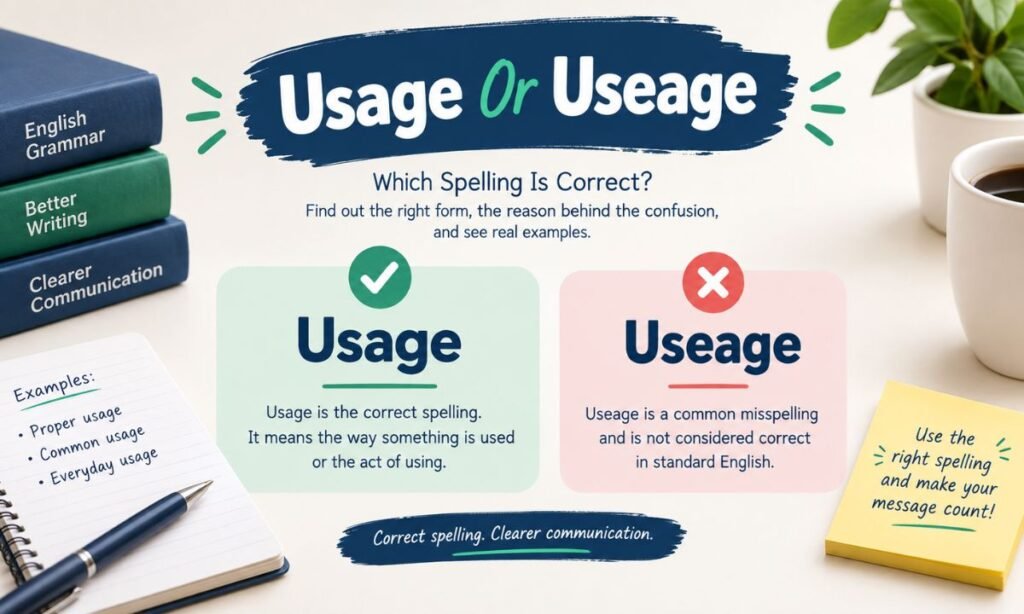

Usage is the correct spelling. Useage is a misspelling, and no major dictionary lists it as a real word. In a report, an email or an essay, write “usage” with one e.
The mix-up is easy to understand. The verb use ends in e, the suffix -age is everywhere, and plenty of people assume the two simply join. English does not always cooperate. This guide covers what usage means, why useage looks tempting, and which spelling rule applies. It also gives you a quick way to choose the right word, plus examples and a short quiz. Dictionary details were checked against current entries in September 2026.
Comparison Overview
Here is the whole answer in one table.
| Feature | Usage | Useage |
|---|---|---|
| Correct spelling? | Yes | No |
| Part of speech | Noun | None (misspelling of usage) |
| Core meaning | The manner, amount or accepted practice of using something | No meaning of its own |
| Listed in standard dictionaries? | Yes | No |
| British English | Usage | Not accepted |
| American English | Usage | Not accepted |
| Safe for formal writing? | Yes | No |
| Example | Data usage rose last month. | Data useage rose last month. (wrong) |
There is no British versus American split here, and useage is not a British variant. Both varieties of English use the same spelling.
Definition of Usage
Usage is a noun. It describes how something is used, how much of it is used, or how people habitually use it. Merriam-Webster covers the usual practice of doing something, the way words and phrases are really used, and the simple action of using.
In everyday writing, the word shows up in four main senses:
- Amount of use: energy usage, data usage, water usage.
- Manner of use: the usage of a tool or a machine.
- Language convention: English usage, a usage guide, a usage note in a dictionary.
- Custom or habit: a word that is in common usage.
Say it as YOO-sij. Merriam-Webster also records a second pronunciation with a z sound, YOO-zij.
The word has a long history. It came into Middle English from Anglo-French, from the noun us, meaning “use,” and its first known appearance dates to the 14th century. Etymonline traces it to around 1300, when it meant an established practice or custom, and to the Latin usus. That origin matters later, when we get to the spelling rule.
Phrases you will meet often:
- data usage limit
- word usage
- usage policy
- in common usage
- proper usage
- electricity usage
Definition of Useage
Useage has no definition because it is not a word. It is a spelling error for usage.
Writers who type it usually mean exactly what usage means: the way or amount something is used. The error tends to turn up in informal places such as forum posts, quick emails, product pages and social media captions. Spell checkers flag it almost every time.
Merriam-Webster, Oxford and Cambridge do not recognize it, and using it in professional or academic writing can quietly hurt your credibility. Search engines may show plenty of pages containing “useage,” but volume does not make a spelling correct. It only shows how common the slip is.
Main Differences Between Usage and Useage
Since one of the two is not a word, the difference is about validity, not meaning. Here is how the gap shows up:
- Status: usage is standard English. Useage is an error.
- Dictionary support: usage has full entries with definitions, history and pronunciation. Useage has none.
- Software response: word processors accept usage and underline useage.
- Reader reaction: correct spelling goes unnoticed. The wrong spelling makes careful readers pause.
- History: usage has been in English for roughly seven centuries. Useage has no recorded standing at all.
Why do people confuse them?
The mistake is logical, which is exactly why it survives. Several things push writers toward the extra e:
- The root verb use ends in a visible e, so the e feels like part of the word.
- Some words with the same suffix do keep the e, such as mileage and acreage.
- The related word usable has a variant, useable, that keeps the e.
- Fast typing and lazy autocorrect let the error pass without notice.
- Once someone sees “useage” on a website, it starts to look familiar.
Its frequent appearance online comes largely from sound-based guessing and from autocorrect blind spots.
Spelling Rule Behind Usage
The standard rule says that when you add a suffix beginning with a vowel to a word ending in a silent e, you usually drop the e. That is why use becomes using and used. The same pattern gives us:
| Base word | Suffix | Result |
|---|---|---|
| use | -age | usage |
| store | -age | storage |
| dose | -age | dosage |
| waste | -age | wastage |
| cleave | -age | cleavage |
English has exceptions. Mile + age gives mileage, and acre + age gives acreage. Those exceptions are the reason “useage” feels believable. But usage is not one of them.
There is a second, historical reason. As noted above, usage did not grow out of the modern verb use. It came from the older noun us, which never had a final e. So the word arrived with no e to keep.
Some writers use a simple memory trick: “Usage has no spare e.” Another is to compare it with message and passage. Neither carries an extra vowel before the -age ending.
Grammar Guide
How each term is used in sentences
Usage is a noun. It usually behaves as an uncountable noun, so you rarely see it with “a” or “an.” In language contexts it can be plural: “Regional usages differ.”
Typical sentence patterns:
- Subject: Usage of the app peaks on Sundays.
- Object: The report measures water usage.
- After a preposition: That phrase is rare in modern usage.
- As a modifier: The usage policy changed in June.
Useage has no grammar of its own. Any sentence containing it needs a one-letter fix.
Writers also blur use and usage. The two nouns overlap, but they are not identical:
| Use | Usage | |
|---|---|---|
| Part of speech | Noun and verb | Noun only |
| Focus | The act or purpose of using | The pattern, manner or amount of use |
| Example | I have no use for this. | Phone usage rose sharply. |
| Frequency in English | Very common | Less common, more specific |
One language tutor points out that usage carries an extra sense of quantity, which is why we say energy usage or electricity usage. The same source suggests going with use when you are unsure, since it is far more frequent.
Common mistakes learners make
- Adding the extra e. Writing “useage” is the big one.
- Using usage as a verb. “I usage this tool” is wrong. Say “I use this tool.”
- Choosing usage where use is plainer. “The usage of force” sounds off because the fixed phrase is “use of force.”
- Assuming British English allows it. It does not.
- Trusting a search hit. A misspelling that appears on many websites is still a misspelling.
- Ignoring the red underline. Some writers click “ignore” on the spelling flag and move on.
Simple rules to remember
- If you mean the noun, write usage. There is only one correct form.
- If you need a verb, write use.
- If you want the act or purpose, lean toward use.
- If you mean amount, pattern or language custom, lean toward usage.
- “Useage” is never the answer.
Quick tips for writing and speaking
For writing
- Add “useage” to your editor’s find-and-replace list and swap it for “usage” before you publish.
- Read the final draft aloud. Your ear will catch odd word choices that your eye skims past.
- Keep a personal list of words you misspell. Add this one.
- Do not rely on autocorrect alone.
For speaking
- Say YOO-sij. Because the two spellings sound identical, speech never reveals the mistake.
- In presentations, put the correct spelling on slides. Reviewers notice typos on screen quickly.
- If you are unsure whether use or usage fits, say use. It is almost always safe in speech.
When to Use Each One
Use “usage” when you are:
- describing how much of something is consumed, as in electricity usage or data usage
- talking about how words and phrases are normally used, as in grammar and usage guides
- naming a policy, limit or report, as in a usage policy or usage statistics
- describing a custom that has become normal, as in “common usage”
- discussing how a tool, product or service is used over time
Use “useage” when you are:
- quoting a sentence that already contains the error and you need to reproduce it exactly
- writing an article about this very spelling mistake, like this one, and you place the word in quotation marks
Outside those two cases, there is no situation that calls for it.
When NOT to Use Each One
Do not use “usage”:
- as a verb
- when the simple noun use says the same thing more cleanly (“What is the use of this button?” is more natural than “What is the usage of this button?”)
- inside fixed phrases that require use, such as “use of force,” “in use” and “make use of”
- to sound formal when a shorter word would do
Do not use “useage”:
- in emails, essays, resumes, cover letters or reports
- in captions, product descriptions or website copy
- in exam answers, where the mark may drop
- in any published text, since it damages trust in the writer
Which One to Use (Decision Guide)
Run through these steps in order.
- Do you need a verb? Write use. Stop here.
- Do you mean the simple act or purpose of using something? Write use as a noun (“the use of a hammer”), or keep usage if it fits the pattern or amount.
- Do you mean amount, manner, pattern, or accepted language practice? Write usage.
- Are you tempted to type an extra e before -age? Remove it. The answer is usage.
Quick version:
| Situation | Best choice |
|---|---|
| Need a verb | use |
| Measuring how much | usage |
| Discussing grammar or word choice | usage |
| Talking about purpose | use |
| Anything spelled u-s-e-a-g-e | Change it to usage |
Real-World Practical Examples
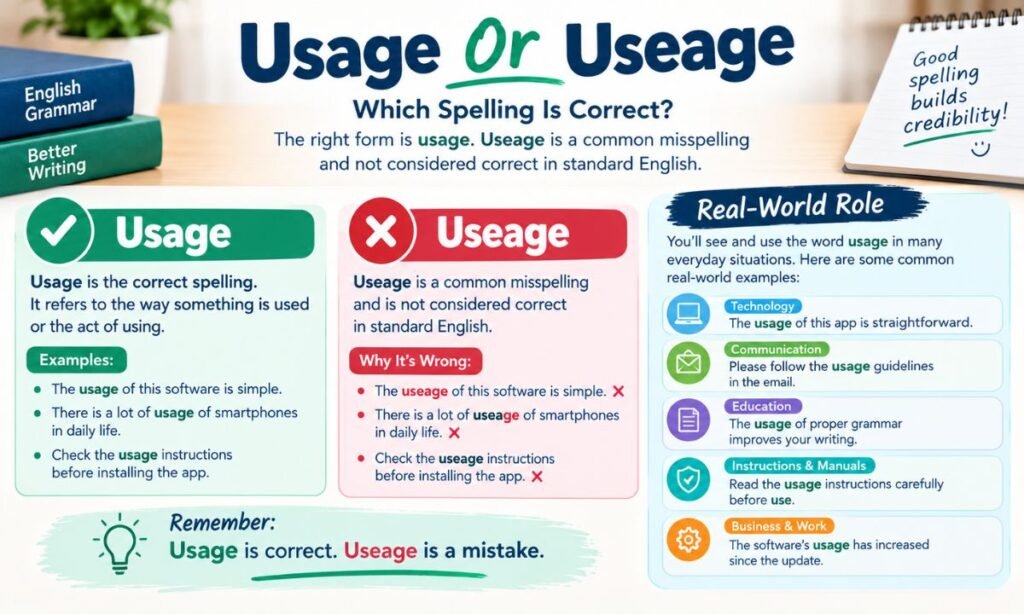
Usage Examples
These sentences show the word in different settings.
- Our mobile data usage doubled during the summer trip.
- The style guide explains correct usage of the semicolon.
- That expression has fallen out of common usage.
- Please read the acceptable usage policy before you log in.
- Water usage in the region dropped after the new rules took effect.
- Heavy app usage drains the battery faster.
- The dictionary includes a usage note about the word “literally.”
- Energy usage is highest between six and nine in the evening.
- Regional usages of the word differ from town to town.
- Teachers often mark down students for careless word usage in essays.
Useage Examples
Every “wrong” sentence below contains the misspelling. Each one is followed by its fix.
| Incorrect | Correct |
|---|---|
| Your data useage is over the limit. | Your data usage is over the limit. |
| The report tracks electricity useage. | The report tracks electricity usage. |
| Please review the useage policy. | Please review the usage policy. |
| Her word useage is impressive. | Her word usage is impressive. |
| Water useage rose in July. | Water usage rose in July. |
| That term is not in common useage. | That term is not in common usage. |
In every row the only change is deleting one letter.
Self-Assessment (Fill in the Blanks)
Choose the correct word for each blank: use, usage or useage. Answers are below.
- The company monitors employee internet ______.
- Grammar books explain correct English ______.
- That slang word is no longer in common ______.
- Please read our acceptable ______ policy.
- Water ______ doubled during the heatwave.
- I ______ my phone every morning as an alarm.
- Choose the misspelling: usage / useage.
- Heavy phone ______ at night can disturb sleep.
- Fix this phrase: “monthly electricity useage report” becomes “monthly electricity ______ report.”
- The ______ of force must follow strict rules.
Answers
- usage: it measures how much the internet is used.
- usage: it refers to language conventions.
- usage: “common usage” is a standard phrase.
- usage: “usage policy” is the accepted term.
- usage: it describes an amount used.
- use: you need a verb here.
- useage: it is the misspelling.
- usage: it points to a pattern of use.
- usage: delete the extra e.
- use: the fixed phrase is “use of force.”
If you scored 9 or 10, you have this locked in. If you missed items 6 or 10, revisit the use versus usage table above.
Frequently Asked Questions
Is “usage” or “useage” the correct spelling in the UK?
Usage. British English uses the same spelling as American English, and useage is not accepted in either.
What does “usage” mean?
It means the way, manner or amount in which something is used, and also the accepted way words are used in a language.
What are examples of usage?
Data usage, energy usage, water usage, word usage and “common usage” are all standard examples.
What is usage in a sentence?
“Our monthly data usage went up after we started streaming more video.”
Conclusion
The rule fits in one line: write usage, never useage. The extra e feels logical because use ends in e and a few -age words keep theirs, but this word descends from the older noun us and never had one. Dictionaries agree, and so do spell checkers. If you are ever unsure, run the decision guide: verb means use, and amount, pattern or language custom means usage. Add “useage” to your personal watch list, and one small habit will keep your writing clean.