
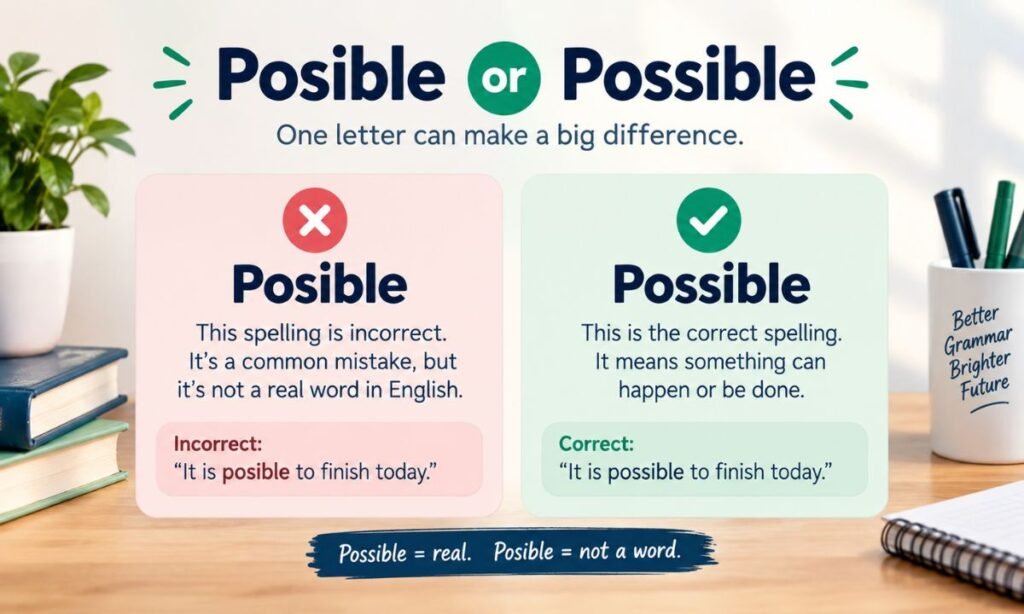

Possible is the correct spelling in English. Posible is not an English word. It is the Spanish spelling (and a common Filipino/Tagalog one) of the same idea, and it shows up in English writing only as a typo or a borrowed word. If you are writing in English, always use possible with a double “s.”
That answers the question, but the confusion is worth a closer look. The two words look nearly identical, mean the same thing, and come from the same Latin root. Mixing them up is one of the most common spelling slips among Spanish speakers learning English, and among English speakers who type quickly. This guide explains where each word belongs, why the mistake happens, and how to stop making it.
Comparison Overview
Here is the short version before we get into detail.
- Possible is an English adjective meaning able to happen, exist, or be done.
- Posible is the Spanish (and Tagalog) word for the same idea. It is not valid in standard English.
- Both trace back to the Latin possibilis, which comes from posse, “to be able.”
- The only visible difference is the spelling: English doubles the “s,” Spanish does not.
Think of them as cousins that grew up in different countries. They share a family name, but only one of them belongs in an English sentence.
Definition of Posible
Posible is an adjective in Spanish. It describes something that can happen or can be done. Spanish speakers use it constantly, in phrases like es posible (“it is possible”), hacer todo lo posible (“to do everything possible”), and si es posible (“if possible”). Its noun form is posibilidad, and the adverb is posiblemente.
Spanish spelling rules rarely double the letter “s” inside a word, which is why posible has just one. The word is pronounced roughly “po-SEE-bleh,” with a clear vowel at the end.
The word also lives in Filipino. Tagalog speakers say posible in sentences like “Posible bang umulan bukas?” (“Could it rain tomorrow?”). It arrived through Spanish colonial influence and stayed in everyday speech.
Key Point
Posible is a real word, but in Spanish and Tagalog, not English. In an English essay, email, or exam, it counts as a spelling error. The only time you should write it is when you are quoting Spanish or Filipino text, or discussing the word itself, and then it is best set in italics.
Definition of Possible
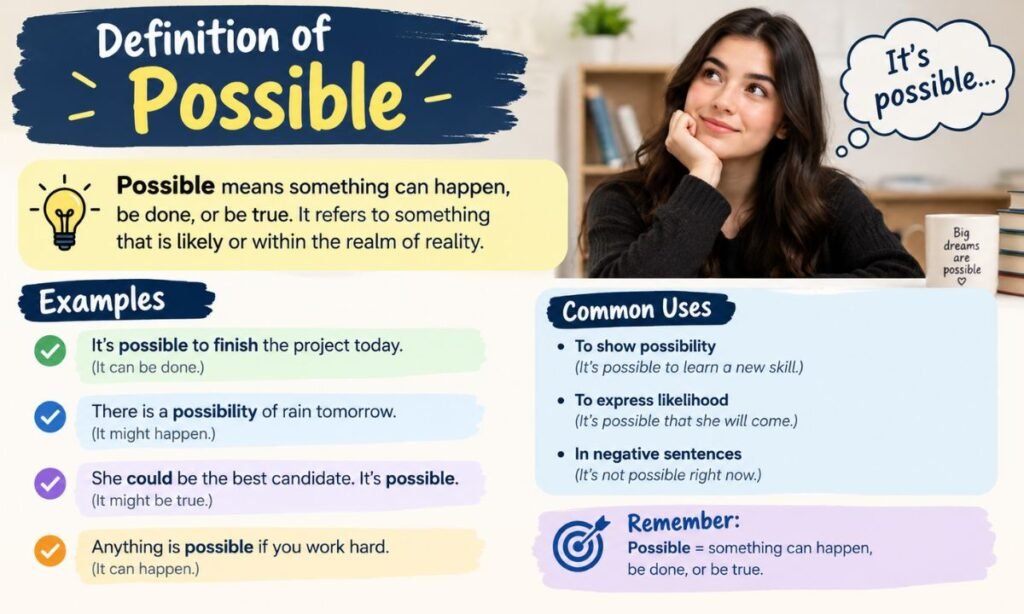
Possible is an English adjective. Dictionaries such as Merriam-Webster and Oxford define it as something capable of existing, happening, or being done. It can also mean something that might be true or might be chosen, as in “a possible explanation” or “a possible candidate.”
The word has a few related forms worth knowing:
- Possibly (adverb): “She might possibly arrive early.”
- Possibility (noun): “There is a possibility of rain.”
- Impossible (adjective, the opposite): “That deadline is impossible.”
- Possibilities (plural noun): “The job opens up new possibilities.”
Possible is pronounced “POS-uh-bul,” with stress on the first syllable. It has three syllables and two “s” letters in the middle.
Linguists trace it to the Latin possibilis, built on posse, meaning “to be able.” The English form came through Old French and settled into its current spelling several centuries ago.
Key Point
Possible is the only accepted spelling in standard English, in both American and British usage. There is no regional variant that drops an “s.” If you see posible in an English text, it is an error unless the writer is deliberately using Spanish.
Main Differences Between Posible and Possible
The gap between these two words is small on the page but clear in practice.
Meaning Difference
There is essentially none. Both words describe something that can happen or be done. Translate “it is possible” into Spanish and you get es posible. Translate it back and you are home again.
That is what makes this pair tricky. When two words mean different things, you learn them as separate items. When they mean the same thing, your brain files them as one word with two spellings, and the wrong one slips out.
Usage Difference
The real difference is language and context.
- Possible belongs in English sentences, in every register: casual texts, school essays, business reports, legal documents.
- Posible belongs in Spanish and Tagalog sentences, and nowhere else.
Spell-checkers reinforce this. Type posible into an English document and most tools will underline it in red and suggest possible. Search engines behave the same way, often showing results for the corrected spelling.
Why People Confuse Posible and Possible
Several things push people toward the wrong spelling.
Spanish influence. Millions of English learners speak Spanish as a first language. Since the words are cognates (words that share an origin and look alike), learners naturally carry the Spanish spelling into English. Teachers call these “false friends” when the meanings differ, but here the meanings match, so the error is easy to miss.
Sound. In everyday speech, the double “s” makes no audible difference. Say “possible” out loud and you cannot hear whether one or two letters sit in the middle. Spelling has to be memorized, because the ear does not help.
Fast typing. Even fluent English writers drop a doubled letter when they type quickly. Words with double consonants, such as necessary, accommodate, and occurrence, cause the same trouble.
Pattern confusion. English has plenty of words with a single “s” between vowels (visible, responsible, sensible). Because possible ends in the same “-ible” pattern, some writers assume it should follow suit.
Mixed-language habits. In multilingual communities, people switch between languages mid-message. A stray posible in an English chat is a natural result.
None of this reflects poor intelligence. It reflects how memory works with look-alike words. The fix is a few simple rules, which come later in this guide.
Comparison Table
| Feature | Possible | Posible |
|---|---|---|
| Language | English | Spanish, Tagalog/Filipino |
| Correct in English? | Yes | No, a misspelling |
| Part of speech | Adjective | Adjective |
| Spelling | Double “s” (pos-si-ble) | Single “s” (po-si-ble) |
| Meaning | Able to happen or be done | Able to happen or be done |
| Opposite | Impossible | Imposible |
| Noun form | Possibility | Posibilidad |
| Adverb form | Possibly | Posiblemente |
| Pronunciation | POS-uh-bul | po-SEE-bleh |
| Example | “It is possible to finish today.” | “Es posible terminar hoy.” |
Grammar Guide
How Each Term Is Used in Sentences
Posible
Use posible only inside Spanish or Tagalog sentences. In Spanish, it usually follows the verb ser (“to be”) or appears in fixed phrases.
- Es posible que llueva esta tarde. (It is possible that it will rain this afternoon.)
- Haré todo lo posible por ayudarte. (I will do everything possible to help you.)
- No es posible entrar sin permiso. (It is not possible to enter without permission.)
Note that es posible que is followed by the subjunctive mood in Spanish, a grammar feature English lacks.
Possible
In English, possible works in two main positions.
Before a noun:
- “This is the only possible solution.”
- “We are exploring every possible option.”
After a linking verb (be, seem, remain):
- “Is it possible to reschedule?”
- “The trip seems possible if we leave early.”
It also appears in useful fixed phrases:
- “as soon as possible” (often shortened to ASAP)
- “if possible”
- “wherever possible”
- “the best possible result”
- “whenever humanly possible”
Notice that possible often follows a superlative: “the fastest route possible,” “the best outcome possible.” Both word orders are correct here.
Common Mistakes Learners Make
- Writing posible in English. The classic error. Fix: add the second “s.”
- Writing possable. This swaps “-ible” for “-able.” The correct ending is “-ible.”
- Writing possibile or possibel. Letters get scrambled at the end of the word.
- Misspelling the opposite. Writers who forget the double “s” often write imposible too. The correct form is impossible: im-pos-si-ble, with the double “s” kept.
- Using possible for people. Saying “He is possible” is wrong. Use capable or able for people, and keep possible for events, actions, and things.
- Confusing possible with probable. Something possible can happen. Something probable is likely to happen. A meteor strike is possible but not probable.
Simple Rules to Remember
- Rule 1: In English, possible always has two “s” letters in the middle.
- Rule 2: Possible and possess both have a double “s.” If you can spell possess, you can spell possible.
- Rule 3: The ending is “-ible,” never “-able.”
- Rule 4: If your sentence is in English, there is no reason to write posible.
- Rule 5: Impossible follows the same pattern with “im-” added to the front.
A memory hook that works for many learners: picture the word as pos-SI-ble, with “s” and “s” standing side by side like two people holding hands. The pair is the part your brain skips, so give it a picture.
Quick Tips for Writing and Speaking
Writing
- Turn on spell-check, but do not trust it blindly. It will flag posible, but it may miss possible used where you meant probable.
- Read your draft backward, word by word. This breaks your brain’s habit of auto-correcting what it expects to see.
- Keep a short personal list of words you misspell and review it now and then.
Speaking
- Stress the first syllable: POS-uh-bul.
- The middle vowel is soft, close to “uh.” Do not say a full “ee” as in Spanish.
- In a fast conversation, “possible” often sounds like “POSS-bull.” That is normal.
When to Use Each One
Use Possible When
Use possible whenever you write in English. That covers:
- Emails, reports, essays, and school assignments
- Websites, product pages, and social media posts
- Legal, medical, and academic writing
- Text messages and chats in English
- Job applications and CVs
Examples: “Please reply as soon as possible.” “Is a refund possible?” “It’s possible that the meeting moved.”
Use Posible When
Use posible only when you are writing Spanish or Tagalog, or when you are quoting those languages inside an English text.
- A Spanish-language email, article, or subtitle
- A Filipino conversation or social media post
- A language lesson comparing the two words (write it in italics or quotation marks)
- A direct quotation from a Spanish speaker
If you are unsure which language your sentence is in, that alone is your answer. English sentences take possible.
When NOT to Use Each One
Do Not Use Posible
Avoid posible in any of these English settings:
- Exams such as IELTS, TOEFL, and Cambridge tests, where a spelling error costs marks
- Resumes and cover letters, where small errors can weigh against you
- Business emails and client messages
- Blog posts, articles, and SEO content, since misspellings hurt trust and search visibility
- Academic papers
One stray posible rarely ruins a message, but repeated errors change how readers see the writer.
Do Not Avoid Possible
Some learners become so nervous about the spelling that they dodge the word and swap in awkward alternatives. That is unnecessary. Possible is a common, useful word, and you should use it freely.
If you find yourself writing “can be done” or “can happen” over and over to escape the spelling, stop. Learn the double “s” once and the word stops being a problem. Clear writing depends on using plain words confidently.
Which One to Use (Decision Guide)
Ask yourself three quick questions.
- What language am I writing in?
- English → possible
- Spanish or Tagalog → posible
- Am I quoting or teaching?
- Quoting a Spanish or Filipino speaker → posible (in italics)
- Anything else in English → possible
- Still unsure?
- Use possible. In English, it is the only safe choice.
Quick reference:
| Situation | Correct choice |
|---|---|
| English email or essay | possible |
| Spanish text message | posible |
| English exam answer | possible |
| Tagalog conversation | posible |
| Explaining the difference in an English article | both, with posible in italics |
Real-World Practical Examples
Posible Examples
These sentences are in Spanish or Tagalog, so posible is correct.
- ¿Es posible cambiar mi reserva? (Is it possible to change my reservation?)
- Si es posible, llámame mañana. (If possible, call me tomorrow.)
- Es posible que el vuelo se retrase. (The flight might be delayed.)
- Posible bang makarating ka nang maaga? (Is it possible for you to arrive early?)
- No creo que sea posible terminar hoy. (I don’t think it’s possible to finish today.)
Possible Examples
These sentences are in English, so possible is correct.
- “Is it possible to change my booking?”
- “Please send the file as soon as possible.”
- “There are several possible explanations for the delay.”
- “She wanted the best possible grade on the final.”
- “It’s possible the store is already closed.”
- “The new software makes faster delivery possible.”
- “If possible, avoid travelling during peak hours.”
- “Nothing is impossible if you plan carefully.”
Self-Assessment (Fill in the Blanks)
Part A. Choose possible or posible for each sentence.
- Is it ______ to finish this report by Friday? (English)
- Es ______ que llegue tarde. (Spanish)
- Please reply as soon as ______. (English)
- The doctor listed several ______ causes. (English)
- Haré todo lo ______ por ti. (Spanish)
- We need to find the best ______ solution. (English)
Part B. Fix the spelling.
- Correct the word: “It is imposible to please everyone.”
- Correct the word: “That seems posible to me.”
- Correct the word: “Is a refund possable?”
- Fill in the missing letters: “P _ _ sible” (the correct English word)
Answers
- possible (English sentence)
- posible (Spanish sentence)
- possible
- possible
- posible (Spanish sentence)
- possible
- impossible (double “s” in both places)
- possible
- possible (the ending is “-ible,” not “-able”)
- P-o-s-s-ible, spelling possible
Scoring: 9 to 10 correct means you have it down. 6 to 8 means review the rules above once more. Below 6, reread the “Simple Rules to Remember” section and try again tomorrow.
FAQs
What is this word possible? Possible is an English adjective meaning able to happen, exist, or be done. For example: “A quick fix is possible.”
What is the meaning of possibility? A possibility is a chance that something might happen or be true. “There is a possibility of snow tonight.”
How do you spell possible correctly? Spell it P-O-S-S-I-B-L-E, with two “s” letters in the middle and an “-ible” ending. The Spanish form posible is not correct in English.
What is another word for possible? Common synonyms include feasible, achievable, viable, doable, workable, and conceivable. Pick the one that fits your sentence, since each has a slightly different tone.
Conclusion
The answer is short: in English, write possible. Posible is a legitimate word in Spanish and Tagalog, but it is a spelling mistake in English. The two share a Latin ancestor and a meaning, which is exactly why they get mixed up.
Remember the double “s,” link it to possess, and end the word with “-ible.” Do that consistently and the error disappears. Whenever your sentence is in English, the decision is already made for you.