
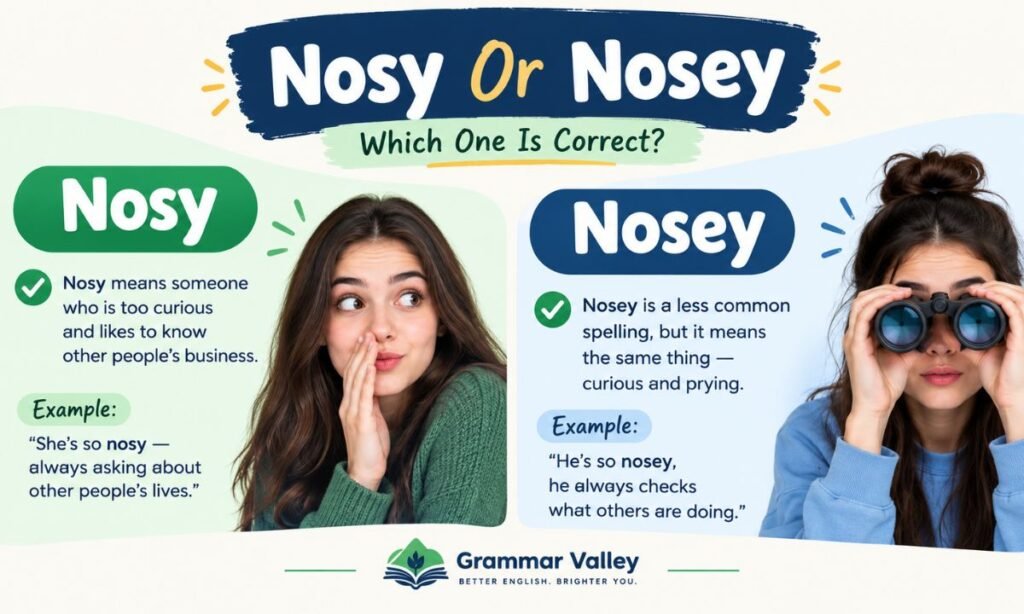

Somebody asks you to proofread an email, and there it is: “Don’t be so nosey.” Your cursor hovers over the “e.” Is it wrong? Should you fix it? Most people freeze at exactly this moment, because both spellings look plausible, and honestly, both are.
Here’s the short version before we go deep: nosy and nosey mean the same thing — someone who pries into other people’s business — and the choice between them mostly comes down to spelling convention, not grammar rules. But “mostly comes down to convention” isn’t a satisfying answer if you’re writing a resume, a novel, or a school assignment, so let’s actually unpack where each spelling belongs.
Comparison Overview
| Feature | Nosy | Nosey |
|---|---|---|
| Standard region | American English | British English (older/variant form) |
| Dictionary status | Primary spelling | Accepted variant |
| Common in formal writing | Yes | Rarely |
| Common in casual speech/text | Yes | Yes |
| Root word | Nose | Nose |
| Meaning | Overly curious, prying | Overly curious, prying |
Both words describe a person who wants to know things that aren’t their business. Neither one is “incorrect” in an absolute sense, but one shows up far more often in edited, professional text.
Definition of Nosy
Nosy is an adjective used to describe a person, question, or comment that shows excessive interest in someone else’s private affairs. A nosy coworker asks about your salary. A nosy neighbor watches who comes and goes from your house. The word carries a mildly negative tone — it’s rarely a compliment.
Grammatically, nosy follows the same pattern as many other adjectives built from short nouns plus “-y”: think of words like messy or bossy. That pattern is part of why nosy, without the extra “e,” has become the dominant spelling in modern usage. Dictionaries such as Merriam-Webster list nosy as the main entry, with nosey noted as a secondary form.
Definition of Nosey
Nosey carries the exact same meaning as nosy: a person who is intrusive, prying, or overly interested in things that don’t concern them. The only difference is the extra letter. You’ll find nosey used more often in British, Irish, Australian, and New Zealand writing, and it still turns up in casual American text messages and social posts.
Some dictionaries flag nosey as informal or list it purely as “variant of nosy.” That doesn’t make it wrong — it just means style guides and formal publications tend to favor the shorter form.
Main Differences Between Nosy and Nosey
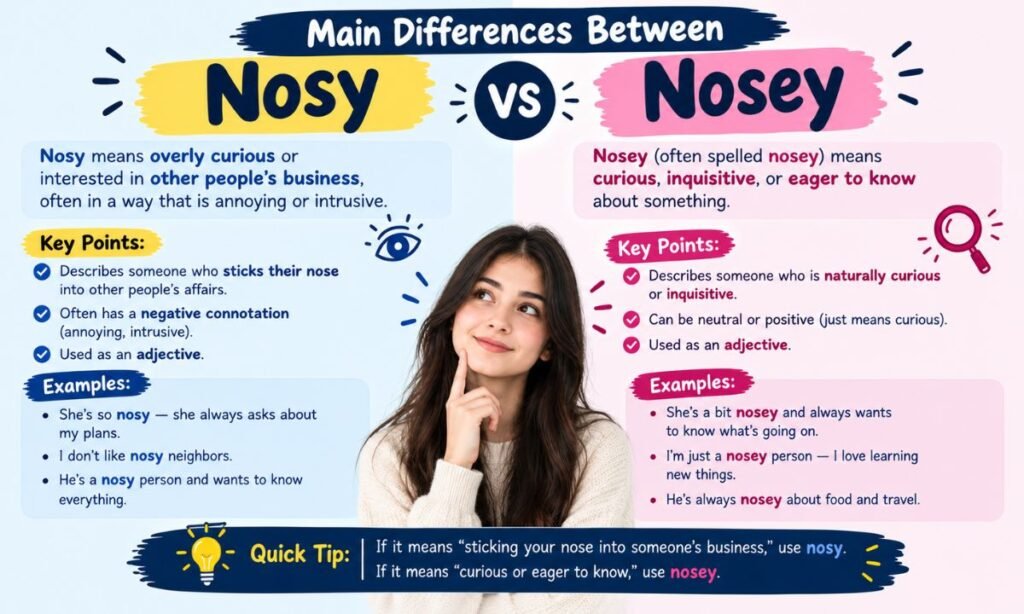
The two words aren’t really rivals with different jobs. They’re the same word wearing two outfits. Still, a few practical differences are worth knowing before you commit to one in your own writing.
Spelling Preference
Nosy drops the “e” before adding the “-y” suffix, matching a common English spelling pattern where a silent “e” disappears when a vowel suffix is attached (compare have → having). Nosey keeps the “e,” which more directly preserves the visual link to the root word “nose.” Neither rule is being broken here — English just tolerates both outcomes for this particular word.
Frequency of Use
Search data and corpus studies consistently show nosy appearing far more often than nosey across English-language books, news, and web content. It isn’t close. Nosy is the default choice you’ll see in dictionaries, style guides, and edited publications worldwide.
Formality
Nosy leans slightly more formal simply because it’s the standard dictionary headword. Nosey reads as informal or regional, which is fine for a text message or a blog post with a conversational tone but less at home in a cover letter or academic paper.
Meaning
There is no meaning difference at all. A nosy person and a nosey person are doing the identical thing: sticking their nose where it doesn’t belong. If someone tells you nosey means something slightly different from nosy — more playful, less rude, whatever — that’s folk etymology, not established usage.
Origin and History of the Words
The word traces back to the noun “nose” combined with the adjective-forming suffix “-y,” the same suffix you see in sandy, rainy, and itchy. The imagery is straightforward: a person who is nosy metaphorically pushes their nose into situations where it isn’t wanted, much like an animal sniffing around for something interesting.
Early written records of the adjective appear in the 1800s, with “nosey” showing up as one of the first recorded spellings. Over the following century, American English gradually simplified a number of “-ey” adjectives down to “-y,” and nosy benefited from that broader trend. British English held onto the older, fuller spelling more consistently, which is part of why the regional split exists today.
By the twentieth century, nosy had overtaken nosey as the more frequently printed form almost everywhere, including in Britain, though nosey never disappeared. It remained common enough in everyday British writing that dictionaries kept listing it rather than marking it obsolete.
Comparison Table: Which Spelling Should You Choose?
| Writing Context | Recommended Spelling | Why |
|---|---|---|
| Academic essays | Nosy | Matches dictionary standard and formal style guides |
| Business emails | Nosy | More professional, widely recognized |
| Fiction/dialogue (American character) | Nosy | Matches natural American speech |
| Fiction/dialogue (British character) | Nosey | Feels authentic to regional voice |
| Casual texting or social media | Either | Both are understood; personal preference rules |
| SEO content targeting a US audience | Nosy | Aligns with search habits and dictionary norms |
| Content targeting a UK audience | Nosey (or nosy) | Nosey feels familiar; nosy is still accepted |
If you only remember one rule from this table, make it this one: when in doubt, use nosy. It works everywhere, and no reader will question it.
Grammar Guide
How each term is used in sentences
Both words function purely as adjectives, so they modify nouns or follow linking verbs like “is,” “seems,” or “looks.”
- As a modifier before a noun: “The nosy neighbor peeked through the blinds again.”
- After a linking verb: “He’s always been a bit nosey about other people’s finances.”
- In comparative form: “She’s nosier than her sister.” (Note: the “e” drops when adding “-er,” even from the “nosey” base — most style guides simply funnel this back to the nosy spelling pattern.)
- In superlative form: “He’s the nosiest person in the office.”
Notice that the comparative and superlative forms — nosier and nosiest — almost always follow the “nosy” spelling pattern. You rarely see “nosier” spelled as “noseyer,” because that reads awkwardly and doesn’t follow standard English suffix rules.
Common mistakes learners make
- Confusing it with “noisy.” These two words are spelled similarly and sound nothing alike once you slow down, but learners frequently mix them up in writing. Noisy describes sound (a noisy street); nosy or nosey describes curiosity (a nosy question).
- Inconsistent spelling within one document. Switching between nosy and nosey in the same article or story looks careless, even though both are technically correct.
- Treating nosey as slang or “wrong.” It isn’t slang. It’s a legitimate, dictionary-recognized variant, just less common.
- Misspelling the comparative form, writing “nosyer” or “noseier” instead of the correct “nosier.”
Simple rules to remember
- Nosy = shorter, more common, safer default.
- Nosey = longer, regional, still correct.
- Comparative and superlative forms use the “nosy” base: nosier, nosiest.
- Pick one spelling per document and stay with it.
Quick tips for writing and speaking
Speaking doesn’t require a decision at all — both words are pronounced identically, so nobody will ever hear the difference. Writing is where the choice matters. A fast way to decide: picture your reader. Writing for a US business audience, a school assignment, or a global readership? Go with nosy. Writing dialogue for a British character, or matching the house style of a UK-based publication? Nosey fits naturally.
When to Use Each One
Use nosy when:
- You’re writing for an American audience or publication.
- You need the version most style guides and dictionaries recognize as standard.
- You’re writing formal or semi-formal content — reports, resumes, professional emails.
- You want the safest, most universally understood option.
Use nosey when:
- You’re writing British, Irish, Australian, or New Zealand English and want the regionally familiar spelling.
- You’re writing dialogue and want a character’s voice to sound authentically British.
- Your publication’s or client’s style guide specifically calls for it.
- You’re texting a friend and it genuinely doesn’t matter.
When NOT to Use Each One
Avoid nosy when:
- Your entire project already uses nosey consistently — switching mid-document breaks visual consistency.
- A specific British publication’s style sheet requires nosey.
Avoid nosey when:
- You’re submitting to an American academic journal, business client, or publication that expects US spelling conventions.
- You’re optimizing content for search engines that show nosy as the dominant, more-searched term.
- Consistency with the rest of your document calls for nosy instead.
Which One to Use (Decision Guide)
Ask yourself these questions in order:
- Does my style guide or employer specify a spelling? If yes, use that one and stop here.
- Is my audience primarily American, or is this for global/SEO content? Choose nosy.
- Is my audience primarily British, Irish, Australian, or Kiwi, or am I writing a British character’s dialogue? Nosey is a fine, natural choice.
- Is this casual, personal writing with no specific audience? Either spelling works — pick the one you find easier to type and stick with it.
- Am I unsure? Default to nosy. It’s the safer, more widely recognized choice in nearly every context.
Real-World Practical Examples
Nosy Examples
- My grandmother is nosy about everyone’s love life, including people she’s met once.
- The interviewer’s nosy question about my previous salary caught me off guard.
- Stop being so nosy — it’s none of your business who I’m texting.
- Our new neighbor seems nosy; she’s already asked three questions about our work schedules.
- The nosy tabloid reporter camped outside the singer’s house for a week.
- He gave me a nosy look when I mentioned the meeting.
- Nosy customers sometimes ask staff about other customers’ orders.
- The kids next door are nosy little things, always watching through the fence.
Nosey Examples
- She’s a bit nosey, always wanting to know what’s in everyone else’s shopping trolley.
- “Don’t be so nosey,” Mum said, pulling the curtain shut.
- The nosey postman knows more gossip than anyone on the street.
- My nosey aunt asked when we’re having children, again.
- He’s nosey about other people’s paychecks but never shares his own.
- The nosey villagers gathered outside to see what the commotion was about.
- Being nosey isn’t always a bad trait — sometimes it’s just curiosity.
- Her nosey questions made the whole dinner uncomfortable.
Self-Assessment (Fill in the Blanks)
Test yourself. Choose nosy or nosey (or note where either works) for each sentence.
- My coworker is far too ______ about my personal life.
- In an academic paper, the standard spelling is ______.
- “Quit being so ______,” she snapped, closing the door.
- British readers often expect ______ in casual writing.
- The comparative form is spelled ______er, not “noseyer.”
- For a business email, choose ______.
- He’s the ______iest person in the whole department.
- Both spellings are pronounced ______ the same way.
- A US-based blog optimizing for search should use ______.
- My neighbor’s ______ questions are getting exhausting.
Answers
- Nosy or nosey (either is acceptable; nosy is more common)
- Nosy
- Nosy or nosey
- Nosey
- Nosier
- Nosy
- Nosiest
- Exactly (both pronounced identically)
- Nosy
- Nosy or nosey
Frequently Asked Questions
How do you spell “I’m nosy”?
Spell it “nosy” for standard American English, or “nosey” if you’re following British spelling conventions. Both are correct.
What does nosey mean?
Nosey describes someone who is overly curious about other people’s private business, asking intrusive questions or prying where they shouldn’t.
How do you spell nosey people?
“Nosey people” is correct in British-style writing; “nosy people” is the more common spelling overall, especially in American English.
Do Americans use the word “nosy”?
Yes, nosy is the standard, dictionary-preferred spelling in American English and appears far more often than nosey in US writing.
Conclusion
Nosy and nosey are the same word split across two spellings, not two different words with two different meanings. Nosy wins on frequency and formality, especially in American and international contexts, while nosey remains a legitimate, commonly used choice in British-style English. The real skill isn’t memorizing a rigid rule — it’s knowing your audience, checking your style guide, and staying consistent once you’ve picked a side. Do that, and you’ll never second-guess that “e” again.