
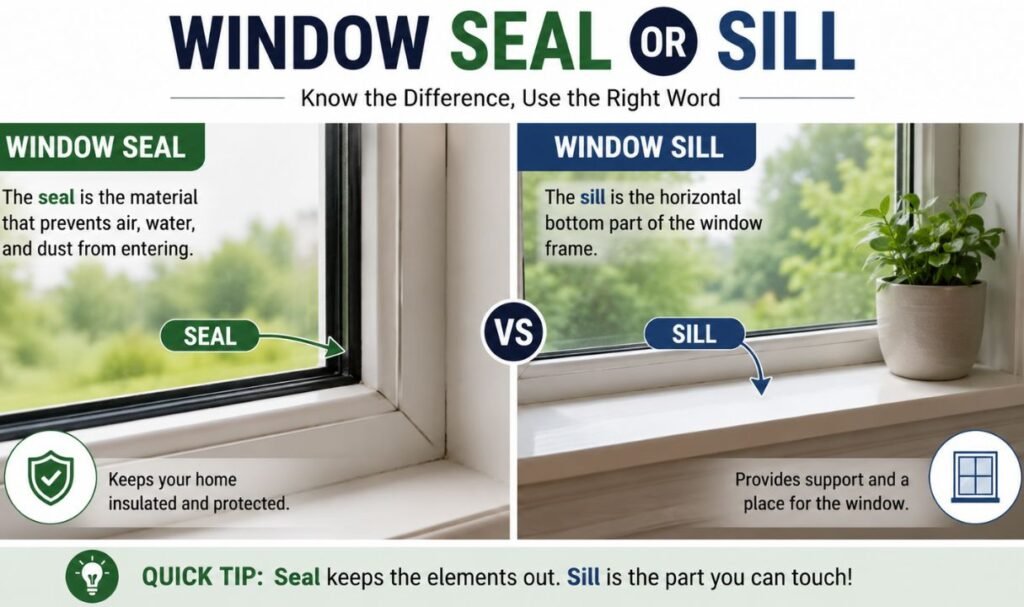

If you have ever typed “window seal or sill” into Google, you already know how murky this gets. One sounds like the other. Both sit near the bottom of a window. And most people use the two words as if they mean the same thing, right up until a contractor asks which one is actually broken.
They are not the same part. A window seal keeps air and water from sneaking through gaps around the glass and frame. A window sill is the physical ledge the window sits on, inside and outside your home. Mixing them up is more than a grammar slip. It can send you shopping for the wrong repair, paying for work you don’t need, or ignoring a problem that keeps getting worse.
This guide breaks down what each term actually means, how to tell which one is failing, and what to do about it, whether you’re patching drafts before winter or replacing a rotted ledge.
Why “Window Seal” and “Window Sill” Are Commonly Confused
Three things drive the mix-up, and none of them have much to do with how the parts actually work.
Sound. Say “seal” and “sill” quickly in a sentence and they blur together, especially with an accent or over the phone with a contractor.
Location. Both sit at the lower half of a window assembly, so pointing and saying “right there” doesn’t clear anything up.
Habit. A lot of people grew up hearing both words used loosely for “that flat part at the bottom of the window,” so the distinction never stuck.
Here’s the short version to keep in your back pocket:
- A window seal stops air, water, and heat from moving where they shouldn’t.
- A window sill supports the window and sheds rainwater away from your wall.
One is about keeping the elements out. The other is about structure and drainage. Once that separation clicks, the rest of this guide will make a lot more sense.
Understanding the Core Difference Between Window Seal and Window Sill
Think of a window as a system with two very different jobs happening at once.
The seal works quietly, often out of sight, closing every small gap so air and moisture can’t pass through. It’s rubber, silicone, foam, or a gas-filled barrier between glass panes.
The sill, on the other hand, is something you can see and touch. It’s the ledge under the window, made of wood, stone, PVC, or metal, angled just enough to let rain run off instead of pooling.
| Window Seal | Window Sill | |
|---|---|---|
| Job | Blocks air, water, and heat | Supports frame, drains water |
| Visible? | Mostly hidden | Fully visible |
| Made of | Rubber, silicone, foam, gas | Wood, stone, PVC, aluminum |
| Fails as | Drafts, fog, whistling | Rot, cracks, pooling |
That table alone answers most of what people are actually searching for.
What Is a Window Seal?
A window seal is the material that closes the gaps between a window’s moving and fixed parts. Without it, wind, rain, and outside temperatures would flow straight through your window frame like an open slot.
You’ll typically find seals:
- Around the edge of the glass pane
- Between the sash (the part that opens) and the frame
- Sandwiched inside double-pane or triple-pane glass
Most homeowners never see their window seals directly. They’re tucked into the frame or hidden between panes of glass. That doesn’t make them any less important; it just makes them easy to forget until something goes wrong.
What a Window Seal Does
A seal that’s doing its job properly will:
- Keep outside air from leaking in
- Stop rainwater and condensation from getting inside the frame
- Hold indoor temperatures steady
- Cut down on outside noise
- Protect the wood or vinyl frame from moisture damage
Skip the seal, or let it degrade, and the window stops doing the one thing it’s actually there for.
Key Characteristics of a Window Seal
Good seals share a few traits regardless of material:
- They flex rather than crack under pressure
- They compress tightly against adjoining surfaces
- They hold up against repeated temperature swings
- They resist moisture without breaking down for years
These aren’t decorative trim pieces. They’re functional parts built to survive constant expansion and contraction as your window heats up and cools down each day.
The Role of a Window Seal in Home Performance
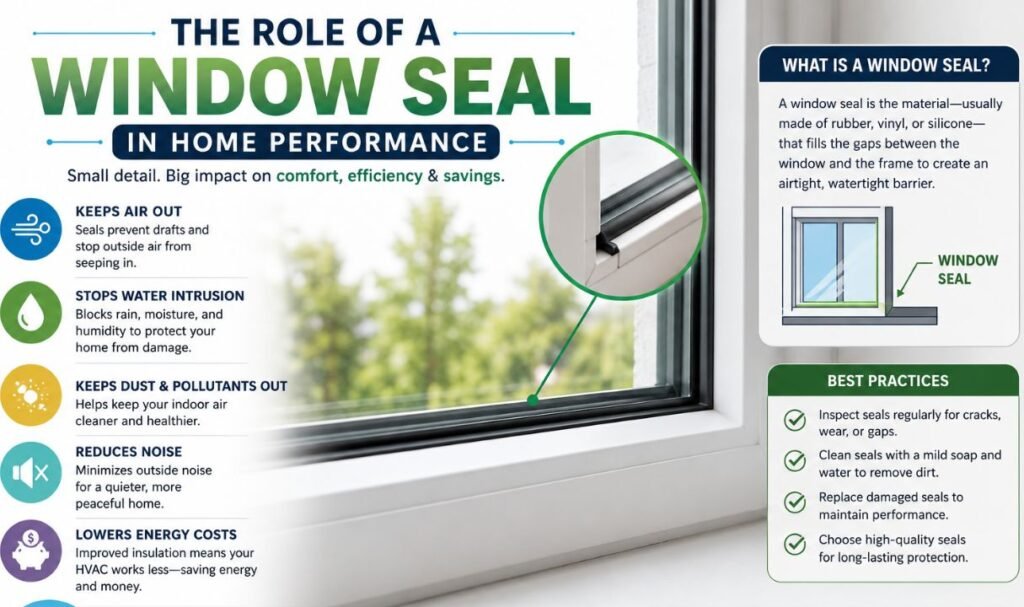
A seal that’s failing quietly costs you more than you’d think, and the effects show up in three separate ways.
Energy Efficiency
Once a seal fails, conditioned air starts finding its way out, even through gaps you can’t see. Homeowners often notice their heating and cooling bills creeping up before they notice the actual draft. A compromised seal can be responsible for a meaningful chunk of wasted energy in a home, particularly around older single-pane or poorly maintained double-pane windows.
Moisture Control
Where air leaks in, moisture usually follows. Left unaddressed, that moisture leads to:
- Condensation building up on glass or frames
- Mold growth in the wall cavity
- Wood rot around the window opening
- Stained or damaged drywall inside
Comfort and Noise Reduction
A tight seal doesn’t just save on utility bills. It also dampens sound from outside. If a bedroom facing a busy street suddenly feels louder than it used to, a failed seal is worth checking before you assume it’s just “the neighborhood.”
Common Types of Window Seals
Not every seal is built the same way, and the type used often depends on the window’s age and design.
Silicone Seals
Silicone is flexible, holds up well against UV exposure, and rarely needs replacing more than once every couple of decades. It’s a common choice for exterior sealing around frames.
Rubber and EPDM Seals
EPDM rubber is used heavily in modern windows because it “remembers” its shape after being compressed, springing back instead of staying flattened. It also tolerates extreme heat and cold without turning brittle.
Foam Compression Seals
Foam seals show up mostly on operable windows, the kind you slide or crank open. They’re inexpensive and simple to swap out, which makes them a popular DIY fix. You’ll often see foam window seal tape sold at hardware stores specifically for this kind of touch-up job, alongside window sill trim and window seal trim used to finish the edges neatly once the repair is done.
It’s worth noting that people searching for an interior window seal or sill are often actually describing the window sill trim or the stool, the flat interior ledge, rather than a true seal. Interior work almost never involves an actual seal; the seal lives around the glass and sash. What’s visible inside is the window sill interior, sometimes still called the windowsill or window sill even though technically the correct interior term is the stool.
Insulated Glass Unit (IGU) Seals
In double- and triple-pane windows, a seal sits between the panes, trapping insulating gas like argon inside. When this seal fails, gas escapes and moisture gets in, which is why you sometimes see permanent fog or haze between the panes that no amount of cleaning fixes. IGU seal failure almost always means the glass unit itself needs replacing, not just a caulk touch-up.
What Is a Window Sill?
A window sill is the horizontal ledge at the base of a window opening. Depending on the build, a home can have an interior sill, an exterior sill, or both, and they’re not always made from the same material.
Unlike a seal, a sill is something you interact with daily, whether that’s resting a coffee mug on it or lining it with potted herbs.
Interior vs Exterior Window Sills
Interior sills finish off the window opening, give you a shelf for decor, and act as a buffer protecting the wall below from moisture that condenses on the glass.
Exterior sills carry more weight functionally. They’re angled to direct rainwater away from the siding, protect the masonry or wall cavity beneath, and reduce the chance of water working its way behind the exterior finish.
Primary Functions of a Window Sill
A sill isn’t just a shelf. Its actual jobs include:
- Supporting the weight of the window frame
- Keeping water from pooling against the wall
- Directing rain outward and away from the building
- Shielding the wall material underneath from repeated moisture exposure
A sill that’s sloped wrong, cracked, or rotted stops doing all of that, and water damage tends to spread quietly behind the scenes before it’s ever visible from inside.
Window Seal vs Window Sill: Side-by-Side Comparison
| Feature | Window Seal | Window Sill |
|---|---|---|
| Main purpose | Insulation and moisture blocking | Structural support and drainage |
| Location | Around glass, sash, or frame | Bottom ledge of the window |
| Visibility | Mostly hidden | Fully visible, inside and out |
| Common materials | Silicone, rubber, EPDM, foam | Wood, stone, PVC, aluminum |
| Typical failure signs | Drafts, foggy glass, whistling | Rot, cracking, water pooling |
| Average lifespan | 10 to 20 years | 20 to 50 years, material dependent |
Seal or Sill: Why Context and Spelling Matter
“Seal” can work as a noun or a verb. You seal a window, and the material you use is called a seal.
“Sill” is always a noun. It refers to a specific physical part of the window, nothing else.
One spelling that trips people up constantly is “window sil,” dropping the second L. That spelling is always wrong. Whether you’re writing an email to a contractor or searching for replacement parts online, “sill” needs both L’s.
Correct Usage Examples in Real Sentences
- “The window seal cracked, and now cold air comes through every night.”
- “We’re replacing the window sill because the wood underneath is soft.”
- “There’s condensation building up, so I think the seal on the glass has failed.”
- “Rainwater keeps collecting on the sill instead of running off.”
Notice how swapping the words in any of these sentences would completely change what’s actually broken.
When to Use “Window Seal” Correctly
Reach for “window seal” when you’re talking about:
- Drafts around a closed window
- Fog trapped between panes of glass
- Rising energy bills tied to the window
- Moisture getting in where it shouldn’t
If the issue is about air or insulation, you’re almost certainly dealing with a seal problem, not a sill problem.
When to Use “Window Sill” Correctly
Reach for “window sill” when you’re talking about:
- A visible ledge, inside or outside
- Structural cracking, softness, or rot
- Interior design and decor placement
- Water pooling or drainage issues outside
If you can point at it, sit something on it, or see visible damage, you’re describing the sill.
Common Mistakes Homeowners Make
A surprising number of repair headaches start with the wrong diagnosis. Common ones include:
- Replacing the sill when a failed seal was letting in the moisture that caused the rot
- Caulking over a rotted sill instead of addressing the wood underneath
- Ignoring a seal issue for years until it eventually causes real structural damage to the sill and frame
Getting the label right the first time saves a second trip, a second invoice, and often a bigger repair bill down the line.
How to Tell If a Window Seal Is Damaged
Seal failure usually announces itself in ways you feel before you see:
- A cold draft near a window that’s fully closed
- Condensation or fog trapped between glass panes that won’t wipe away
- A faint whistling sound during windy weather
- An unexplained jump in heating or cooling costs
In double-pane and triple-pane windows, once the seal between the glass fails, the fog is permanent. Cleaning won’t touch it because the moisture is trapped inside the sealed unit itself.
How to Tell If a Window Sill Needs Repair
Sill damage tends to be something you can actually see or feel with your hand:
- Wood that feels soft, spongy, or gives under light pressure
- Visible cracking or chipped edges
- Dark staining or mold spots
- Water sitting on the surface instead of draining off
Exterior sills wear out faster simply because they take on direct sun, rain, and temperature swings year-round, while interior sills mostly deal with condensation and everyday wear.
Repair vs Replacement: Seal and Sill
Not every problem calls for a full replacement. Sometimes a smaller fix is enough.
Window Seal Repair
- Small gaps around the frame can often be caulked
- Foam or rubber weatherstripping is affordable and simple to swap yourself
- A failed IGU seal, however, usually means replacing the entire glass unit, since re-sealing between panes isn’t something you can do after the fact
Window Sill Repair
- Minor surface rot can sometimes be patched with wood filler and sealed
- Deep or widespread rot generally means replacing the whole sill piece
- Exterior sills with the wrong slope may need to be reset so water actually runs off instead of collecting
As a rough guide, seals tend to last somewhere between 10 and 20 years, while a well-maintained sill, especially one made of stone or PVC, can last anywhere from 20 to 50 years.
Materials That Matter: Choosing the Right Options
Best Materials for Window Seals
- Silicone for long-term durability and UV resistance
- EPDM rubber for handling temperature extremes without cracking
- Foam for operable sashes that open and close often
- Butyl for sealing directly against glass
Best Materials for Window Sills
- Treated wood for a classic look in interior spaces
- PVC where moisture resistance matters most
- Stone for exterior durability with minimal upkeep
- Aluminum for a modern finish on contemporary builds
Picking the right material up front, rather than the cheapest option on the shelf, usually saves money over the life of the window.
Installation and Prevention Tips
Most seal and sill problems are preventable with a bit of routine attention:
- Make sure exterior sills are sloped properly so water drains away instead of sitting
- Apply seals and caulk in one continuous line, without gaps or thin spots
- Walk around and inspect windows at least once a year, ideally before winter
- Replace weatherstripping and seals before they visibly fail, not after
A few minutes of inspection each fall is a lot cheaper than a rotted sill or a fogged-up window pane a few years down the road.
Real-World Case Study: Seal vs Sill Confusion
A homeowner noticed water staining on the wall just below a bedroom window. Assuming the sill was the problem, they had it replaced entirely. The staining came back within a month.
The actual cause was a failed seal higher up around the sash, letting water in every time it rained, which then ran down and pooled at the sill. Once the seal was properly replaced, the staining stopped for good.
The lesson here isn’t complicated: fix the source, not just the symptom you happen to see first.
Frequently Asked Questions
Is it window seal or window sill?
Both terms exist and mean different things. A seal blocks air and water; a sill is the ledge supporting the window.
What part is the window sill?
It’s the flat, horizontal surface at the base of the window opening, found inside, outside, or both.
How do you spell seal as in Windowsill?
There’s no “seal” in the spelling of windowsill. The correct word is “sill,” spelled with two L’s, not “sil.”
Should windows be sealed under the sill?
Yes. A continuous seal or caulk line under the sill helps stop water and air from getting behind the wall.
Conclusion
A window seal protects your home from air, water, and heat loss. A window sill supports the window and manages how water drains away from your wall. They sit close together and often get blamed for each other’s problems, but they are not interchangeable parts.
Knowing the difference means you can:
- Diagnose the actual problem instead of guessing
- Talk to a contractor without confusion
- Avoid paying for the wrong repair
Once you understand the distinction between a window seal and a window sill, you’ll never second-guess which one needs attention again.