
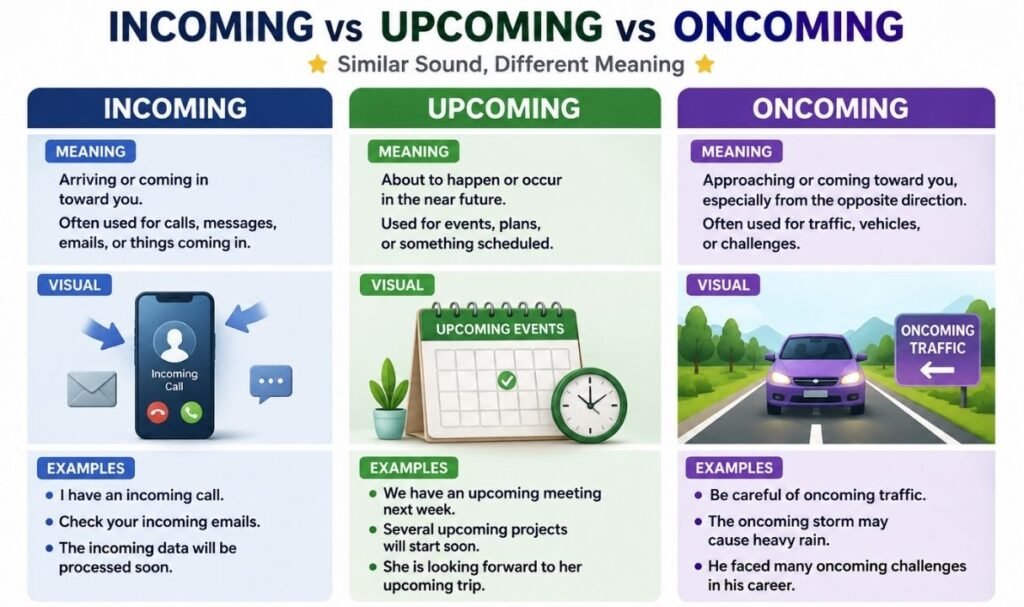

Three words, three meanings, one common mix-up. Incoming, upcoming, and oncoming look like cousins on paper, but they don’t behave the same way in a sentence. Mix them up in an email or a school essay and the message still lands — just slightly off, the way a shirt buttoned one hole wrong still covers you but never quite sits right.
This guide walks through each word on its own, then lines them up side by side so you can pick the right one without pausing mid-sentence. You’ll find real examples, a comparison table, common slip-ups, and a few memory tricks that actually stick.
Understanding “Incoming”, “Upcoming”, and “Oncoming”
All three words describe something that hasn’t fully arrived yet. That’s where the similarity ends.
- Incoming is about arrival — a call, a package, a new hire.
- Upcoming is about timing — a date circled on a calendar.
- Oncoming is about direction — something physically moving toward you.
Think of it as three separate questions.
- Is it arriving somewhere?
- Is it scheduled for later?
- Is it heading straight at you right now? Once you know which question applies, the correct word almost picks itself.
What “Incoming” Really Means
Definition of Incoming
Incoming describes something that is entering, being received, or about to arrive at a place, device, or system. The focus sits on the act of arrival — not on when it happens or how it’s moving, just that it’s coming in.
When You Use “Incoming”
You’ll hear this word constantly across a handful of everyday situations. Here’s where it shows up most.
Tech & Communication
Phones buzz with incoming calls. Inboxes fill with incoming emails. Servers log incoming traffic. In every case, something is entering a system from outside, and “incoming” flags that entry point.
Deliveries & Logistics
Warehouses track incoming shipments. Airports announce incoming flights. Retail staff prepare for incoming stock. The word signals that goods, people, or vehicles are on their way to a specific destination.
Weather & Natural Forces
News anchors warn of an incoming storm when conditions are building and heading toward a region. It’s less about violent motion and more about a system that’s approaching a place.
Emergencies & Warnings
Military and emergency terminology leans on this word heavily — incoming fire, incoming threat, incoming alert. The urgency comes from the context, not the word itself.
Examples of Incoming
- “You have three incoming messages.”
- “The incoming flight is delayed by twenty minutes.”
- “Our team welcomed five incoming employees this month.”
- “Radar picked up an incoming storm system off the coast.”
Key Insight
Incoming = something is arriving, entering, or being received. It can happen digitally, physically, or through a system. There’s no rule that says it must involve motion you can see with your own eyes.
Related searches people also ask:
- Incoming vs upcoming vs oncoming synonym — there isn’t a true one-word synonym for any of these three, since each carries a distinct shade of meaning (arrival, timing, or direction).
- Incoming vs upcoming vs oncoming examples — a ringing phone is incoming, a birthday party next week is upcoming, a car in the other lane is oncoming.
- Oncoming vs incoming traffic — oncoming traffic moves toward you from the opposite direction; incoming traffic usually refers to data or vehicles arriving at a specific hub, like an airport.
- Upcoming vs incoming examples — “upcoming exam” (scheduled) versus “incoming email” (arriving now).
- Incoming or upcoming week — “upcoming week” is the standard phrase; a week doesn’t arrive anywhere, it’s simply ahead on the calendar.
- Incoming or upcoming president — “incoming president” is correct once someone has been elected and is about to take office; it marks the transition of arrival into a role, not a future event.
What “Upcoming” Really Means
Definition of Upcoming
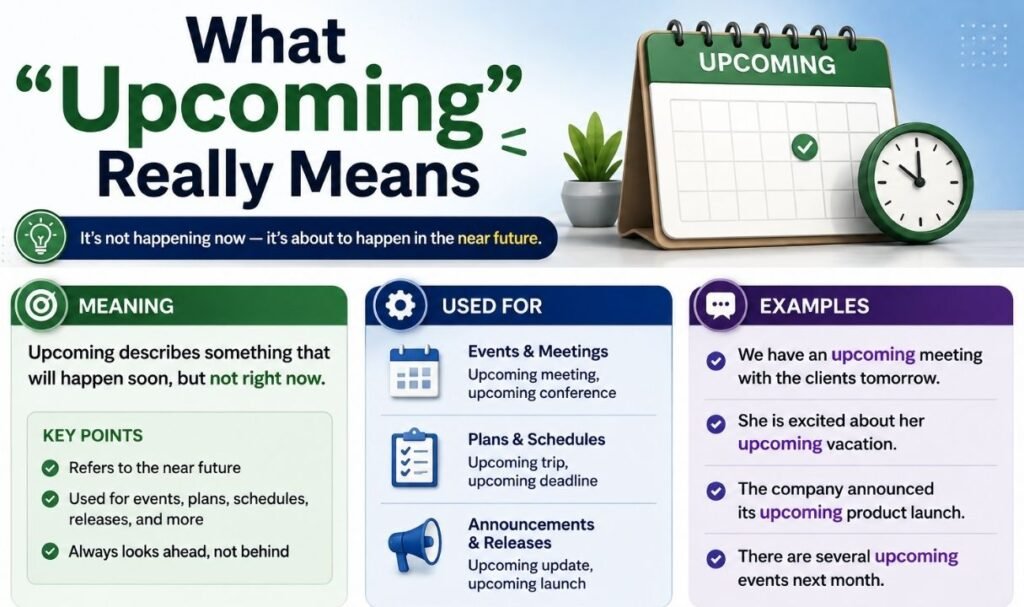
Upcoming describes something scheduled, planned, or expected to happen in the near future. There’s no movement involved — just timing. A wedding, a product launch, a school semester: none of these physically travel anywhere, they simply sit on the calendar waiting for their date.
Practical Uses of “Upcoming”
This word covers anything with a future date attached to it, whether that date is fixed or roughly estimated.
- Events: conferences, weddings, concerts, festivals
- Deadlines: assignments, tax filings, contract renewals
- Releases: movies, albums, software updates, books
- Milestones: graduations, anniversaries, elections
Examples
- “Our upcoming webinar covers budgeting basics.”
- “She’s nervous about her upcoming interview.”
- “The upcoming season premieres next Friday.”
- “There’s an upcoming holiday sale starting Monday.”
Typical Daily Uses
People use “upcoming” in planners, calendars, marketing emails, school announcements, and news previews. It’s the go-to word whenever you’re pointing at something on the horizon rather than something in motion.
Key Insight
Upcoming = scheduled for later. Nothing is arriving or moving toward you right now — the event simply hasn’t happened yet. If you can circle it on a calendar, “upcoming” almost always fits.
What “Oncoming” Really Means
Definition of Oncoming
Oncoming describes something physically moving directly toward you or toward a fixed point, often with speed or force behind it. Out of all three words, this one carries the most physical weight — and frequently, a hint of danger.
Common Uses of “Oncoming”
Traffic & Vehicles
This is the word’s most familiar home. “Oncoming traffic” refers to vehicles approaching from the opposite direction on a road. Drivers are trained to watch for it at intersections, on highways, and especially on narrow roads without a median.
Danger & Physical Threats
Oncoming shows up in warnings and confrontations — an oncoming wave, an oncoming vehicle, even an oncoming enemy in fiction or historical writing. The common thread is direct, physical approach.
Weather
When a storm isn’t just forecasted but visibly rolling toward a specific spot, writers often switch from “incoming” to “oncoming” to emphasize how close and immediate it feels.
Examples
- “The cyclist swerved to avoid the oncoming truck.”
- “Sailors watched the oncoming waves grow taller.”
- “Residents fled before the oncoming wildfire reached the neighborhood.”
- “He froze, staring at the oncoming headlights.”
Key Insight
Oncoming = physical motion, headed straight at you or a specific location, often urgent. If nothing is moving, this word doesn’t apply — no matter how soon the thing is expected.
Side-by-Side Comparison
Meaning Differences Table
| Word | Core Meaning | Involves Motion? | Common Contexts |
|---|---|---|---|
| Incoming | Arriving or being received | Sometimes (can be digital) | Calls, emails, shipments, flights, new staff |
| Upcoming | Scheduled for the future | No | Events, deadlines, releases, plans |
| Oncoming | Physically moving toward you | Always | Traffic, storms, waves, danger |
Best Word Choice by Scenario
| Scenario | Correct Word | Why |
|---|---|---|
| A meeting next Tuesday | Upcoming | It’s scheduled, not moving |
| A text notification | Incoming | It’s arriving on your device |
| A car in the opposite lane | Oncoming | It’s physically approaching you |
| A new semester starting soon | Upcoming | Time-based, not directional |
| A storm visibly rolling in | Oncoming or Incoming | Oncoming if it’s close and visible; incoming if it’s still building |
| A new employee starting Monday | Incoming | They’re arriving at the company |
Why Context Matters
Picking the right word usually comes down to three quick checks. Run through them in order and the answer tends to reveal itself.
1. Is it physically moving toward you?
If yes, and you can picture the motion — a truck, a wave, a person walking toward you — “oncoming” is your word.
2. Is it arriving to your device, system, or location?
If something is landing in your inbox, at your airport, or on your desk, “incoming” fits, even if you can’t physically see it move.
3. Is it planned for the future?
If there’s no motion and no arrival, just a date sitting on a calendar, “upcoming” is the natural choice.
Examples from Everyday Life
Incoming
- “Check your incoming mail before you leave the office.”
- “The base detected incoming missiles on radar.”
- “We have twelve incoming freshmen this fall.”
Upcoming
- “The upcoming budget meeting has been moved to Thursday.”
- “Fans are excited about the upcoming sequel.”
- “Her upcoming trip to Japan is in three weeks.”
Oncoming
- “The motorcyclist leaned away from the oncoming wind.”
- “Nurses braced for the oncoming flu season surge in patients arriving that week.”
- “The hikers spotted an oncoming storm cloud over the ridge.”
Common Mistakes to Avoid
Even confident writers slip up here. These are the errors that show up most often.
Using “oncoming” for events
“Oncoming wedding” is wrong. Weddings don’t move — they’re scheduled. Say “upcoming wedding” instead.
Using “incoming” for scheduled things
“Incoming exam next week” sounds odd. The exam isn’t arriving at you; it’s on the calendar. Use “upcoming exam.”
Using “upcoming” for something happening now
“My upcoming call” is confusing if the phone is already ringing. If it’s happening right now, it’s “incoming,” not “upcoming.”
Using “oncoming” for digital stuff
“Oncoming email” doesn’t work — emails don’t physically travel through space toward you the way a car does. Stick with “incoming email.”
Using “incoming” for things that don’t move
“Incoming holiday” reads strangely because a holiday doesn’t arrive at a location or device. “Upcoming holiday” is the natural phrase.
Easy Memory Tricks
A few small anchors make these words easier to recall under pressure.
1. Incoming = In-coming
Something is coming in — to your phone, your inbox, your airport, your building.
2. Upcoming = Up next
Think of a lineup or a schedule. Whatever’s “up next” on the list is upcoming.
3. Oncoming = On the way toward you
Picture headlights coming straight at your windshield. That’s the feeling this word carries.
4. The Car Rule
If you’d shout “watch out!” because something is barreling toward you, it’s oncoming. Traffic, waves, and storms all pass this test.
5. The Calendar Rule
If you could circle it in red on a calendar, it’s upcoming. No calendar entry moves toward you physically.
Case Studies
Case Study 1: The Weather App
A weather app pings your phone: “Incoming storm expected in your area within the hour.” Later that evening, the radio host says, “Drivers should watch for oncoming winds along the coastal highway.” The first message is about arrival to your location; the second is about the physical force pushing against cars in real time. Same storm, two different angles, two different words.
Case Study 2: A Company Announcement
An HR email reads: “We’re excited to welcome our incoming class of interns starting Monday.” A separate line in the same email says: “Don’t forget about our upcoming town hall next Thursday.” The interns are arriving at the company — incoming. The town hall is simply scheduled — upcoming. Swapping the two words would confuse anyone skimming the message.
Case Study 3: Traffic Incident
A local news report describes a near-miss: “The driver swerved to avoid an oncoming vehicle that crossed the center line.” Nobody would write “incoming vehicle” here, because the danger isn’t about something arriving at a destination — it’s about a car heading directly at another car. The physical, in-the-moment nature of the event calls for “oncoming.”
Quotes to Help You Remember
- “If it’s arriving, it’s incoming. If it’s scheduled, it’s upcoming. If it’s headed straight at you, it’s oncoming.”
- “Calendars hold upcoming events. Inboxes hold incoming messages. Roads hold oncoming traffic.”
- “Motion picks oncoming. Timing picks upcoming. Arrival picks incoming.”
Frequently Asked Questions
What is the difference between incoming and upcoming?
Incoming means something is arriving or being received right now, like a call or a shipment. Upcoming means something is scheduled for later, with no arrival or motion involved.
Which is correct: “upcoming 3rd year” or “incoming 3rd year”?
“Incoming 3rd year” is correct when referring to a student about to start that year, since it marks their arrival into that grade or stage.
Which is correct: “upcoming week” or “incoming week”?
“Upcoming week” is correct. A week is a stretch of time on the calendar, not something that physically arrives.
Which is correct: “incoming” or “upcoming” student?
“Incoming student” is correct for someone about to join a school or program, since it describes their arrival into that institution.
Conclusion
None of these three words are interchangeable, but none of them are hard to master either. Ask yourself what’s actually happening: is something arriving, is something scheduled, or is something moving toward you? Answer that one question honestly, and incoming, upcoming, and oncoming will stop feeling like a guessing game and start feeling like second nature.