
You’ve typed it a hundred times. Halfway through, your cursor hovers and a small, annoying question shows up: is it requester or requestor? Spellcheck doesn’t flag either one, your coworker uses one spelling, your company’s software uses the other, and now you’re stuck second-guessing a word you use almost every day.
Here’s the short version: both spellings are correct, both mean the same thing, and the difference comes down to context, not grammar rules. But that one-line answer doesn’t tell you which one to pick when you’re filling out a legal form, naming a database field, or writing a customer email. That’s what this guide is for.
Requester vs. Requestor — Meaning, Usage, and Correct Contexts
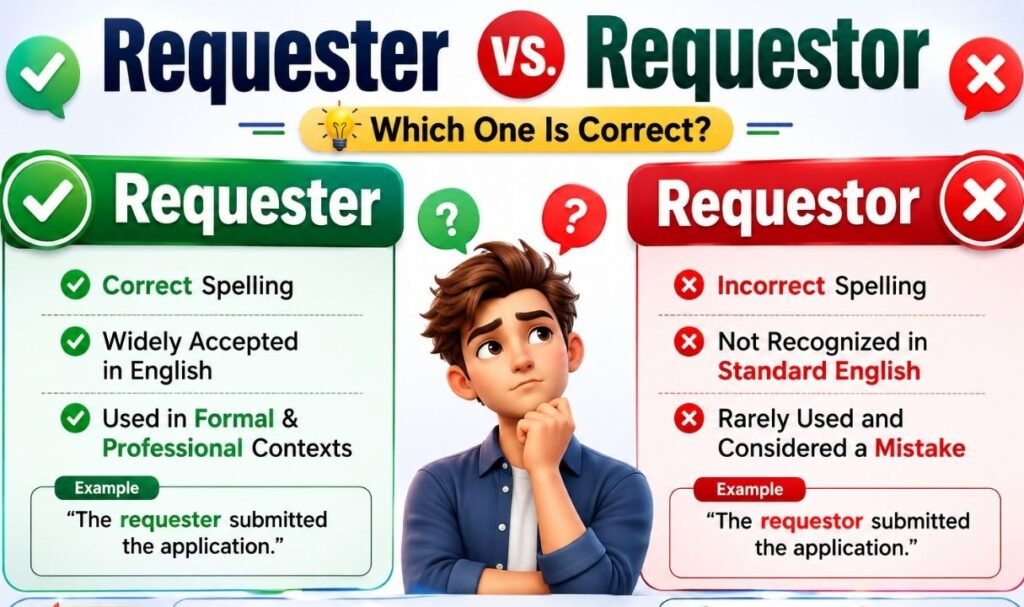
Both words describe a person or entity that makes a request — someone asking for information, access, approval, money, or action from someone else. Dictionaries treat them as variant spellings of the same noun, not as two different words with two different meanings.
What separates them isn’t definition. It’s where each spelling tends to show up:
| Feature | Requester | Requestor |
|---|---|---|
| Meaning | Person or entity making a request | Person or entity making a request |
| Region | Dominant in American English | Appears in both, more common in older legal texts |
| Tone | Everyday, conversational | Formal, official |
| Common fields | Business writing, customer support, IT tickets | Legal documents, government forms, procurement systems |
| Word formation | Follows the standard “-er” pattern (teacher, builder) | Uses the older “-or” pattern (actor, editor) |
| Dictionary status | Primary listed form in most modern dictionaries | Listed as a variant spelling |
If you only remember one thing from this table, remember this: pick requester when you’re unsure. It’s the safer, more widely recognized default in 2026.
The Meaning and Usage of “Requester” and “Requestor”
Both words come from the verb “request,” and both describe the person on the asking side of a transaction. A requester (or requestor) isn’t the person granting a request — that’s usually called an approver, a grantor, or a reviewer, depending on the field.
Since the underlying meaning is identical, the real work is figuring out which spelling fits your writing situation.
Requester
Requester is the form you’ll see most often in day-to-day writing. It shows up in:
- Emails and customer service tickets
- Software interfaces (think “requester name” on a form)
- News articles and blog posts
- General business correspondence
It reads naturally because English speakers are used to the “-er” ending. Teach becomes teacher. Build becomes builder. Request becomes requester. Nothing about it feels stiff or old-fashioned.
Example sentences:
- The requester filled out the access form before noon.
- Please forward this ticket to the original requester.
- Our support team replies to each requester within 24 hours.
Requestor
Requestor carries a slightly more formal, almost bureaucratic feel. You’ll run into it in:
- Legal contracts and court filings
- Government and municipal forms
- Enterprise software and database schemas
- Procurement and compliance documentation
It uses the Latin-style “-or” ending, the same pattern found in words like actor, auditor, and contractor. That ending tends to survive longest in fields where terminology gets locked into place early and rarely gets revised — think of a records-request law passed decades ago that still uses “requestor” throughout.
Example sentences:
- The requestor shall submit all supporting documents within 30 days.
- Requestor ID: 88213 (as it might appear in a database field)
- The requestor bears responsibility for the accuracy of the submitted claim.
Key Difference Between Requester and Requestor
Put simply: there isn’t a difference in what the word means, only in where it’s expected. Style guides don’t argue that one spelling is grammatically wrong. They argue about consistency and audience.
A few points worth keeping straight:
- Both spellings are dictionary-recognized nouns.
- Neither one is a typo of the other.
- The choice usually reflects the register of the document — casual versus formal, or conversational versus contractual.
- Once an organization picks a spelling for a system or form, switching mid-document creates confusion, not correctness.
Exploring the Prevalence of “Requester” in American English
Search almost any American newspaper archive, style guide, or corporate handbook, and requester wins by a wide margin. It’s the form the Associated Press and most U.S. business writing default to, and it’s the spelling most American dictionaries list first.
Part of this comes down to word-formation habits. English speakers in the U.S. are far more comfortable adding “-er” to a verb than “-or.” Nobody says “buildor” or “teachor.” The brain reaches for the pattern it already knows, and requester fits that pattern perfectly.
Examples in American English
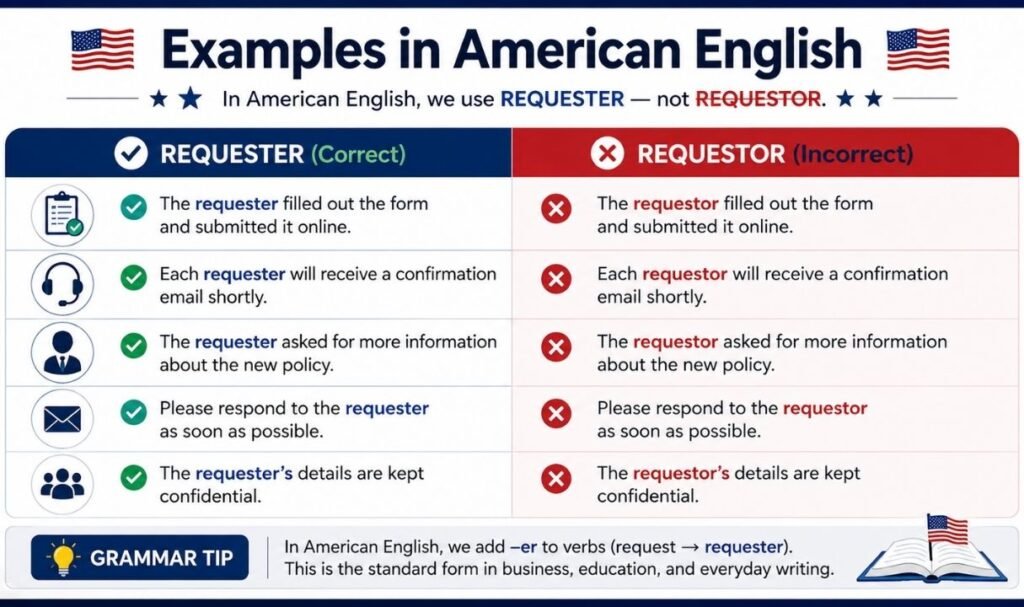
- A government IRS document might read: “The requester must provide a valid form of identification.”
- A tech support macro might say: “We’ve notified the requester of the resolution.”
- A news article covering a public records dispute might write: “The requester filed an appeal after the agency denied access.”
Common Examples and Usage in Daily Language
Outside of official paperwork, requester shows up constantly in ordinary speech and writing:
- Workplace Slack messages (“the requester needs this by Friday”)
- App notifications (“your requester has been notified”)
- Retail and service industries (“please confirm with the requester before processing a refund”)
None of these settings call for legal precision. They call for a word that reads naturally, and requester does that job.
Impact of Language Trends on Word Preference
Word preference doesn’t stay fixed. A term that was common in 1950s legal writing can quietly fade from daily use fifty years later while staying frozen inside the systems built during that earlier era. Three forces are pushing requester further ahead right now.
1. Digital communication simplifies language
Apps, chat platforms, and support tickets favor short, familiar words over formal ones. When a product team designs a form field, they’re writing for speed and clarity, not legal precision, so requester gets chosen almost automatically. This same shift explains why people search terms like “requester or requestor UK,” “requester synonym,” “requester vs requestor examples,” “requester opposite,” and “requester plural” — they’re trying to pin down a word that keeps popping up in software and forms but was never formally taught in school. (For the record: the plural is requesters, a rough synonym is petitioner or applicant, and the rough opposite is approver or grantor. A related but distinct term, requestee, refers to the person or system a request is directed at — not the one making it.)
2. American English influences global usage
Because so much software, documentation, and business content originates in the U.S., American spelling conventions spread through international teams by default. A company based in London might still standardize on requester simply because its ticketing software or American parent company set the term first.
3. Style guides encourage consistency
Editorial style guides generally favor whichever spelling appears in a major dictionary as the primary form, and for most of them, that’s requester. Once a style guide picks a lane, writers who follow that guide stop debating the spelling altogether.
Requestor in British English and Specialized Contexts
British English doesn’t strongly favor requestor over requester either — both appear there too, and requester is still more common in everyday UK writing. Where requestor holds its ground, in both British and American contexts, is inside specialized systems that were built before “requester” became the dominant default, or that intentionally lean on formal, Latin-rooted vocabulary.
Examples of Requestor in Specialist Contexts
Legal Contexts
Legal drafting tends to favor older, more formal word endings. Contracts, court documents, and freedom-of-information statutes often use requestor because the terminology was set decades ago and legal writing resists unnecessary revision.
- “The requestor must demonstrate standing before the court will consider the petition.”
- “Upon receipt, the requestor shall be notified of the agency’s decision within ten business days.”
Technical Contexts
Database architecture and enterprise software frequently use requestor as a field label or object name, especially in older systems.
- A workflow engine might log an action as:
requestor_id: 4471, status: pending - An IT ticketing system built in the early 2000s might still reference “Requestor Information” on its intake form, even though the company’s marketing copy uses requester everywhere else.
Understanding Language Variations
This kind of split isn’t unique to requester and requestor. English is full of word pairs where formal, older-sounding endings hang on inside institutions long after everyday speech moves toward the simpler form — think “advisor” versus “adviser,” or “connector” versus “connecter.” The pattern is the same: legal and technical systems freeze a spelling in place, while general usage keeps evolving.
Etymology and Evolution of the Term “Requester”
Historical Perspective of the Word “Request”
“Request” traces back to Old French requeste, itself rooted in Latin requirere — to seek again, to ask for. English borrowed the noun form directly, and the verb “to request” followed a similar path. From there, English speakers did what they always do with verbs: they added an agent suffix to describe the person performing the action.
Two suffixes were available. “-or” came through Latin agent nouns (actor, doctor, editor). “-er” came through the native Germanic pattern already used for common English verbs (worker, driver, teacher). Both attached themselves to “request” at different points, which is exactly why two spellings survived instead of one winning out immediately.
The Emergence of “Requester” in Modern Usage
As English writing moved away from heavily Latinized legal prose and toward plainer, more direct business and technical writing, the “-er” ending became the practical default. Dictionaries updated accordingly, listing requester as the primary form, with requestor noted as a secondary or variant spelling. That’s roughly where things still stand today.
Practical Examples: How to Use “Requester” in Sentences
- The requester needs approval from their manager before the purchase can proceed.
- Each requester receives an automated confirmation email.
- The support agent asked the requester to clarify the issue.
- As the requester, you’re responsible for double-checking the shipping address.
- The requester’s account was flagged for manual review.
Common Mistakes and How to Avoid Them
Most problems with this word pair aren’t about picking the “wrong” spelling — they’re about picking inconsistently.
Mixing spellings in the same document
Using requester in paragraph one and requestor in paragraph four makes a document look unedited, even if both spellings are technically valid. Pick one at the start and run a find-and-replace check before you send anything out.
Switching spellings inside a system definition
If a database field, an API parameter, or a form label is already named requestor, don’t rename half your documentation to requester while the code still says requestor. That mismatch causes real confusion for developers and end users, not just a style complaint.
Thinking one spelling is “wrong”
Neither form is a misspelling. Correcting a colleague’s “requestor” to “requester” in a legal document that already uses “requestor” throughout isn’t fixing an error — it’s introducing an inconsistency.
Letting autocorrect decide for you
Autocorrect tools sometimes default to whichever spelling is more common in their training data, silently converting requestor to requester mid-sentence. If your workplace has standardized on requestor for legal or technical reasons, check your document after autocorrect runs, not just before.
Frequently Asked Questions
Is there such a word as requester?
Yes. “Requester” is a standard, dictionary-recognized noun meaning a person who makes a request.
When to use requester or requestor?
Use “requester” for everyday, business, and general writing; use “requestor” for legal, government, or established technical/database contexts.
Is “requester” or “requestor” the correct spelling in English?
Both are correct. “Requester” is the more common and modern form, while “requestor” is an accepted formal variant.
What does requester mean?
It refers to a person or entity that asks for something, such as information, access, approval, or action from another party.
Conclusion
Both requester and requestor are correct, and neither one will get flagged by a dictionary or a grammar checker. The choice comes down to where you’re writing and who’s going to read it. For emails, support tickets, marketing copy, and general business writing, requester is the safer and more natural pick. For legal filings, government forms, and older technical systems, requestor often fits the established terminology better.