
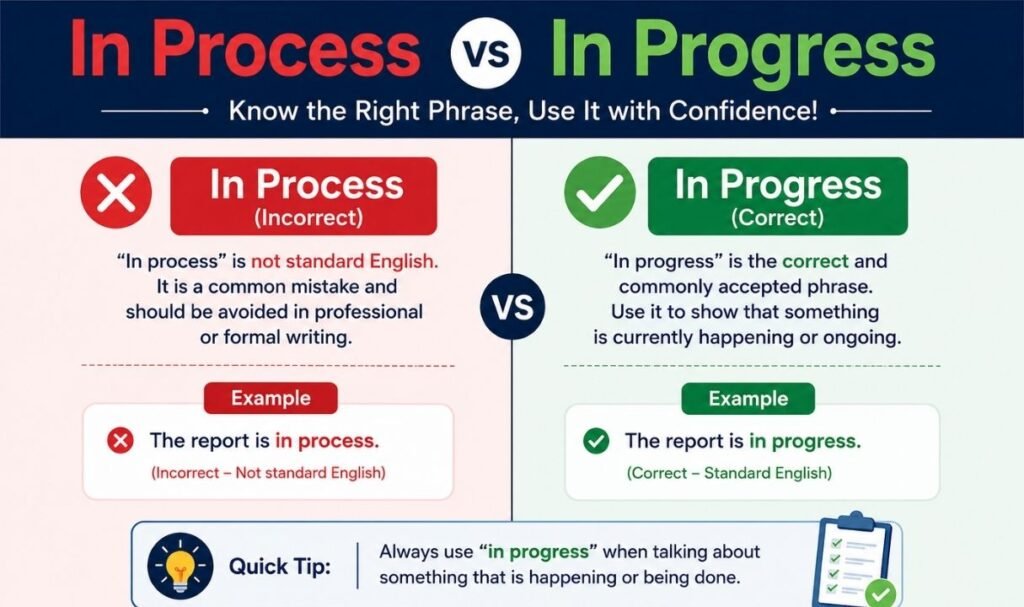

You type an email, pause, and stare at two words. “The order is in process.” Or is it “in progress”? Both look correct. Both sound fine out loud. And that small hesitation costs you a few seconds of confidence every single time you write it.
Here’s the short version: “in progress” describes active, visible work happening right now, while “in process” describes something moving through a formal system, workflow, or set of steps. One is about hands-on effort. The other is about a status inside a pipeline.
That distinction sounds simple, but it trips up writers, students, customer service reps, and even project managers constantly. This guide breaks down exactly where each phrase fits, why English settled on one over the other, and how real industries use both terms differently. You’ll walk away knowing precisely which phrase to use — no more guessing.
What “In Process” vs “In Progress” Really Mean
Both phrases describe something unfinished. That’s where the overlap ends.
Think of it this way: “in progress” points to a person doing something. “In process” points to a thing moving through a system. A chef cooking dinner is a task in progress. A loan application sitting with an underwriting department is in process — nobody has to be touching it at this exact moment for that to be true.
| Aspect | In Process | In Progress |
|---|---|---|
| Focus | A system or procedure | Active, hands-on work |
| Feel | Formal, administrative | Everyday, active |
| Common settings | Manufacturing, HR, banking, logistics | Project management, writing, construction |
| Requires active effort right now? | Not necessarily | Usually yes |
| Frequency of use | Less common | Far more common |
Meaning of “In Process”
“In process” describes something that has entered a defined sequence of steps and hasn’t come out the other end yet. It doesn’t promise that a human is actively working on it at this second — only that it’s somewhere inside the workflow.
A job application sitting in a hiring system is a textbook example. Nobody may be reviewing it right this minute, yet it’s accurate to say the application is in process. The phrase works because it describes status within a structure, not effort happening in real time.
You’ll spot “in process” most in operational language: order fulfillment, quality checks, approvals, and background procedures where the emphasis is on the pipeline rather than the person.
Meaning of “In Progress”
“In progress” signals that something is actively underway. Someone is doing the work, or a visible process is unfolding in real time. A meeting in progress means people are sitting in a room talking right now. A renovation in progress means tools are out and walls are coming down today.
This phrase carries a sense of motion and immediacy that “in process” lacks. It answers the question “is something happening right now?” with a clear yes.
Because of that immediacy, “in progress” fits naturally into everyday conversation, status updates, and project dashboards — anywhere people want a quick, visual sense of what’s actively being handled.
Side-By-Side Comparison: “In Process” vs “In Progress”
| Sentence | Correct Phrase | Why |
|---|---|---|
| Your refund is ___ at the bank. | In process | Moving through a formal banking procedure |
| The mural on Fifth Street is ___. | In progress | An artist is actively painting it |
| Quality inspection is ___. | In process | A structured checklist, not necessarily hands-on right now |
| The wedding rehearsal is ___. | In progress | Real-time, visible activity |
| The background check is ___. | In process | Administrative system, automated steps |
| The novel’s third draft is ___. | In progress | Writer actively working on it |
Notice a pattern? If you can point to a person doing the work at this exact moment, “in progress” fits. If the item is simply sitting somewhere inside a chain of steps, “in process” fits better.
Where These Words Come From (And Why It Matters)
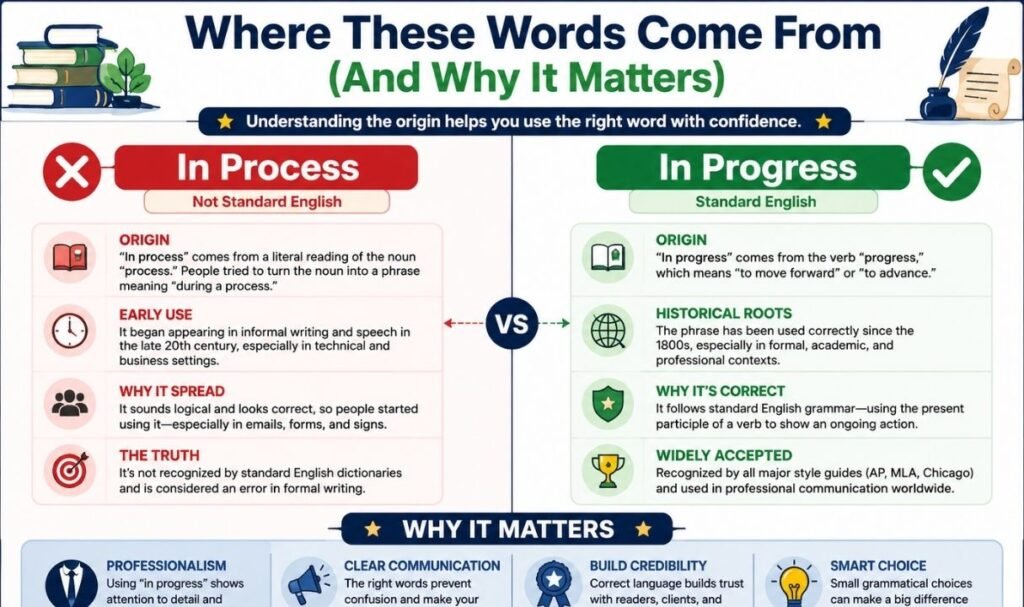
Understanding the roots of these two words explains why they drifted apart in meaning — and why one eventually became far more popular.
Origin of “Process”
“Process” traces back to the Latin processus, meaning “a going forward” or “advance,” built from procedere — to proceed or go forth. Over centuries, the word narrowed toward a technical sense: a series of steps performed to achieve a particular outcome. That’s why “process” today feels tied to procedures, manufacturing lines, legal systems, and structured workflows. The word inherited a bureaucratic, mechanical flavor.
Origin of “Progress”
“Progress” also comes from Latin, from progressus, meaning “an advance” — built from gradi, to step or walk. Rather than settling into a technical meaning, “progress” kept its broader sense of movement, improvement, and forward motion. It became the word people reach for when describing visible advancement of any kind, from a football game’s clock to a personal fitness goal.
Both words share a family tree rooted in forward motion, yet “process” leaned toward systems while “progress” leaned toward movement itself. That small fork in meaning is why the two phrases feel different centuries later.
Why “In Progress” Is More Common Today
Language data stretching back roughly two hundred years shows “in progress” pulling ahead of “in process” and never looking back. Several reasons explain the gap.
1. It’s clearer
“In progress” instantly tells a reader that work is happening. There’s no ambiguity about whether a person or a machine is involved — the phrase simply signals motion.
2. It feels more active
Search interest around this topic includes phrasing like in process vs in progress workday, work in process or in progress, in process vs in progress job application, and still in process or progress, which shows how often people search for the more energetic option when describing tasks, jobs, and daily work. “In progress” has that energy built in.
3. It’s used in project management
Kanban boards, sprint trackers, and task management software almost universally use a column labeled “In Progress” rather than “In Process.” That single design choice, repeated across thousands of tools, cemented the phrase in professional vocabulary.
4. It works in more contexts
You can describe a game, a renovation, a conversation, a lawsuit, or a painting as “in progress.” “In process” fits a narrower band of formal, procedural situations, which naturally limits how often people reach for it.
When to Use “In Progress” vs. “In Process” (Context-Based Guide)
Use “In Progress” when:
- Someone is actively doing the work right now
- You’re describing a task, project, event, or creative work
- You want the sentence to sound natural in everyday speech
- The situation involves visible movement (construction, cooking, writing, repairs)
- You’re updating a project board or status tracker
Use “In Process” when:
- The item is moving through a formal system or procedure
- No single person needs to be actively handling it at this moment
- You’re writing in a business, legal, HR, or administrative context
- The phrase appears alongside words like application, request, order, or claim
- You want to emphasize the pipeline rather than the effort
Comparison Examples (To Make It Crystal Clear)
Example 1
Wrong: “My performance review is in progress with HR.” Better: “My performance review is in process with HR.” Why: HR reviews move through scheduled administrative steps; nobody needs to be actively reviewing it every second.
Example 2
Wrong: “The concert is in process right now.” Better: “The concert is in progress right now.” Why: A concert is a live, visible event happening in real time.
Example 3
Wrong: “Our client’s lawsuit settlement is in progress at the courthouse filing office.” Better: “Our client’s lawsuit settlement is in process at the courthouse filing office.” Why: A filing office moves paperwork through defined legal steps, not hands-on work every minute.
How Different Industries Use “In Process” vs “In Progress”
Technology & Agile Workflows
Software teams split the two cleanly. A feature being coded is “in progress” — a developer is actively typing. A build running through automated testing stages or a CI/CD pipeline is “in process,” since it’s moving through predefined system steps without a human touching it directly.
Business & Operations
Operations teams lean on “in process” for anything tied to internal workflows: invoice approvals, vendor onboarding, or compliance checks. “In progress” shows up more when describing active projects, negotiations, or strategy work.
Customer Service
Support teams often default to “in process” for refunds, claims, and tickets sitting in a queue, since those items move through structured systems. When an agent is actively chatting with a customer or troubleshooting live, “in progress” fits better.
Manufacturing & Supply Chain
Manufacturing has its own accounting term: work in process, referring to partially finished goods sitting on the production line, tracked as a current asset. Work in progress, by contrast, usually describes larger, longer-timeline projects like construction builds, sometimes tracked as a non-current asset. This is one of the clearest professional distinctions between the two phrases.
Academia & Research
A dissertation a student is actively writing is “in progress.” A grant application sitting with a review board, moving through committee stages, is “in process.”
Creative Industries (Art, Design, Writing)
Creatives almost always say “in progress” — a painting, a manuscript, a film edit. The hands-on, visible nature of creative work naturally pairs with the more active phrase.
Grammar Rules: How to Use Each Phrase Correctly
Sentence Construction
Both phrases function as adjective or adverbial complements, typically following a linking verb like is, are, was, or remains.
Correct placements
- Subject + linking verb + in progress/in process
- Example: “The audit is in process.” / “The concert is in progress.”
- Avoid placing these phrases before the noun they describe (you wouldn’t say “the in progress concert” in standard usage — instead, use “ongoing” or “current” as a true adjective there).
Verb Combinations
Pairs with “In Progress”:
- is in progress
- remains in progress
- currently in progress
- still in progress
Pairs with “In Process”:
- is in process
- moving through the process
- currently in process
- remains in process at [department/stage]
Capitalization Notes
Neither phrase requires capitalization in regular sentences. Capitalize only when it appears as a formal status label, such as a column header on a project board (“In Progress”) or a system-generated order status (“In Process”). Outside of labels and titles, keep both lowercase.
Quick Memory Tricks (Easy to Remember)
Mnemonic 1:
Progress = Person. Both words start with a “pr” sound tied to visible movement — think of a person actively pushing something forward.
Mnemonic 2:
Process = Pipeline. Picture paperwork traveling down a conveyor belt through a series of stations. That’s “in process.”
Mnemonic 3:
If you can answer “yes” to “is someone doing this right now?” — use “in progress.” If the honest answer is “it’s just sitting in a queue” — use “in process.”
Quick Test:
Ask yourself: Could I watch this happening if I stood next to it right now? If yes, “in progress.” If it’s invisible paperwork or automated steps, “in process.”
Common Mistakes (Avoid These)
Mistake 1: Using “in process” for tasks
Saying “my homework is in process” sounds stiff and unnatural. Homework is a task someone actively does — “in progress” fits better.
Mistake 2: Using “in progress” for system steps
Telling a customer “your background check is in progress” implies someone is actively working on it every second, which can set unrealistic expectations. “In process” is more accurate for automated or multi-step systems.
Mistake 3: Mixing them in documentation
Switching between the two phrases within the same policy document or user interface creates inconsistency and confuses readers. Pick one term per context and stay consistent throughout.
Mistake 4: Over-formalizing everyday language
Using “in process” in casual conversation (“dinner is in process”) sounds overly formal and awkward. Save it for procedural, business, or technical contexts.
Real Case Study: A Technical Team Miscommunication
A software team once labeled a deployment stage “in progress” on their internal dashboard, even though the stage was actually an automated pipeline running unattended overnight. A junior engineer, seeing “in progress,” assumed a colleague was actively monitoring it and didn’t escalate a warning that appeared in the logs. By morning, the deployment had failed and needed a full rollback. Relabeling that stage “in process” — signaling an automated system step rather than active human oversight — became part of the team’s new dashboard standard.
Another Case Study: Manufacturing Confusion
At a mid-sized manufacturing plant, a supervisor told inventory staff that a batch was “in progress” when it was actually sitting in a quality-check queue with no worker assigned yet. Staff assumed hands-on work was underway and delayed reordering raw materials, expecting the batch to clear quickly. The mix-up between an active task and a queued procedural step ended up delaying inventory classification by two days. The plant now trains staff to use “in process” specifically for anything sitting in an automated or queued stage.
Helpful Quotes to Remember
- “In progress” means hands are on the work, right now.
- “In process” means the item is moving, even if nobody is touching it this second.
- When in doubt, picture the action: visible effort points to progress; invisible steps point to process.
Frequently Asked Questions
What is the difference between in progress and in process?
“In progress” means active work is happening right now, while “in process” means something is moving through a formal system or set of steps, whether or not someone is actively handling it at that moment.
Is it work in process or work in progress?
Both exist as distinct accounting terms: “work in process” refers to partially finished goods in manufacturing, while “work in progress” usually refers to larger, longer-timeline projects like construction.
Is it better to say “in process” or “in progress”?
“In progress” is the more common and versatile choice for everyday and professional writing; save “in process” for formal, procedural, or system-based contexts.
What is another way to say “in process”?
Alternatives include “underway,” “pending,” “being processed,” “in the pipeline,” or “moving through review.”
Conclusion
The gap between “in process” and “in progress” comes down to one question: is a person actively doing the work, or is the item simply moving through a system? Once that distinction clicks, choosing the right phrase stops being a guessing game.
Reach for “in progress” when describing visible, active effort — a project, a renovation, a conversation. Reach for “in process” when describing something traveling through a formal workflow, like an application, an order, or an approval. Keep that one test in mind, and you’ll never second-guess this phrase pair again.