
You type a quick message, hit send, and spot the mistake a second later. “I have to much work.” Or “Are you coming to?” Nobody is harmed, but it stings a little.
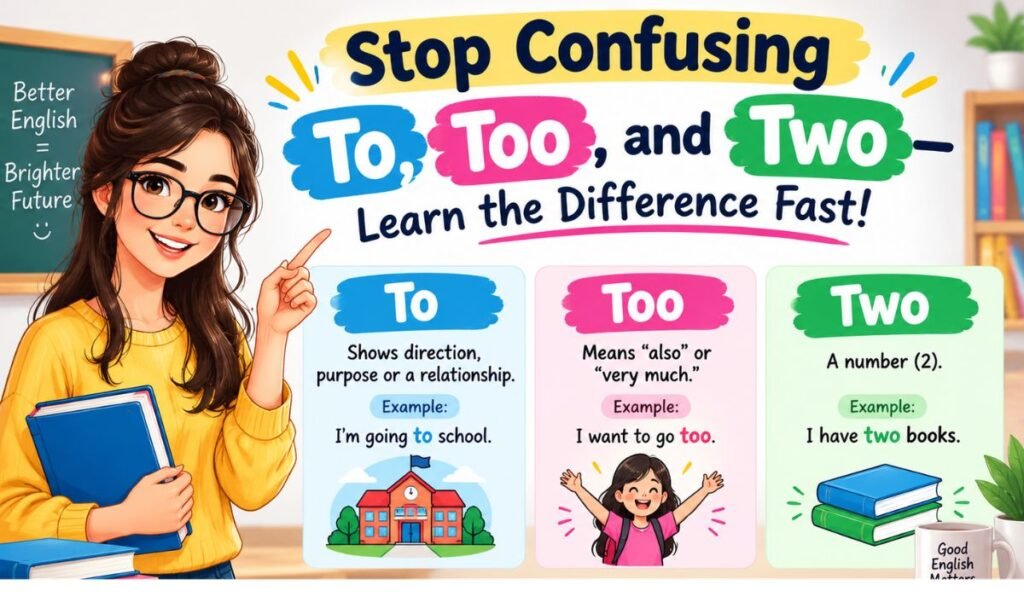
Here is the short version. “To” points toward something or sits before a verb. “Too” means “also” or “excessively.” “Two” is the number 2. That is the whole system, and the rest of this guide shows you how to apply it without second-guessing yourself.
These three words are homophones. They sound identical, yet each has its own spelling, meaning, and job in a sentence. They rank among the most commonly confused words in English, and even careful writers slip when typing fast.
Definition of To vs Too vs Two
Let’s pin down each word before comparing them.
To is a preposition and also the marker of the infinitive verb form. As a preposition, it shows direction, destination, a recipient, or a limit. As an infinitive marker, it sits in front of a base verb, as in “to run” or “to think.”
Too is an adverb. It carries two meanings: “also” (She wants dessert too) and “more than needed” (The soup is too hot). A third, softer sense is “very,” usually in casual speech (I’m not too sure).
Two is a number. It is the numeral that comes after one and before three. It never acts as a preposition or adverb.
So the three words belong to three separate categories: a preposition (and infinitive marker), an adverb, and a number. Once you know which category you need, the spelling follows.
To vs Too vs Two – Quick Comparison Table
Bookmark this one. It answers most questions in under ten seconds.
| Feature | To | Too | Two |
|---|---|---|---|
| Part of speech | Preposition or infinitive marker | Adverb | Number (numeral) |
| Core meaning | Direction, purpose, recipient, limit | Also, or excessively | The number 2 |
| Typical position | Before a noun, pronoun, or verb | End of a clause, or before an adjective or adverb | Before a noun, or standing alone |
| Quick test | Is it followed by a place, person, or base verb? | Can you swap in “also” or “too much”? | Can you replace it with 2? |
| Example | We drove to Lahore. | The tea is too sweet. | I ordered two cups. |
| Spelling clue | Short and plain | Extra “o” for “extra” | “tw” links to twin, twice, twelve |
Three-Step Swap Test
When you are unsure, run these checks in order:
- Replace the word with the digit 2. If the sentence still makes sense, write two.
- Replace it with “also” or “excessively.” If that works, write too.
- If neither swap works, write to.
The order matters. Numbers are easy to spot, so rule them out first.
Meaning and Usage of “To”
“To” is the shortest of the three, but it does the most work. It appears in almost every paragraph of everyday English.
“To” as a Preposition
A preposition links a noun or pronoun to the rest of the sentence. “To” does this in several ways:
- Direction or destination: She walked to the market.
- Recipient or target: Pass the salt to him.
- Limit or range: The shop is open from nine to five.
- Comparison: Our team lost by a score of 3 to 1.
- Relationship or ownership: This key belongs to my sister.
- Time before the hour: It’s ten to six.
In each case, a noun, pronoun, or noun phrase follows “to,” and that group of words is called the object of the preposition.
“To” as an Infinitive Marker
The second job is quieter. Here “to” joins a base verb to form the infinitive:
- I want to learn French.
- He decided to leave early.
- They have to finish by Friday.
- She forgot to call.
This form also shows up inside common structures such as “going to,” “used to,” “have to,” and “ought to.” Writers often type “too” in those spots because the sound is the same, so slow down when you see a verb coming.
A Subtle Trap: “To” Followed by -ing
Sometimes “to” is a preposition even though an -ing word follows it. In that case the -ing word acts like a noun.
- I look forward to seeing you. (preposition)
- She is committed to improving her writing. (preposition)
- We are used to waking early. (preposition)
Compare that last one with “We used to wake early,” where “to” belongs to the infinitive. The test is simple: if you can put a noun or pronoun after “to,” it is a preposition (I look forward to it).
When “To” Is Left Hanging
In casual speech, the verb after “to” is sometimes dropped because everyone knows what it would be.
- “Are you coming?” “I’d love to.”
- “Did you finish the report?” “I tried to.”
The word is still “to,” even with nothing after it. Many writers wrongly change it to “too” here because the sentence ends and the word feels like a closing “also.”
Meaning and Usage of “Too”
“Too” is the word with a little extra in it, and its meaning follows its spelling. It adds something.
Meaning 1: Also or In Addition
Use “too” when you are adding another person, thing, or fact.
- You can come along, too.
- I like jazz. My brother likes it too.
- The hotel has a pool, and a gym too.
At the end of a sentence, a comma before “too” is optional. Many editors prefer to leave it out in short sentences and keep it when the sentence is longer or you want a pause.
When “too” sits in the middle of a sentence, commas usually frame it: She, too, wanted to speak. Here the word works as a gentle interruption.
Meaning 2: More Than Necessary or Allowed
This sense signals excess. It usually sits directly before an adjective or an adverb.
- The suitcase is too heavy to lift.
- You’re driving too fast.
- There are too many cooks in this kitchen.
- It’s too late to change the plan.
Notice the pattern “too + adjective + to + verb.” The sentence The coffee is too hot to drink contains both words, and each is correct. The first marks excess. The second begins an infinitive.
Meaning 3: Very, Extremely
Speakers also use “too” as an intensifier, often with a wink.
- That’s just too funny.
- I’m not too worried about it.
- You are too kind.
This usage is common in conversation and informal writing. In formal writing, “very” is often safer.
“Too” as an Emphatic Reply
Anyone who has argued with a sibling knows this one.
- “You didn’t call me.” “I did too!”
Here “too” adds a stubborn affirmation. It is informal but perfectly correct.
Meaning and Usage of “Two”
“Two” is the simplest word of the set, because it is only ever a number. It names the quantity one plus one.
How “Two” Works
You can use it in a few ways:
- Before a noun: two tickets, two answers, two decades
- As a pronoun: The two of them left together.
- In compound numbers: twenty-two, two hundred, two thousand
- In fractions and measures: two-thirds, two-and-a-half miles
- In compound adjectives: a two-year-old child, a two-way street
Hyphens matter in the compound forms. We say “a two-year contract” but “the contract lasts two years.”
The Word Family Clue
“Two” belongs to a family of words that all carry the idea of doubling. Look at the shared “tw” start:
- Twice: two times
- Twin: one of two born together
- Twelve: two more than ten
- Twenty: two tens
- Between: literally “by two”
That visible “tw” is your best spelling anchor. If the idea of two is in the sentence, you will see the same letters elsewhere.
Common Mistakes and Confusions
Most errors come from speed, not ignorance. The brain hears one sound and the fingers pick whichever spelling arrives first. Here are the patterns that show up again and again.
| Incorrect | Correct | Why |
|---|---|---|
| I have to much homework. | I have too much homework. | “Too” signals excess before “much.” |
| We are going too the park. | We are going to the park. | A place follows, so use the preposition. |
| She wants too see the film. | She wants to see the film. | A base verb follows, so it is an infinitive. |
| Me to! | Me too! | “Also” fits the meaning. |
| It’s two late now. | It’s too late now. | You can’t replace it with 2. |
| I bought to books. | I bought two books. | A number is needed. |
| Its too cold to go out. | It’s too cold to go out. | Both words appear, and each has its own job. |
| I’m too tired too drive. | I’m too tired to drive. | The second word starts an infinitive. |
Mistake 1: Writing “To” When You Mean “Also”
This happens most at the end of a sentence. “I love you to” feels natural because the word is a closing one, but “to” can’t mean “also.” Try the swap: “I love you also” works, so the answer is “too.”
Mistake 2: Writing “Too” Before a Verb
The reverse also happens. “I need too go” looks wrong once you apply the test. “I need excessively go” makes no sense, and “I need 2 go” doesn’t either. So the word is “to.”
Mistake 3: Missing That Both Words Can Appear Together
A sentence can hold “too” and “to” side by side, and this is where confidence slips.
- It’s too early to call.
- She was too shy to speak.
Read them aloud slowly. Your ear can’t tell the difference, but your eye can.
Mistake 4: Over-Correcting
Once people learn to watch for “too,” they sometimes spell every “to” with two o’s, assuming more is safer. It isn’t. The extra “o” belongs only where “also” or “excessively” fits.
Spellcheck won’t rescue you here, because all three words are spelled correctly on their own. Proofreading by eye is the best defense.
Sentence Examples for Practice
Reading examples builds instinct faster than memorizing rules. Study these, then try covering the bold word and guessing it.
1. Examples with “To”
- The train to Karachi leaves at noon.
- He gave his notes to the new student.
- I’d like to apologize.
- We walked from the station to the hotel.
- Our flight lands at a quarter to nine.
- She is dedicated to her craft.
- Nobody wants to wait.
2. Examples with “Too”
- We are leaving soon, and you should come too.
- That jacket is too big for me.
- It’s too quiet in here.
- Maya speaks French, and Omar does too.
- The test was too hard for most of the class.
- You’ve eaten too much cake already.
- I’m not too sure about this plan.
3. Examples with “Two”
- There are two ways to solve this.
- We waited for two hours.
- He lives on the two hundredth floor.
- She has two brothers and a sister.
- A two-minute break is all I need.
- Only two of the five chairs were free.
- Two wrongs don’t make a right.
Sentences Where All Three Appear
These are great for training your eye:
- Two of us went to the shop, but it was too crowded.
- I’m too tired to carry two bags.
- Are two hours too long to wait?
- Take these two letters to the post office, and please take the others too.
Linguistic Insight: Why These Words Sound the Same
If you have ever wondered why English has three spellings for one sound, the answer lies in how the language changed over several centuries.
A Quick Look at Where Each Word Came From
“To” goes back to Old English tō, a small word of direction that has existed in much the same form for well over a thousand years. Its relatives appear in other Germanic languages, such as German zu and Dutch toe.
“Too” began as the very same word. In Old English and early Middle English, tō could mean “to” and also “in addition” or “excessively.” Over time, writers started using a doubled spelling for the adverb senses. This helped readers tell the two jobs apart on the page, and the spelling “too” became standard roughly around the 16th century. That means “to” and “too” are twins, not distant cousins, which is partly why they sound alike.
“Two” has a different background. It comes from Old English twā (and a related form tū), and the “w” was originally pronounced. People said something close to “twoh.” You can still hear that trace in “twin,” “twelve,” and “twenty.”
Why the “W” Went Silent
Between roughly 1400 and 1700, English went through a large change in vowel sounds, usually called the Great Vowel Shift. During this period, the “w” sound dropped out before certain rounded vowels in some words. The same thing happened in “sword” and, in a different way, in “who.”
Once the “w” vanished from speech, “two” sounded like “to” and “too,” but the written form kept its old spelling. English spelling tends to preserve history this way, which is why so many words look odd compared with how they sound.
What This Means for Learners
Because all three words arrived at one sound by different routes, you can’t rely on your ear. Spelling has to be learned through meaning and grammar. That’s not a flaw in you. It’s a quirk of the language, and the same quirk produces there/their/they’re, your/you’re, and its/it’s.
Teachers and editors call these “commonly confused words.” Naming them helps, because once you expect a trap, you notice it.
Expert Grammar Tips for Remembering the Difference
You don’t need ten tricks. Pick the ones that match how you think.
Tip 1: Count the O’s
“Too” has an extra “o,” and its meaning is “extra.” A sentence like This is too much even pairs the idea with the spelling. If the sense is “more than enough” or “as well,” add the spare letter.
Tip 2: Link “Two” to Its Relatives
Remember tw: twin, twice, twelve, twenty. If you can picture the number, you can picture the “w.”
Tip 3: Use the Swap Test Every Time
The three-step swap from earlier takes five seconds. Try 2, then try “also” or “too much,” and fall back on “to.” It almost never fails.
Tip 4: Spot the Verb
After “to,” if the next word is a verb in base form (go, see, wait), you have an infinitive and the spelling is “to.” Verb next, no extra “o.”
Tip 5: Learn the Mnemonic Sentence
Try this one: “Two people went to the shop, but it was too crowded.” It holds all three words and works as a template you can tap into when stuck.
Tip 6: Proofread in a Separate Pass
Don’t check these words while drafting. Write first, then do one pass that looks only at homophones. Your brain is far more alert when it has only one job.
Self-Assessment Quiz
Choose to, too, or two for each blank. Write your answers down before checking.
- I’m going ___ the library after lunch.
- Can I bring a friend ___?
- She has ___ cats and a parrot.
- This bag is ___ heavy for me.
- He asked me ___ wait outside.
- It’s far ___ cold ___ swim today.
- We read ___ chapters last night.
- “I love this song.” “I do, ___!”
- They sent the package ___ the wrong address.
- There are ___ many tabs open on my laptop.
- I’d like ___ thank everyone for coming.
- Her ___ sisters live close ___ each other.
- You’re speaking ___ quickly for me ___ follow.
- Give the note ___ your teacher.
- ___ minutes is ___ short ___ finish this.
Answers to Self-Assessment
- to (a place follows)
- too (means “also”)
- two (a number)
- too (excess, before the adjective “heavy”)
- to (infinitive: “to wait”)
- too, to (“too cold” shows excess; “to swim” is an infinitive)
- two (a number)
- too (means “also”)
- to (preposition before “the wrong address”)
- too (excess, before “many”)
- to (infinitive: “to thank”)
- two, to (a number; then a preposition in “close to each other”)
- too, to (“too quickly” shows excess; “to follow” is an infinitive)
- to (a recipient follows)
- Two, too, to (number; excess; infinitive)
Scoring: 13 or more correct means you have a firm grasp. Between 9 and 12 is solid, and a quick reread of the swap test will tighten it. Under 9 means it’s worth revisiting the mistakes table and trying the quiz again tomorrow
Frequently Asked Questions
What is the difference between to and too and two?
“To” is a preposition or infinitive marker, “too” is an adverb meaning “also” or “excessively,” and “two” is the number 2. They sound identical but have different spellings and jobs.
When should I use to or too?
Use “too” when you can swap in “also” or “too much.” Use “to” before a place, person, or base verb.
Is it “I love you too” or “two”?
It’s “I love you too,” because “too” means “also” here. “Two” would only be correct if you were counting.
How can you use too?
You can use “too” to mean “also” (Come along, too) or to show excess before an adjective or adverb (too hot, too fast). It can also mean “very” in casual speech.
Final Thoughts
The trouble with to, too, and two is never the meaning. It’s the sound. Because the ear can’t help, you rely on a quick mental check, and that check is short. Remember three anchors. “Two” is a number, so test it with 2. “Too” adds or exaggerates, so test it with “also” or “too much.” “To” covers everything else, from places and people to the verb that comes next.