
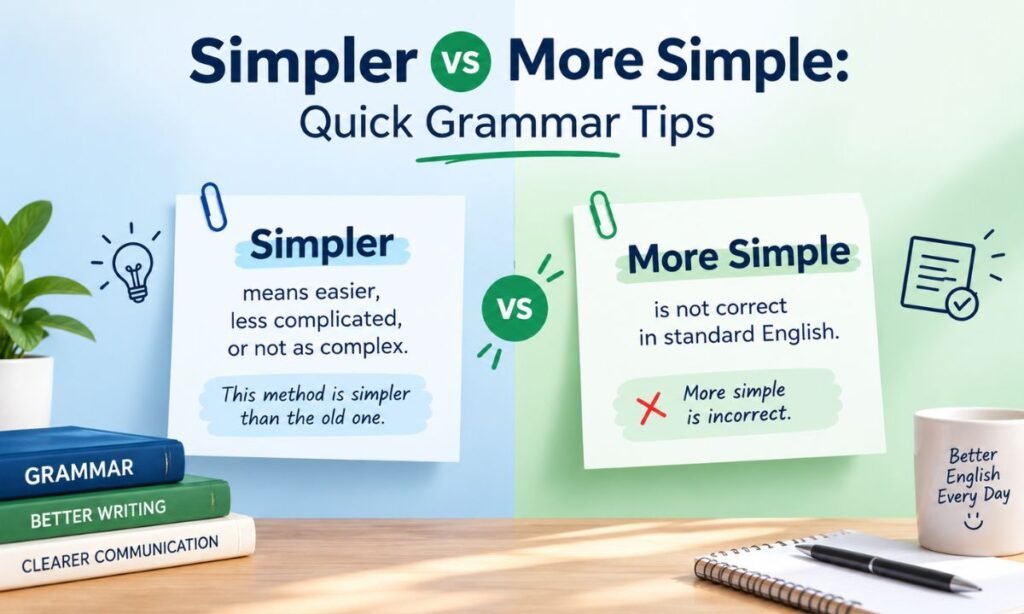

“Simpler” is the standard comparative of “simple,” and it is correct in nearly every sentence. “More simple” is also grammatical, but it is less common and usually appears for rhythm or emphasis. Both forms mean less complicated.
Definition of Simpler vs More Simple
Simpler is the comparative form of the adjective simple. It compares two things and says one has fewer parts or difficulties than the other. For example, a bicycle is much simpler to repair than a car.
More simple means the same thing but builds the comparison with the word more. English allows this because simple is a two-syllable adjective, and many two-syllable adjectives accept either pattern. Both versions are understood by every reader.
Understanding the Core Meaning of “Simpler” and “More Simple”
Both phrases express a greater degree of simplicity. Neither one changes the meaning of the sentence. The difference lies in sound and frequency rather than logic, so the choice often feels like a matter of taste.
Consider the sentences “This recipe is simpler” and “This recipe is more simple.” A reader gets the same information from each. The first sounds smoother to most ears, while the second sounds deliberate, as if the writer stressed the word.
Grammar Rules Explained: Why “Simpler” Is Usually Correct
English usually forms comparatives of one-syllable adjectives with the ending -er, as in taller or faster. Two-syllable adjectives ending in -le or -y, such as simple or happy, take the same ending without any trouble.
That pattern is why simpler is the default choice. Dictionaries list simpler as the regular comparative of simple, and style guides rarely object to it. Using the -er form is safe in both formal and casual writing.
The Case for “More Simple”: When It’s Perfectly Acceptable
More simple is not an error. Grammarians note that when an adjective could take either form, both are acceptable. Writers have used more simple for centuries, and it appears in respected books and in modern journalism.
When to use “more simple”
Choose more simple when you want emphasis or a particular rhythm. In a phrase like “a more simple and direct approach,” the extra word balances the sentence and lets the reader slow down on the idea.
It also fits when simple is paired with another adjective that takes more, such as “more simple and elegant.” Matching the pattern keeps the two comparatives parallel, which helps the whole sentence read more evenly.
Usage Frequency and Popularity Trends
Corpus searches generally show simpler appearing far more often than more simple in modern published English. The gap holds steady across both books and news writing, though more simple never fully disappears from either one.
Learners often look up the phrase because they doubt which form is right. That uncertainty is common in English, even though the standard answer is clear: simpler is the safer and more frequent choice overall.
Real-Life Examples of Each Form
Here are two sentences with simpler. “The new form is simpler than the old one.” “Nothing could be simpler than boiling an egg.” Both follow the standard pattern and would pass any editor without comment.
Now sentences with more simple. “The committee wanted a more simple and transparent process.” “It is a more simple idea than it first appears.” Both read naturally, though a few editors would still change them to simpler.
Common Mistakes and Misunderstandings
Most errors come from half-remembered rules. Writers either avoid more simple out of fear or confuse the adjective with an adverb. The mistakes below cover the most frequent problems and show how to fix each one.
Mistake 1: Thinking “more simple” is wrong.
Some people mark more simple as an error. It is not one. Grammar references accept both forms for adjectives like simple. If you see it in someone’s writing, leave it alone unless a style guide for your project requires -er forms.
Mistake 2: Confusing “simpler” with “more simply.”
Simpler is an adjective and describes nouns, as in “a simpler plan.” More simply is an adverb and describes verbs, as in “Explain it more simply.” Swapping them can produce errors such as “She explained it simpler.”
Mistake 3: Overusing “more simple” for formality.
Some writers think more simple sounds more formal or polished. It does not. Extra words rarely add polish, and a sentence full of more constructions can feel padded. Use simpler by default and save more simple for emphasis.
Quick Comparison Table: “Simpler” vs. “More Simple”
The table below summarizes the main practical differences between the two forms. Use it as a quick reference while you edit or proofread, and remember that both forms carry exactly the same meaning in a sentence.
| Feature | Simpler | More simple |
|---|---|---|
| Grammar status | Standard comparative | Acceptable alternative |
| Frequency | Far more common | Less common |
| Tone | Smooth and neutral | Slightly emphatic |
| Best use | Default choice | Rhythm or parallel structure |
| Risk | Almost none | Occasional editor change |
Synonyms and Alternatives
If you want to avoid the question, choose another word. Easier and plainer both express similar ideas, though each has a slightly different shade. Easier focuses mainly on effort, while plainer focuses mainly on style.
Other options include more straightforward and less complicated. Less complicated works well in casual writing, and more straightforward suits explanations of processes. These alternatives also keep a sentence from repeating the word simple too often.
Style and Preference in Modern Writing
Modern writing favors short, direct words, so simpler matches current taste. Newsrooms and technical writers generally prefer the -er form because it saves a word and reads faster. More simple remains an option rather than a trend.
Style Guide Insights
Style guides generally do not ban more simple. They tend to advise using the -er form for short adjectives when it sounds natural and using more when the -er form sounds awkward. Simple falls into the first group.
Psychological Insight
Readers process familiar patterns faster. Because simpler is the more common form, it creates less friction, while more simple makes some readers pause. That pause can be useful for emphasis, but it can also look like a mistake to editors.
Linguistic Insight: How Comparatives Work in English
Standard English builds comparatives in two ways: adding -er to short adjectives and placing more before longer ones. The split is partly about syllables, but it is also about sound and habit in everyday speech.
Simple sits in the middle. It has two syllables but ends in -le, a pattern that accepts -er comfortably, as in gentler or nobler. That is why simpler feels natural, while more simple feels like a deliberate choice.
Practical Guidance for Writers and Learners
Use simpler unless you have a specific reason not to. When you want emphasis or parallel structure, more simple is available. When in doubt, read the sentence aloud and choose the version that sounds smoother.
Practice Sentences
Fill in each blank with simpler or more simple, then compare your choice with the answers listed after the sentences. Either form is often acceptable, so the notes explain which one sounds better and why.
- This route is ___ than the highway.
- We need a ___ and more transparent process.
- Her second draft was much ___ to read.
- Nothing could be ___ than a one-button remote.
Answers: (1) simpler, the standard comparison with “than.” (2) either works, but “more simple” matches the parallel “more transparent.” (3) simpler. (4) simpler.
Real-World Case Study: Simplicity in Tech Design
Product teams talk about simpler interfaces constantly. A checkout page that removes extra fields is simpler than one that asks for every detail, and designers measure that gain in fewer abandoned carts and faster completion times.
In this field, simpler is the standard word in documentation and release notes: “a simpler setup flow” or “simpler permissions.” More simple appears occasionally in marketing copy when a writer wants a slower, more emphatic tone.
Expert Opinion: What English Teachers Recommend
English teachers generally tell students to use simpler and move on without further debate. The advice is practical and low risk because the -er form is standard and is rarely questioned when essays are graded.
Teachers who accept more simple usually add one condition: the writer should have a reason, such as parallelism or emphasis. A choice made on purpose reads as style, while an accidental one can look like uncertainty.
Self Assessment Section
Test your understanding with these five questions. Answers appear at the end of the section, so try each one before you read them. A score of four or higher means you can use both forms with confidence.
- Which form is the standard comparative of simple?
- True or false: “more simple” is always a grammar error.
- Which is correct: “Please explain it simpler” or “Please explain it more simply”?
- Why might a writer choose “more simple” over “simpler”?
- Is “simpler” an adjective or an adverb?
Answers: (1) Simpler. (2) False. (3) “More simply,” because the word describes a verb. (4) For emphasis or parallel structure. (5) An adjective.
Similes About Simplicity (with Meaning, Definition, Usage, Example)
Similes make the idea of simplicity easy to picture. Each one below includes its meaning, a short definition, guidance on usage, and an example sentence, so you can borrow the comparison in your own writing.
As simple as ABC
- Meaning: Extremely easy.
- Definition: A comparison to the first letters a child learns, suggesting a task anyone can do.
- Usage: Casual and instructional writing.
- Example: “Setting up the app is as simple as ABC.”
As easy as pie
- Meaning: Requiring almost no effort.
- Definition: A comparison to something pleasant and uncomplicated.
- Usage: Informal speech and relaxed writing.
- Example: “Once you know the shortcut, the report is as easy as pie.”
As plain as day
- Meaning: Obvious.
- Definition: So easy to see that it needs no explanation.
- Usage: When a fact or answer is clear to everyone.
- Example: “The solution was as plain as day once we saw the chart.”
As clear as crystal
- Meaning: Easy to understand.
- Definition: Free from confusion or hidden complexity.
- Usage: Explanations, instructions, and rules.
- Example: “Her instructions were as clear as crystal.”
Frequently Asked Questions
What is correct: “simpler” or “more simple”?
Both are correct, but simpler is the standard and more common choice. Use it by default in essays and emails. More simple is grammatical and works when you want emphasis or parallel structure with another more phrase.
Is “more simple” wrong in English?
No. More simple is grammatically correct and appears in published writing. It is just less common than simpler, and some editors prefer the shorter form. Treat it as a stylistic option rather than a mistake.
When should I use “simpler” instead of “more simple”?
Use simpler in almost every case, especially in formal writing and documentation, where short words read faster. It is also clearly the safer choice for exams and professional editing, because readers almost never question it.
What’s the difference between “simpler” and “more simply”?
Simpler is an adjective that modifies nouns, as in “a simpler design.” More simply is an adverb that modifies verbs or whole statements, as in “More simply, the plan failed.” Mixing them up is a common grammar error.
Why do some people prefer “more simple”?
Some writers prefer more simple for rhythm and emphasis. The extra word slows the sentence and draws attention to the idea. Others use it because they learned that multisyllable adjectives need more, and the habit stuck.
Final Thoughts
Simpler is the better default, and more simple is a valid variation. Choose the -er form when you want smooth, standard writing, and choose more simple when emphasis or parallel structure calls for it. Neither choice changes your meaning.