
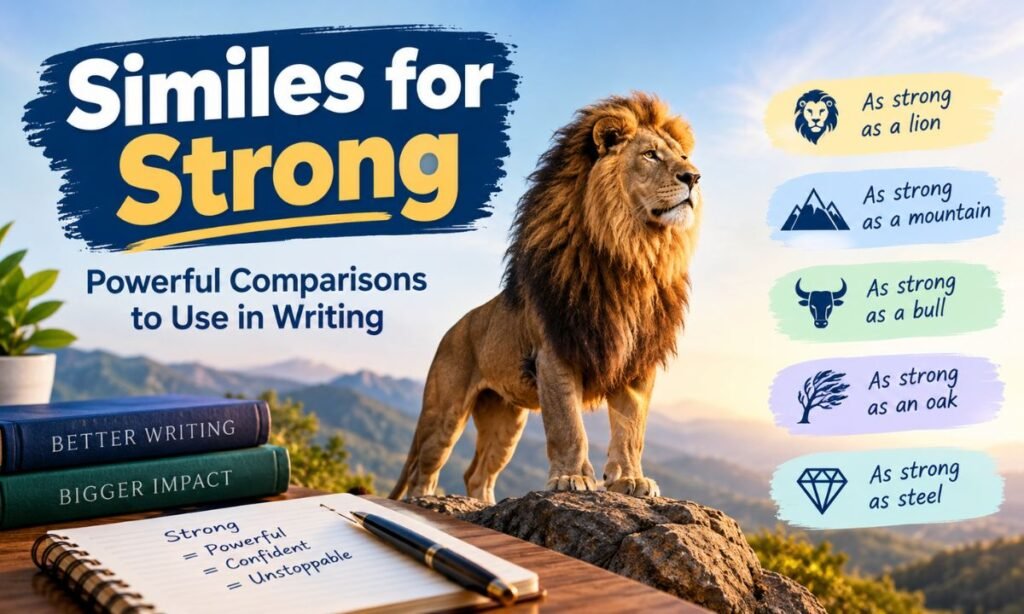

Similes for strong are comparisons that use “as” or “like” to show great physical power, firm character, or lasting endurance. Phrases such as “strong as an ox” and “solid as a rock” help readers picture strength instantly. Plain adjectives tell readers what you mean, but they rarely make anyone feel it. A good simile gives the idea weight and texture, so the reader sees the strength.
Quick answer: The most popular similes for strong
- Strong as an ox: steady, reliable physical power
- Solid as a rock: calm, dependable stability
- Tough as nails: grit under hardship
- Hard as steel: firm body or will
- Strong as a lion: courage with a proud presence
What Are Similes for Strong?
Similes for strong are figures of speech that compare power, toughness, or endurance to something familiar. Writers use them to turn the plain adjective “strong” into a picture. The comparison can describe muscles, willpower, buildings, or even a friendship.
Strength shows up in different forms. Physical strength covers lifting and stamina, while mental toughness covers focus under pressure. Emotional resilience means recovering after loss. A good comparison matches the form, so “tough as nails” and “heavy as lead” differ.
Most similes for strong borrow from animals and from hard materials, with a smaller group drawing on nature and buildings. The table below shows how each source shapes the feeling of a sentence, so you can choose with confidence.
| Source | Examples | Feeling |
|---|---|---|
| Animals | ox, lion, bear, bull | Warm, physical |
| Materials | steel, iron, granite, lead | Cold, firm |
| Structures | tank, wall, fortress | Protective |
| Nature | mountain, thunder, ocean, fire | Grand, poetic |
Knowing the source helps you pick the right tone. Animal similes feel warm and physical, while material similes feel cold and firm. Nature similes stretch the image to a larger scale, which suits speeches, poems, and dramatic scenes.
What Is a Simile?
A simile is a figure of speech that compares two different things using the words “like” or “as.” The comparison highlights one shared quality. In “she is as brave as a lion,” bravery is the quality both share.
The word comes from the Latin similis, meaning “like.” Simile belongs to the family of figurative language, alongside metaphor and personification. Teachers, poets, and advertisers all use it because the structure is simple and the effect is immediate.
A simile differs from a literal comparison because it links unlike things. Saying one boxer is as strong as another is plain comparison. Saying he is as strong as an ox is a simile, since people and animals differ.
Many writers confuse similes with metaphors, even though the two work differently. The table below shows the difference in a quick format that is easy to scan on a phone or on a laptop screen.
| Feature | Simile | Metaphor |
|---|---|---|
| Signal words | like, as | none |
| Example | Strong as an ox | He is an ox |
| Effect | Clear, gentle link | Bold, direct claim |
Similes keep a little distance, because the reader sees two separate things being compared. Metaphors merge the two, which can feel stronger but also less precise. For describing strength, similes often read as more natural and more believable.
Similes work for four main reasons:
- They create vivid imagery that readers can picture.
- They explain an abstract quality through a familiar object.
- They make descriptive writing more memorable.
- They add emotion without long explanations.
Similes for Strong (With Meaning, Definition, and Examples)
The twenty similes below cover physical power, mental toughness, and emotional resilience. Each entry gives a short meaning and two original examples. A usage note then explains when the comparison works best and when to skip it.
Start with the quick reference table. It lets you scan the best option for your sentence before reading the full entries, which saves time when you already know the tone and the kind of strength you need.
| Simile | Best for | Tone |
|---|---|---|
| Strong as an ox | Steady labor | Warm |
| Strong as a lion | Courage | Proud |
| Built like a tank | Big frame | Casual |
| Hard as steel | Firm body or will | Cold |
| Muscles like iron | Dense muscle | Gritty |
| Strong as a bear | Protective power | Warm |
| Solid as a rock | Reliability | Calm |
| Tough as nails | Grit | Casual |
| Like a wall of stone | Defense | Serious |
| Strong like steel cables | Lean power | Fresh |
| Firm as granite | Stubborn will | Formal |
| Heavy as lead | Crushing force | Grim |
| Powerful like thunder | Loud force | Dramatic |
| Strong as a bull | Driving force | Bold |
| Unbending like iron | Principles | Stern |
| Steady as a mountain | Calm strength | Quiet |
| Fierce as fire | Passion | Intense |
| Strong like a fortress | Protection | Grand |
| Resilient as rubber | Recovery | Modern |
| Mighty as the ocean | Vast power | Poetic |
Before you choose, follow these steps:
- Name the kind of strength you want to show: physical or emotional.
- Match the tone of your piece, whether casual, formal, or poetic.
- Check for freshness. If readers have seen the phrase a thousand times, add a new detail.
- Keep the comparison in proportion to the scene.
Strong as an Ox
Meaning: This simile describes someone with great physical power and stamina. Oxen have pulled plows and carts for centuries, so the comparison suggests steady, reliable work instead of sudden force. It is one of the most familiar similes for strong.
Examples:
- After years on the dock, Marcus was strong as an ox and never asked for help with the crates.
- She hauled the sofa up three flights, strong as an ox and twice as stubborn.
Usage note: Use it for dependable laborers and farmers. Because readers have met this phrase many times, pair it with a fresh detail, such as the sound of the load shifting, so the line does not feel worn out.
Strong as a Lion
Meaning: Lions stand for courage and raw power, so this simile suits people who show strength in danger. It mixes physical force with a proud, commanding presence, which makes it a better fit for leaders than for simple heavy lifters.
Examples:
- The coach was strong as a lion when the team fell behind, and his calm voice held the locker room together.
- Strong as a lion, the old captain stood at the bow while the storm broke over the deck.
Usage note: Choose this one when you want strength with dignity. It works well in speeches and fantasy writing, where courage matters as much as muscle, and it gives a leader a calm, commanding presence on the page.
Built Like a Tank
Meaning: This phrase pictures a broad, heavily armored body that does not move for anyone. It describes a person with a thick frame and serious power, and it often carries a slightly humorous, casual tone in everyday speech.
Examples:
- The new linebacker was built like a tank and ran through blockers without slowing.
- Her old pickup was built like a tank, and it survived two winters of potholes.
Usage note: Because it describes build rather than character, use it for appearance and durability. It also works for objects such as cars or phones, which makes it handy in product writing and casual reviews, though formal pieces need a gentler phrase.
Hard as Steel
Meaning: Steel is a hard, durable alloy of iron, so this simile signals a body or will that cannot be bent or broken. It works for both literal toughness and emotional firmness, which gives writers a flexible option.
Examples:
- His stomach muscles were hard as steel after a decade of boxing.
- Her resolve was hard as steel, and no argument at the meeting moved it.
Usage note: Pick this simile when you want a cold, serious tone. It suits thrillers and sports profiles, though it can sound harsh in warm, gentle scenes, so match it to the mood of the passage and the character involved.
Muscles Like Iron
Meaning: This comparison focuses on the body itself. Iron suggests dense, unyielding muscle, and the phrase usually appears when writers describe weightlifters or blacksmiths. It gives the reader a quick sense of hardness and weight without extra description.
Examples:
- The blacksmith’s arms had muscles like iron, scarred and heavy from years at the forge.
- He had muscles like iron, yet he handled the newborn with surprising care.
Usage note: Add a contrast, like the gentle handling in the second example, to give the line emotional depth. A bare description of muscle is easy to forget, but a tender surprise stays in the mind of the reader.
Strong as a Bear
Meaning: Bears can flip heavy logs and rocks while searching for food, so this simile suggests wild, heavy power. It also carries a protective note, because a mother bear defending her cubs is one of nature’s clearest images of fierce strength.
Examples:
- The ranger gripped the rope, strong as a bear, and hauled the boat onto the bank.
- Her hug was strong as a bear’s, and it lifted him off the ground.
Usage note: This simile fits warm, sturdy characters such as fathers or outdoor guides. Use it when the strength feels protective instead of threatening, and avoid it for villains, since the image of a bear can also feel gentle and loyal.
Solid as a Rock
Meaning: Rock does not shift, crack, or wear down easily, so this simile describes stability more than muscle. People use it for reliable friends and calm minds that stay steady under pressure, which makes it a favorite in praise.
Examples:
- Through the whole crisis, Dana stayed solid as a rock for her staff.
- The old bridge, solid as a rock, has carried traffic for generations.
Usage note: Reach for it when you mean emotional strength or dependability. It is gentle and positive, so it fits tributes and personal stories well. It is also very common, so consider adding a small twist to keep it fresh.
Tough as Nails
Meaning: A nail must withstand hammer blows without bending, so this simile describes someone who handles hardship without complaint. It focuses on grit and resilience, and it often praises people who refuse to quit, even when the work drags on.
Examples:
- Grandma was tough as nails and still shoveled her own driveway at eighty.
- The rookie nurse proved tough as nails during the overnight shift.
Usage note: This is a conversational choice. It works in dialogue and profiles, but it may feel too casual in a formal report, where a plainer word can serve better. Save it for voices that sound like real people talking.
Like a Wall of Stone
Meaning: A stone wall blocks anything that tries to pass. This simile describes a person or group that holds the line and protects others, and it fits sports and protective family roles especially well, as the examples below show.
Examples:
- The defensive line stood like a wall of stone, and the runner found no gap.
- Her father stood like a wall of stone between the crowd and the door.
Usage note: Use it to show defense and resistance, not raw lifting power. It pairs well with verbs such as stood or held, which reinforce the image of a barrier. Avoid it when the character needs to move or chase.
Strong Like Steel Cables
Meaning: Steel cables hold up suspension bridges and lift heavy loads, so this simile points to tensile strength: the ability to take strain without snapping. It suits lean, wiry people whose power comes from tight, flexible muscle.
Examples:
- The climber’s forearms were strong like steel cables, thin but never tired.
- Her patience was strong like steel cables, taking every strain without a snap.
Usage note: This comparison is less common than plain steel, which makes it fresher. Use it for athletes with lean builds, such as climbers or gymnasts, when a bulky image would be the wrong picture for the scene.
Firm as Granite
Meaning: Granite is a hard, coarse rock that resists weathering for thousands of years. As a simile, it suggests firm opinions, fixed decisions, and a body that stays unmoved. It often carries a slightly stubborn edge.
Examples:
- The judge stayed firm as granite and refused every request to delay.
- His jaw was firm as granite while he listened to the verdict.
Usage note: Choose it when someone refuses to change their mind. It gives a serious, formal tone, so it works well in fiction and opinion writing where stubborn strength is the point of the character or argument.
Heavy as Lead
Meaning: Lead is a dense metal, so this simile stresses weight and force. It can describe a punch, a stare, or a burden. People also use it for emotions that feel hard to carry, which widens its range.
Examples:
- His fists were heavy as lead, and every punch rattled the chains on the bag.
- The news sat heavy as lead in her chest.
Usage note: Use it when strength comes with pressure or pain. It reads as slow and crushing, not quick and sharp, so it fits boxing scenes and emotional moments better than fast action or light, playful scenes.
Powerful Like Thunder
Meaning: Thunder rolls across the sky with force you can feel in your chest. This simile describes strength that is loud and impossible to ignore, such as a booming voice or a charging crowd in a stadium.
Examples:
- His voice was powerful like thunder and filled the hall without a microphone.
- The drummers struck together, powerful like thunder, and the ground trembled.
Usage note: This one appeals to the ear. Use it for loud voices and sudden bursts of force. Avoid it for quiet strength, where the loudness of thunder would clash with your meaning and break the mood of the scene.
Strong as a Bull
Meaning: Bulls are muscular, headstrong animals, so this simile combines great strength with stubborn drive. It fits people who push through obstacles by sheer force, and it often appears in sports and farm settings as well as casual speech.
Examples:
- The wrestler was strong as a bull and twice as hard to turn.
- She pushed the stalled car, strong as a bull, until the engine caught.
Usage note: Compare it with strong as an ox. The ox is patient and steady, while the bull is forceful and impulsive. Choosing the right animal lets you shade a character’s personality in a few words, so choose with care.
Unbending Like Iron
Meaning: A bar of iron does not give way easily under force. This simile therefore describes character more than muscle. It suits people whose principles or discipline do not yield under pressure from others or from their own doubts.
Examples:
- The old sergeant was unbending like iron about the rules.
- Her discipline stayed unbending like iron through every long winter of training.
Usage note: Pair it with abstract nouns such as will or discipline. This turns a physical image into a moral one, which gives your writing a more thoughtful feel. It also keeps the line from sounding like gym talk.
Steady as a Mountain
Meaning: Mountains stand for millions of years and barely change within a human lifetime. This simile describes calm, immovable strength, the kind that does not panic or rush. It works well for mentors and anyone who makes others feel safe.
Examples:
- In the middle of the argument, the captain stayed steady as a mountain.
- Steady as a mountain, the teacher waited until the room fell silent.
Usage note: Use it for quiet confidence. It adds scale and age to the image, which suits reflective writing and speeches. Avoid it for fast action, because mountains are slow, and the pace of your sentence should match that calm.
Fierce as Fire
Meaning: Fire spreads, burns, and cannot be reasoned with. This simile describes strength that is wild and passionate, and almost impossible to control. It fits fighters and anyone whose determination seems to burn from the inside out.
Examples:
- Her loyalty was fierce as fire, and nobody dared to insult her team.
- The goalkeeper fought for every ball, fierce as fire.
Usage note: This simile shows emotional intensity as much as power. Use it when the strength has heat or passion behind it, such as a protest or a final match. For calm strength, choose stone or a mountain instead.
Strong Like a Fortress
Meaning: A fortress is built to survive attack, with thick walls and a clear purpose. This simile describes protection and defense, whether in a person’s mind or in a well-built structure, and it suggests that nothing gets in easily.
Examples:
- Their friendship was strong like a fortress, and rumors never got through.
- After the loss, she kept her mind strong like a fortress.
Usage note: It has a slightly dramatic, historical tone. Use it in stories and motivational writing that needs a grand image of protection. Skip it in light, everyday scenes, where the walls and towers would feel too heavy.
Resilient as Rubber
Meaning: Rubber stretches, bends, and returns to its shape. This simile shows a different kind of strength: the ability to recover after a hit. It suits people who bounce back from setbacks or injury without losing their spirit.
Examples:
- After every rejection, Priya came back resilient as rubber.
- The young gymnast was resilient as rubber and landed ready for another try.
Usage note: Use it for emotional strength and recovery. Hard similes such as steel suggest resistance, while rubber suggests flexibility, which many readers see as a more modern and relatable form of strength in everyday life and work.
Mighty as the Ocean
Meaning: The ocean holds enormous energy and cannot be controlled. This simile describes vast, sweeping power, and it is useful when you want a poetic tone. It suits large forces such as armies or emotions, especially in epic scenes.
Examples:
- The army moved forward, mighty as the ocean, and the valley filled with sound.
- Their grief rose, mighty as the ocean in a storm.
Usage note: Because it is grand, keep it for big moments. Used on small things, such as a cup of coffee, it sounds forced, so match the size of the comparison to the size of the scene.
Frequently Asked Questions
What are the best similes for strong in writing?
“Strong as an ox,” “solid as a rock,” and “tough as nails” are the most widely understood. For a fresher option, try “strong like steel cables.”
Can similes for strong describe emotions?
Yes. “Resilient as rubber” and “solid as a rock” describe emotional strength and the ability to stay calm or recover after hardship.
Are similes better than adjectives?
Similes add imagery that a single adjective cannot. Use adjectives for speed and clarity, and use similes when you want the reader to picture the quality.
Can I use similes in formal writing?
Yes, in moderation. Choose a dignified comparison such as “firm as granite” and avoid casual phrases like “tough as nails” in reports.
How do I avoid clichés when using similes?
Add a specific detail, swap a common object for a surprising one, or build the comparison from your own scene instead of a stock phrase.
Conclusion
Similes for strong give your writing a clear picture of power. Animals suggest warm physical strength, while metals suggest firm will. Pick the comparison that fits the kind of strength your reader needs to see. Familiar similes work best with a fresh detail attached. “Strong as an ox” becomes memorable when you add the creak of the cart or the sweat on the neck. Small specifics turn a stock phrase into your own line.