

You’re writing a college application, a resume, or maybe just a text to a friend, and you pause. Should it be “high school” or “highschool”? Your fingers hover over the keyboard because both versions look strangely normal after you’ve typed them a few times. That’s a real phenomenon — linguists call it semantic satiation, and it’s part of why this particular spelling question trips up so many people, from teenagers writing college essays to professionals drafting reports.
The good news is that the answer isn’t complicated once you understand the reasoning behind it. This guide walks through the correct spelling, why the confusion exists in the first place, how British and American English treat the term, and the situations where you genuinely need to think twice before typing.
High School or Highschool: Quick Answer ✅⚡
If you only read one section of this article, make it this one.
✔ Main Difference:
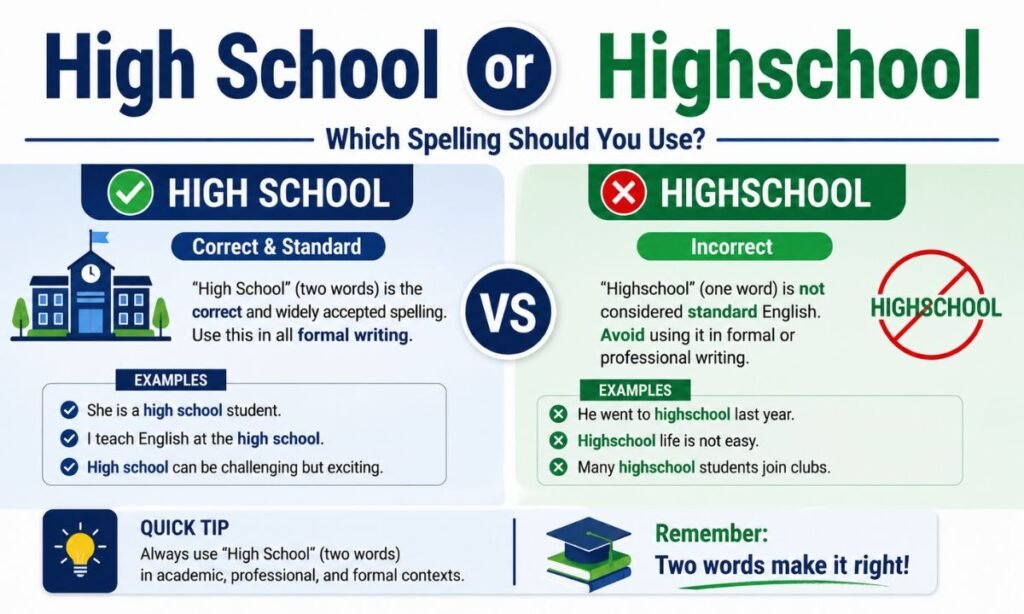
“High school” — written as two separate words — is the only spelling recognized by dictionaries, style guides, and educational institutions. “Highschool,” squeezed into a single word, is a spelling error. It shows up constantly in casual writing, but no major dictionary lists it as a standard entry.
The reason comes down to grammar classification. “High school” is what’s known as an open compound noun. Two words work together to create one meaning, but they keep their own space on the page. Compare that to a closed compound like “notebook,” where the two original words fully merge. High school never made that jump. It has stayed open since the term entered common use in the 19th century, and nothing about modern usage has changed that rule.
📌 Examples:
- ✅ She starts high school in September.
- ✅ My cousin just graduated from high school.
- ❌ She starts highschool in September.
- ❌ My cousin just graduated from highschool.
Every time you see “highschool” typed as one word, treat it as a typo, not a stylistic option.
High School or Highschool: Definitions with Examples 📖
Understanding why one form is correct gets easier once you look at what each version actually represents.
🟢 High School (Definition)
High school refers to a secondary educational institution, typically covering grades 9 through 12 in the United States, or an equivalent stage of education in other countries. It sits between middle school (or junior high) and college or university. Students usually attend high school between the ages of 14 and 18, working through core subjects, electives, and often extracurricular programs that prepare them for higher education or the workforce.
Grammatically, “high school” functions as a noun. It can also work as an adjective before another noun, as in “high school teacher” or “high school reunion,” though the two words still remain separated by a space in most standard usage.
📌 Examples:
- My son plays basketball for his high school team.
- High school graduation is one of the most memorable milestones for many families.
- She teaches biology at the local high school.
- We’re planning a high school reunion for the class of 2015.
- College admissions officers review your entire high school transcript.
🔴 Highschool (Definition)
“Highschool” isn’t a recognized word. It’s simply a misspelling that happens when writers merge two separate words the way they’d merge parts of an established closed compound, like “bookstore” or “keyboard.” Search engines see this misspelling constantly, which is exactly why questions like these rank so highly:
- High school or highschool grammar
- High school or highschool essay
- Is high school capitalized
- High school or highschool reddit
- Is high school hard
- Highschool of the Dead
- Is high schooler one word
- Is high school diploma capitalized
That last group of search terms is worth pausing on. Notice that even the popular anime title “Highschool of the Dead” uses the incorrect spelling — that’s a stylistic choice made by the title’s creators, not evidence that “highschool” is grammatically acceptable in everyday English. Titles, brand names, and usernames sometimes bend spelling rules on purpose. Your essay or resume shouldn’t.
📌 Incorrect Examples:
- ❌ He dropped out of highschool.
- ❌ Highschool was the best four years of my life.
- ❌ What’s your highschool GPA?
- ❌ I met my best friend in highschool.
🟡 Simple Meaning
Think of it this way: “high school” is a school that’s “high” in the sense of advanced or senior level, much like “middle school” or “elementary school.” None of those terms fuse into single words, and high school follows the same pattern for a reason rooted in how English classifies compound education terms.
The Origin of High School or Highschool 📜

Understanding where the term came from helps explain why the spelling has stayed fixed for so long.
Development:
The phrase “high school” traces back to Scotland, where the Royal High School in Edinburgh was established centuries ago as an institution for advanced learning beyond basic schooling. The term crossed into American English during the early 1800s, as public education systems began separating students into grade levels. By the mid-1800s, cities across the United States were opening institutions specifically labeled “high schools” to distinguish them from grammar schools and primary schools.
Because “high” described the advanced level of instruction and “school” described the institution itself, the two words retained separate identities from the very beginning. Unlike words that merged naturally over centuries of everyday speech — think “cupboard” or “breakfast” — “high school” entered formal educational vocabulary already structured as two distinct words tied to a clear institutional meaning. That structure never changed.
Why confusion happens:
A few factors explain why so many writers still merge the words today:
- Spoken rhythm. When you say “high school” out loud, it often blends together, especially in fast or casual speech. The ear doesn’t naturally register the space the way the eye does on a page.
- Pattern matching with closed compounds. English is full of words that started as two separate terms and eventually merged, like “notebook,” “bedroom,” and “football.” Writers sometimes assume “high school” followed the same path, even though it never did.
- Autocorrect and predictive text habits. Fast typing on phones can encourage writers to run words together, and once a mistake gets typed enough times, it starts to feel familiar.
- Informal online writing. Forums, texts, and social captions rarely get proofread, so “highschool” spreads without anyone flagging it as wrong.
None of these explanations make “highschool” correct — they just explain why the mistake keeps circulating.
British English vs American English Spelling 🌍
Spelling differences between British and American English trip people up constantly — think “colour” versus “color” or “organise” versus “organize.” Naturally, people wonder if the same kind of split applies here.
📌 Key Point:
It doesn’t. Both British English and American English treat “high school” as two separate words. There’s no regional variation to account for, which actually makes this term simpler than many other spelling questions in English. The United Kingdom more commonly uses “secondary school” as the general term, while “high school” is still used and understood, particularly in Scotland and increasingly across the UK due to American media influence. Either way, when the phrase “high school” is used, it’s spelled with a space in both regions.
📊 Comparison Table:
| Feature | American English | British English |
|---|---|---|
| Common term | High school | Secondary school (high school also used) |
| Spelling | Two words: “high school” | Two words: “high school” |
| Typical age range | 14–18 (grades 9–12) | 11–16 or 11–18 |
| “Highschool” accepted? | No | No |
| Capitalization rule | Lowercase unless part of a proper name | Lowercase unless part of a proper name |
The takeaway is simple: no matter which side of the Atlantic your audience is on, “high school” as two words is the safe, correct, and expected form.
Which Spelling Should You Use? 🎯
By now the answer should be clear, but it helps to break down exactly when the rule matters most.
✔ Use “High School” When:
- Writing essays, resumes, cover letters, or college applications
- Drafting professional emails or workplace documents
- Publishing blog posts, articles, or web content meant to rank well and read professionally
- Referring to any accredited secondary education institution
- Writing academic papers, reports, or research documents
- Filling out forms that ask about your educational background
❌ Avoid “Highschool” Because:
- No major dictionary — Merriam-Webster, Oxford, Cambridge, or otherwise — lists it as a standard entry
- It signals a lack of attention to detail in formal writing, including resumes and applications
- Teachers, professors, and editors will typically flag it as an error
- It can make a document look rushed or unpolished, even if the content itself is strong
- Search engines and grammar checkers consistently mark it as incorrect
🌍 Audience Tip
If you’re writing for an international audience, “high school” is universally understood and accepted, which makes it a safer choice than assuming everyone uses American grade terminology. If your audience is specifically British and you want to match local convention exactly, “secondary school” may fit better in certain contexts — but “high school,” spelled correctly, will never confuse a reader anywhere in the English-speaking world.
🧠 Memory Trick (Easy)
Here’s a simple way to lock the spelling in permanently: swap “high” for another adjective that describes a school level, like “middle” or “elementary.” You’d never write “middleschool” or “elementaryschool” as one word — the space would look obviously wrong. Apply that same logic to “high school,” and the correct spelling becomes automatic.
Common Mistakes with High School or Highschool ❌⚠️
Even careful writers slip up here. These are the most frequent patterns worth watching for.
1. Combining the Words
This is the core mistake this entire article addresses. Writers merge “high” and “school” into “highschool,” most often out of habit or because it mirrors how the phrase sounds when spoken quickly. Reading your writing out loud slowly, or running it through a grammar checker, usually catches this instantly.
2. Copying Informal Online Usage
Social media threads, forum posts, and casual comment sections are full of the incorrect spelling. Because readers absorb spelling patterns from what they read regularly, frequent exposure to “highschool” online can make the wrong version start to feel normal. Formal writing should never take its spelling cues from unedited social content.
3. Assuming All Compound Words Join Together
English compound words fall into three categories: closed (notebook), hyphenated (mother-in-law), and open (high school, real estate, living room). Writers sometimes assume that because many compound words eventually merge, “high school” must follow suit. It doesn’t, and it never has.
4. Forgetting Space in Formal Writing
Under pressure — during an application deadline, a timed essay, or a fast work email — small errors like a missing space are easy to miss. This one carries more weight than it might seem, since admissions readers and hiring managers do notice spelling consistency.
High School or Highschool in Everyday Examples 💬
Seeing the correct form used across different contexts makes it easier to remember.
🏠 Daily Life
- “What time does high school start in your district?”
- “Our neighbor’s kid just started high school this fall.”
- “I still talk to a few friends from high school.”
📱 Social Media
- “Throwback to my high school graduation photos! 🎓”
- “High school reunion this weekend, wish me luck.”
- “Can’t believe it’s been ten years since high school.”
📚 Academic Writing
- “Research shows that high school students benefit from structured study routines.”
- “The study surveyed 500 high school seniors across three states.”
- “High school curricula vary significantly between public and private institutions.”
💼 Professional Writing
- “Candidates must hold a high school diploma or equivalent.”
- “She completed her high school education before pursuing a technical certification.”
- “Our mentorship program partners with local high school students.”
High School or Highschool: Usage Trends & Popularity 📊
Search data and published writing both tell the same story, and it’s worth understanding why.
📌 Trend Insight:
Searches comparing “high school” and “highschool” happen tens of thousands of times per month, largely because people want quick spelling confirmation rather than a deep grammar lesson. That demand reflects genuine, widespread uncertainty — not carelessness. Plenty of fluent English speakers second-guess this one.
📊 Key Observation:
Despite that uncertainty, published and edited writing overwhelmingly favors the two-word form. News outlets, academic journals, government education websites, and dictionaries are consistent on this point. The one-word version shows up almost exclusively in unedited, informal writing: texts, social captions, forum posts, and quickly typed comments. That gap between formal and informal usage is a strong signal of which spelling carries real authority.
Comparison Table 📋
| Aspect | High School (Correct) | Highschool (Incorrect) |
|---|---|---|
| Dictionary recognition | Yes, listed in all major dictionaries | No, not a recognized entry |
| Grammar classification | Open compound noun | Not a standard grammatical form |
| Used in formal writing | Yes | No |
| Common in casual/social writing | Occasionally | Frequently |
| Accepted in academic papers | Yes | No |
| British and American agreement | Consistent | N/A |
| Hyphenated form (high-school) | Acceptable before a noun as an adjective | N/A |
Common User Queries 🔍
People searching this topic tend to ask a consistent set of follow-up questions. Here are direct answers to the most common ones.
Is high school capitalized? Only when it’s part of an official name, like “Lincoln High School,” or when it starts a sentence. In general use — “she’s in high school” — it stays lowercase.
Is high schooler one word? Yes. “Highschooler” is typically written as one word when referring informally to a student, though “high school student” remains the more formal and widely accepted phrasing.
Is high school diploma capitalized? No, not typically. “High school diploma” is written in lowercase in regular sentences unless it appears in a title or heading.
Is high school hard? That depends entirely on the student, the school, and the course load — it’s a subjective experience rather than a spelling or grammar question, but it’s one of the most common related searches people run alongside this topic.
Frequently Asked Questions
Is it spelled highschool or high school?
It’s spelled “high school,” as two separate words. “Highschool” is a common misspelling not recognized by standard dictionaries.
Is high school one word or two?
Two words. “High school” is classified as an open compound noun in English grammar.
Is there a hyphen in high school?
Generally no, except when it’s used as an adjective directly before a noun, such as “high-school-aged,” where some style guides allow a hyphen.
Is it “a high school” or “an high school”?
It’s “a high school,” since “high” begins with a consonant sound, and English uses “a” before consonant sounds and “an” before vowel sounds.
Final Takeaway
The spelling question behind “high school or highschool” has a clear, settled answer: high school, written as two words, is correct in every English-speaking region and every formal context. “Highschool” persists online because of habit, fast typing, and the way the phrase sounds when spoken aloud, but no dictionary or style authority treats it as standard. Whether you’re finishing a college essay, updating a resume, or just texting a friend about your old classmates, keeping that space between “high” and “school” is a small detail that quietly signals careful, credible writing.