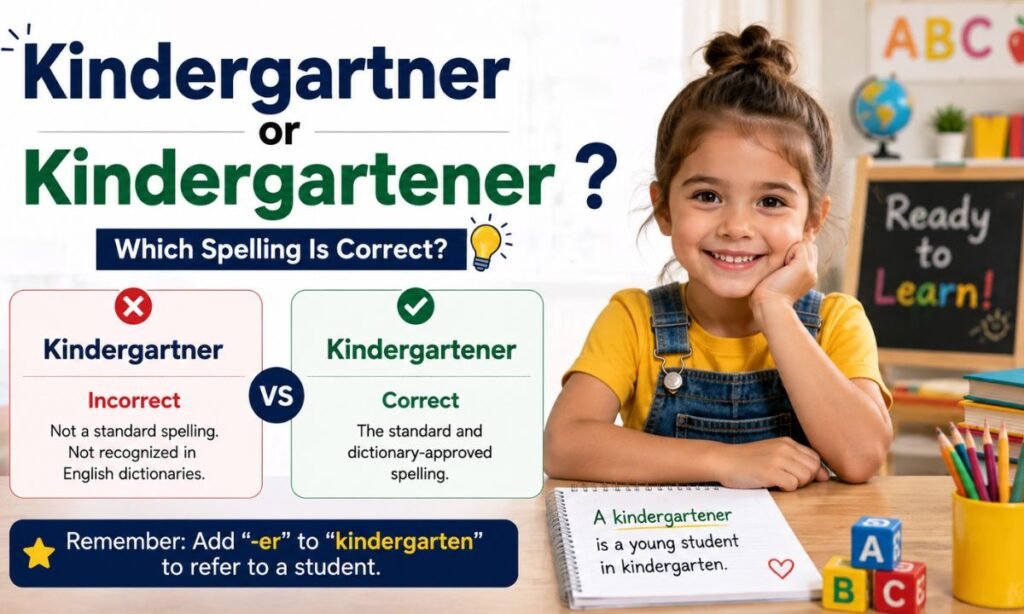

Every August, the same small argument shows up in group chats, classroom newsletters, and parenting forums: is it kindergartner or kindergartener? You type one version, spellcheck stays silent, and you’re left wondering if you just made it up. You didn’t. Both words exist, both show up in dictionaries, and both describe the same small human carrying a backpack twice their size on the first day of school.
This guide walks through where the word came from, how American and British writers treat it differently, which version shows up more in professional writing, and how to stop second-guessing yourself every September.
Kindergartner
Kindergartner is the shorter of the two spellings. It drops the second “e” that appears in “kindergarten” before adding the “-er” ending, the same way English builds words like teacher, painter, or runner. Most major American dictionaries, including Merriam-Webster, list this as the primary entry, and it’s the version you’ll see most often in news writing, style guides, and formal documents.
Kindergartener
Kindergartener keeps the full spelling of “kindergarten” intact and simply adds “-er” on top. It reads a little closer to how the word sounds when spoken aloud, which is probably why it feels so natural in casual writing, texts, and everyday conversation. Dictionaries list it as an accepted variant rather than an error.
Kindergartner or Kindergartener: Quick Answer
Both spellings are correct. Neither one is a typo, and neither will get flagged by an editor as wrong. The difference comes down to preference and setting, not grammar rules.
- Kindergartner — shorter, older, more common in American dictionaries and formal or journalistic writing.
- Kindergartener — longer, closer to natural pronunciation, common in casual and conversational contexts.
If you want a one-line rule to remember: when unsure, go with kindergartner, then stay consistent with that choice for the rest of your document.
You May Like: 31st or 31th: The Complete Guide to Getting It Right Every Time
The Origin of Kindergartner or Kindergartener
The story starts in Germany. “Kindergarten” is a direct borrowing of the German word meaning “children’s garden,” a term coined by educator Friedrich Fröbel in the 1830s. Fröbel believed young children learned best through guided play, much like a garden needs tending rather than forcing, and the name stuck when the concept spread internationally.
When English speakers needed a word for a child attending this program, they reached for a familiar pattern: take a noun, add “-er,” and you get a person who does that thing. A baker bakes, a driver drives, a kindergartner attends kindergarten. Dropping the extra “e” mirrored how English often simplifies borrowed or lengthy words for smoother pronunciation — think of how “burglar” never became “burglarer.”
Over time, though, plenty of writers and speakers kept the full spelling of “kindergarten” before adding the ending, since it matched how the word is actually pronounced out loud. That produced “kindergartener.” Neither version pushed the other out of use, and both settled into the language side by side, which is exactly why the debate still pops up in classrooms and comment sections today.
British English vs American English Spelling
Here’s a detail that surprises a lot of people: British English barely uses either word. In the UK, children this age are typically called “reception pupils” or simply described as being “in reception,” since the British school system doesn’t use the term “kindergarten” as a formal grade level the way American schools do. When British writers do use “kindergarten” — often in reference to private nurseries or international schools — they tend to borrow the American spelling conventions rather than having a distinct British form.
So this isn’t really a British-versus-American spelling battle in the way “colour” versus “color” is. It’s closer to an American English internal debate, with “kindergartner” as the dictionary-favored form and “kindergartener” as the widely accepted, commonly spoken alternative.
Comparison Table
| Feature | Kindergartner | Kindergartener |
|---|---|---|
| Spelling style | Shorter, drops the second “e” | Longer, keeps full “kindergarten” spelling |
| Dictionary status | Primary/preferred entry | Accepted variant |
| Common setting | News writing, formal documents, style guides | Casual speech, social media, everyday conversation |
| Pronunciation match | Slightly less phonetic | Closer to spoken pronunciation |
| Region | Used in American English | Used in American English (rare in British English) |
| Word pattern | Matches “teacher,” “painter,” “runner” | Matches “teenager,” “villager” |
Which Spelling Should You Use?
Pick based on your audience and your setting, then hold that choice steady across the whole piece.
- Writing for a newspaper, press release, or school district website? Go with kindergartner. It’s the version favored by AP-style writing and most professional editors.
- Writing a casual caption, text message, or classroom newsletter? Either spelling works fine, and kindergartener often feels more natural in that context.
- Filling out school forms or official paperwork? Check the form itself first — many districts have already picked one spelling, and matching it keeps your submission consistent.
- Writing for an international or academic audience? Lean toward kindergartner, since it’s the version more likely to appear in dictionaries and reference material outside the US.
The real mistake isn’t choosing the “wrong” spelling. It’s switching back and forth within the same document, which reads as sloppy even though both words are technically fine.
Common Mistakes with Kindergartner or Kindergartener
A few patterns trip people up beyond the basic spelling question.
- Mixing both spellings in one document. Using “kindergartner” in paragraph one and “kindergartener” in paragraph three looks like a typo even though each word is correct on its own.
- Adding an extra letter that doesn’t belong. Watch out for “kindergartner” being misspelled as “kindergardener” or “kindergardner” — the word is garten, not garden, even though the German root translates to garden.
- Getting the plural wrong. The plural forms follow the same pattern as the singular: kindergartners and kindergarteners, both with a simple “s” at the end, no apostrophe.
- Confusing the noun with the adjective. “Kindergarten” itself stays unchanged when used as a modifier, as in “kindergarten teacher” or “kindergarten classroom.” You wouldn’t say “kindergartner teacher.”
- Capitalizing kindergarten unnecessarily. More on this below, since it trips up even experienced writers.
A related capitalization note worth mentioning: AP style keeps “kindergarten” lowercase in general use, the same treatment given to “sophomore” or “freshman.” It only gets capitalized at the start of a sentence or when it’s part of an official proper name, like “Sunshine Kindergarten” or “Lincoln Elementary Kindergarten Program.” The same logic applies to “kindergarten teacher” — lowercase, unless it opens a sentence or sits inside a title.
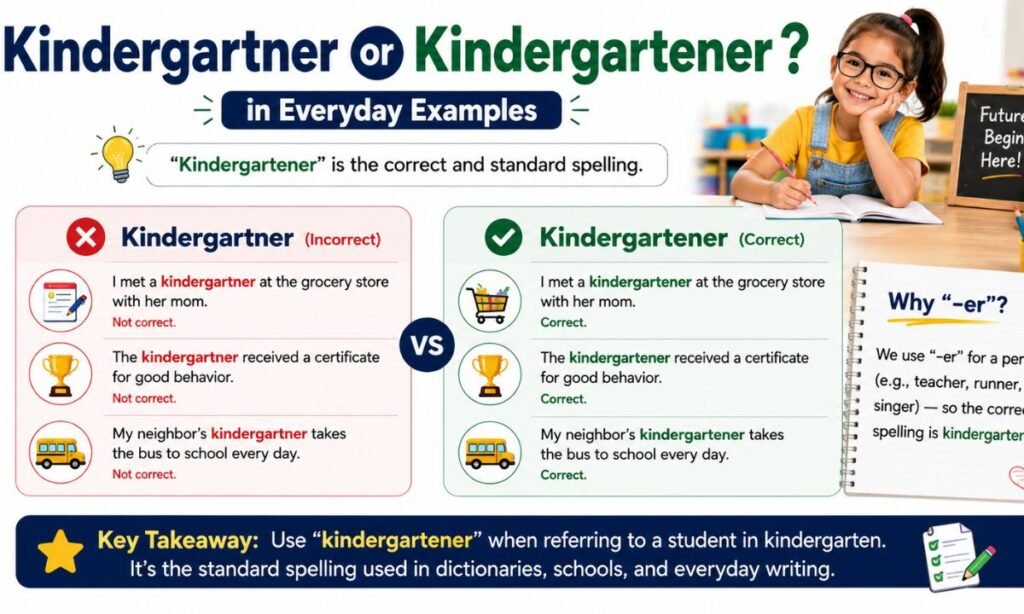
Kindergartner or Kindergartener in Everyday Examples
Emails
School emails tend to favor whichever spelling the district already uses in its official materials. A typical line might read: “Please remind your kindergartner to bring a labeled water bottle on Monday.” Consistency here matters more than which word you pick, since parents will notice if the spelling shifts between the subject line and the body text.
News Writing
Journalists lean toward kindergartner almost every time, following the lead of AP style and most major dictionaries. A local news story might read: “More than 400 kindergartners started their first day of school Tuesday morning across the district.”
Social Media
This is where kindergartener shows up most. Captions like “My kindergartener today!” or “Officially a kindergartener 🎒” feel warm and conversational, matching the tone people use when talking about their kids online.
Formal Writing
Academic papers, official reports, and published books tend to default to kindergartner, matching dictionary preference and reducing the chance of an editor flagging it during review.
You May Like: Speech or Speach: Which One Is Correct?
Kindergartner or Kindergartener: Google Trends & Usage Data
Search interest data and language corpus tools consistently show kindergartner as the more frequently used spelling in the United States, though the gap between the two isn’t wide. Google Ngram data, which tracks word frequency across millions of published books, shows both spellings rising and falling together over the decades, with kindergartner holding a modest but steady lead. That pattern lines up with what dictionaries report: one is listed first, the other is listed right beside it as fully acceptable.
In practice, this means neither word is fading out or taking over. Parents, teachers, and writers keep using both, and search engines return results for either spelling without treating one as a misspelling of the other.
Comparison Table: Kindergartner vs Kindergartener
| Category | Kindergartner | Kindergartener |
|---|---|---|
| Definition | Child attending kindergarten | Child attending kindergarten |
| Correctness | Correct | Correct |
| Preferred in | Formal writing, journalism, dictionaries | Informal speech, social captions |
| Search popularity | Slightly higher | Slightly lower |
| Plural form | Kindergartners | Kindergarteners |
| Example sentence | “He’s a kindergartner this fall.” | “She’s a kindergartener this fall.” |
Frequently Asked Questions
Is it kindergartner or kindergartener?
Both spellings are correct and mean the same thing. “Kindergartner” is more common in dictionaries and formal writing, while “kindergartener” is widely used in casual and spoken contexts.
Who is a kindergartner?
A kindergartner is a child, typically around five years old, who is enrolled in kindergarten, their first year of formal schooling.
Why do Americans call kindergarten kindergarten?
The term comes from German, meaning “children’s garden,” coined by educator Friedrich Fröbel, and it was adopted into American English along with the early childhood education model he developed.
What do you call a child who goes to kindergarten?
You can call them a kindergartner or a kindergartener — both terms are accepted and used interchangeably across American English.
Conclusion
The kindergartner-versus-kindergartener question doesn’t have a losing side. One spelling trims the word down for print and formality, the other keeps it closer to how it sounds when spoken. Dictionaries accept both, editors rarely reject either, and readers understand exactly what you mean no matter which one lands on the page.
If you write for a newspaper, a school district, or anything with a formal tone, reach for kindergartner. If you’re writing a caption for a proud first-day-of-school photo, kindergartener fits just as well. The only real rule left is the one that applies to almost every spelling choice in English: pick one, and stick with it for the rest of the piece.