
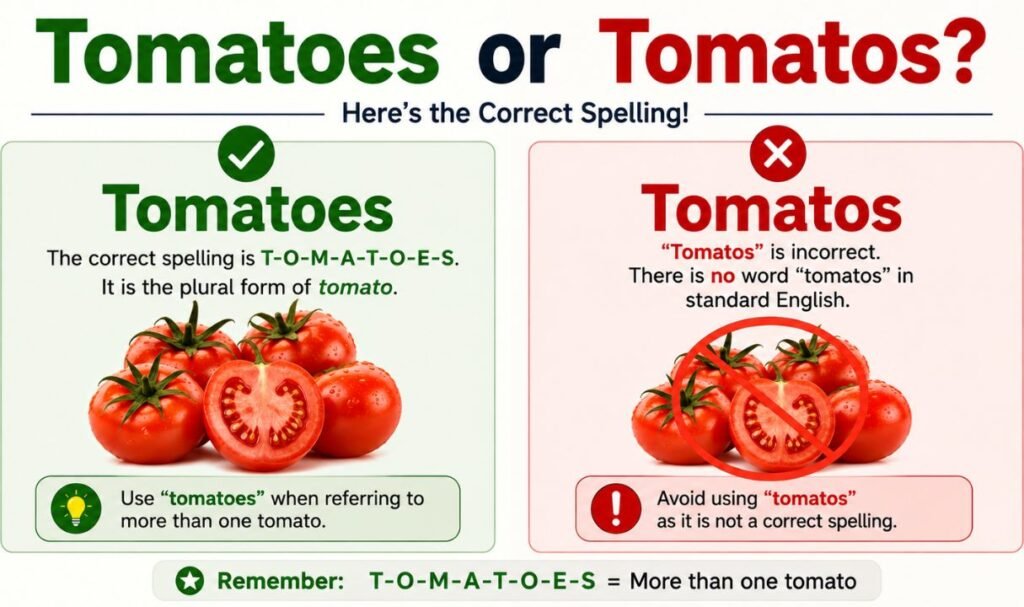

Few words trip up English writers as often as this one. You’re typing a grocery list, a recipe, or a school essay, and suddenly you freeze: is it tomatoes or tomatos? The word looks like it should just take an “s,” yet something about “tomatos” feels off.
Here’s the short answer: tomatoes is correct. Tomatos is a misspelling, full stop. But knowing the rule isn’t the same as understanding it, and once you see why English handles this word the way it does, you’ll never second-guess yourself again. This guide walks through the spelling, the grammar behind it, the word’s history, and a few memory tricks that actually stick.
What the Word “Tomato” Actually Means (And Why It Matters to Spell It Right)
A tomato is the round, juicy fruit of the plant Solanum lycopersicum, typically red when ripe, though yellow, orange, and green varieties exist. Botanically, it’s a fruit. In the kitchen and at the grocery store, everyone treats it as a vegetable.
That everyday, casual use is exactly why spelling matters here. Tomatoes show up in recipes, menus, shopping lists, gardening blogs, school assignments, and business copy. A misspelled plural in a printed menu or a product label doesn’t just look careless — it can quietly undermine how trustworthy your writing seems, even when the content itself is solid.
The Real Reason This Debate Exists: English’s Messy Plural Rules
Most English nouns become plural with a simple added “s.” Cat becomes cats. Book becomes books. Table becomes tables. So it’s completely reasonable that someone would apply that same logic to tomato and land on “tomatos.”
The problem is that words ending in “-o” don’t all follow the same path. Some take only “-s” (photos, pianos, videos). Others take “-es” (tomatoes, potatoes, heroes). There’s no single rule stamped across every “-o” word, which is exactly why this particular plural causes so much confusion, even among fluent native speakers.
You May Like: 31st or 31th: The Complete Guide to Getting It Right Every Time
So Which Is Correct—Tomatoes or Tomatos?
✔ Correct: Tomatoes
“Tomatoes” is the only accepted plural form of “tomato” in both American and British English. It appears this way in every major dictionary, style guide, and grammar reference. There’s no regional variant, no informal exception, and no context where “tomatos” becomes acceptable.
✘ Incorrect: Tomatos
“Tomatos” is a common spelling mistake, not an alternate spelling. It usually comes from over-applying the basic “add an s” rule without accounting for how words ending in a consonant plus “o” behave differently.
| Form | Status | Example Sentence |
|---|---|---|
| Tomatoes | Correct | She added fresh tomatoes to the salad. |
| Tomatos | Incorrect | ~~She added fresh tomatos to the salad.~~ |
Understanding “-ES” Plurals for Words Ending in -O
English groups “-o” nouns into rough patterns based on what comes right before the final “o.”
When the word ends in a consonant + O → add -ES
When a noun ends in a consonant immediately followed by “o,” the plural usually takes “-es.” Tomato fits this pattern exactly: the “t” right before the final “o” is a consonant, so the plural becomes tomatoes, not tomatos.
Other words that follow this same consonant + “o” pattern include potato/potatoes, hero/heroes, and echo/echoes. Compare that with words like radio or video, where a vowel sits right before the final “o” — those simply add “-s” (radios, videos), because the vowel already smooths out the pronunciation.
Why “Tomatoes” Takes -ES: The Linguistic Explanation
There isn’t one single reason tomato behaves this way. Three separate factors line up together.
1. Origin (Borrowed Word Behavior)
Tomato entered English as a borrowed word, not a native one. Borrowed words often keep or adapt spelling patterns from the language that shaped their pronunciation, and English tends to apply its consonant-plus-“o” plural rule more consistently to these imported terms.
2. Phonetics (How It Sounds)
Say “tomatos” out loud and then “tomatoes.” The “-es” ending creates a smoother, more natural syllable break after a consonant-plus-“o” word. English plural rules were shaped over centuries partly by what’s easiest to pronounce clearly, and “-es” simply reads and sounds better after that final consonant-o combination.
3. Standardization (Dictionaries + Education)
Once a spelling gets locked into dictionaries, style guides, and school curricula, it becomes the fixed standard regardless of how logical an alternative might seem. “Tomatoes” has been the standardized form for so long that “tomatos” never gained any foothold as an accepted variant, in the US, the UK, or anywhere else English is taught.
Origin of the Word “Tomato” (Short But Important)
The word traces back to the Nahuatl (Aztec) term tomatl. Spanish colonizers picked it up as tomate after encountering the plant in the Americas, and the word spread into English from Spanish and French sources in the 16th and 17th centuries. The spelling settled into “tomato” in English, and the plural followed the standard consonant + “o” pattern that had already applied to other borrowed food words.
Examples of “Tomatoes” Used Correctly in Sentences
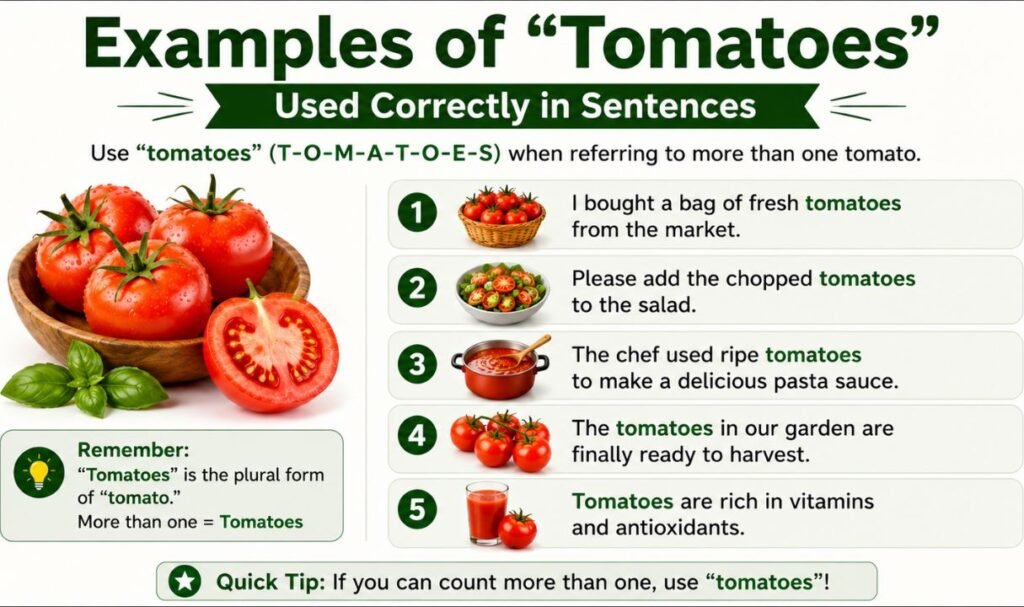
Correct Usage
- Fresh tomatoes add color and flavor to almost any summer dish.
- The farmer harvested three crates of ripe tomatoes this morning.
- She grows heirloom tomatoes in raised garden beds every year.
- Add the chopped tomatoes once the onions have softened.
- The recipe calls for two large tomatoes, diced.
Incorrect Usage
- ~~He bought red tomatos from the grocery store.~~
- ~~I love green tomatos in pickles.~~
- ~~Restaurants serve fresh tomatos in salads.~~
Common Spelling Errors People Make (And Why They Happen)
1. Over-applying the photo rule
Because “photos” only needs an “s,” many writers assume every “-o” word follows suit. Photo ends in a vowel plus “o,” though, which puts it in a different category entirely.
2. Phonics confusion
Kids and English learners often write words the way they sound rather than the way they’re spelled. Since “tomatoes” is pronounced close to “tuh-MAY-tohz,” the “e” doesn’t stand out audibly, so it gets dropped on the page.
3. Fast typing + autocorrect
When people type quickly on a phone or in a rush, autocorrect doesn’t always catch “tomatos” as an error, especially in casual messaging apps with looser spell-check settings.
4. Exposure to bad spelling online
Social media captions, forum posts, and unedited product listings are full of the same mistake repeated over and over. Seeing “tomatos” enough times can make it start to look right, even though it never was.
You May Like: Kindergartner or Kindergartener: Which Spelling Is Correct
Other Words That Follow the Same Pattern as “Tomatoes”
| Singular | Plural |
|---|---|
| Potato | Potatoes |
| Hero | Heroes |
| Echo | Echoes |
| Volcano | Volcanoes (or volcanos) |
| Torpedo | Torpedoes |
| Mosquito | Mosquitoes (or mosquitos) |
Words Ending in -O That Don’t Add -ES
| Singular | Plural |
|---|---|
| Photo | Photos |
| Piano | Pianos |
| Video | Videos |
| Radio | Radios |
| Zoo | Zoos |
| Studio | Studios |
Notice the pattern: most of the “-s only” words either end in a vowel before the final “o,” or they’re shortened forms, loanwords from music and technology, or relatively modern additions to English. Food words with older, more established roots — tomato, potato, echo — tend to follow the “-es” rule instead.
How to Always Remember the Correct Spelling “Tomatoes”
1. The Potato Rule
If you already know potato becomes potatoes, apply the same logic to tomato. The two words are practically twins in how they behave.
2. The “Two Syllable” Trick
Longer, older “-o” words ending in a consonant tend to take “-es.” If the word feels established and food-related, lean toward the “-es” ending.
3. The Food Rule
Most food words ending in consonant + “o” take “-es”: tomatoes, potatoes, mangoes. This isn’t universal across every “-o” word, but it’s a solid instinct check specifically for food vocabulary.
4. The “Add an E to Eat” Trick
Both “eat” and “tomatoes” contain an “e.” A slightly silly link, but memorable ones tend to stick better than dry grammar rules.
5. The Spanish Memory Hook
Tomato came from the Spanish tomate. Picture the Spanish spelling for a second, then remember English adds “-es” rather than a bare “-s” to close out the plural.
Case Study: Tomato Spelling Errors in the Real World
Spelling slips like this aren’t just a classroom problem. Grocery chains, restaurant menus, and small business signage have printed “tomatos” on labels, chalkboards, and packaging more than once, only to reprint materials after customers and copy editors flagged the error. For a business, a single missing letter on printed signage or packaging can mean real reprinting costs and a small dent in perceived professionalism. It’s a useful reminder that correct spelling isn’t just a grammar-class concern — it shows up in real budgets and real brand impressions.
A Quick Reference Table: Tomato Plural Rules
| Question | Answer |
|---|---|
| Correct plural of tomato | Tomatoes |
| Is “tomatos” ever correct | No |
| Rule that applies | Consonant + “o” → add “-es” |
| US vs UK spelling difference | None — both use “tomatoes” |
| Similar words | Potatoes, heroes, echoes |
| Exceptions to watch for | Photos, pianos, videos (vowel + “o” → add “-s” only) |
Frequently Asked Questions
What is correct, tomatos or tomatoes?
Tomatoes is correct. Tomatos is a common misspelling and is never accepted in standard English.
Is it Potatos or potatoes?
Potatoes is correct, following the same consonant + “o” rule as tomatoes.
Which is correct, tomato or tomatoe?
Tomato (no “e”) is correct for the singular. The “e” only appears in the plural form, tomatoes.
How do Americans spell tomatoes?
The same way the British do: tomatoes. There’s no US/UK spelling difference for this word.
Conclusion
The tomatoes-versus-tomatos mix-up isn’t really about tomatoes at all — it’s about how English handles borrowed words ending in a consonant plus “o.” Once that pattern clicks, so do dozens of other tricky plurals, from potatoes to heroes to echoes.
So the next time your fingers hover over the keyboard, trust the rule: one tomato, two tomatoes, always with the “e.” Write it, print it, and say it with confidence.