

If you’ve ever paused mid-sentence wondering whether to type “cognisant” or “cognizant,” you’re not alone. Both spellings show up in dictionaries, both sound identical when spoken aloud, and both mean the same thing. The confusion isn’t about meaning — it’s about geography.
This guide breaks down exactly where each spelling comes from, when to use one over the other, and how to avoid the small mistakes that make writing look inconsistent.
Cognisant
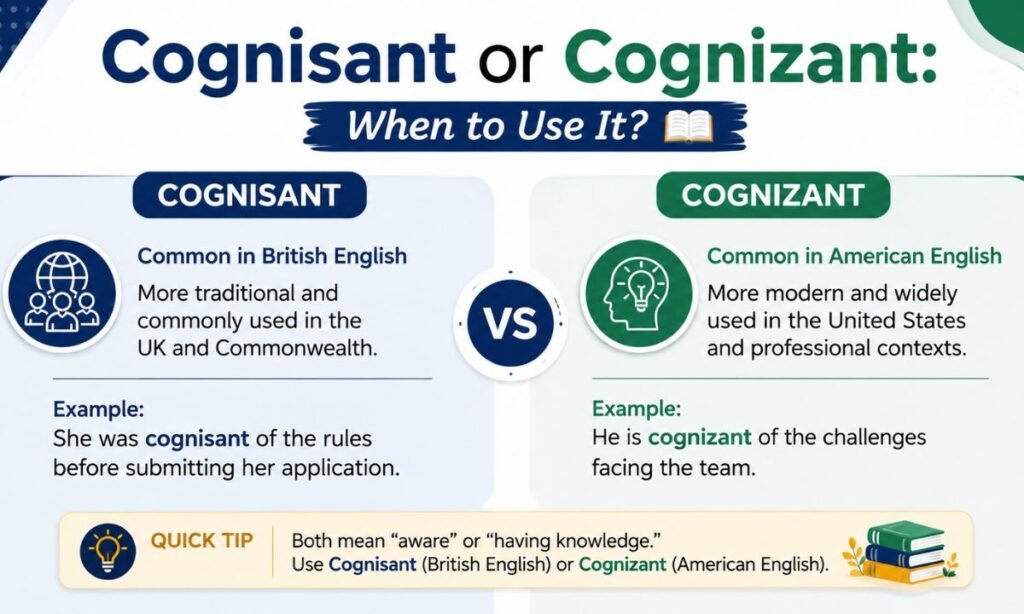
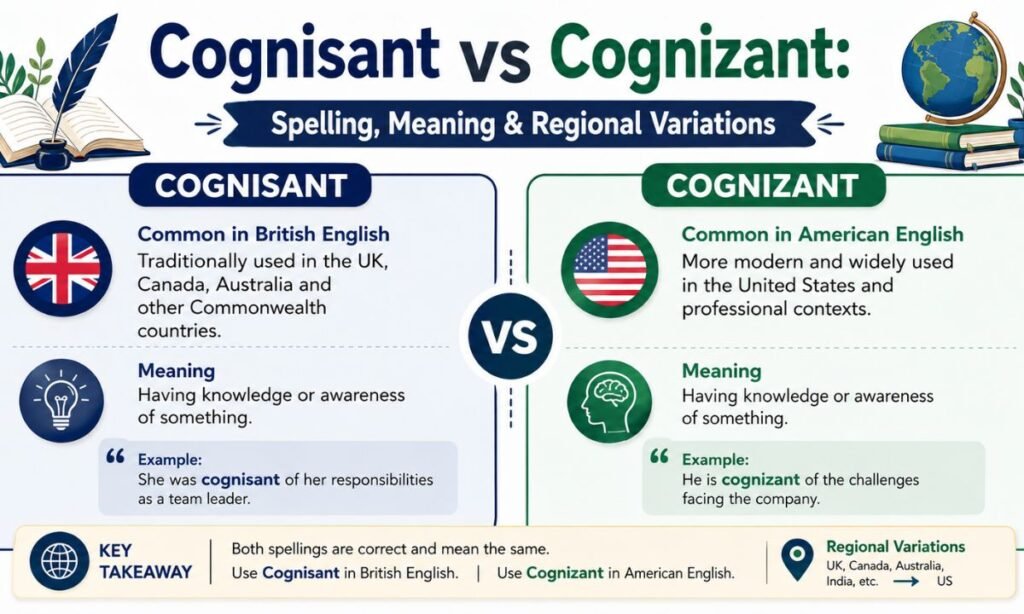
Cognisant is the spelling favored in British English, Australian English, and most Commonwealth countries. It follows the same pattern as words like “organise,” “realise,” and “recognise,” where the “s” replaces the “z” found in American spelling conventions.
Cognizant
Cognizant is the standard American English spelling. It’s also the form most style guides and major dictionaries list first, since American publishing conventions dominate a large share of online content. If you’re writing for a U.S. audience or an international business audience, this is generally the safer default.
Cognisant or Cognizant: Quick Answer
Here’s the short version, if you’re in a hurry:
- Writing for American readers? Use cognizant.
- Writing for British, Australian, or Indian readers? Use cognisant.
- Writing for a mixed, global audience? Either works, but pick one and stay consistent through the entire document.
Both words mean the same thing: aware of, informed about, or having knowledge of something. Neither spelling is “more correct” than the other — they’re regional variants, similar to color and colour, or organize and organise.
The Origin of Cognisant / Cognizant
The word traces back to the Latin cognoscere, meaning “to know” or “to become acquainted with.” From there it passed into Old French as conoissant, a present participle of conoistre — again meaning “to know.”
English absorbed the term through Anglo-French roughly around the 15th to 17th century, initially in legal and academic writing, where precise language about awareness and knowledge mattered. Over time, the word split along the same lines as many other English words with Latin roots: British usage kept closer to the French-influenced “-isant” pattern, while American usage moved toward the “-izant” form, matching the wider American preference for “z” over “s” in words like realize and organize.
Interestingly, historical language data shows the split wasn’t always so clean. Early written records show “cognisant” appearing in British texts well into the 20th century, but usage patterns have shifted noticeably since the 1960s, with “cognizant” gaining ground even in the UK. Despite that shift, “cognisant” remains the recognized standard in formal British writing today.
You May Like: 31st or 31th: The Complete Guide to Getting It Right Every Time
British English vs American English Spelling
The cognisant/cognizant split fits into a much bigger pattern in English spelling. British English generally prefers “s” in words where American English uses “z,” particularly in verbs ending in “-ise/-ize” and their related adjectives and nouns.
| British English | American English |
|---|---|
| Organise | Organize |
| Realise | Realize |
| Recognise | Recognize |
| Cognisant | Cognizant |
| Analyse | Analyze |
This pattern isn’t universal — some British style guides (including certain Oxford publications) actually accept “-ize” endings as a valid alternative, since the “z” spelling has older historical roots in English than many people assume. Still, for everyday British writing, “cognisant” with an “s” remains the expected form.
Which Spelling Should You Use?
Choosing between the two comes down to two main factors: who you’re writing for, and what kind of document you’re producing.
1. Audience Based Advice
Think about where your readers are located and what spelling conventions they already expect.
- U.S. audience → use cognizant
- UK, Australian, or Indian audience → use cognisant
- Global or mixed audience → default to cognizant, since American spelling tends to be more widely recognized online, though cognisant is equally understood
- Company style guide exists → follow that guide over personal preference
2. Academic & Professional Writing
In academic papers, legal documents, and professional correspondence, consistency matters more than which spelling you choose. A single document that mixes both forms looks careless, even if each individual instance is technically valid somewhere in the English-speaking world.
A few practical rules:
- Set your word processor’s language/region setting before you start writing, so autocorrect doesn’t quietly switch spellings on you.
- If you’re submitting work to a specific journal, follow that journal’s house style, not your personal habit.
- For business emails sent internationally, cognizant is generally the safer choice, since it’s the form most non-native English speakers encounter first through American media and software.
Cognisant vs Cognizant: Spelling, Meaning & Regional Variations
Meaning and Usage
Both words describe a state of awareness or informed understanding. Someone who is cognisant (or cognizant) of a situation knows about it, recognizes its significance, and isn’t ignoring it.
Cognisant or cognizant meaning: aware of something, especially a fact, situation, or consequence; informed and mindful of relevant details.
Cognisant meaning: identical to cognizant — having knowledge or awareness of a fact, condition, or circumstance. The “s” spelling carries no different shade of meaning; it’s purely regional.
- Cognisant or cognizant UK spelling: UK writing defaults to cognisant, matching British conventions for words like “organise” and “realise.”
- Cognisant or cognizant in a sentence: “The manager was cognizant of the budget constraints before approving the project” (US) or “The manager was cognisant of the budget constraints before approving the project” (UK).
- Cognisant or cognizant pronunciation: both are pronounced the same way — “KOG-ni-zuhnt.” The spelling difference doesn’t change how the word sounds.
- Cognisant or cognizant synonym: aware, conscious, mindful, informed, knowledgeable, alert to.
- Cognisant or cognizant oxford dictionary: the Oxford English Dictionary lists both spellings, with British usage examples typically showing the “-isant” form and international/American examples showing “-izant.”
Spelling Clarification
If you remember nothing else, remember this: the letter “z” points to the American spelling. American English uses “z” the way British English leans on “s” in this word family, so “cognizant” with a “z” belongs with U.S. writing, and “cognisant” with an “s” belongs with British writing.
You May Like: Speech or Speach: Which One Is Correct?
Common Mistakes with Cognisant / Cognizant
A few errors show up again and again in professional and academic writing:
- Mixing spellings in the same document. Writing “She remained cognisant of the risks, but he was not cognizant of the deadline” in one piece looks inconsistent, even though both words are individually correct.
- Confusing cognizant with cognitive. These are related in root but different in meaning — more on this below.
- Assuming one spelling is “wrong.” Neither form is a misspelling. They’re regional equivalents, not an error and a correction.
- Overusing the word in formal writing. Because it sounds sophisticated, writers sometimes reach for “cognizant” repeatedly instead of varying their vocabulary with “aware,” “mindful,” or “informed.”
- Mispronouncing it based on spelling. Some readers assume “cognisant” is pronounced with a soft “s” sound, but it’s still pronounced with a “z” sound regardless of spelling.
Cognisant or Cognizant in Sentences and Real Usage
1. Basic Sentence Examples
- The board was fully cognizant of the financial risks before signing the deal.
- She was cognisant of her colleague’s workload and offered to help.
- Employees must remain cognizant of the new safety regulations.
- He seemed cognisant of the tension in the room but chose not to address it.
2. Cognisant vs Conscious
“Conscious” and “cognizant” overlap but aren’t perfect substitutes. “Conscious” often relates to a physical or mental state of being awake or aware in a general sense — “she was conscious after the surgery.” “Cognizant” more often refers to awareness of a specific fact, risk, or situation — “she was cognizant of the surgical risks before signing the consent form.” In many everyday sentences, though, the two words are close enough to swap without changing the meaning much.
3. UK vs US Sentence Style
| Context | UK Example | US Example |
|---|---|---|
| Business report | “The team was cognisant of the deadline pressure.” | “The team was cognizant of the deadline pressure.” |
| Legal writing | “The defendant was cognisant of the contract terms.” | “The defendant was cognizant of the contract terms.” |
| Casual writing | “I’m cognisant that this might sound strange.” | “I’m cognizant that this might sound strange.” |
4. Quick Usage Tips
- Pick a spelling based on your audience, then stick with it throughout the piece.
- Use a spell-checker set to the correct regional dictionary (UK English vs US English) to catch accidental switches.
- In formal writing, prefer “aware” or “mindful” if you want a simpler, more universally understood word.
5. Common Search Based Clarifications
People frequently search this topic because they’re worried about looking unprofessional. The short answer: both spellings are dictionary-approved, and the “mistake” isn’t choosing the “wrong” one — it’s switching between them inconsistently within the same document.
Cognisant / Cognizant in Everyday Examples
Beyond formal writing, the word shows up often in workplace communication, journalism, and everyday conversation:
- “Be cognizant of your surroundings when walking alone at night.”
- “Investors should remain cognisant of market volatility.”
- “The company says it’s cognizant of customer concerns about pricing.”
- “Teachers need to be cognizant of different learning styles in the classroom.”
Notice how the word almost always pairs with “of” — cognizant of something. That’s the standard grammatical pattern, and dropping the “of” usually sounds incomplete.
Cognisant / Cognizant: Google Trends & Usage Data
Search and usage data over the past century tells an interesting story. Through the early 1900s, “cognisant” was the more common spelling even outside Britain. But from roughly the 1960s onward, “cognizant” began overtaking “cognisant” in global usage, partly due to the growth of American publishing, media, and later, the internet.
Today, “cognizant” appears far more frequently in global search volume and web content overall, simply because American English dominates so much of the internet’s written content. That doesn’t make “cognisant” outdated — it’s still the expected form in British, Australian, and Indian English — but it does explain why “cognizant” feels like the more familiar spelling to many readers worldwide.
Comparison Table: Cognisant vs Cognizant
| Feature | Cognisant | Cognizant |
|---|---|---|
| Region | British English, Australian English, Indian English | American English, Canadian English |
| Dictionary status | Valid variant | Standard/default spelling |
| Pronunciation | Same (“KOG-ni-zuhnt”) | Same (“KOG-ni-zuhnt”) |
| Meaning | Aware, informed, mindful | Aware, informed, mindful |
| Common in | UK news, formal British writing | US business writing, global tech content |
| Word origin | Latin cognoscere via Old French | Latin cognoscere via Old French |
Frequently Asked Questions
What is the difference between cognizant and cognisant?
Only the spelling differs — cognizant is American English, cognisant is British English. The meaning and pronunciation are identical.
What does cognisant mean?
It means being aware of, informed about, or having knowledge of a particular fact or situation.
Is IT spelled cognisant or cognizant?
Both are correct; use cognisant for British/Australian audiences and cognizant for American audiences.
What is the difference between cognizant and cognitive?
Cognizant means “aware,” while cognitive relates to mental processes like thinking, learning, and memory — they share a root but describe different things.
Conclusion
Cognisant and cognizant are two spellings of the same word, split along regional lines rather than any real difference in meaning. If you’re writing for American readers, go with cognizant. If your audience is British, Australian, or Indian, cognisant fits better. For anything aimed at a broad, international readership, cognizant tends to read as the more globally familiar option, though either spelling will be understood almost anywhere English is spoken.