
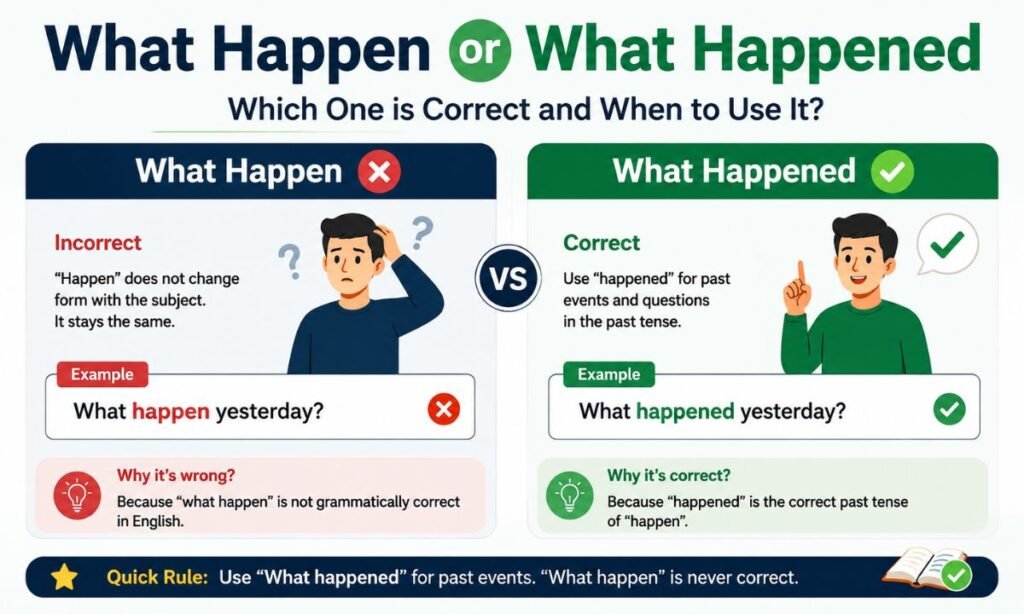

Ask ten people whether it’s “what happen” or “what happened,” and most will pause before answering. That hesitation is normal. English learners, texters, and even native speakers trip over this pair constantly, usually because casual speech has trained our ears to accept a shortcut that formal grammar doesn’t allow.
Here’s the short version: “What happened” is correct. “What happen” is not standard English, no matter how often you see it in a text message or a comment section. But knowing the answer isn’t the same as understanding why — and understanding why is what actually stops you from making the mistake again. This guide walks through the grammar, the exceptions, the real-life examples, and the small rule that makes the whole thing click.
Understanding Why “What Happen” Feels Right
If “what happen” is wrong, why does it sound so natural to so many people? A few reasons stand out.
First, spoken English moves fast. Native speakers often blur or soften the final “-ed” sound in casual conversation, so “happened” can come out sounding closer to “happen” or “happen’d.” Learners who pick up English by ear, rather than by reading it, sometimes copy the sound rather than the spelling.
Second, many other languages don’t mark past tense with a verb ending the way English does. A learner translating directly from a language that handles time through context, or through a separate word entirely, may not instinctively reach for “-ed.”
Third, there’s the influence of texting and social media. Typing fast means people drop letters, skip punctuation, and lean on whatever feels quickest. “What happen?” is shorter to type than “What happened?” and in an informal chat, nobody corrects it. Over time, that repetition makes the incorrect version feel familiar, even though familiarity isn’t the same as correctness.
None of these explanations make “what happen” acceptable in writing or formal speech. They just explain why the error is so common — and why it’s worth fixing early rather than letting it become a habit.
How Verb Tenses Communicate Time
Verb tense is how English tells you when something happened, without needing to add extra words every time. Change the verb, and you change the timeline.
- Present tense describes something happening now or something that happens regularly. Example: “Accidents happen.”
- Past tense describes something that already took place. Example: “The accident happened last night.”
- Future tense describes something that hasn’t occurred yet. Example: “Something unexpected will happen tomorrow.”
That small shift from “happen” to “happened” isn’t decoration. It’s the entire signal that tells your listener whether you’re talking about a completed event or an ongoing one. Skip it, and the sentence loses its timestamp.
| Tense | Form | Example |
|---|---|---|
| Present | happen(s) | “This happens every winter.” |
| Past | happened | “This happened last winter.” |
| Future | will happen | “This will happen again next winter.” |
Understanding the Verb Happen
“Happen” is a regular intransitive verb, meaning it doesn’t take a direct object and it follows the standard pattern for forming its past tense: add “-ed.”
| Base Form | Past Tense | Past Participle | Present Participle |
|---|---|---|---|
| happen | happened | happened | happening |
There’s no irregular twist here — no hidden spelling change like “go” becoming “went.” “Happen” simply adds “-ed,” the same way “walk” becomes “walked” or “call” becomes “called.” That regularity is actually good news: once you know the rule, there’s nothing else to memorize.
The verb describes something occurring or taking place, usually without a clear cause stated. “The storm happened suddenly.” “Nobody knows what happened.” It’s one of the most common verbs in English precisely because it’s so flexible — it works in casual conversation, in news reports, and in formal writing alike.
Why “What Happen” Is Grammatically Incorrect
Here’s the grammatical core of the issue: when you’re asking about a completed event, English requires a past-tense verb, and “what happen” simply doesn’t have one.
In a normal past-tense sentence, you’d either use the simple past (“It happened”) or an auxiliary verb plus the base form (“It did happen”). “What happen” does neither. It leaves the verb in its bare present form while trying to describe something that already occurred, and that mismatch is what makes it read as broken English.
Think of it this way: the sentence needs exactly one marker of past tense. That marker can live in the main verb (“happened”) or in a helping verb (“did”). “What happen” has neither, so it has zero past markers for a question that clearly needs one.
Compare:
- ❌ What happen at the party? — no past-tense marker anywhere in the sentence
- ✅ What happened at the party? — the verb itself carries the past tense
- ✅ What did happen at the party? — the helping verb “did” carries the past tense, so “happen” stays in base form
That third example matters, because it shows “happen” isn’t always wrong — it just needs support from an auxiliary verb when it’s not carrying the tense itself.
Why “What Happened” Works
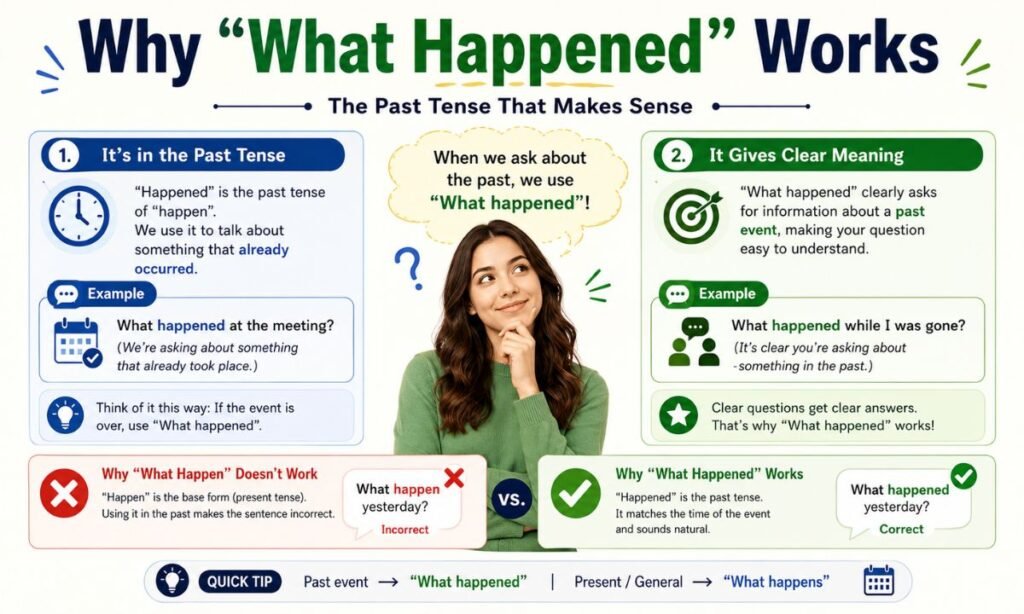
“What happened” works because it follows the basic rule of subject questions in English: when “what” is the subject of the sentence, you don’t add an auxiliary verb. You simply put the verb straight into its past-tense form.
That’s different from how most past-tense questions are built. Normally, you’d invert the sentence with “did”: “Did you see the movie?” But “what happened” isn’t asking about something someone did to an object — “what” itself is the one doing the happening. It’s the subject, not the object, and subject questions skip the auxiliary entirely.
So “What happened?” is grammatically complete on its own. It doesn’t need “did” in front of it, and adding one — “What did happened?” — is actually a separate, equally common mistake, because now you’ve got two past-tense markers stacked on top of each other.
Subject Questions vs Object Questions
This distinction is the real key to the whole topic, and once it clicks, you’ll rarely mix these phrases up again.
Subject questions ask about who or what is performing the action. The question word itself takes the subject’s place, so the verb stays in its normal tense — no auxiliary needed.
- What happened?
- Who called you?
- What broke the window?
Object questions ask about the thing being acted upon. Here, the subject stays in its usual spot, and you need an auxiliary verb (“did,” “does,” “do”) to form the question correctly.
- What did you do?
- What does she want?
- What did the storm break?
| Question Type | Structure | Example |
|---|---|---|
| Subject question | Question word + past-tense verb | What happened? |
| Object question | Question word + auxiliary + subject + base verb | What did you see? |
“Happen” almost always shows up in subject questions, because you’re rarely asking who or what “happened” something to — you’re asking what the event itself was. That’s precisely why “what happened” needs no helper verb, while “what did you do” does.
What Happen or What Happened: Quick Reference
| Phrase | Correct? | When to Use |
|---|---|---|
| What happen? | ❌ No | Never — missing tense marker |
| What happened? | ✅ Yes | Asking about a completed past event |
| What happens? | ✅ Yes | Asking about a general or repeated event |
| What will happen? | ✅ Yes | Asking about a future event |
| What did happen? | ✅ Yes (with emphasis) | Contrastive or emphatic past question |
| What happen to you? | ❌ No | Common error, especially in texting |
| What happened to you? | ✅ Yes | Standard correct phrasing |
When to Use “What Happened”
Reach for “what happened” whenever the event you’re asking about is already finished. A few common situations:
- Recounting an incident. “What happened at the meeting?”
- Checking on someone after an event. “What happened to your arm?”
- Investigating a past outcome. “What happened to the missing package?”
- Writing narrative or news content. “What happened next changed everything.”
- Formal correspondence. “Please explain what happened during the incident.”
If your sentence includes — or implies — a time marker like yesterday, last night, earlier, this morning, or already, “what happened” is almost certainly the form you need.
- What happen or what happened meaning: the meaning is identical — both are trying to ask about an event — but only “what happened” carries that meaning correctly in standard grammar. “What happen” isn’t a different meaning; it’s simply an incomplete version of the same question.
- What happen or what happened in a sentence: in a full sentence, “happened” fits naturally as the main verb (“I want to know what happened”), while “happen” only fits when paired with a helper (“I want to know what did happen” or “what will happen”).
- What happen or what happened synonym: if you want alternatives, try “What occurred?”, “What took place?”, or “What went on?” — all of these use correct past-tense structure the same way “what happened” does.
- What happen or what happened answer: the direct answer is “what happened” — it’s the version accepted in grammar guides, dictionaries, and style manuals.
- What happen or what happened examples: see the comparison table above and the real-life section below for side-by-side sentences.
- What happen is correct: only in the narrow case where it’s paired with a helping verb, such as “what did happen” or “what will happen.” On its own, “what happen” is not correct.
- What happen meaning: as a standalone phrase, it doesn’t have a distinct meaning of its own — it’s simply a grammatically incomplete attempt at asking “what happened.”
- What happen to you or What happened to you: “What happened to you?” is the correct form, commonly used to ask about an injury, a change, or an unexpected situation someone experienced.
Why “What Happen” Should Be Avoided
Some might argue that meaning still comes through even with the wrong tense, and that’s often true in casual chat. But avoiding “what happen” matters for a few concrete reasons:
- Clarity. Dropping the tense marker can momentarily confuse a reader or listener about whether you’re asking about now, later, or before.
- Professionalism. In emails, reports, interviews, and any formal writing, grammatical slips undercut your credibility, even if the reader understands your intent.
- Consistency. Once you build the habit of skipping “-ed,” it tends to bleed into other verbs too, compounding small errors across your writing.
- Testing and exams. Standardized English tests and academic grading consistently mark “what happen” as incorrect.
None of this means casual texting has to follow textbook grammar to the letter. But knowing the rule — and choosing when to bend it — is very different from not knowing it at all.
Spoken English vs Written English
Grammar doesn’t vanish in conversation, but it does get looser. Native speakers frequently soften unstressed syllables, so “happened” can sound like “happen” in fast, casual speech. A friend might ask, “What happen last night?” and be understood perfectly, because tone, context, and shared knowledge fill in the gaps.
Written English doesn’t have that safety net. There’s no tone of voice, no facial expression, no shared context to lean on — just the words on the page. That’s why written communication holds a tighter standard, and why “what happened” is the only acceptable choice in essays, emails, reports, articles, and any text meant to be read rather than heard.
| Context | Acceptable Form | Notes |
|---|---|---|
| Texting a close friend | What happen? (informal, still flagged as incorrect) | Understood through context, but not grammatically correct |
| Casual conversation | What happened? (may sound softened) | Native speakers still intend the correct form |
| Emails, reports, essays | What happened? | Only correct written form |
| Exams and academic writing | What happened? | Required for full marks |
Common Mistakes Related to “What Happened”
Even people who know the rule slip into related errors. Watch for these:
- “What did happened?” — Doubling the past tense. Choose one: either “what happened” or “what did happen.”
- “What’s happen?” — Mixing present tense “happen” with a contraction meant for “is” or “has.” Should be “What’s happening?” or simply “What happened?”
- “What happen to you?” — Missing the past-tense ending entirely, especially common in quick messages.
- Using “happened” for future or general events. “What happened tomorrow?” doesn’t work — future events need “will happen.”
- Confusing “happen” with “happens.” “Happens” is present tense for habitual or general events (“This happens a lot”), not a substitute for the past tense.
Real-Life Examples: Correct vs Incorrect Usage
| Incorrect | Correct | Context |
|---|---|---|
| What happen at the party? | What happened at the party? | Asking about a finished event |
| What happen to your car? | What happened to your car? | Asking about damage or a change |
| I don’t know what happen. | I don’t know what happened. | Reporting uncertainty about a past event |
| Tell me what happen yesterday. | Tell me what happened yesterday. | Time marker “yesterday” confirms past tense |
| What happen next in the story? | What happened next in the story? | Narrative recount |
| What did happened at work? | What did happen at work? / What happened at work? | Avoiding double past-tense marking |
A quick scenario makes the difference obvious. Imagine two coworkers texting after a long day:
Incorrect: “Hey, what happen in the meeting? You looked stressed after.” Correct: “Hey, what happened in the meeting? You looked stressed after.”
The correct version reads as polished and professional, even in a casual text — proof that fixing this one habit doesn’t require sounding stiff or overly formal.
Quick Rule to Remember
If you only take one thing from this guide, make it this: a sentence needs exactly one past-tense marker, not zero and not two.
- No helping verb? The main verb carries the past tense: What happened?
- Helping verb present (did, will, might, could)? The main verb stays in base form: What did happen? What will happen? What might happen?
Say it out loud a few times. “What happened” on its own. “What did happen” with the helper. Once your ear adjusts to that pattern, choosing between “what happen” and “what happened” stops being a guessing game.
Frequently Asked Questions
Is it what happens or what happened?
Use “what happens” for general, repeated, or present situations, and “what happened” for something that has already occurred.
What is correct: happen or happened?
“Happened” is correct for describing a completed past event; “happen” only works with a helping verb like “did,” “will,” or “might.”
What did happen vs. what happened?
Both are correct, but “what did happen” adds emphasis or contrast, while “what happened” is the neutral, everyday way to ask about a past event.
Is it correct to say “what happened to you”?
Yes — “What happened to you?” is the standard, grammatically correct way to ask about an injury, change, or unexpected event someone went through.
Conclusion
“What happened” is the grammatically correct choice whenever you’re asking about something that has already taken place, and “what happen” — used alone, without a helping verb — is not standard English, however common it might look in a text thread. The rule itself is simple: English allows one past-tense marker per sentence, either in the main verb or in an auxiliary verb, never both and never neither.
Understanding the small grammar behind subject questions, verb tense, and regular verbs like “happen” makes this distinction stick far better than memorizing a single right answer. Next time you’re about to type “what happen,” pause, picture that one past-tense marker, and let “what happened” do the job it’s built for.