

Few pairs of English words trip up writers as often as “become” and “became.” They look almost identical, they sound similar in fast speech, and yet mixing them up can make an email, an essay, or a resume read as careless. If you’ve ever paused mid-sentence wondering whether to write “she become a manager” or “she became a manager,” this guide will settle the question for good.
By the end, you’ll know exactly when to use become, became, becomes, has become, have become, and would become — plus the small memory tricks that make the choice automatic.
Understanding the Basics of Become vs Became
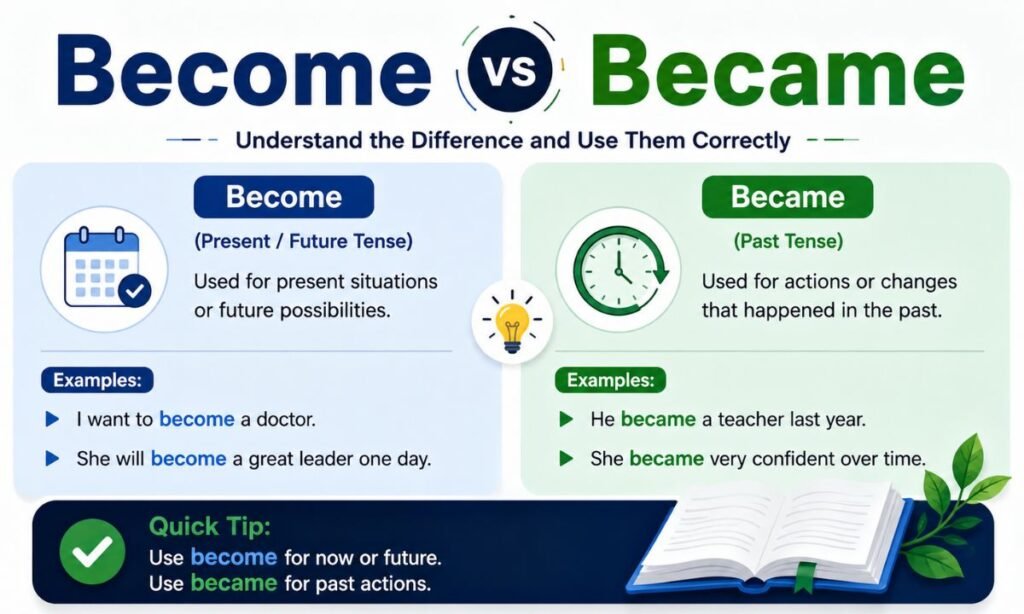
“Become” and “became” are two forms of the same verb, but they point to different moments in time. Become is the base form. Became is its simple past tense. Neither word is more “correct” than the other — the right choice depends entirely on when the change you’re describing took place.
Here’s the short version:
- Become — used for the present, the future, infinitives, and after helping verbs like has, have, had, will, and would.
- Became — used only for a single, completed action that happened in the past.
That one distinction solves most of the confusion. But there’s more nuance once you add subject-verb agreement, perfect tenses, and conditional sentences into the mix, so let’s break each form down properly.
The Base Form “Become”: What It Really Means
“Become” describes a change, transformation, or shift from one state to another. Someone can become a doctor, a city can become crowded, or a hobby can become a career. The word carries a sense of process — something moving from what it was to what it now is or will be.
Grammatically, “become” is both the base form and the past participle of the verb. That second detail matters more than most learners realize, because it explains why phrases like “has become” and “have become” are correct while “has became” never is.
When to Use “Become”
Use “become” in these situations:
- Present tense, especially with I, you, we, and they.
- Future tense, right after “will.”
- Infinitives, following “to.”
- After modal verbs such as can, could, should, would, and might.
- In present perfect and past perfect constructions, following has, have, or had.
A simple test: if you can swap in “will” or “to” naturally before the verb, “become” is the form you need.
Examples of “Become” in Present Tense
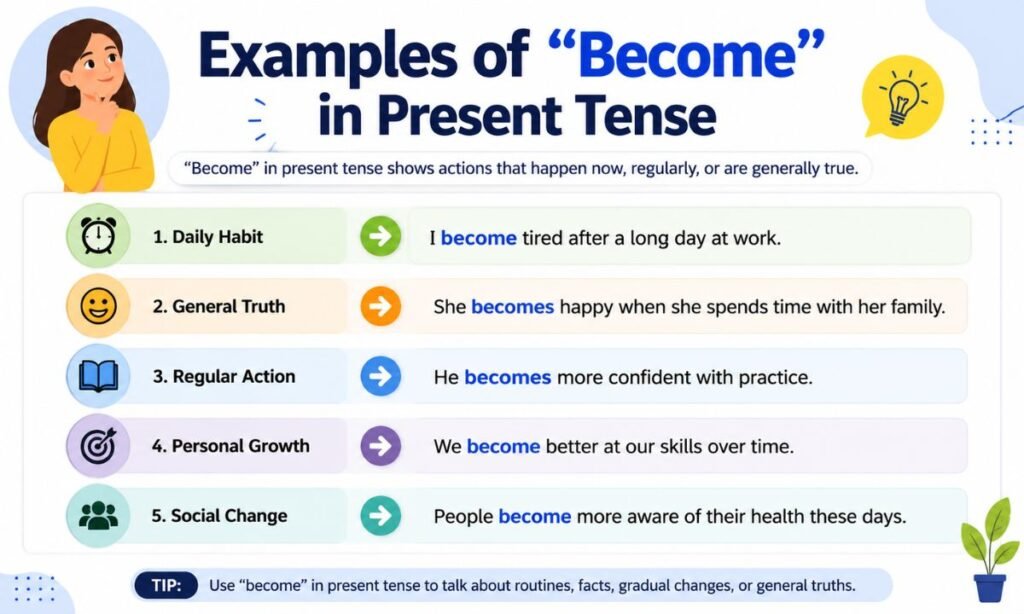
- I become more confident every time I speak in public.
- They become restless when meetings run long.
- We become better writers through daily practice.
- You become a stronger candidate with every project you finish.
- Children become curious the moment they start asking “why.”
Quick Tip
If the sentence describes something happening now, something that happens regularly, or something that hasn’t happened yet, reach for “become.” Ask yourself: is this change finished, or is it still in motion? Unfinished or upcoming change always calls for “become.”
The Simple Past Form “Became”: Understanding Its Purpose
“Became” marks a change that already happened and is now complete. It belongs entirely to the past tense, and it never follows has, have, had, will, or would. If you’re describing something that occurred yesterday, last month, or ten years ago, “became” is doing the work.
When to Use “Became”
Reach for “became” when:
- The change is finished and sits in the past.
- The sentence includes a past time marker such as yesterday, last year, in 2015, or during college.
- You’re narrating a completed story, event, or transformation.
Correct Examples of “Became”
- She became a licensed architect in 2019.
- The small bakery became a neighborhood favorite within a year.
- He became frustrated after the third delay.
- Winters became harsher across the region over the last decade.
- The negotiation became tense once the deadline passed.
Pro Tip
Try attaching a past-time phrase to your sentence — “yesterday,” “last year,” “in 2012.” If it fits without sounding forced, “became” is almost certainly correct.
- become vs became past tense: became is the only past-tense form; become never functions as a simple past verb on its own.
- become vs became sentences: compare “I become nervous before interviews” (a habitual present truth) with “I became nervous the moment she walked in” (one completed past event).
- become vs became example: “The company becomes profitable every fourth quarter” versus “The company became profitable in its third year” — one is a repeated pattern, the other a specific past milestone.
- become vs became grammar: the grammar rule hinges on tense, not meaning. Both words describe transformation; only the timing of that transformation changes which form you use.
- became or become for future: future sentences always use “become,” typically paired with “will” — “The market will become more competitive next year.”
- becomes: this is the third-person singular present form, reserved for he, she, it, or a singular noun.
- become meaning: to change from one state, condition, or role into another.
- become became past participle: became is never a past participle. The past participle of become is become itself, which is why perfect tenses always use “become,” not “became.”
Become vs Becomes: The Simple Present Tense Difference
This is where subject-verb agreement enters the picture. “Become” pairs with I, you, we, and they. “Becomes” pairs with he, she, it, and singular nouns.
| Subject | Correct Form |
|---|---|
| I | become |
| You | become |
| He / She / It | becomes |
| We | become |
| They | become |
| A singular noun (the city, the plan) | becomes |
| A plural noun (the cities, the plans) | become |
Examples:
- She becomes anxious before big presentations.
- He becomes quieter as the day goes on.
- The room becomes noisy after lunch.
- My colleagues become more productive after a short break.
- A habit becomes part of who you are.
Notice the pattern: add an “s” for singular third-person subjects, drop it everywhere else. This mirrors ordinary present-tense rules across English verbs, so once you’ve internalized it for “become,” it applies almost automatically elsewhere.
Present Perfect Tense: “Has Become” and “Have Become”
Present perfect tense connects a past action to the present moment, and it always uses the past participle — which, for this verb, is “become,” never “became.”
Has Become
Use “has become” with he, she, it, and singular subjects.
- She has become one of the top performers on the team.
- The traffic has become worse this month.
- His attitude has become noticeably more positive.
Have Become
Use “have become” with I, you, we, and they.
- I have become far more organized this year.
- We have become close friends over the past decade.
- They have become experts in their field.
Why “Has Became” Is Always Incorrect
This is one of the most common errors in everyday writing, and it happens because “became” looks like it should slot in anywhere the past is involved. It doesn’t. Perfect tenses require a past participle, and English marks that requirement strictly: has, have, and had are always followed by become, never became.
- ❌ He has became a better leader.
- ✔️ He has become a better leader.
- ❌ We have became stronger as a team.
- ✔️ We have become stronger as a team.
If you remember only one rule from this entire guide, make it this one. “Has became” and “have became” are not casual variations — they’re grammatical errors, full stop.
The Subtleties of “Would Become”
“Would become” shows up in two distinct situations: hypothetical outcomes and repeated past actions. Both uses can feel a little slippery at first, so it helps to see them side by side.
- Hypothetical or conditional outcomes — describing what might happen under different circumstances. “If she practiced daily, she would become fluent within a year.”
- Repeated past patterns — describing something that happened again and again over time, almost like a habit viewed from a distance. “Every winter, the lake would become a skating rink for the whole town.”
Examples
- If he had taken that job, he would become the youngest director in the company’s history.
- Whenever the weather turned cold, the garden would become quiet and still.
- She always said that with enough patience, any beginner would become skilled.
- Had they merged sooner, the two brands would become a single, stronger identity.
The thread connecting both uses is distance from certainty — either the event is imagined rather than real, or it’s a pattern remembered rather than a single fixed moment.
Comparison Table: Become vs Became vs Becomes vs Has Become vs Have Become
| Form | Tense | Used With | Example |
|---|---|---|---|
| Become | Present / Future / Base | I, you, we, they; after will, to, would | I will become a better writer. |
| Becomes | Present (third-person singular) | He, she, it, singular nouns | She becomes tired after long shifts. |
| Became | Simple past | Any subject, past-completed action | They became partners in 2020. |
| Has become | Present perfect | He, she, it, singular nouns | The city has become a tourist hotspot. |
| Have become | Present perfect | I, you, we, they | We have become close over the years. |
Keep this table nearby the next time you’re editing a draft. Scanning it takes seconds and can prevent one of the most common tense errors in English writing.
Memory Tricks to Never Confuse Become vs Became Again
Rules are useful, but tricks stick. Here are five ways to lock in the difference for good.
1. The Timeline Trick
Picture a straight line with “now” marked in the middle. Anything to the right of now — future plans, ongoing habits, hypotheticals — uses “become.” Anything to the left, already finished and behind you, uses “became.” Before writing the sentence, place the event on that line and let its position choose the word for you.
2. The “S” Rule
If the subject is singular and sitting in the present tense, add an “s”: becomes. Everyone else in the present tense drops it. This one small letter carries a lot of grammatical weight.
3. The “Has Became” Red Flag
Train your eye to treat “has became” and “have became” as an alarm bell. The moment you see has, have, or had sitting next to “became,” stop and fix it. That combination is never correct in standard English.
4. The Sound Test
Read the sentence aloud with “yesterday” tacked onto the front. “Yesterday, she become a manager” sounds wrong immediately, while “Yesterday, she became a manager” flows naturally. Your ear often catches tense errors faster than your eye does.
5. The Color Change Analogy
Think of a leaf changing color in autumn. “The leaf becomes red” describes the process as it happens, right now, before your eyes. “The leaf became red” describes looking back at a leaf that has already finished turning. The image itself hasn’t changed — only your position in time relative to it has.
Mini Case Study: How Grammar Changes Meaning
The exact same idea can shift meaning entirely depending on which verb form carries it. Here are three short cases that show the stakes.
Case Study 1: Career Transformation
Compare “She becomes a manager” with “She became a manager.” The first suggests a pattern — perhaps she’s promoted to manager in every company she joins, or the sentence is part of a general description. The second is a factual, one-time milestone: it happened, it’s finished, and the reader understands it as history.
Case Study 2: Habits
“He becomes irritable when he’s hungry” describes a recurring trait, something readers should expect to see again. “He became irritable when he skipped lunch” describes a single afternoon. Swap the verbs and you swap the entire implication — a personality trait versus a passing mood.
Case Study 3: Long-Term Change
“The neighborhood has become safer” tells readers that the improvement is ongoing and connects directly to the present. “The neighborhood became safer in 2015” locks that improvement into a specific year, treated as a closed chapter rather than a continuing trend. A city planner writing a report would choose between these two forms very deliberately, because each one sends a different signal to whoever reads it next.
Expert Insights
Professional editors tend to flag become/became errors more often in resumes, cover letters, and business reports than almost any other tense mistake, largely because these documents mix timelines constantly — past achievements sitting next to present responsibilities and future goals in the same paragraph. A resume bullet that reads “Became team lead and manages a five-person department” mixes past and present awkwardly; “Became team lead and now manages a five-person department” or “Have become the team lead managing a five-person department” reads far more cleanly.
Style guides across academic and business writing agree on one point above all others: the past participle of “become” is “become,” not “became.” Writers who internalize that single fact eliminate the majority of their errors with this verb. It’s a small rule, but it does a lot of quiet work in making writing sound polished and deliberate.
Editors also point out that “became” tends to strengthen storytelling. Because it signals a completed, specific event, it gives sentences a sense of closure that “become” doesn’t offer. Writers crafting a narrative — a biography, a case study, a personal essay — often lean on “became” precisely because it draws a clear line between before and after.
Frequently Asked Questions
What’s the difference between become and becomes?
Become is used with I, you, we, and they, while becomes is reserved for he, she, it, and singular nouns in the present tense.
When did I become or became?
Use “became” for a specific, completed past event, such as “I became a teacher in 2018.”
Which is correct: “I have become” or “I became”?
Both can be correct — “I have become” links a past change to the present, while “I became” simply states a finished past event.
What does it mean “became”?
It means a transformation or change was completed at a specific point in the past.
Conclusion
The difference between become and became comes down to one question: is the change finished, or is it still unfolding? Became belongs to the past, describing something that already happened and is done. Become covers everything else — the present, the future, habits, hypotheticals, and every perfect-tense construction with has, have, or had.
Keep the comparison table close, run the timeline trick when you’re unsure, and treat “has became” as a warning sign every time you spot it. With a little practice, choosing between these two forms will stop feeling like guesswork and start feeling automatic.