


If you’ve typed “enrol” and then watched autocorrect quietly change it to “enroll,” you’re not imagining things. Both spellings are real, both show up in dictionaries, and both are used by millions of writers every day. The confusion isn’t a typo problem — it’s a geography problem.
This guide breaks down exactly when to use enrol, when to use enroll, where the split came from, and how to avoid the small mistakes that make writing look inconsistent. By the end, you’ll be able to pick the right spelling without pausing to second-guess yourself.
Enrol
Enrol is the British English spelling. It’s used across the United Kingdom, Australia, New Zealand, and most Commonwealth countries. It’s built with a single “l,” matching the pattern British English tends to favor in the base verb form.
Enroll
Enroll is the American English spelling. It’s the version taught in US schools, printed in US style guides, and used by American universities, government forms, and news outlets. It carries the extra “l” that American spelling conventions kept.
Enrol or Enroll – Quick Answer
Both spellings are correct. Neither one is a mistake. The only thing that decides which to use is your audience:
- Write enroll for American readers.
- Write enrol for British, Australian, Canadian, or other Commonwealth readers.
- Pick one and stay consistent throughout the same piece of writing.
The meaning is identical in both cases: to officially register or sign up for something, such as a school, course, program, or service.
Examples:
- American English: “She plans to enroll in the fall semester.”
- British English: “She plans to enrol in the autumn term.”
- American English: “The college enrolled over 3,000 new students this year.”
- British English: “The college enrolled over 3,000 new students this year.” (Note: “enrolled” is spelled the same in both regions — more on that below.)
Enrol vs Enroll: Spelling Differences and Common Variations
The tricky part about enrol and enroll isn’t the base word — it’s what happens when you add endings. Most British-versus-American spelling pairs follow a predictable pattern: British English doubles a consonant before a suffix (traveller, labelled), while American English keeps it single (traveler, labeled). Enrol and enroll actually flip that pattern in the base form, which is exactly why so many people get tripped up.
Here’s how the word behaves in its different forms:
- Base verb: enrol (UK) / enroll (US)
- Past tense: enrolled (same in both)
- Present participle: enrolling (same in both)
- Third person singular: enrols (UK) / enrolls (US)
- Noun form: enrolment (UK) / enrollment (US)
So while the present and past tense forms line up perfectly, the base verb, the third-person form, and the noun all split by region. That inconsistency is exactly why writers reach for a grammar checker or a quick search before hitting publish.
Learners of English often find this word harder than average because it doesn’t behave like the “usual suspects” of British-American spelling. Words like colour/color or analyse/analyze follow patterns you can memorize once and apply everywhere. Enrol and enroll require remembering an exception to the exception, which is exactly why the topic keeps generating so many searches and grammar-blog explainers.
A few related variations worth knowing:
- Re-enrol / re-enroll — both correct, following the same regional rule.
- Unenrol / unenroll — less common, but the same split applies.
- Enrolee / enrollee — someone who has enrolled, again split by region.
The Origin of Enrol or Enroll
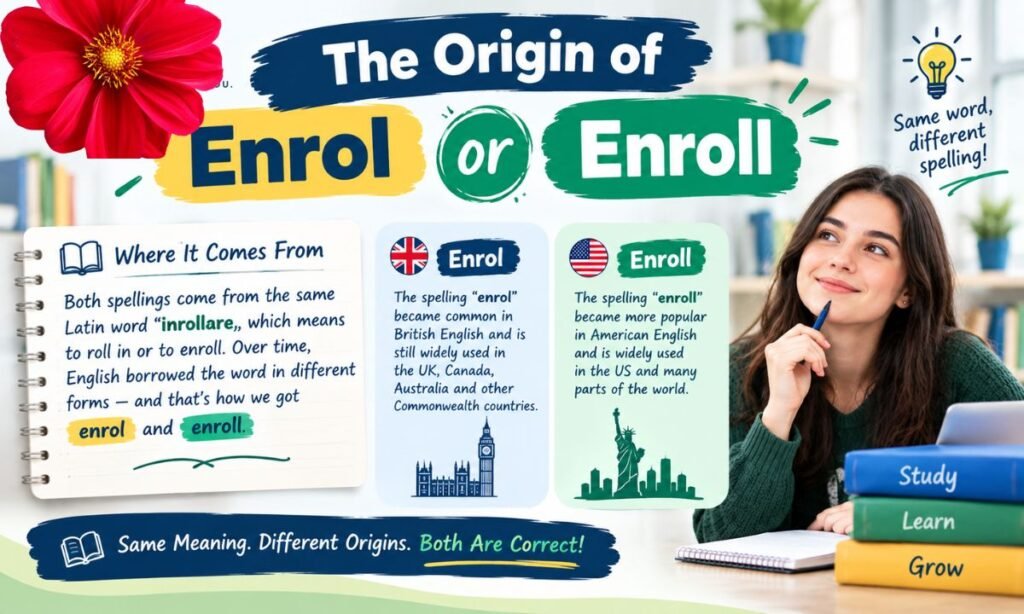
The word traces back to the Old French enroller, built from en- (meaning “in” or “into”) and rolle (meaning “roll” or “list”). In medieval administration, a “roll” was a physical scroll or list where names, records, or legal matters were recorded. To “enrol” someone literally meant to write their name into that roll.
English absorbed the word sometime in the 14th century, and for a long while spelling wasn’t standardized at all — writers on both sides of the Atlantic used single and double consonants somewhat interchangeably. The split we know today only hardened much later, largely thanks to one man: Noah Webster.
Webster’s early 19th-century American dictionaries pushed for simplified, more phonetic spellings across American English. Words like colour lost their “u” to become color, and travelling dropped a consonant to become traveling. Oddly, enrol went the opposite direction in the United States — it picked up an extra “l” rather than losing one. British English, meanwhile, kept the older, single-l form largely unchanged.
The result is a spelling pair that looks like it breaks the usual British-doubles/American-simplifies rule, when really it’s just one of English’s small historical quirks.
It helps to remember that spelling reform in America wasn’t a single event — it unfolded over decades through dictionaries, school textbooks, and printers’ style choices. Webster wanted American English to look distinct from British English, partly for practical reasons (simpler spelling was easier to teach in a young, rapidly growing school system) and partly for national identity. Most of his changes trimmed letters away. Enroll is one of the rare cases where the American version actually ended up longer than the British one, which is part of why the word still confuses people looking for a tidy rule to apply everywhere.
British English vs American English Spelling
1. British English
British English favors enrol, along with enrolled, enrolling, enrols, and enrolment. This is the standard taught in UK schools, used by British universities and government departments (such as the electoral roll), and followed across most Commonwealth nations.
2. American English
American English favors enroll, along with enrolled, enrolling, enrolls, and enrollment. US style guides, including AP style and Chicago style, use this spelling, and it’s the version taught in American classrooms from an early age.
Examples in Sentences
- UK: “Parents must enrol their children before the term begins.”
- US: “Parents must enroll their children before the semester begins.”
- UK: “Enrolment numbers dropped slightly this year.”
- US: “Enrollment numbers dropped slightly this year.”
- UK: “He enrols new members every Monday.”
- US: “He enrolls new members every Monday.”
Comparison Table
| Form | British English | American English |
|---|---|---|
| Base verb | enrol | enroll |
| Past tense | enrolled | enrolled |
| Present participle | enrolling | enrolling |
| Third person singular | enrols | enrolls |
| Noun | enrolment | enrollment |
| Person who enrols | enrolee | enrollee |
Which Spelling Should You Use?
The honest answer is: it depends entirely on who’s reading your writing. Here’s a simple breakdown by audience.
For American Readers
Use enroll and enrollment. This applies to US-based websites, American school and university communications, US government forms, resumes aimed at American employers, and any content targeting a US audience through search engines.
For UK or Commonwealth Readers
Use enrol and enrolment. This applies to writing for UK, Australian, New Zealand, South African, or Canadian audiences (Canada leans British on this word more often than not, though American influence does creep in). If you’re applying to a British university or filling out a UK government form, this is the spelling to use.
For Global Audiences
If your audience is international or unclear, the safest strategy is to pick one spelling based on your primary market and stay consistent. Many global brands default to American English because of its dominance online, but plenty of international organizations, especially those with British origins, stick with British spelling instead. Whatever you choose, consistency across your website, app, or document matters more than which specific version you pick.
A practical shortcut: check your browser or word processor’s language setting before you start writing. If your document is set to “English (United States),” your spell checker will quietly nudge you toward enroll, enrolled, and enrollment. Switch the setting to “English (United Kingdom)” or “English (Australia),” and it will start flagging enroll as the outlier instead. Content management systems, email platforms, and even some job application portals let you set a regional language preference the same way, which removes a lot of the manual guesswork once it’s configured correctly.
Common Mistakes with Enrol or Enroll
Even experienced writers slip up with this word from time to time, usually because the “rules” for enrol and enroll don’t map neatly onto the patterns people already know from other British-versus-American pairs. Here are the mistakes worth watching for.
1. Mixing Both Spellings in One Text
The most common error is switching between enrol and enroll within the same article, email, or form. A paragraph that opens with “enrol now” and later says “enrollment closes Friday” looks careless, even though both words are technically correct on their own. Pick one spelling and use it throughout the entire piece.
2. Assuming One Version Is Wrong
Some writers assume enrol is a misspelling of enroll, or vice versa. Neither is true. This isn’t a case of correct versus incorrect — it’s a case of regional preference, similar to color versus colour or organize versus organise.
3. Forgetting the Double “L” Rule
Because enrol and enroll flip the usual British/American pattern, people often apply the “regular” rule by mistake — doubling the L in British English or dropping it in American English. Remember: American English adds the second L in the base word here, which is the opposite of what happens with words like traveled or labeled.
4. Using the Wrong Style for Official Documents
Government forms, university applications, and legal documents often specify a required spelling convention. Submitting a US enrollment form with British spelling, or a UK enrolment form with American spelling, can look sloppy even if it doesn’t cause a rejection. Always match the spelling style of the institution you’re dealing with.
5. Incorrect Verb Forms
Some writers mistakenly double the L in “enrolling” or “enrolled” no matter which regional spelling they’re using, producing errors like “enrolleing” or “enrolleed.” Both regions actually agree on these two forms — enrolled and enrolling never change, so there’s no need to overthink them.
Enrol or Enroll in Everyday Examples
Emails
- “Please enroll in the new benefits program before December 1.” (US)
- “Please enrol in the new pension scheme before December 1.” (UK)
News Headlines
- “University Enrollment Hits Record High Amid Rising Tuition Costs” (US outlet)
- “Record Enrolment Figures Reported Across UK Universities” (UK outlet)
Social Media Posts
- “Spots are filling up fast — enroll today and lock in early-bird pricing!” (US brand)
- “Only a few spaces left — enrol today to save your place!” (UK brand)
Formal Writing
- “Applicants seeking to enroll must submit all required documentation no later than thirty days prior to the start date.” (US formal/legal style)
- “Applicants wishing to enrol must submit all requisite documentation no fewer than thirty days before the commencement date.” (UK formal/legal style)
Enrol or Enroll – Google Trends & Usage Data
Search interest for these two spellings tells a clear story: usage tracks almost exactly with regional English preference. “Enroll” dominates search volume in the United States, while “enrol” leads in the UK, Australia, and much of the Commonwealth. Globally, “enroll” tends to show higher overall search volume simply because the US has a larger English-speaking online population, not because it’s the more “correct” spelling.
Keyword Comparison Table
| Keyword | Primary Region | Typical Usage Context |
|---|---|---|
| enroll | United States, Philippines, parts of Canada | Schools, colleges, insurance, online courses |
| enrol | United Kingdom, Australia, New Zealand | Schools, universities, government registration |
| enrollment | United States | Admissions, HR, benefits enrollment |
| enrolment | United Kingdom, Australia | Admissions, electoral registration, HR |
| re-enroll | United States | Returning students, renewed subscriptions |
| re-enrol | United Kingdom | Returning students, renewed memberships |
Enrol or Enroll in Different Countries and Usage Contexts
Spelling conventions aren’t always as clean-cut as “American versus British.” Here’s a rough regional snapshot:
- United States: Enroll and enrollment are the standard across schools, universities, healthcare (as in “open enrollment” for insurance), and government services.
- United Kingdom: Enrol and enrolment are standard, including in university admissions and the electoral roll process.
- Australia and New Zealand: Both countries follow British conventions, so enrol and enrolment are correct and expected.
- Canada: Canadian English is a genuine mix. Government and academic writing often leans toward enrol, but American media influence means enroll appears frequently too. Neither is treated as wrong.
- India, Pakistan, and South Asia: These regions generally follow British English standards inherited from colonial-era education systems, so enrol and enrolment are more common in formal writing.
- Philippines: Despite geographic distance from the US, the Philippines follows American English due to historical ties, so enroll and enrollment are standard.
Understanding your reader’s region takes the guesswork out of which version to use, and it signals attention to detail that readers and institutions notice, even if only subconsciously.
This regional pattern matters more in some industries than others. Education and government are the two areas where the correct spelling gets checked most closely, since enrolment and enrollment forms are often legally binding documents. Marketing and social media are more forgiving, but consistency still shapes how polished a brand looks. A university admissions page that switches between enrol and enroll across different pages, for instance, can quietly undermine trust with prospective international students who are already trying to figure out which country’s system they’re dealing with.
Understanding Child Custody in Colorado: Parental Responsibilities Explained
Luck Is Not a Plan: Where Investing and Games of Chance Actually Differ
FAQs
What is to enrol? To enrol (or enroll) means to officially register your name for a school, course, program, or service.
Is Enrol one L or two? Enrol has one L in British English; the American spelling, enroll, has two.
How do Australians spell “enroll”? Australians use the British spelling, “enrol,” along with “enrolment” for the noun form.
When to use Enroll? Use “enroll” when writing for an American audience or following US English conventions.
Conclusion
Enrol and enroll are two spellings of the exact same word, separated by nothing more than geography and a bit of publishing history. There’s no grammatical winner here — just a British version and an American one, each correct in its own context. The real skill isn’t memorizing which spelling is “right.” It’s knowing your audience, picking the matching regional spelling, and staying consistent from the first sentence to the last. Get that part right, and enrol or enroll stops being a question you have to Google every time you sit down to write.