
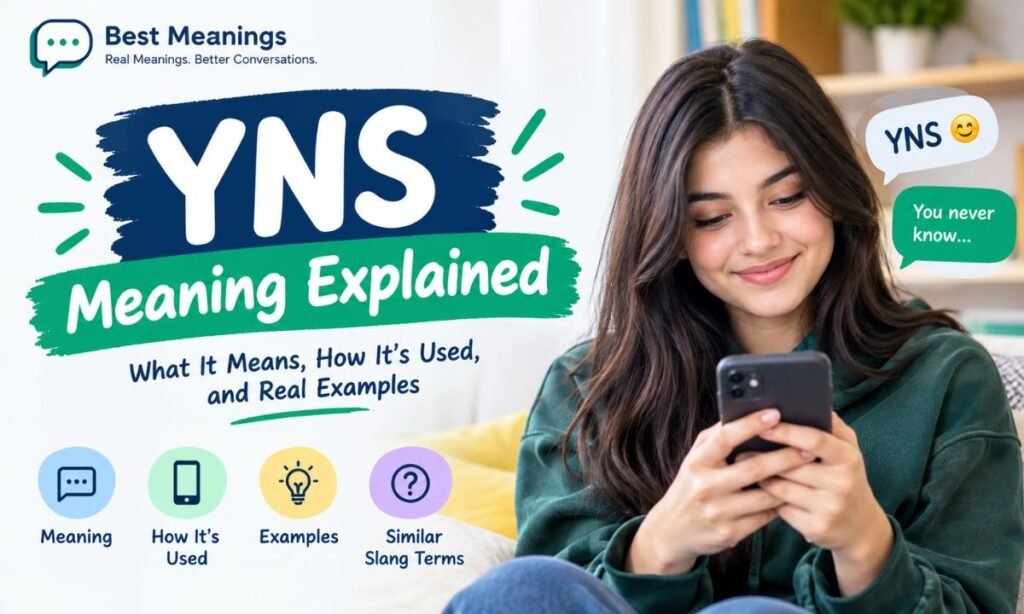

You’re scrolling through a comment section, a group chat, or a TikTok reply, and there it is: YNS. No punctuation, no explanation, just three letters sitting there like they’re supposed to make sense on their own. For a lot of readers, they don’t.
That confusion is fair. YNS is not a fixed, dictionary-approved term. It’s internet slang, which means its meaning bends depending on who’s typing it, what platform they’re on, and what happened right before it got sent. This guide walks through every common reading of YNS, where the term likely came from, how it shows up across chat apps, and how you can reply to it without sounding out of place.
Meaning & Definition of YNS
YNS doesn’t have one official, agreed-upon meaning the way established abbreviations like ASAP or FYI do. It’s a piece of casual shorthand, and casual shorthand survives on flexibility. That said, a handful of readings show up again and again across texting culture and social apps, and a few make far more sense in context than others.
Primary Meaning:
The most common reading in casual chats and comment sections is “You’re Not Serious.” People type it as a quick reaction to something surprising, exaggerated, or hard to believe, similar to how someone might say “no way” or “stop it” out loud. It reads as disbelief first, humor second.
Secondary Meanings:
Depending on the thread, YNS can also stand for “You’re Not Slick” (calling someone out for an obvious or sneaky move), or refer to “youngins,” a casual label for a group of younger people, usually teens or young adults hanging around together. A smaller number of users use it for “You Never Said,” pointing out that someone left out an important detail.
Here’s how the two main readings actually look in a real thread:
- “I just landed a modeling contract in Paris.” → “YNS” (You’re Not Serious, reacting to a surprising claim)
- “Nice try acting like you didn’t see my text.” → “YNS” (You’re Not Slick, calling out an obvious dodge)
Key Point:
There is no single correct answer here, and that’s normal for slang. The right reading almost always comes from context: what was said right before YNS, who sent it, and what platform the conversation is happening on. Treat it as a contextual cue, not a fixed definition. Tone also matters as much as wording. A YNS followed by a laughing emoji reads very differently from a YNS sent with no punctuation at all after a tense exchange, so the surrounding message often carries more weight than the letters themselves.
Background & Origin of YNS
Slang abbreviations rarely trace back to one clean origin story, and YNS is no exception. What’s clear is that it fits a much older pattern of internet shorthand built for speed over formality.
How it started:
Texting culture has leaned on abbreviations since the earliest days of SMS, when character limits and small keypads rewarded short forms. Terms like LOL, BRB, and SMH normalized the habit of swapping full reactions for a handful of letters. YNS grew out of that same instinct: a fast reaction abbreviation built for messaging apps rather than formal writing.
Evolution:
As group chats moved to Instagram, Snapchat, and TikTok comment sections, reaction-based slang spread faster than it ever could through text messages alone. A phrase used by one friend group could reach thousands of viewers within a single viral video’s comment section, and from there it gets copied, remixed, and reused with slightly different tones depending on who picks it up.
That copying process is exactly why YNS carries more than one meaning today. A term doesn’t need a formal launch or an official definition to spread; it just needs one popular comment thread, one creator’s catchphrase, or one group chat habit that other people find useful and start repeating. Over time, separate communities settled on slightly different shorthand for the same three letters, and none of those readings ever pushed the others out completely. That’s a fairly normal life cycle for reaction slang, and it explains why asking “what does YNS actually mean” doesn’t have one tidy answer the way asking about a formal abbreviation would.
Usage of YNS in Different Contexts
Where YNS lands in a conversation changes how it should be read. These four situations cover most of the ways people actually use it day to day.
1. Casual Chats
In one-on-one or group texts, YNS usually pops up as a fast reaction to a wild claim, an unbelievable story, or an over-the-top joke. A friend says something outrageous, and the reply is just “YNS,” standing in for a longer sentence like “there’s no way that’s true.” Group chats tend to amplify this fast, since one person’s YNS often gets echoed by two or three others in the same thread, turning a single reaction into a small running joke.
2. Social Media (Instagram & TikTok)
On public posts, YNS shows up in comment sections reacting to a video, caption, or another comment. It’s often a quick way to call out something exaggerated or dramatic without writing a full sentence, and it tends to get more playful the more comments pile up underneath it. On a video with an unbelievable twist, it’s common to see the same comment repeated dozens of times, each one adding to the sense that the whole audience shares the same reaction.
3. Emotional Reactions
Some users lean on YNS to express genuine shock or disbelief rather than teasing. In this mode, it functions closer to “oh my god” or “wait, what,” reacting to news, a plot twist, or an unexpected update from a friend. Unlike the teasing version, this use rarely comes with a laughing emoji, and it often shows up alone, without any extra commentary attached.
4. Playful Insults (Friendly)
Among close friends, YNS can carry a light teasing edge, especially in its “You’re Not Slick” reading. It calls out an obvious move, like someone pretending they didn’t see a message or trying to take credit for something. The tone stays friendly rather than confrontational, at least between people who already know each other, and it usually gets a laugh in return rather than a defensive reply.
Meanings Across Platforms
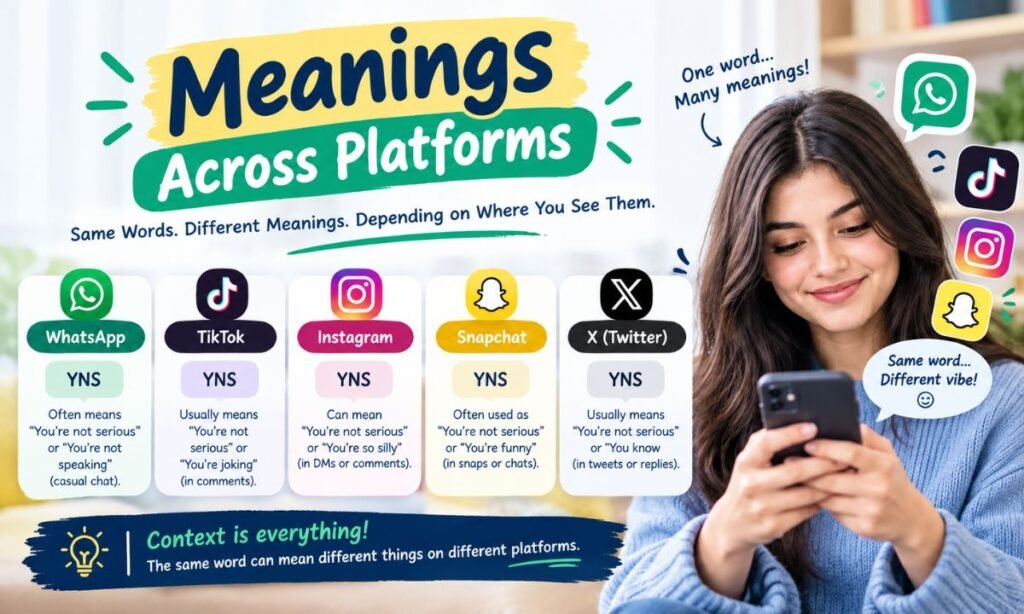
The same three letters can lean different ways depending on the app. Here’s a quick breakdown of how YNS typically reads on each major platform.
| Platform | Common Meaning | Typical Tone |
|---|---|---|
| You’re Not Serious / You’re Not Slick | Personal, used between known contacts | |
| You’re Not Serious, reacting to posts or reels | Playful, sometimes sarcastic | |
| TikTok | Youngins, or You’re Not Serious in comment replies | Casual, comment-thread humor |
| Snapchat | You’re Not Slick, teasing a friend | Light, friend-group specific |
Because WhatsApp conversations tend to happen between people who already know each other, YNS on this app usually carries a personal, in-joke quality. It leans toward disbelief or gentle teasing rather than a public callout.
On Instagram, YNS shows up most often in comments under photos, reels, or stories, reacting to something a friend or creator posted. It’s a quick way to express “no way” without breaking the scroll.
TikTok
TikTok comment sections move fast, and YNS fits right into that pace. It’s common under videos featuring bold claims, dramatic reveals, or content aimed at younger audiences, where the “youngins” reading also surfaces more often.
Snapchat
Snapchat’s more private, friend-focused format makes YNS lean playful and teasing here, closer to an inside joke than a public reaction. It often follows a screenshot or a snap that catches someone doing something obvious.
Other Field Meanings of YNS
Outside of internet slang, YNS is not a widely recognized standard acronym in any single industry. It is not listed as a formal term in medicine, law, or established business terminology. One verifiable, non-slang use is as an aviation code: YNS is the IATA airport code for Nemiscau Airport in Quebec, Canada. A handful of small organizations and clubs also use YNS as an initialism for their own names, but these usages are specific to that group rather than a recognized industry standard, so context always matters more than the letters themselves.
This is worth pointing out because acronym lookup sites often list several unrelated expansions side by side, which can make YNS look more official than it is. In practice, if you see YNS in a work email, a school assignment, or a technical document, it almost certainly refers to a specific name, code, or internal shorthand tied to that organization, not to internet slang or a universal standard.
Common Misconceptions & Mistakes
Because YNS carries several possible meanings, it’s easy to misread or misuse, especially for people newer to the term.
Misconceptions:
A common misconception is that YNS always means the same thing regardless of who sends it. Another is that it’s automatically rude or confrontational; in most cases, it’s closer to a lighthearted reaction than an insult, though tone and relationship still matter.
Mistakes users make:
People sometimes send YNS in serious or professional conversations where casual slang feels out of place, or send it without enough context for the reader to figure out which meaning applies. Both mistakes can lead to genuine confusion on the receiving end.
Reality:
YNS is informal, flexible, and dependent on relationship and platform. Reading the message right before it, along with any emojis attached, usually clears up which meaning fits. When in doubt, a quick follow-up question resolves it faster than guessing.
It also helps to remember that slang like this rarely comes with instructions attached. Nobody sends a glossary before typing YNS; the meaning is expected to be picked up from context the same way tone of voice gets picked up in a face-to-face conversation. Treating an unclear YNS as a small mystery to solve, rather than a mistake on either side, keeps the exchange friendly while you figure out what was actually meant.
Similar Terms & Alternatives
YNS sits alongside a wider group of reaction-based texting abbreviations. Knowing a few neighbors helps place it more precisely.
| Term | Meaning | How It Differs From YNS |
|---|---|---|
| SMH | Shaking my head | Expresses disappointment, not disbelief |
| OMG | Oh my god | General surprise, broader and less playful |
| FR | For real | Confirms sincerity rather than reacting to it |
| NGL | Not gonna lie | Introduces an honest opinion, not a reaction |
| Deadass | Seriously, for real | Emphasizes truthfulness in a statement |
How to Respond to YNS (With Examples)
The right reply depends on tone. These four approaches cover most situations.
1. Playful Response
“lol I know right, wild.” This keeps the exchange light and matches the teasing energy most YNS messages carry.
2. Clarification
“Wait, what do you mean by that?” Useful when the meaning genuinely isn’t clear from context, and better than guessing wrong.
3. Joking Back
“You’re the one who’s not serious lol.” Turns the reaction back on the sender in a friendly, back-and-forth way.
4. Neutral Reply
“Haha yeah.” Works when you’re not fully sure which meaning was intended but still want to keep the conversation moving.
Differences From Similar Words
YNS is reaction-based, meaning it typically responds to something someone else said rather than standing alone as a statement. SMH, by comparison, expresses disappointment or frustration on its own, without needing a specific trigger line beforehand. OMG covers general surprise across almost any context, while YNS leans specifically toward disbelief about a claim’s truthfulness. FR and deadass do the opposite job: they confirm that a statement is genuine rather than questioning it.
The easiest way to keep these apart is to ask what job the word is doing in the sentence. Disbelief points toward YNS. Disappointment points toward SMH. General shock, positive or negative, points toward OMG. And confirming that something is true, rather than questioning it, points toward FR or deadass. Once that distinction clicks, mixing them up becomes far less likely, even across unfamiliar threads.
Relevance in Online Conversations & Dating Apps
On dating apps, quick reaction slang like YNS helps keep early conversations light before either person commits to longer messages. A bold or funny claim in a bio or opening line might get a quick “YNS” as a way to flirt through mild disbelief, similar to teasing someone in person. It works because it signals engagement without requiring a long response, which matters in a format built around short exchanges and quick first impressions.
In broader online conversations, YNS functions as a small piece of shared cultural fluency. Using it correctly can signal that someone is comfortable in casual digital spaces, while using it awkwardly, or in the wrong setting, can have the opposite effect. That’s part of why context matters so much here: a term that reads as friendly and fluent in one thread can land as confusing, or even slightly try-hard, in another, especially if the audience skews older or more formal.
For people newer to online dating or unfamiliar with younger digital slang, seeing YNS pop up mid-conversation isn’t a sign that something has gone wrong. It’s usually just a shorthand for genuine interest, expressed the way that particular platform’s audience tends to express it.
Popularity & Trends Over Time
YNS isn’t a brand-new term, but its visibility has grown alongside short-form video platforms, where comment-section slang spreads faster than it used to through text messages alone.
Trend observations:
Usage tends to spike under viral videos featuring bold claims or dramatic reveals, where a wave of similar comments reinforces the term’s meaning for new viewers. It remains most common among younger users, particularly on TikTok and Instagram, and its meaning continues to shift slightly as new communities pick it up and adapt it to their own conversations.
A few patterns hold up across platforms:
- Usage clusters around comment sections more than direct messages, since public threads reinforce a shared meaning faster than private chats do.
- The teasing, “You’re Not Slick” reading tends to dominate in friend-group texting, while the disbelief reading shows up more in public comments.
- Like most reaction slang, YNS will likely keep evolving rather than settling into one fixed meaning, since that flexibility is part of what keeps it useful.
Frequently Asked Questions
1. What does YNS mean in texting?
It most often means “You’re Not Serious,” a quick reaction to a surprising or exaggerated claim.
2. Is YNS a bad word?
No. It’s informal slang, usually playful or teasing rather than offensive.
3. Can YNS have different meanings?
Yes. Depending on context, it can also mean “You’re Not Slick,” “youngins,” or “You Never Said.”
4. Where is YNS commonly used?
It shows up most on TikTok, Instagram, Snapchat, and WhatsApp, especially in comment sections and casual chats.
5. Should I use YNS in formal messages?
No. It’s strictly casual slang and doesn’t fit professional emails, job applications, or formal writing.
Conclusion
YNS is a small term doing a lot of flexible work. Whether it means “You’re Not Serious,” “You’re Not Slick,” or a nod to a younger crowd, the right reading almost always comes down to platform, tone, and the message that came right before it. Once you know the common variations and how they show up across chats and comment sections, decoding YNS in the wild takes seconds instead of a second guess.