
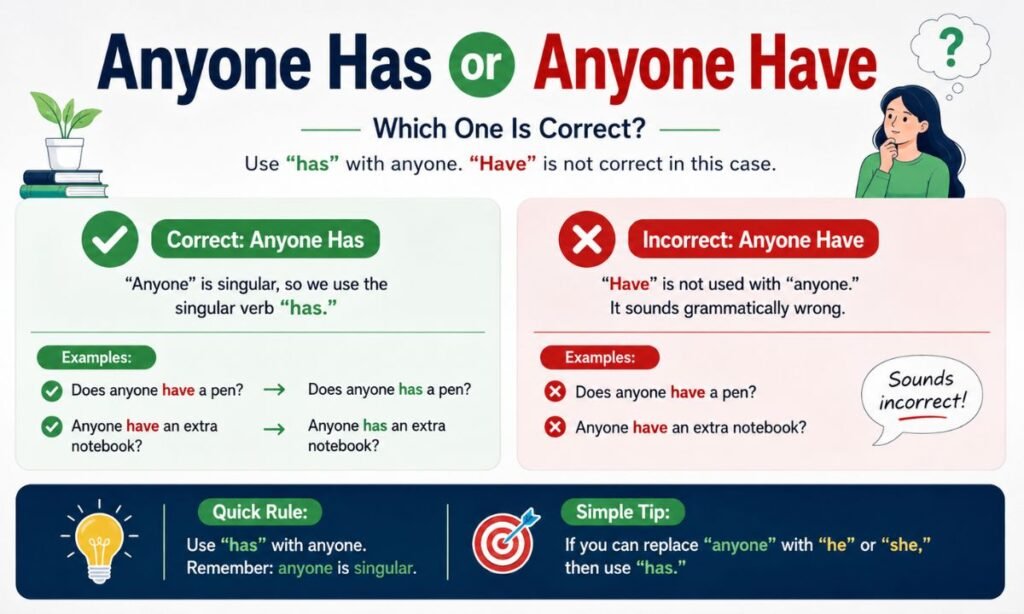

You’ve typed it, deleted it, and typed it again. “Anyone has a pen?” Then a second later: “Anyone have a pen?” Neither one looks wrong on the screen, and that’s exactly the problem.
This mix-up trips up native speakers just as often as English learners. It shows up in emails, group chats, exam answers, and even published articles that should know better. The confusion isn’t really about vocabulary. It’s about how “anyone” behaves grammatically, and how spoken English quietly breaks the rules that written English still enforces.
By the end of this guide, you’ll know exactly which form to use, why the rule exists, and how to catch yourself the next time your fingers want to type the wrong one.
Quick Answer First: Anyone Has vs Anyone Have
“Anyone” is a singular pronoun, so its default verb is has, not have. In a plain statement, you always write “anyone has”:
- Anyone has the right to ask questions.
- Anyone has access to the shared folder.
“Anyone have” only shows up correctly when a helping verb like does, did, or can has already taken care of the tense, forcing the main verb back to its base form:
- Does anyone have a spare charger?
- I don’t think anyone have — no, that’s wrong too. It’s “anyone has” here, because “don’t” governs “think,” not “anyone.”
That last example is worth sitting with for a second, because it’s exactly where people go wrong. More on that below.
The Core Grammar Rule You Must Know
Subject-verb agreement is the foundation of this whole topic, and “anyone” is one of the trickiest subjects in English because it sounds like it could mean several people.
It doesn’t. Grammatically, it never does.
Anyone Is Always Singular
“Anyone” means “any one person.” Even when you’re picturing a whole room full of candidates, the word itself refers to one unspecified individual at a time. English grammar locks onto that singular meaning and demands a singular verb, no matter how the sentence is phrased in your head.
A simple trick fixes this instantly: swap “anyone” for “he” or “she” and see if the sentence still sounds right.
- Anyone has a key. → He has a key. ✅
- Anyone have a key. → He have a key. ❌
If “he have” sounds wrong to you (it should), then “anyone have” is wrong in that same sentence.
Common Singular Indefinite Pronouns
“Anyone” belongs to a whole family of pronouns that follow this same singular rule. Once you memorize the pattern for one, it applies to all of them.
| Pronoun | Verb form | Example |
|---|---|---|
| Anyone | has / is | Anyone has the file. |
| Anybody | has / is | Anybody has the answer. |
| Everyone | has / is | Everyone has a badge. |
| Someone | has / is | Someone has already left. |
| Nobody | has / is | Nobody has called yet. |
| Everybody | has / is | Everybody has a role. |
Notice the shape: every single one of these pairs with “has,” never “have,” in a plain statement. That consistency is what makes the rule easy to keep once it clicks.
When “Anyone Has” Is Correct
Declarative Statements
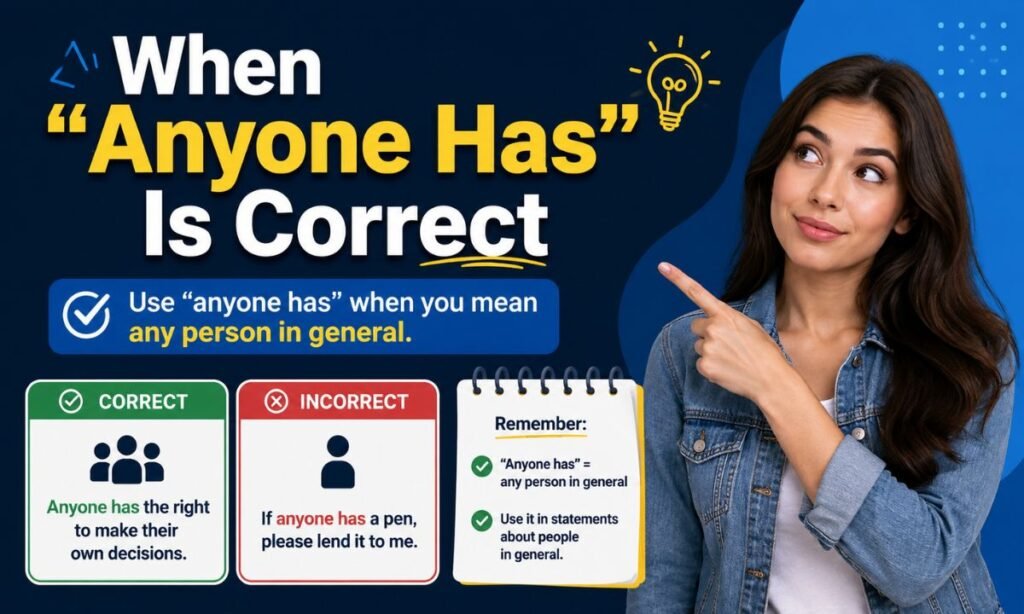
A declarative sentence simply states a fact, opinion, or observation. It doesn’t ask anything and doesn’t rely on a helping verb up front. This is where “has” belongs by default.
- Anyone has the potential to improve with practice.
- Anyone has the option to leave early today.
- Anyone has permission to enter after 9 a.m.
Read each sentence aloud. There’s no “does,” no “did,” no inversion — just a subject followed directly by its verb. That’s the signal that “has” is required.
Embedded Clauses and Indirect Speech
This is where a lot of otherwise careful writers slip. When a question gets folded into a larger sentence, it stops behaving like a question grammatically, even though it still feels like one.
Compare these two:
- Direct question: Does anyone have the report?
- Embedded version: I want to know if anyone has the report.
The second sentence isn’t a question anymore in structure — it’s a statement about wanting to know something. “Anyone” is now the subject of its own clause, sitting right next to its verb with no helping verb in front of it. So it reverts to “has.”
More examples:
- I’m not sure whether anyone has seen the memo.
- She asked if anyone has a car we could borrow.
- Nobody told me if anyone has finished the survey.
This single pattern accounts for most of the “anyone have” mistakes you’ll find in emails and reports, because the sentence still sounds like a question in your head even after it’s been rewritten as a statement.
Formal and Written English
Formal writing has zero tolerance for the dropped “does.” Academic papers, business reports, legal documents, and exam answers all expect the full, grammatically complete structure.
That means:
- In formal writing, always expand shortcuts. “Anyone got a minute?” becomes “Does anyone have a minute?”
- Indirect and reported speech still uses “has,” as covered above.
- Conditional clauses in formal register also lean toward “has” in most everyday cases (more on that shortly).
Anyone has or anyone have grammar comes down to register as much as structure. The stricter the writing context, the less room there is for the spoken shortcuts that feel natural in conversation.
When “Anyone Have” Is Correct
“Have” isn’t wrong. It’s just conditional. It only appears correctly with “anyone” when something else in the sentence has already absorbed the tense — usually an auxiliary verb sitting in front of the whole clause.
Does anyone has or does anyone have? This is one of the most searched versions of this question, and the answer is firm: does anyone have, never “does anyone has.” Once “does” shows up, the main verb drops back to its plain form. Stacking “does” and “has” together doubles up the tense marker, and that’s the actual error.
Direct Questions
Standard yes/no questions in English invert the subject and pull in a helping verb — do, does, or did.
- Does anyone have a question?
- Did anyone have trouble logging in?
- Do any of you have the file? (plural subject, different rule — see below)
Here, “does” or “did” carries the past or present tense. “Have” stays untouched in its base form because English verbs don’t get marked for tense twice in the same clause.
Did anyone has or have? Same logic applies. “Did” already signals past tense, so the verb after “anyone” must return to “have,” giving you “Did anyone have a chance to review this?”
Negative Constructions
Negative sentences follow the identical auxiliary-verb pattern. When “doesn’t” or “didn’t” appears, “have” is correct.
- Doesn’t anyone have a copy of the schedule?
- Didn’t anyone have time to check this earlier?
But watch the version without inversion — the plain negative statement:
- Anyone doesn’t have the password. ❌ (unnatural — English prefers “no one has”)
- No one has the password. ✅
That last swap matters. Native speakers rarely say “anyone doesn’t” in a plain statement; they switch to “no one” or “nobody” instead. If “anyone” stays as the subject and the sentence isn’t a question, “has” is still the default whenever no auxiliary is present.
Conditional and Hypothetical Sentences
Conditional sentences split depending on how real or hypothetical they are.
If anyone has or have — for real, present-tense conditions, “has” is correct:
- If anyone has a suggestion, please raise your hand.
- If anyone has concerns, email me directly.
These describe a realistic possibility happening now or in general, so the verb stays singular and present, just like any other declarative clause.
Hypothetical or more formal conditional structures can shift things slightly, particularly in subjunctive-style constructions, but for everyday writing and speech, “if anyone has” is the form you want in almost every case. Save “have” for conditionals that already include a modal or auxiliary, such as “if anyone should have a question” or “if anyone were to have doubts.”
Why People Keep Getting This Wrong
If the rule is this consistent, why does the mistake keep happening? Two habits are mostly responsible.
Spoken English vs Written English
Conversation moves fast, and speakers routinely drop helping verbs without anyone noticing. “Anyone have a pen?” is missing “does,” but it’s so common in casual speech that it sounds completely natural.
The problem starts when that spoken shortcut gets typed exactly as spoken, in a context that calls for full grammar — an email to a manager, a school assignment, a formal report. What’s fine at the coffee machine isn’t fine on the page.
Word Order Illusions
The second habit is subtler. Writers sometimes match the verb to the closest noun instead of the actual subject. In a sentence like “Anyone on the team have access,” the word “team” sits right before “have,” and it feels plural, so the verb gets pulled toward it. But “team” isn’t the subject — “anyone” is, and it’s still singular no matter what noun happens to sit nearby.
Anyone has or anyone have examples like this are everywhere in real writing, especially in longer sentences where the subject and verb get separated by several words.
Subject-Verb Agreement Made Simple
Strip away the exceptions and the whole topic reduces to one habit: find the true subject, ignore everything sitting between the subject and the verb, and match the verb to that subject alone.
A short checklist for any sentence with “anyone”:
- Locate the actual subject. It’s “anyone,” not any noun phrase attached to it.
- Check whether an auxiliary verb (do, does, did, can, could, should) already appears earlier in the clause.
- If no auxiliary is present, use “has.”
- If an auxiliary is present and it’s carrying the tense, use “have.”
- Ignore plural-sounding words nearby — they don’t change the verb.
This five-step habit clears up almost every case you’ll run into.
Anyone Has vs Anyone Have: Side-by-Side Comparison
| Sentence type | Correct form | Example |
|---|---|---|
| Declarative statement | has | Anyone has the right to speak up. |
| Embedded/indirect question | has | I wonder if anyone has finished. |
| Direct question | have | Does anyone have a minute? |
| Negative question | have | Doesn’t anyone have the keys? |
| Real conditional | has | If anyone has doubts, ask now. |
| Question with modal | have | Can anyone have this ready by Friday? |
| Formal writing | has (as default) | Anyone has access after approval. |
| Casual spoken shortcut | have (informal only) | Anyone have a light? |
Anyone vs Anybody: Is There a Difference?
Grammatically, none at all. “Anybody” and “anyone” are interchangeable in almost every context, and both take the exact same verb agreement rules.
- Anybody has the same rights as anyone else.
- Does anybody have the file?
The only real difference is tone. “Anyone” reads slightly more formal or neutral, while “anybody” leans a touch more conversational. Choose based on the register of your writing, not the grammar — the grammar doesn’t change either way.
Common Mistakes (And How to Fix Them)
Mistake 1: Matching Meaning Instead of Grammar
Writers picture a group of people and instinctively reach for a plural verb, even though “anyone” is grammatically singular no matter how many people it could refer to.
- ❌ Anyone have the right to disagree.
- ✅ Anyone has the right to disagree.
Fix: mentally replace “anyone” with “one person” before choosing the verb.
Mistake 2: Forgetting the Auxiliary Verb Rule
This shows up most often as a doubled-up tense marker.
- ❌ Does anyone has the report?
- ✅ Does anyone have the report?
Fix: once “does,” “did,” or another auxiliary appears, the main verb always returns to its base form — no exceptions.
Mistake 3: Copying Spoken English Into Writing
Casual speech drops helping verbs constantly. Written English, especially formal writing, doesn’t get that same pass.
- Spoken: Anyone have change for a twenty?
- Written: Does anyone have change for a twenty?
Fix: before submitting or sending anything formal, read it back and ask whether a “does” or “did” got quietly dropped along the way.
Pronunciation Traps That Cause Confusion
Part of the blame belongs to how English sounds, not just how it’s written. In fast, natural speech, “has” and “have” can blur together, especially before certain consonant sounds. “Anyone’s got” and “anyone have got” start to sound almost identical when spoken quickly, and that blurred pronunciation bleeds into spelling choices later.
This trap catches ESL learners especially hard, since much of their exposure comes from listening rather than reading. The fix isn’t about training your ear — it’s about trusting the written rule over the sound. When you’re writing, check the grammar on the page, not the rhythm in your head.
Real-World Usage Examples
Everyday Conversation
- Anyone have a charger I could borrow? (casual, spoken)
- I don’t think anyone has left yet.
- Anyone has snacks in the break room, if you’re hungry.
Workplace Communication
- Does anyone have bandwidth to take this task today?
- Anyone has until Friday to submit feedback.
- Please let me know if anyone has concerns about the new policy.
Academic and Exam Writing
- Anyone has the ability to master this skill with consistent practice.
- If anyone has questions regarding the assignment, office hours are available Tuesday.
- The study found that anyone has the capacity to improve memory retention through spaced repetition.
Across all three settings, the underlying rule never changes — only the formality of the surrounding sentence does.
Quick Grammar Checklist (Bookmark This)
- “Anyone” is always singular. Treat it like “he” or “she.”
- Default to “has” in plain statements.
- Use “have” only after do, does, did, can, could, or should.
- Embedded questions (“I wonder if anyone has…”) take “has,” not “have.”
- Don’t stack “does” with “has” — that’s the most common written error.
- “Anybody” follows the exact same rules as “anyone.”
- In formal writing, always spell out the full “does anyone have” structure.
- When unsure, swap in “he” or “she” and trust what sounds correct.
Frequently Asked Questions
Is “does anybody have” correct?
Yes. “Does” is the auxiliary verb, so “have” correctly returns to its base form after it.
Is anyone a singular or plural?
Anyone is always singular, even when it refers to an unspecified group of people.
What is correct: does anyone or do anyone?
“Does anyone” is correct, since “anyone” is singular and pairs with the singular auxiliary “does,” not “do.”
Which is correct, has or have?
Both can be correct depending on structure — use “has” in plain statements and “have” after an auxiliary verb like does, did, or can.
Conclusion
The whole “anyone has or anyone have” debate boils down to one steady rule dressed up in several different sentence shapes. “Anyone” is singular, full stop, so “has” is the default verb in any plain statement. “Have” only earns its place once an auxiliary verb — does, did, can, could — has already stepped in to carry the tense.
Once that pattern is locked in, you’ll stop second-guessing yourself in emails, exams, and everyday conversation. Read your sentence back, check for a hidden “does” or “did,” and let the grammar — not the rhythm of speech — make the final call.