
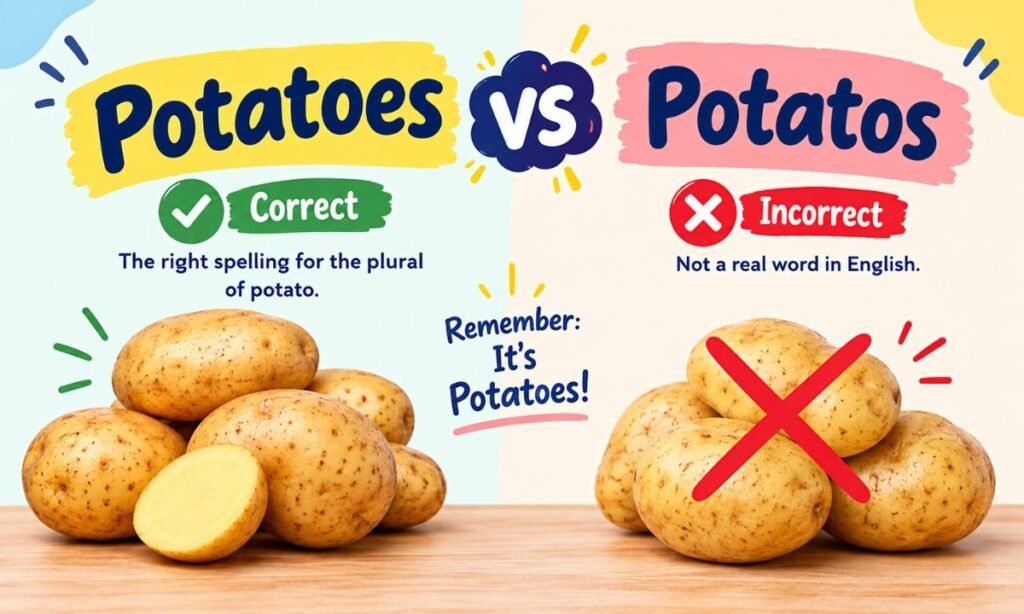

If you’ve ever paused mid-sentence wondering whether to type “potatoes” or “potatos,” you’re not alone. This is one of the most searched spelling questions in English, and the answer is simpler than most people expect.
Only one of these spellings exists in standard English. The other is a mistake that shows up constantly in menus, grocery lists, social media posts, and even news headlines. By the end of this guide, you’ll know exactly which word to use, why the rule works the way it does, and how to avoid the error for good.
Comparison Overview
Before getting into grammar rules, here’s a quick snapshot of what separates the two words.
| Feature | Potatoes | Potatos |
|---|---|---|
| Correctness | Correct plural spelling | Incorrect spelling |
| Dictionary status | Listed in every major English dictionary | Not found in any standard dictionary |
| Usage in formal writing | Accepted everywhere | Marked as an error |
| Common cause | Follows the -o plural rule | Typing mistake or unfamiliarity with the rule |
| Frequency online | Used correctly the vast majority of the time | Appears mainly as a typo |
The short version: “potatoes” is the word you want. “Potatos” should never appear in anything you write.
Definition of Potatoes
Potatoes is the plural form of the noun “potato.” A potato is a starchy vegetable that grows underground as a tuber and serves as a staple food across the world. Whether boiled, roasted, mashed, or fried, potatoes appear in kitchens everywhere from home dinner tables to high-end restaurants.
Grammatically, “potatoes” follows a specific pluralization pattern in English: nouns that end in a consonant plus “o” typically take “-es” rather than a simple “-s.” Think of words like “tomatoes,” “heroes,” and “echoes.” Potato fits neatly into this group.
Example sentence: She roasted the potatoes with rosemary and olive oil.
Definition of Potatos
“Potatos” has no legitimate definition. It doesn’t appear in Merriam-Webster, Oxford, Cambridge, or any other recognized dictionary. It’s simply a misspelling of “potatoes,” created when someone drops the required “e” before adding the plural “s.”
This mistake usually happens for one of a few reasons: the writer types quickly and skips a letter, they mentally apply the standard “just add s” plural rule instead of the “-es” rule, or they’ve seen the misspelling elsewhere and assumed it was correct.
There is no context, formal or informal, where “potatos” is the right choice.
Main Differences Between Potatoes and Potatos
The core difference comes down to one missing letter, but that single letter changes a correct word into an error. Here’s a closer breakdown of how the two compare.
Comparison Table
| Aspect | Potatoes | Potatos |
|---|---|---|
| Spelling | Ends in -oes | Ends in -os |
| Grammar rule followed | Consonant + o → es | Does not follow standard rule |
| Acceptable in exams | Yes | No |
| Acceptable in professional writing | Yes | No |
| Recognized by spell-checkers | Yes | Flagged as an error |
| Historical usage | Documented since the 1500s | Not a recognized historical spelling |
| Similar words | Tomatoes, echoes, heroes | None (not a valid pattern for this word) |
Once you see the pattern laid out this way, the difference stops feeling confusing. It becomes a simple case of one word following the rule and one word breaking it.
Grammar Guide
How each term is used in sentences
“Potatoes” functions as a plural noun in a sentence, referring to two or more potato tubers. It can act as a subject, an object, or part of a compound phrase.
- Potatoes grow well in cool climates. (subject)
- I bought potatoes at the farmers market. (object)
- Sweet potatoes and regular potatoes taste very different. (compound subject)
“Potatos” would technically occupy the same grammatical position if it were used, but because it’s not a real word, it has no correct sentence use. Any sentence containing “potatos” is grammatically flawed the moment that spelling appears.
Common mistakes learners make
English learners and even native speakers slip up with this word more often than you’d think. Some of the most frequent mistakes include:
- Dropping the “e” and writing “potatos” instead of “potatoes”
- Writing “potatoe” as the singular form, confusing it with the plural
- Assuming the plural rule for words like “photos” or “pianos” applies to “potato”
- Relying on autocorrect without double-checking, since some tools miss this error
- Mixing up “potatoes” with “tomatoes” in fast typing
The Dan Quayle example from 1992 is still brought up in classrooms today. During a spelling bee, the former U.S. Vice President corrected a student’s correctly spelled “potato” to the incorrect “potatoe,” a moment that became a lasting lesson in why even simple words deserve a second look.
Simple rules to remember
Here’s the rule in plain terms: when a noun ends in a consonant followed by “o,” the plural usually adds “-es.” Potato ends in “t” followed by “o,” so the plural becomes potatoes.
Compare it with words that end in a vowel plus “o,” which usually just add “s”:
| Word type | Example | Plural |
|---|---|---|
| Consonant + o | potato | potatoes |
| Consonant + o | tomato | tomatoes |
| Consonant + o | hero | heroes |
| Vowel + o | radio | radios |
| Vowel + o | video | videos |
A handy mental trick: picture the word “potato” needing an extra letter to “hold” the plural sound, much like how “tomato” needs the same treatment. If you remember one, you’ll remember the other.
Quick tips for writing and speaking
- Say the word slowly and picture the spelling before you write it, since “potatoes” and “potatos” sound almost identical when spoken quickly.
- Run a spell-check, but don’t rely on it completely. Some browser spell-checkers still miss this specific error.
- Keep a short mental list of similar words (tomatoes, heroes, echoes) as a memory anchor.
- Read your sentence back once before publishing anything online, especially menus, ads, or product listings where a misspelling can look unprofessional.
- If you’re ever unsure, search the exact phrase you’re about to publish. A quick check takes seconds and can prevent an embarrassing typo in a headline or ad campaign.
When to Use Each One
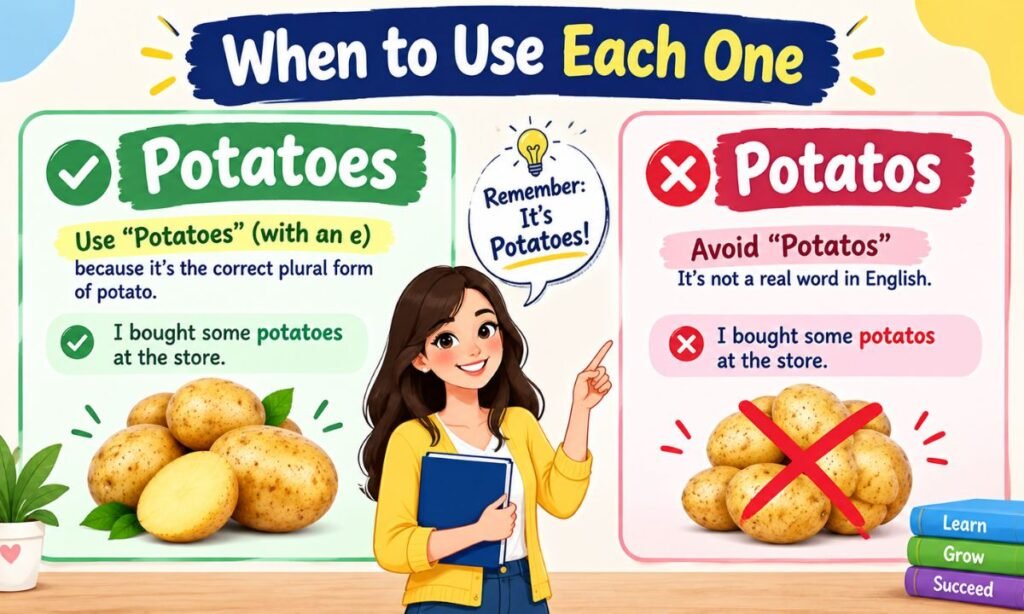
Use “potatoes” any time you’re referring to more than one potato, in any type of writing:
- Recipes and cooking instructions
- Grocery lists and menus
- Academic papers and essays
- Business emails and marketing copy
- Casual conversation, texts, and social media posts
There is no situation where “potatos” should be used. It isn’t a regional variant, an accepted alternative spelling, or a stylistic choice. It’s simply incorrect.
When NOT to Use Each One
Never use “potatos” in any form of writing, formal or informal. This includes:
- School assignments and exams, where it will be marked wrong
- Restaurant menus, where it can hurt credibility
- Professional documents, resumes, and reports
- Website content, where it can quietly damage search rankings and reader trust
Even “potatoes” has one limit worth noting: don’t use it when referring to a single potato. The singular form is “potato,” with no “e” at the end. Confusing the singular and plural forms is a separate but related mistake.
Which One to Use (Decision Guide)
Still unsure? Walk through this simple checklist:
- Are you talking about one potato? Use potato.
- Are you talking about two or more potatoes? Use potatoes.
- Are you about to type “potatos”? Stop. Add the missing “e” before the final “s.”
- Does your sentence sound natural when read aloud with “potatoes”? If yes, you’re using the correct word.
If you ever forget the rule entirely, just remember this: “potatoes” is always correct for the plural, and “potatos” is never correct in any context.
Real-World Practical Examples
Potatoes Examples
- The chef peeled ten potatoes for the stew.
- Potatoes are one of the most widely grown crops in the world.
- We planted potatoes in the garden last spring.
- These potatoes taste amazing with garlic butter.
- Farmers harvest potatoes in the early fall.
- The recipe calls for two pounds of potatoes.
- Mashed potatoes are a classic side dish for holiday dinners.
Potatos Examples
There are no correct examples of “potatos” because the spelling itself is wrong. The only accurate way to reference it is to show what the mistake looks like:
- ~~I bought five potatos at the store.~~ (Incorrect. Should be “potatoes.”)
- ~~She grew potatos in her backyard.~~ (Incorrect. Should be “potatoes.”)
- ~~The menu listed fried potatos as a side.~~ (Incorrect. Should be “potatoes.”)
Each of these examples exists purely to illustrate the error, not to model correct usage.
Self-Assessment (Fill in the Blanks)
Test what you’ve learned. Fill in each blank with either “potato” or “potatoes.”
- I only need one _______ for this recipe.
- She bought a bag of _______ from the market.
- The farmer grows _______ every year on his land.
- Can you hand me that _______ on the counter?
- Roasted _______ pair well with almost any main dish.
- He forgot to buy _______ for tonight’s dinner.
- This single _______ weighs almost half a pound.
- _______ are rich in potassium and fiber.
Answers
- potato
- potatoes
- potatoes
- potato
- potatoes
- potatoes
- potato
- Potatoes
Frequently Asked Questions
Is Potatos or potatoes correct?
Potatoes is the correct spelling. Potatos is a common misspelling and is never accepted in standard English.
Is there an E at the end of potatoes?
Yes, the plural form always ends in “-oes.” The singular “potato” does not have an “e,” but the plural does.
Are potatoes singular or plural?
Potatoes is the plural form. The singular form is potato, referring to just one.
What is healthier, sweet potatoes or potatoes?
Sweet potatoes are slightly higher in fiber, vitamin A, and antioxidants, while regular potatoes offer more potassium. Both are nutritious when prepared without excessive oil or salt.
Conclusion
The choice between potatoes and potatos isn’t really a choice at all. Potatoes is correct, potatos is not, and no context changes that fact. The confusion comes from a small, understandable gap in how English handles words ending in a consonant plus “o,” but once the rule clicks, it sticks for good.
Whether you’re writing a school essay, a recipe, a business email, or a restaurant menu, spelling this word correctly is a small detail that signals care and attention. Keep the comparison table and the simple rule in mind, and you’ll never second-guess this spelling again.