
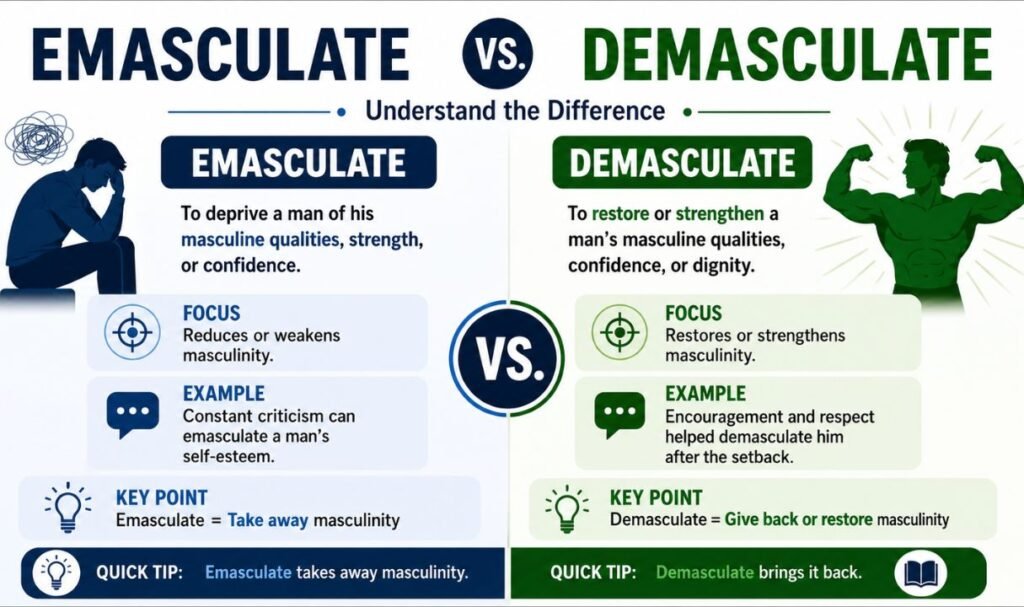

Type “emasculate” into a search bar and autocomplete will almost always suggest “demasculate” right beside it. The two words look like siblings. They sound like siblings. And a lot of people use them as if they’re interchangeable.
Only one of them, though, is actually a word.
This guide breaks down what “emasculate” really means — from its Latin roots to its use in plant science to its heavy presence in conversations about masculinity — and explains why “demasculate” keeps showing up even though dictionaries won’t touch it.
Understanding “Emasculate vs. Demasculate”: What’s the Real Difference?
Here’s the short version, for anyone who wants the answer before the details.
“Emasculate” is a verb with over 400 years of documented use in English. It has a literal, biological meaning (to remove male reproductive organs) and a figurative one (to weaken someone’s power, confidence, or authority). It appears in Merriam-Webster, Oxford, and Cambridge without qualification.
“Demasculate” does not appear in any of those dictionaries. It’s a word people build on the fly, usually by assuming “emasculate” is somehow missing its “de-” prefix. It isn’t. The word already contains that meaning — adding “de-” just duplicates it.
That distinction matters more than it seems. One term is safe for essays, articles, and professional writing. The other will get flagged by an editor, a spell-checker, or a sharp-eyed reader every time.
Understanding “Emasculate”: Meaning, Usage, and Real-World Contexts
Before getting into where the confusion comes from, it helps to understand what “emasculate” is actually doing in a sentence — because it does more work than most people realize.
The word shows up in biology textbooks, agricultural manuals, political commentary, and personal essays about identity. That range is part of why it carries so much weight. It isn’t a niche term confined to one field; it’s a word that moves comfortably between a laboratory and a locker room.
What “Emasculate” Means (Core Definition)
At its core, “emasculate” means to deprive something or someone of strength, vigor, or power. Dictionaries typically list two senses:
- Literal: to castrate, or to remove the male reproductive organs from a person, animal, or plant
- Figurative: to weaken, undermine, or strip someone of authority, confidence, or perceived masculinity
The figurative sense is the one people encounter most often, especially in writing about politics, relationships, and workplace dynamics. A budget cut can emasculate a department. A public failure can emasculate a leader’s authority. Neither example involves anatomy — both involve a loss of standing.
You May Like: Next Friday vs This Friday: The Clear Guide to Never Miss a Date Again
Linguistic Roots of “Emasculate”
The word traces back to the Latin ēmasculāre, built from ex- (“out of” or “away from”) and masculus (“male”). Put together, the original sense was straightforward: to remove maleness from something.
English absorbed the term in the 17th century, first in a clinical and biological sense, describing surgical procedures on animals. Writers soon stretched it into metaphor, using it to describe anything — a policy, an institution, a person — that had been stripped of its force.
Evolution of the Meaning: Quick Timeline Table
| Period | Dominant Usage | Example Context |
|---|---|---|
| Early 1600s | Literal, medical/biological | Surgical removal of male organs in animals |
| Late 1600s–1700s | Early figurative use emerges | Weakening of institutions, armies, or authority |
| 1800s–1900s | Figurative sense becomes dominant | Literature, political writing, social commentary |
| 2000s–present | Figurative use dominates online discourse | Gender debates, pop culture, social media |
Literal Uses of “Emasculate”
The literal meaning hasn’t disappeared — it’s just less common in everyday conversation. It still shows up in two specific fields: veterinary and medical practice, and botany.
Biological Use
In veterinary contexts, “emasculate” describes castration, particularly in livestock. A veterinarian might emasculate a bull calf to control aggression, growth rate, or breeding. The term here is clinical, not emotional — no cultural baggage attached, just a description of a physical procedure.
Botanical Use: A Critical Term in Plant Breeding
This is the meaning most people never encounter, and it’s arguably the most practical use of the word today.
What It Means in Plant Science
In botany, emasculation refers to removing the male reproductive parts — the stamens, specifically the anthers — from a flower. Breeders do this to plants that are naturally bisexual (containing both male and female parts in the same flower) so the flower can’t fertilize itself.
Once the anthers are gone, the flower becomes functionally female. A breeder can then introduce pollen from a chosen parent plant and control exactly which traits get passed on.
How Emasculation Works in Botany
The goal is always the same: prevent self-pollination so a specific, deliberate cross can happen instead. This is a cornerstone technique in hybrid seed production, used across crops like rice, wheat, tomato, and cotton.
Breeders typically remove the anthers before they mature and release pollen — a stage called dehiscence. Timing matters. Remove the anthers too late, and the flower may have already pollinated itself, ruining the cross.
Botanical Emasculation: Step-by-Step Table
| Step | What Happens | Why It Matters |
|---|---|---|
| 1. Select the flower | Breeder chooses a bisexual flower at the right developmental stage | Timing affects whether emasculation succeeds |
| 2. Remove the anthers | Stamens are carefully extracted with forceps or fine tools | Prevents the flower from fertilizing itself |
| 3. Bag the flower | The emasculated flower is covered to block unwanted pollen | Keeps the cross controlled and uncontaminated |
| 4. Apply chosen pollen | Breeder introduces pollen from the selected parent plant | Produces a deliberate, planned hybrid |
| 5. Monitor seed development | Breeder tracks the resulting seeds and traits | Confirms the cross worked as intended |
This process supports a huge share of modern agriculture. Seedless fruit, disease-resistant grain varieties, and higher-yield crops often trace back to careful, hands-on emasculation work in a breeding program.
Metaphorical Uses of “Emasculate”: The Most Common Meaning Today
Outside of biology labs and greenhouses, this is the version of the word people actually use — and the one that generates the most heated conversation.
Metaphorical Emasculation Means:
- Undermining someone’s confidence or authority
- Removing power from a role, institution, or policy
- Making someone feel diminished, small, or stripped of control
- Weakening influence in a professional, social, or political setting
None of this requires gender to be involved in a literal sense, though the word’s roots keep it tied to ideas about masculinity in cultural conversation.
Examples of Metaphorical Emasculation
- “Budget cuts threatened to emasculate the agency’s ability to enforce regulations.”
- “He felt emasculated after his manager overruled him in front of the entire team.”
- “The new legislation was seen as an attempt to emasculate local government authority.”
- “Public criticism can emasculate even a confident public figure.”
Notice that none of these sentences describe anything physical. They describe a loss of standing — a person, department, or institution losing its ability to act with authority.
Why the Word “Emasculate” Gets So Emotional
Few verbs carry this much cultural charge. Part of it is the word’s dual meaning — it started as something literal and physical before becoming symbolic, and that physical origin still colors how the figurative sense lands.
Part of it is timing. Conversations about gender roles, workplace power, and masculinity have become louder and more public over the last two decades. “Emasculate” sits right in the middle of those conversations because it names something specific: the loss of a trait tied, culturally, to male identity and authority.
That specificity is exactly why the word provokes a reaction. Calling something “weak” is vague. Calling it “emasculated” points directly at gendered expectations, and readers respond to that directness — sometimes with recognition, sometimes with defensiveness.
You May Like: Window Seal or Sill? The Complete Guide to the Difference
“Demasculate”: What People Think It Means (But Doesn’t)
Given how often “demasculate” appears online, it’s worth being clear about what people are reaching for when they use it.
Most of the time, they mean the exact same thing as the figurative sense of “emasculate”: stripping someone of masculine traits, confidence, or authority. The intended meaning is rarely in dispute — the word choice is what trips people up.
Is “Demasculate” a Real Word?
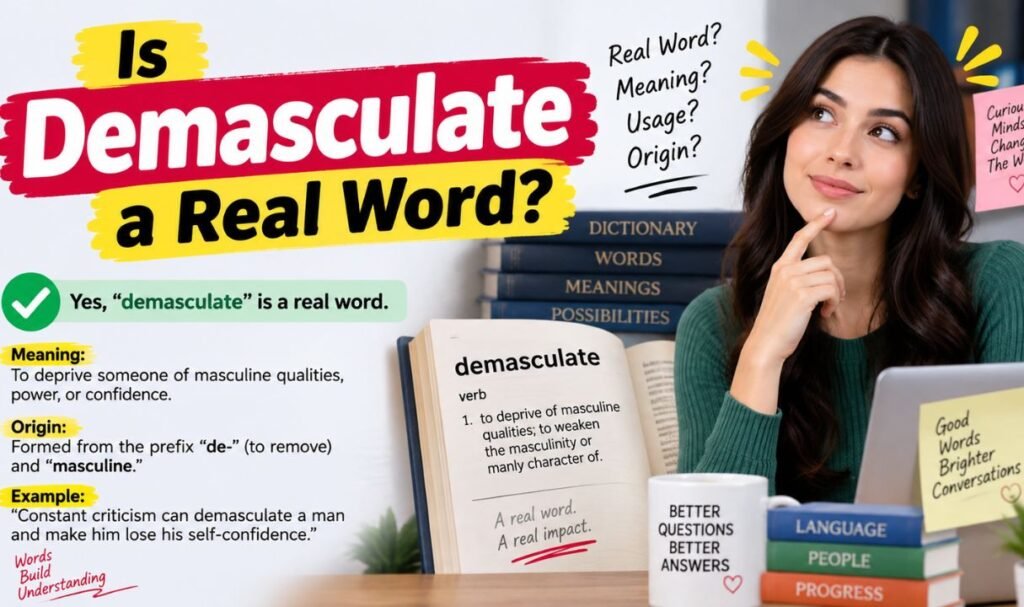
No. It doesn’t appear in Merriam-Webster, Oxford, or Cambridge dictionaries. Spell-checkers flag it. Style guides don’t recognize it. Academic and professional writing consistently avoids it in favor of “emasculate.”
Why People Think It’s a Real Word
A few patterns explain the confusion:
- The “de-” prefix habit. English has plenty of verbs built by adding “de-” to reverse or remove something — deactivate, defrost, declaw. It’s reasonable to assume “masculate” plus “de-” would follow the same pattern.
- Sound-alike confusion. “Emasculate” and “demasculate” share enough syllables that in casual speech, the difference barely registers.
- Online repetition. Once a nonstandard word gets used enough times in comment sections, forums, and social posts, it starts to look normal, even though no dictionary has adopted it.
- Redundant logic that feels intuitive. “Emasculate” already means to remove masculinity. Adding “de-” doesn’t clarify anything; it just repeats work the word is already doing.
Key Differences: Emasculate vs Demasculate
Comparison Table
| Feature | Emasculate | Demasculate |
|---|---|---|
| Dictionary status | Recognized in all major dictionaries | Not recognized in any major dictionary |
| Origin | Latin ēmasculāre (ex- + masculus) | Informal coinage, likely prefix confusion |
| First documented use | Early 1600s | No formal documented origin |
| Literal meaning | To castrate; remove male reproductive organs | None established |
| Figurative meaning | To weaken power, confidence, or authority | Same intended meaning, used informally |
| Used in scientific/medical fields | Yes (veterinary, botany) | No |
| Accepted in professional writing | Yes | No |
| Appears in style guides | Yes | No |
Why People Confuse the Terms
Main Reasons
- Both words sound similar when spoken aloud, especially at conversational speed
- Both are trying to communicate the same emotional idea
- English’s “de-” prefix pattern makes “demasculate” feel logical even though it’s incorrect
- Social media and forums normalize nonstandard spellings through repetition
- Few people fact-check a word before using it, especially in casual writing
Cultural and Social Dimensions of “Emasculate”
Word choice aside, “emasculate” carries weight because it’s tangled up in bigger conversations about identity and power.
Emasculation in Gender Roles and Masculinity Debates
Traditional ideas about masculinity often center on strength, control, and authority. When someone describes a man as “emasculated,” they’re usually pointing at a moment where one of those traits was publicly taken away — a demotion, a public correction, a loss of financial control, a visible failure.
These conversations sit at the center of ongoing debates about what masculinity should look like, and whether tying self-worth to power and control is healthy in the first place. Some writers use “emasculate” critically, pointing out how rigid these expectations can be. Others use it descriptively, simply naming a feeling readers recognize.
Quote:
“The word doesn’t just describe weakness — it describes a very specific kind of weakness, one tied to identity rather than ability.”
Media and Pop Culture
Film, television, and music reference emasculation constantly, often through storylines about men losing jobs, status, or control within relationships. Comedy leans on it too — the “henpecked husband” trope is essentially emasculation played for laughs. That constant repetition in media is part of why the word feels so loaded by the time people encounter it in everyday conversation.
Modern Shifts in Perspective
Recent cultural conversation has started pushing back on the assumption that losing control or authority automatically threatens someone’s identity. Writers and psychologists increasingly frame confidence and self-worth as separate from dominance or status.
That reframing doesn’t erase the word “emasculate” — it’s still accurate for describing a loss of power or authority. But it does shift how people talk about the feeling attached to it, treating it less as an inevitable blow to identity and more as a specific, situational experience.
How to Choose the Right Word (And Avoid Mistakes)
When You SHOULD Use “Emasculate”
- Describing a literal biological or veterinary procedure
- Explaining a botanical breeding technique
- Writing about someone’s loss of authority, confidence, or control
- Any formal, academic, journalistic, or professional context
When You SHOULD NOT Use “Demasculate”
- In any professional, academic, or published writing
- Anywhere accuracy and credibility matter
- When writing for an audience likely to notice nonstandard usage
Correct Alternatives Instead of “Demasculate”
- Emasculate
- Undermine
- Weaken
- Diminish
- Strip of authority
- Disempower
Quick Decision Guide
- Talking about a biological procedure or plant breeding? Use emasculate.
- Talking about someone losing confidence, power, or authority? Use emasculate.
- About to type “demasculate”? Swap it for emasculate, or pick a plain alternative like undermine or weaken.
Getting this right isn’t about gatekeeping vocabulary. It’s about choosing a word that dictionaries, editors, and readers will all recognize without pausing to question it.
Frequently Asked Questions
Is there a female version of emasculation?
Not a direct linguistic equivalent. “Emasculate” is rooted in masculinity specifically, though the figurative sense — losing confidence or authority — applies to anyone regardless of gender.
What does demasculinize mean?
“Demasculinize” is closer to a real, occasionally used term meaning to remove masculine characteristics, but it’s still far less standard and less common than “emasculate.”
Is it emasculating or emasculating?
“Emasculating” is the correct spelling and the standard present-participle form of “emasculate.”
What does it mean to emasculate a person?
It means to strip someone of power, confidence, or authority — figuratively — or, in a literal medical sense, to remove male reproductive organs.
Conclusion
“Emasculate” earns its place in the dictionary through centuries of consistent use — as a precise biological term, a working tool in plant science, and a loaded metaphor for lost power and confidence. “Demasculate” hasn’t earned that place. It’s a word built on a reasonable-sounding assumption about prefixes, kept alive mostly through repetition rather than formal recognition.
The fix is simple. Whenever “demasculate” comes to mind, reach for “emasculate” instead — or, if the tone calls for something gentler, “undermine” or “weaken” will do the job just as well.