
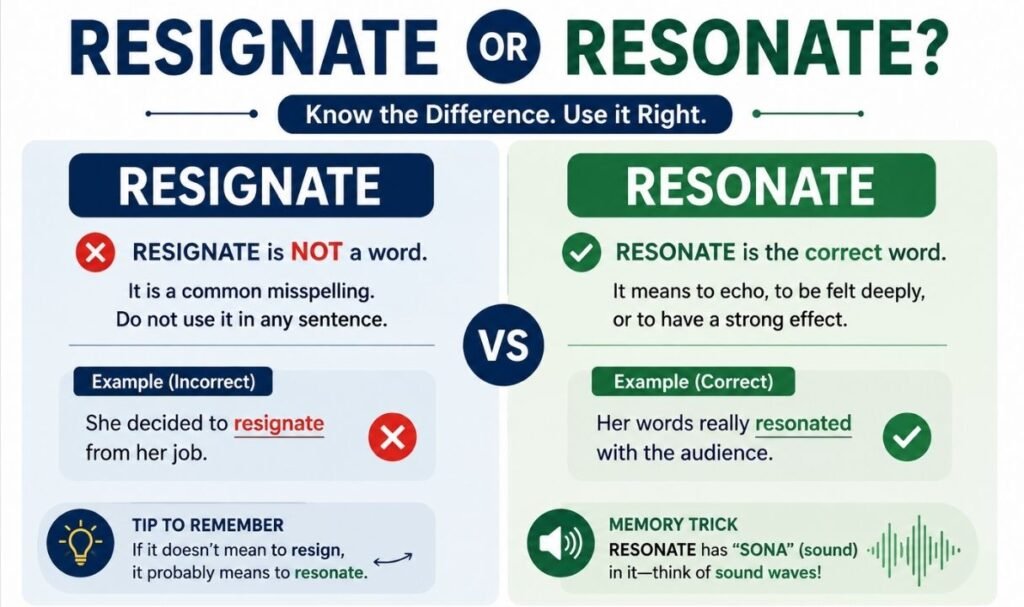

If you’ve typed “resignate” and then paused, wondering if that’s actually a word, you’re far from alone. Thousands of people search this exact question every month, usually right before hitting publish on an email, a caption, or a school essay. The short answer: resonate is correct, and resignate isn’t a real word at all. But the reason this mix-up keeps happening — and how to use “resonate” the way skilled writers do — is worth a closer look.
This guide breaks down where the confusion comes from, what the dictionary actually says, and how to write sentences that resonate rather than fall flat.
Resignate or Resonate: Why This Mix-Up Happens Everywhere
Open any comment section, group chat, or LinkedIn post long enough and you’ll spot it: “This really resignated with me.” It reads naturally. It sounds fine out loud. And that’s exactly the problem — the error is smooth enough that spell-checkers sometimes miss it, and readers glide right past it without noticing anything is off.
Language mistakes like this one spread fastest when a word already sounds like something else in the listener’s ear. “Resonate” has a soft, familiar rhythm, and “resignate” slides into that same rhythm with barely a syllable out of place. Add in how often people hear the word spoken rather than see it written — in podcasts, speeches, and video captions — and the error has plenty of room to grow.
The Core Mix-Up: What People Think They’re Saying vs. What They Actually Say
Here’s the gap in plain terms:
| What the speaker means | What they say | What’s actually correct |
|---|---|---|
| “That idea connects with me emotionally.” | “That idea resignates with me.” | “That idea resonates with me.” |
| “Her speech had a lasting impact.” | “Her speech resignated.” | “Her speech resonated.” |
| “This message speaks to our audience.” | “This message resignates with our audience.” | “This message resonates with our audience.” |
Notice the pattern: in every case, the intended meaning is about connection, impact, or emotional response. Nobody actually means “resign,” yet the sound of that word quietly sneaks into the spelling. That’s the whole mix-up in a nutshell — a meaning borrowed from one word, wearing the spelling of another.
Why People Keep Using “Resignate” (Even Though It Isn’t a Real Word)
This isn’t a case of people being careless. There are real linguistic reasons this error keeps reappearing across generations of writers.
Phonetic Confusion
Say “resonate” and “resignate” out loud at normal speaking speed. The difference is a single soft sound in the middle, and in casual speech, that sound often gets swallowed entirely. Your ear fills in a word that isn’t there.
Misheard Words
A huge share of vocabulary is absorbed by ear long before it’s ever seen in print — through conversation, videos, or audiobooks. When a word is learned this way, the brain sometimes reconstructs the spelling based on a related-sounding word instead of the actual term.
Assumptions About Word Patterns
English is full of verbs ending in “-ate”: designate, activate, hesitate, originate. Since “resign” is a common, familiar word, it feels like a short logical leap to attach that same “-ate” ending and produce “resignate.” The pattern feels correct even though the word doesn’t exist.
Social Spread
Once one influencer, teacher, or coworker uses “resignate” in a caption or comment, it gets absorbed by everyone who reads it. Repetition builds a false sense of legitimacy — if enough people use a word, it starts to feel real, even when no dictionary has ever recorded it.
Lack of Exposure to the Correct Term
Some people simply haven’t encountered “resonate” often enough in written form to lock in the correct spelling. Without that repeated visual exposure, the ear-based guess takes over by default.
Is “Resignate” a Real Word? The Unfiltered Answer
No. “Resignate” does not appear in Merriam-Webster, Oxford, Cambridge, or any other major dictionary. It has no formal definition, no accepted grammatical role, and no recognized history as a standard English term. Linguists sometimes call words like this “ghost words” — forms that sound plausible and get repeated widely, but were never actually coined with a defined meaning.
Using it in a resume, a formal email, or a published article can quietly undercut your credibility, even if the reader can’t name exactly why the sentence feels off. It’s one of those small details that experienced editors catch instantly.
Why It Fails Linguistically
- It has no established root in Latin, Greek, or Old English that supports its formation.
- It isn’t a recognized variant, dialect form, or regional spelling anywhere in the English-speaking world.
- It doesn’t follow a consistent derivational pattern the way genuine “-ate” verbs do.
- No style guide, from AP to Chicago, lists it as acceptable.
In short, “resignate” isn’t wrong because of a rule someone invented. It’s wrong because it simply was never built as a word in the first place.
The Correct Word: What “Resonate” Actually Means
“Resonate” is a verb with two connected meanings — one physical, one emotional — and both trace back to the idea of sound continuing or repeating.
Core Definitions
- Literal meaning: to produce or be filled with a rich, continuing sound, especially through vibration. A cathedral bell resonates through the surrounding streets.
- Figurative meaning: to strike a chord with someone emotionally or intellectually; to feel true, familiar, or deeply relevant.
The figurative sense is the one people reach for most in everyday speech and writing, especially when describing how a message, story, or piece of art connects with an audience.
Real-World Examples of “Resonate”

- “Her story resonated with everyone in the room, and a few people were visibly moved.”
- “The brand’s new slogan didn’t resonate with younger customers the way the marketing team expected.”
- “The lecture hall was built so that even a quiet voice would resonate to the back row.”
- “That line from the film still resonates with me years later.”
A few related searches worth clearing up quickly, since they all point back to the same word:
- Resignate or resonate synonym — people usually mean synonyms for “resonate,” such as echo, strike a chord, or connect.
- Resignate or resonate meaning — “resonate” means to produce a lasting sound or emotional effect; “resignate” has no meaning because it isn’t a real word.
- Resonate meaning — to evoke a strong, often emotional response, or to produce a continuing sound.
- Resignate or resonate examples — see the sentence list above; “resonate” is the version used in every correct example.
- Resignate meaning — none; it’s a misspelling of “resonate.”
- Resignate spelling — not a standard spelling of any recognized English word.
- Resonate synonym — echo, strike a chord, connect, reverberate, ring true.
- Resonate with someone — to feel a strong personal connection to what they said, wrote, or created.
What Dictionaries and Style Guides Say About “Resonate”
Merriam-Webster defines “resonate” as producing a resonant sound and, in its extended sense, as having a lasting or profound impact. Oxford’s entry runs along the same lines, listing both the acoustic definition and the figurative one tied to emotional or cultural relevance. Cambridge Dictionary similarly lists the figurative sense as “to remind someone of their own ideas, experience, or emotions.”
None of these sources — nor AP Style, nor Chicago Manual of Style — recognize “resignate” in any form. Every major English-language authority treats “resonate” as the only standard spelling and usage for this concept.
Etymology: How “Resonate” Evolved from Latin to Today
Latin Origin
“Resonate” traces back to the Latin verb resonare, built from re- (“again”) and sonare (“to sound”). Together, the word originally meant something close to “to sound again” or “to sound back” — a fitting description of an echo bouncing off a canyon wall.
Evolution Over Time
That Latin root passed into English through the sciences of acoustics and music, where “resonance” described how a sound wave sustains or amplifies itself within a space. Over the following centuries, writers began borrowing the term for emotional and intellectual experiences, since the feeling of an idea “echoing” inside a person captures something real about how understanding and connection work. By the twentieth century, the figurative sense had become just as common as the literal one, and today it shows up constantly in marketing, psychology, and everyday conversation.
How to Use “Resonate” Correctly in Everyday Life
In Daily Conversation
Use “resonate” when describing a personal reaction to something you heard, read, or experienced: “That advice really resonated with me” works naturally in casual speech and carries genuine emotional weight.
In Professional Writing
In reports, pitches, and emails, “resonate” is useful for describing audience reaction: “The proposal resonated with stakeholders” or “This messaging needs to resonate with a younger demographic.” It reads as polished without sounding stiff.
In Media & Literature
Critics and reviewers often use “resonate” to describe a work’s lasting emotional effect: “The novel’s final chapter resonates long after the book is closed.” It’s a common word in reviews precisely because it captures something readers already feel but struggle to name.
Correct vs Incorrect Usage
| Incorrect | Correct |
|---|---|
| “Her words resignated with the crowd.” | “Her words resonated with the crowd.” |
| “I hope this resignates with you.” | “I hope this resonates with you.” |
| “The campaign didn’t resignate this time.” | “The campaign didn’t resonate this time.” |
| “His speech resignated across the internet.” | “His speech resonated across the internet.” |
Writing Messages That Truly Resonate
Knowing the correct word is one thing. Writing something that actually resonates with a reader is a separate skill, and it comes down to a handful of habits.
Know Your Audience
A message can only strike a chord if it reflects something the reader already cares about or recognizes in their own life. Before writing a single sentence, get specific about who’s reading it and what they’re worried about, hoping for, or dealing with right now.
Speak to Emotions
Facts inform people; feelings move them. A sentence that names a real emotion — frustration, relief, pride, worry — lands harder than one that only states information.
Keep It Clear
Confusing sentences can’t resonate, because a reader who’s busy untangling grammar has no attention left for feeling anything. Short, direct sentences almost always beat long, layered ones.
Use a Strong Hook
The first line decides whether the rest gets read at all. A question, a small surprising fact, or a vivid scene works better than a slow warm-up.
Add Sensory Details
Specific, physical details make writing feel real. “The coffee had gone cold by the time she finished reading” resonates more than “she was busy,” because a reader can picture it.
Be Authentic
Readers can usually tell when a message is manufactured rather than felt. Writing in your own natural voice, including its small imperfections, tends to land better than a polished but hollow version of the same idea.
Communication Tips to Make Your Messages Resonate
Use Storytelling
A short, specific story does more emotional work than a general statement. People remember narratives far longer than they remember bullet points.
Use Concrete Examples
Abstract claims (“our product improves efficiency”) rarely resonate. Specific ones (“our client cut onboarding time from three weeks to four days”) almost always do.
Use Rhythm
Vary sentence length on purpose. A long, flowing sentence followed by a short one creates emphasis and gives the reader a place to pause and absorb the point.
Use Contrast
Pairing opposites — before and after, expectation and reality, silence and noise — creates tension that draws a reader in and makes the resolution feel earned.
Avoid Jargon
Technical language creates distance. Plain words create closeness, and closeness is what makes a message resonate in the first place.
Use Active Verbs
“The team solved the problem” resonates more than “the problem was solved by the team.” Active verbs put energy and ownership directly into a sentence.
Table: What Creates Resonance vs. What Kills It
| Creates Resonance | Kills Resonance |
|---|---|
| Specific, sensory language | Vague generalizations |
| Short, varied sentence rhythm | Long, uniform paragraphs |
| Genuine emotion | Forced or exaggerated tone |
| A clear, relatable story | Abstract statistics with no context |
| Active voice | Passive, distant phrasing |
| Direct address to the reader | Impersonal, corporate wording |
Practice: Exercises to Master “Resonate”
Fill-in-the-Blank
- Her closing argument ______ with every juror in the room.
- The song’s lyrics still ______ with listeners decades later.
- I’m not sure this slogan will ______ with our target audience.
(Answer for all three: resonate / resonated)
Rewrite the Sentence
Original: “His words resignated with a lot of people online.” Rewrite: “His words resonated with a lot of people online.”
Original: “The ad campaign resignated well in the first week.” Rewrite: “The ad campaign resonated well in the first week.”
Mini Writing Prompt
Write three sentences about a moment, a song, or a piece of advice that resonated with you personally, and explain in one line why it stuck. This kind of short reflection is one of the fastest ways to lock the correct word into memory, since you’re pairing it with a real experience rather than a dictionary definition.
Frequently Asked Questions
What does resonate with mean?
It means to feel a strong personal, emotional, or intellectual connection with something — an idea, a story, or an experience that feels true to you.
Can you say “I resonate with that”?
Yes, it’s a common and correct way to say you personally relate to or agree with something on a deeper level.
Is resignate a word?
No, “resignate” is not a recognized English word; it’s a common misspelling of “resonate.”
What does resonate mean in feelings?
In an emotional context, it means something evokes a genuine, often lasting reaction — a sense of recognition, connection, or being deeply understood.
Conclusion
“Resignate” isn’t a shortcut, a variant, or an accepted alternative — it’s simply an error that spreads because it sounds so close to a word people already know well. “Resonate” is the only correct choice, whether you’re describing a vibrating bell, a moving speech, or an idea that finally clicks.
Once you understand where the confusion comes from and how the correct word actually works, using it well becomes second nature. The next time you’re tempted to type “resignate,” pause for half a second, and let “resonate” do the work instead.