
You type a sentence, pause at the word “myself,” and something feels off. Should there be a space? Is “my self” even a real phrase, or did autocorrect just fail you? This mix-up trips up students, professional writers, and native English speakers alike, and the reason is simple: the two forms sound identical when spoken but belong to completely different worlds of language.
One is a pronoun. The other is a noun phrase about who you are. This guide breaks down both forms completely, with examples, tables, common mistakes, and a quick-reference system so you never hesitate over this again.
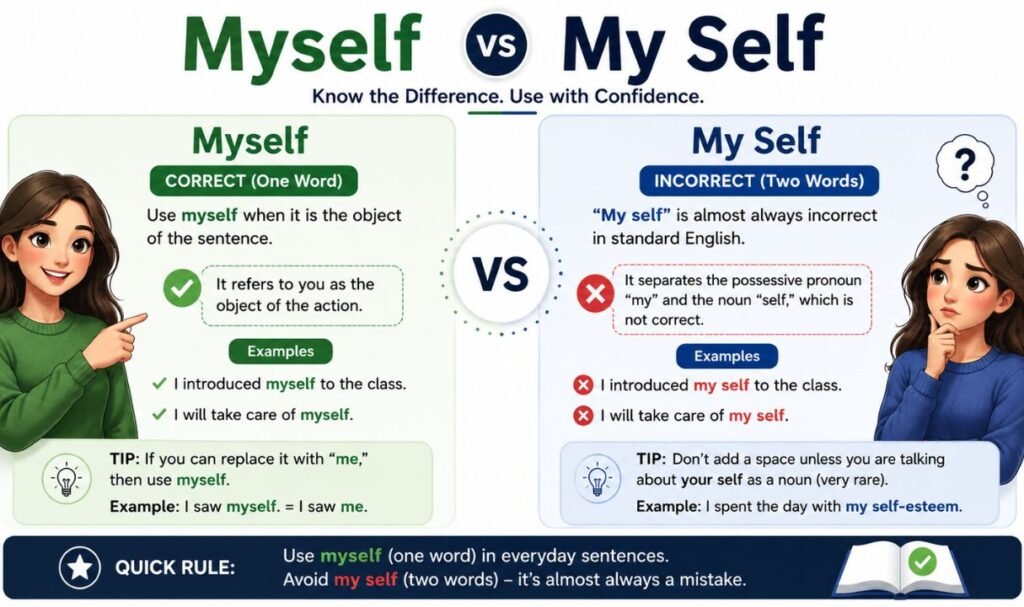
Myself vs My Self: What’s the Real Difference?
The short version: “myself” is a grammatical pronoun, and “my self” is a two-word phrase about identity, consciousness, or inner life.
“Myself” follows fixed grammar rules — it either reflects an action back onto you or adds emphasis to a sentence. “My self,” on the other hand, treats “self” as a standalone noun, modified by the possessive “my,” much like “my heart” or “my mind.” One belongs to a grammar textbook. The other belongs to a psychology journal or a personal essay.
| Feature | Myself | My Self |
|---|---|---|
| Word type | Reflexive/intensive pronoun | Possessive + noun |
| Common context | Everyday speech, formal writing | Psychology, philosophy, journaling |
| Grammatical role | Refers back to subject “I” | Refers to identity or inner being |
| Example | I hurt myself. | I lost my self in the noise. |
| Standard in grammar? | Yes | No, situational |
What “Myself” Really Means in English
“Myself” is a first-person singular pronoun that ties directly to “I.” It shows up constantly in daily conversation, and most speakers use it correctly without ever thinking about the grammar behind it. Problems appear mainly when people try to use it as a substitute for “me” or “I,” which is where things go wrong.
“Myself” as a Reflexive & Intensive Pronoun
English has a small family of reflexive pronouns: myself, yourself, himself, herself, itself, ourselves, yourselves, themselves. Each one sends the action of a verb back to the person who performed it. “Myself” does this job for the first-person singular subject “I.”
But “myself” carries a second job too. It can step into a sentence purely to add weight or emphasis, without changing the sentence’s core meaning at all.
Two main functions of “myself”:
- Reflexive use — the subject performs an action on itself. Example: I taught myself to cook.
- Intensive use — the word adds emphasis to who did something, and could be removed without breaking the sentence. Example: I built the shed myself.
Correct Examples in Everyday Sentences
Seeing the two functions side by side makes the pattern click faster than any rule ever could.
Reflexive Use
- I reminded myself to call the dentist.
- She pushed herself through the last mile of the race, and I pushed myself too.
- I caught myself daydreaming during the meeting.
- He introduced himself, and I introduced myself right after.
- I prepared myself for a difficult conversation.
Intensive Use
- I, myself, prefer tea over coffee.
- I finished the report myself, without any help.
- The manager herself approved the request, and I myself signed off on it.
- I’ll handle the presentation myself.
- I locked the office myself last night.
Notice the test that separates the two: in reflexive sentences, removing “myself” breaks the meaning. In intensive sentences, removing it leaves the sentence intact — only the emphasis disappears.
You May Like: Window Seal or Sill? The Complete Guide to the Difference
Incorrect Uses of “Myself” (Very Common!)
This is where most mistakes happen, and it usually comes from a habit called hypercorrection. People know that “me and Sarah went to the store” sounds informal, so they overcorrect by swapping in “myself,” assuming it sounds more polished. It doesn’t. It sounds wrong to anyone who actually knows the rule.
Common errors include:
- ❌ Please send the file to John or myself. → ✔️ Please send the file to John or me.
- ❌ My manager and myself will review the proposal. → ✔️ My manager and I will review the proposal.
- ❌ Myself and the team completed the project. → ✔️ The team and I completed the project.
- ❌ Contact myself if you have questions. → ✔️ Contact me if you have questions.
“Myself” only works when “I” already appears somewhere in the sentence as the subject performing the action. Without that anchor, “myself” has nothing to reflect back to, and the sentence collapses grammatically.
Understanding “My Self” (Two Separate Words)
Once you split “self” off as its own word, it stops behaving like a pronoun altogether. “Self” becomes a noun — an abstract one, referring to a person’s core identity, consciousness, or inner experience. “My” simply modifies it the way it would modify any other noun, such as “my mood” or “my thoughts.”
This form rarely appears in ordinary conversation. You’ll find it far more often in reflective writing, therapy sessions, or discussions about who a person really is beneath the surface.
What “My Self” Actually Means
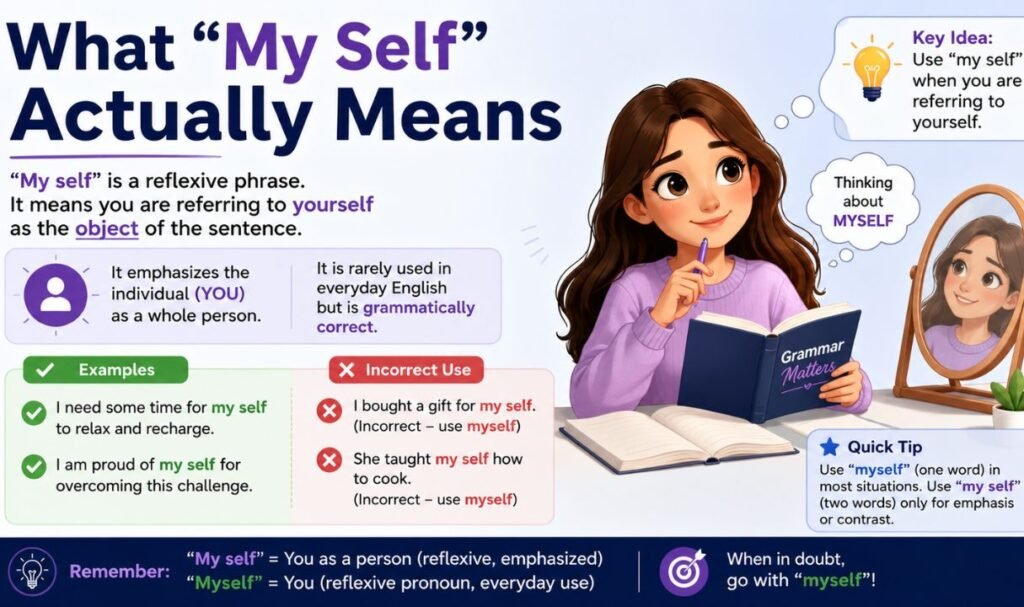
When a writer chooses “my self” over “myself,” they’re usually drawing a line between the outer, performing “me” and the inner, private self. The space itself becomes meaningful — a small pause that signals depth, introspection, or emotional weight.
Examples
- I’m learning to accept my self, flaws and all.
- Meditation helped me reconnect with my self.
- I lost touch with my self during those stressful years.
- Therapy is helping me rebuild my self.
- She wrote about rediscovering her true self after the divorce.
In each case, “self” functions as a noun that could theoretically be replaced with words like “identity,” “core,” or “inner being,” and the sentence would still make sense.
Where “My Self” Is Commonly Used
This phrase doesn’t wander randomly into writing. It clusters around a handful of specific fields where identity itself is the subject under discussion.
Psychology
Psychologists and counselors often separate “self” into layers — the self-concept, the ideal self, the observed self. In this context, writers might describe “protecting my self” or “understanding my self” as distinct from simply describing an action they performed.
Philosophy
Philosophers have debated the nature of the self for centuries, asking what continuity of identity actually means over a lifetime. Writing about “my self” in this context signals a deliberate, conceptual use of “self” as a noun with philosophical weight, not a grammatical accident.
Literature
Poets and essayists sometimes break “myself” into two words specifically to slow the reader down and draw attention to the idea of identity. It’s a stylistic choice, not a grammar rule, and it shows up in reflective essays, memoirs, and poetry more than in reports or emails.
Why “Myselves” Is Incorrect — Always
English reflexive pronouns don’t pluralize the way regular nouns do. “Myself” is fixed to the first-person singular “I,” and there is no plural version of it. When a group of people needs a reflexive pronoun, English switches to an entirely different word: “ourselves.”
- ❌ We blamed myselves for the mistake.
- ✔️ We blamed ourselves for the mistake.
- ❌ The children taught myselves how to swim.
- ✔️ The children taught themselves how to swim.
“Myself” belongs to one person only. The moment more than one person is involved, the pronoun changes entirely rather than gaining an -s.
How “Myself” Functions in Grammar
Grammatically, “myself” always needs an anchor. It cannot stand alone as a subject, and it cannot substitute for an object pronoun just because a sentence feels formal.
Reflexive Structure: Subject = Object
In a reflexive sentence, the person performing the verb and the person receiving it are identical. The formula looks like this: I + verb + myself. Examples include “I hurt myself,” “I convinced myself,” and “I forgave myself.” Strip away “myself” from any of these, and the sentence no longer makes sense — proof that the reflexive form is doing real grammatical work.
You May Like: How-To vs. How-Tos The Definitive Guide to Getting It Right
Intensive Structure: Adding Emphasis
Intensive sentences follow a looser pattern: a full, complete sentence with “myself” added afterward purely for emphasis. “I finished the marathon” is already a whole sentence. Adding “myself” — “I finished the marathon myself” — highlights personal effort without changing the underlying meaning. This is the version people misuse most often when they try to force “myself” into places where “me” or “I” belongs.
Identity & Philosophy: The Non-Reflexive “Self”
Step outside grammar entirely, and “self” becomes something closer to a concept than a word. Writers, therapists, and philosophers treat it as the seat of personal identity — the part of a person that persists through change, memory, and experience.
“Self” as a Concept
Terms like self-awareness, self-worth, and self-image all treat “self” as a noun representing identity rather than a grammatical tool. When someone writes “my self” as two words, they’re borrowing this same sense of “self” and attaching it to the possessive “my,” producing a phrase about personal identity rather than a sentence about an action.
How Spacing Changes Meaning
A single space carries enormous weight in this pair of words. It shifts “self” from a bound suffix inside a pronoun into a free-standing noun, and that shift changes the entire category of meaning a sentence falls into.
| Version | Category | Sample Sentence |
|---|---|---|
| Myself | Grammar (pronoun) | I hurt myself while hiking. |
| My self | Identity (noun phrase) | I hurt my self through years of self-doubt. |
Read those two sentences aloud, and they sound identical. Read them on the page, and they mean something quite different — one describes a physical or grammatical action, the other describes an emotional or psychological state.
Common Errors and How to Avoid Them
Using “Myself” Instead of “Me” or “I”
This is the single most frequent mistake in professional writing. “Myself” cannot replace “me” as an object or “I” as a subject unless the sentence is already reflexive or intensive. Test it by removing every other name from the sentence: “Send it to John and myself” becomes “Send it to myself,” which immediately sounds wrong and reveals the error.
Using “My Self” When “Myself” Is Correct
The opposite mistake happens too, usually in casual typing or autocorrect slips. “I taught my self to swim” should be “I taught myself to swim,” since the sentence describes an action, not an exploration of identity.
Adding “Myself” to Sound Formal
Some writers assume that “myself” sounds more polished or professional than “me.” It doesn’t. Overusing it actually signals uncertainty about basic pronoun rules, which undercuts the formality it’s meant to project.
Confusing Identity With Grammar
The deepest confusion happens when writers blend the two functions — using “my self” in a sentence that’s purely about action, or using “myself” in a sentence that’s clearly about inner identity. Keeping the two categories separate in your head solves most of the confusion instantly.
Quick Decision Guide to Remember the Difference
Ask yourself: Is it about grammar or identity?
If your sentence describes an action performed by “I,” you almost certainly want “myself.” If your sentence describes who you are, how you feel about yourself, or your inner state, “my self” may fit better — though even then, “myself” remains far more common in everyday writing.
Fast Test
Try substituting “me” or “I” into the sentence. If the sentence still makes grammatical sense with either of those words, you likely need “myself” as a reflexive or intensive pronoun. If substituting those words feels wrong because the sentence is really about identity or emotion, “my self” may be the better, more deliberate choice.
One-Line Rule
If you’re not writing about consciousness, therapy, or philosophy, use “myself.” That single guideline resolves well over ninety percent of real-world cases.
Real-Life Examples & Micro Case Studies
Case Study 1: Email at Work
A project manager drafts a message: “Please loop in Sarah or myself with any questions.” The correct version replaces “myself” with “me,” since no reflexive or intensive structure exists here — “myself” has nothing to reflect back to.
Case Study 2: Personal Journal Entry
A journal entry reads: “I’ve spent the last year trying to find my self again after the layoff.” Here, “my self” works precisely because the writer means identity and inner stability, not a physical action.
Case Study 3: Classroom Grammar
A teacher corrects a student’s sentence, “The dog hurt myself,” pointing out that “myself” can only refer to the first-person “I,” never to a third party like a dog. The corrected sentence becomes “The dog hurt itself.”
Case Study 4: Meditation Coaching
A meditation coach tells a client, “This practice is about coming home to your self, not performing for anyone else.” The phrase “your self” mirrors “my self,” treating “self” as the noun at the center of the sentence rather than part of a reflexive pronoun.
Frequently Asked Questions
What is the difference between yourself and your self?
“Yourself” is the second-person reflexive/intensive pronoun used in actions like “take care of yourself.” “Your self” treats “self” as a noun referring to someone’s identity, as in “your self is worth protecting.”
Is it grammatically correct to say “myself”?
Yes, when it’s used reflexively (the subject and object match) or intensively (for emphasis). It’s incorrect when used as a simple substitute for “me” or “I.”
Is it correct to say “myself” and “John”?
No. Phrases like “myself and John” or “John and myself” are grammatically incorrect when they function as a subject or object; “John and I” or “John and me” is correct depending on the sentence role.
Why do people keep saying “myself” instead of “me”?
It usually happens through hypercorrection — writers worry that “me” sounds too casual or grammatically risky, so they swap in “myself,” assuming it sounds more careful or formal.
Conclusion
“Myself” and “my self” look almost like twins, but they live in completely different corners of language. One is a workhorse pronoun, showing up in reflexive and intensive sentences across everyday speech and writing. The other is a quiet, deliberate phrase reserved for moments when identity itself is the subject worth naming.
Once you separate the grammar question from the identity question, the confusion mostly disappears. Ask what your sentence is actually doing — describing an action, or describing a person’s inner world — and the right form follows naturally.