
If you’ve ever typed “stop” into a word processor, added “-ing,” and then stared at the screen wondering whether you need one “p” or two, you’re not alone. This mix-up shows up in emails, school essays, and social media posts every single day. The good news is that the rule behind it is short, and once it clicks, you won’t second-guess it again.
Stopping
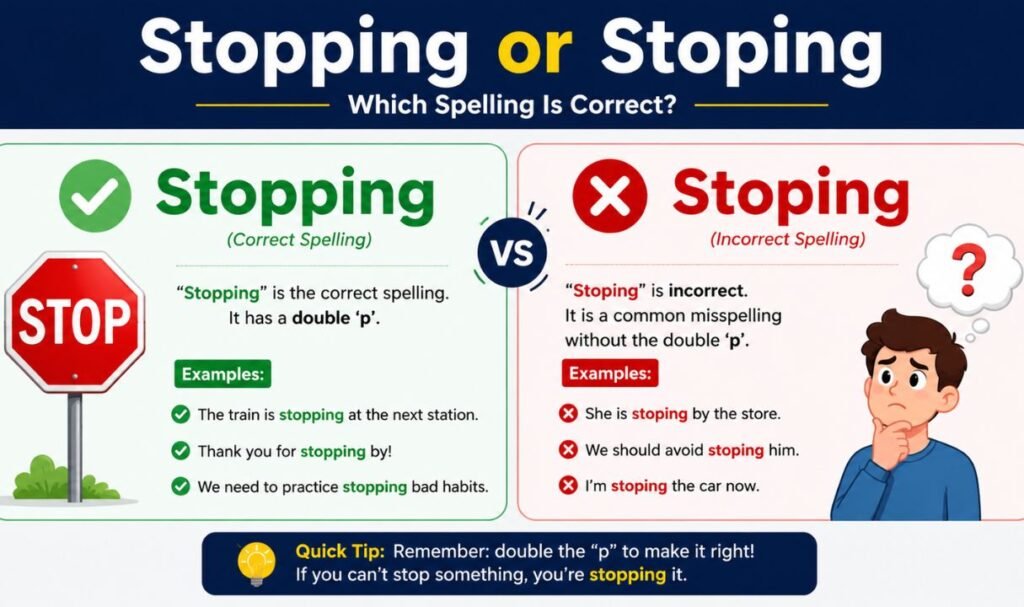
Stopping is the correct spelling for the present participle of the verb “stop.” It means coming to a halt, pausing an action, or preventing something from continuing. You’ll see it in sentences like “The bus is stopping here” or “She’s stopping by later.”
Stoping
Stoping is a real word too, but it belongs to a completely different world. Geologists and mining engineers use it to describe removing ore from underground and leaving behind an open cavity called a stope. Outside that field, “stoping” is almost always a typo for “stopping.”
Stopping or Stoping: Quick Answer
For everyday writing, stopping is what you want. It’s the form used in grammar, conversation, driving instructions, software messages, and just about anything else a regular person writes.
Stoping, meanwhile, only belongs in technical or geological writing. If your sentence has nothing to do with underground mining, drop the single-“p” version and use “stopping” instead.
| Word | Status | Where It’s Used |
|---|---|---|
| Stopping | Correct, standard English | Everyday writing, grammar, conversation |
| Stoping | Correct only in a narrow context | Mining and geology |
The Origin of Stopping
The verb traces back to Middle English stoppen, which itself grew out of Old English and West Germanic roots tied to the idea of plugging or blocking something. Over time, the meaning broadened from “to plug a hole” to the wider sense we use now: bringing motion or activity to an end.
As English spelling settled into more consistent patterns, a rule formed around short verbs like “stop.” When a one-syllable verb ends in a single vowel followed by a single consonant, that final consonant usually doubles before you add a suffix that starts with a vowel, such as “-ing” or “-ed.” That’s why “stop” becomes “stopping” and “stopped,” not “stoping” and “stoped.”
A handful of related search terms show up again and again when people research this topic:
- Stopping or stoping synonym — People searching this phrase usually want alternative words for “stopping,” such as halting, ceasing, pausing, or braking, depending on context.
Stopping or stoping grammar — This search points to the doubling rule itself: short vowel, single consonant, double it before adding a vowel suffix.
Stopping or stoping examples — Readers here want to see the word used correctly in real sentences rather than just told the rule.
Two related queries also come up frequently. Stoping mining refers to the underground excavation method mentioned earlier, and stopping in a sentence is simply a request for usage examples, which we’ll cover shortly.
Other nearby search terms include the base stop verb and stoping geology, both of which reinforce the same point: one word is a common verb form, and the other is a specialized noun tied to underground mining.
British English vs American English Spelling
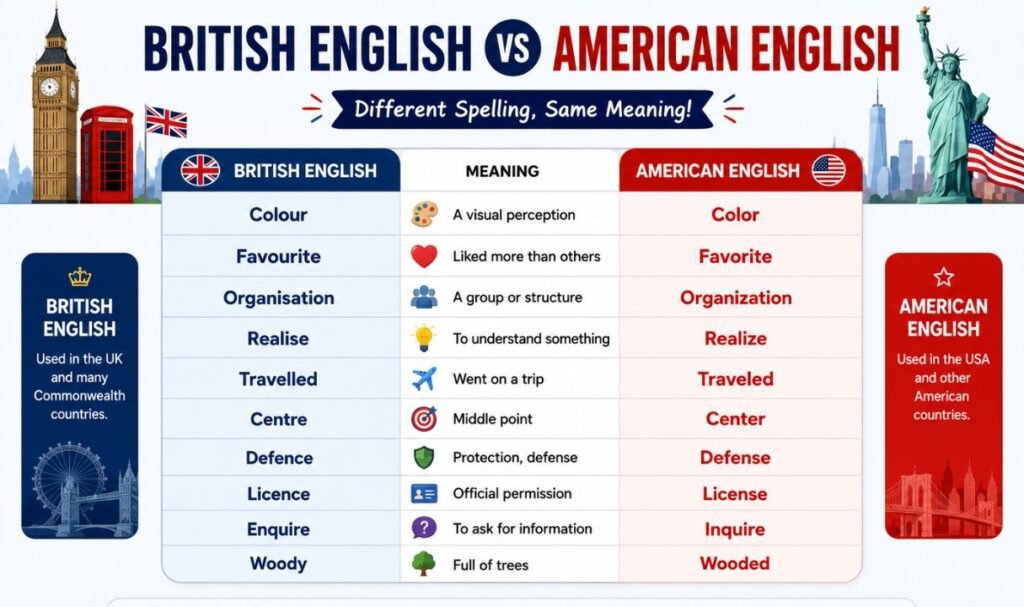
Here’s a piece of good news: this isn’t one of those words where British and American English pull in different directions, like “colour” versus “color” or “travelling” versus “traveling” (interestingly, “traveling” is actually one of the rare cases where American English drops a doubled consonant that British English keeps).
“Stopping” is spelled the same way on both sides of the Atlantic. The pronunciation shifts slightly — British speakers tend toward a rounder “o” sound, while American speakers flatten it — but the spelling never changes. Australian, Canadian, and Indian English all follow the same pattern. If you’re writing for a global audience, you can use “stopping” without worrying about regional spelling variants.
You May Like: How-To vs. How-Tos The Definitive Guide to Getting It Right
Which Spelling Should You Use?
In nearly every situation you’ll encounter, the answer is “stopping.” Use it when you’re writing about:
- A vehicle coming to a halt
- A habit or behavior you’re trying to end
- A process, program, or subscription being paused or canceled
- Someone pausing during a conversation or activity
Reach for “stoping” only if your writing is specifically about underground ore extraction, mine engineering, or geological processes. If you’re not sure which category your sentence falls into, it almost certainly falls into the first one.
🔹 How to Spell “Stopping” Correctly (Common Questions)
Why do we double the “p”?
English spelling has a pattern for short verbs that end in a single vowel plus a single consonant. “Stop” fits that pattern exactly — a short “o” followed by “p.” When you add a suffix beginning with a vowel, the final consonant doubles to keep the short vowel sound intact. Without the second “p,” “stoping” would visually suggest a long “o” sound, similar to “hoping” or “coping.”
Other verbs that follow the same doubling pattern include “run” → “running,” “swim” → “swimming,” and “plan” → “planning.” Once you notice the pattern in one word, it’s easier to spot in the others.
What about “stopped”?
The same doubling rule applies to the past tense. “Stop” becomes “stopped,” never “stoped,” for exactly the same reason — the short vowel needs the doubled consonant to keep its sound. So:
- Stop + ing = stopping
- Stop + ed = stopped
Both follow the identical consonant-doubling logic, and both should always carry two “p”s outside of the mining context.
Common Mistakes with Stopping
Even confident writers slip up occasionally. Here are the errors that show up most often, along with quick fixes.
| Mistake | Why It Happens | Correct Form |
|---|---|---|
| Stoping the car | Missing the doubled consonant | Stopping the car |
| Stoped suddenly | Same doubling error in past tense | Stopped suddenly |
| Stopeing | Extra “e” added by mistake | Stopping |
| Confusing it with “stoping” (mining) | Not recognizing it’s a separate technical term | Use “stopping” unless writing about mines |
| Auto-correct leaving it uncorrected | Some spell-checkers treat “stoping” as valid because it’s a real geological word | Manually check context before accepting suggestions |
A quick way to catch the error yourself: say the word out loud. If it sounds like “stop-ing” with a short, clipped “o,” you need two “p”s. If it sounds like “stope-ing,” something’s gone wrong.
Stopping in Everyday Examples
Seeing the word in context makes the spelling easier to remember. Here are a few natural sentences across different settings:
- “The train is stopping at every station this morning.”
- “We’re stopping the meeting early because of the fire drill.”
- “He’s finally stopping the habit of checking his phone at dinner.”
- “This medication works by stopping inflammation before it spreads.”
- “The app keeps stopping halfway through the download.”
- “Local police are stopping cars near the school to remind drivers to slow down.”
Notice that “stopping” works across driving, health, technology, and everyday habits without changing form. That flexibility is part of why it’s such a commonly searched word — people encounter it constantly, in wildly different contexts.
Stopping: Google Trends & Usage Data
Search interest data consistently shows the same pattern: “stopping” dominates, and “stoping” trails far behind, appearing mostly as either a typo or a niche mining term. Countries where English is a primary or widely used language — the United States, the United Kingdom, Canada, Australia, and India — all show overwhelming preference for the double-“p” spelling.
Most of the traffic behind “stoping” searches breaks down into two groups: people who mistyped “stopping” and want the correct form, and mining students or professionals looking for information on the excavation technique. Search engines have gotten good at recognizing this split, often surfacing a “did you mean stopping?” prompt when someone types the single-“p” version in a non-technical context.
You May Like: Is It Color or Colour? Never Make This Mistake Again
Keyword Variations Comparison Table
| Search Phrase | Intent | Correct Term to Use |
|---|---|---|
| Stopping or stoping | Comparing the two spellings | Stopping (unless mining-related) |
| Stopping synonym | Looking for alternative words | Halting, ceasing, pausing |
| Stoping mining | Learning about the geological term | Stoping (correct in this context) |
| Stopping in a sentence | Wants usage examples | Stopping |
| Stop verb forms | Wants conjugation | Stop, stopped, stopping |
| Stoping geology | Technical mining research | Stoping (correct in this context) |
🔹 Stopping vs Stoping: Spelling Rules and Meaning
Correct usage:
Use “stopping” for anything related to halting movement, ending an action, or pausing a process. Use “stoping” only when discussing the underground mining technique of ore removal.
Key difference:
“Stopping” is a verb form built from “stop” plus the “-ing” suffix, following the standard consonant-doubling rule. “Stoping” is a distinct noun rooted in mining terminology, unrelated in origin to the verb “stop,” even though the two words look similar on the page.
Common search variations explained:
People often search “stopping vs stoping,” “is it stoping or stopping,” or “stopping spelling rule” when they’re unsure which form to trust. All of these point back to the same answer: double the “p” unless you’re specifically writing about mining.
Related verb forms (important for clarity):
| Base Verb | Present Participle | Past Tense | Third Person Singular |
|---|---|---|---|
| Stop | Stopping | Stopped | Stops |
Keeping this table in mind makes it easy to check any form of the word at a glance — none of them drop the second “p.”
Frequently Asked Questions
What does “stopping” mean?
It means bringing movement, action, or a process to a halt, or pausing something that was in progress.
What is the meaning of stoping?
In mining and geology, stoping refers to the process of removing ore underground, which creates an open cavity called a stope.
Which is correct, stoped or stopped?
“Stopped” is correct for the everyday past tense of “stop.” “Stoped” only appears as the past tense of the mining term “stope.”
What is the word for stopping?
Common alternatives include halting, ceasing, braking, pausing, and ending, depending on the context.
Conclusion
The rule behind “stopping” is simpler than it might feel in the moment: double the “p” because “stop” is a short verb ending in a single vowel and consonant. That one detail covers nearly every situation you’ll run into, whether you’re writing a text message, a work email, or a school paper. Save “stoping” for conversations about underground mining, and you’ll never mix the two up again.