
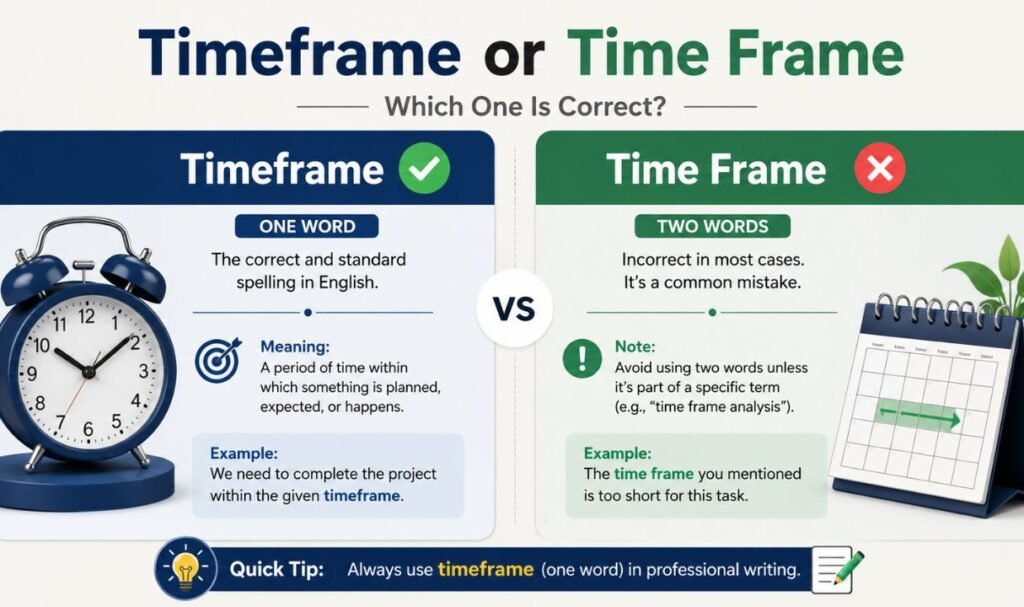

You’re drafting an email, a report, or a project plan, and you pause on one small word. Do you write “timeframe” or “time frame”? Your spellchecker doesn’t complain about either one, which only makes the confusion worse.
Here’s the short version: both spellings are correct. The longer version — the one that actually helps you write with confidence — depends on where the word comes from, how style guides treat it, and what kind of document you’re writing.
Timeframe
“Timeframe” is the single-word, closed-compound version. It’s the newer of the two forms, and it shows up constantly in business emails, marketing copy, and everyday digital writing. Most people who grew up reading online content default to this spelling without thinking twice.
Time
On its own, “time” is one of the oldest and most basic words in English — a measurable duration, a moment, a stretch of hours or years. When you attach “frame” to it, you get a phrase (or a compound) describing a bounded stretch of time with a clear start and end point.
Timeframe or Time Frame: Quick Answer ✅⚡
If you only read one section of this article, read this one.
✔ Main Difference:
- Time frame (two words) is the traditional, dictionary-first spelling. It’s the safer choice for formal writing, academic papers, and legal or business documents.
- Timeframe (one word) is a modern variant that has become common in casual writing, tech content, and everyday business communication. Most major dictionaries now list it as an accepted alternative.
Neither one is a typo. What matters more than which one you pick is that you pick one and stay consistent throughout your document.
📌 Examples:
- We need to finalize the budget within a time frame of two weeks.
- The app tracks your savings goal over a custom timeframe.
- Please confirm the time frame for the audit before Friday.
You May Like: Kindergartner or Kindergartener: Which Spelling Is Correct
Definitions with Examples 📖✍️
Understanding what the phrase actually means makes it much easier to remember how to spell it.
🟢 Time Frame (Definition)
A time frame is a specific, bounded period during which an action, task, or event takes place or is expected to take place. It answers the question “by when?” or “during what window?”
📌 Examples:
- The construction team has a six-month time frame to finish the building.
- Can you give me a realistic time frame for the repairs?
- The survey results cover a time frame of five years.
🔵 Timeframe (Definition)
Timeframe carries the exact same meaning as time frame — a defined stretch of time — but written as a single word. It’s the spelling you’ll see more often in software interfaces, dashboards, and modern digital publications.
📌 Examples:
- Choose a timeframe from the dropdown menu to view your spending history.
- Our delivery timeframe is three to five business days.
- The report was compiled within a tight timeframe.
🟡 Simple Meaning
Strip away the spelling debate, and both words mean the same thing: a window of time with edges. Think of it as a picture frame, except instead of holding a photograph, it holds a period — a start date, an end date, and everything that happens in between.
The Origin of Time Frame 📜⏳
Long before “timeframe” existed as a single word, English speakers used “time” and “frame” as two separate, ordinary nouns. “Frame” originally referred to a physical structure — think window frames or picture frames, something that gives shape and boundaries to whatever sits inside it.
Somewhere in the 20th century, writers began pairing “time” with “frame” to describe a period with defined boundaries, the same way a picture frame defines the edges of an image. The phrase caught on quickly in planning, engineering, and business contexts, where people constantly needed a word for “the period during which this must happen.”
📚 Meaning Together:
- Time = a measurable duration.
- Frame = a structure that sets boundaries.
- Time frame / Timeframe = a bounded duration with a clear beginning and end.
Like many two-word phrases in English — “web site” becoming “website,” “e mail” becoming “email” — “time frame” gradually picked up a single-word variant as writers looked for shorter, faster ways to type common phrases. That single-word habit stuck, especially in American digital and business writing, even though the original two-word form never went away.
📌 Example:
- The negotiations dragged on far longer than the original time frame allowed.
British English vs American English Spelling 🌍
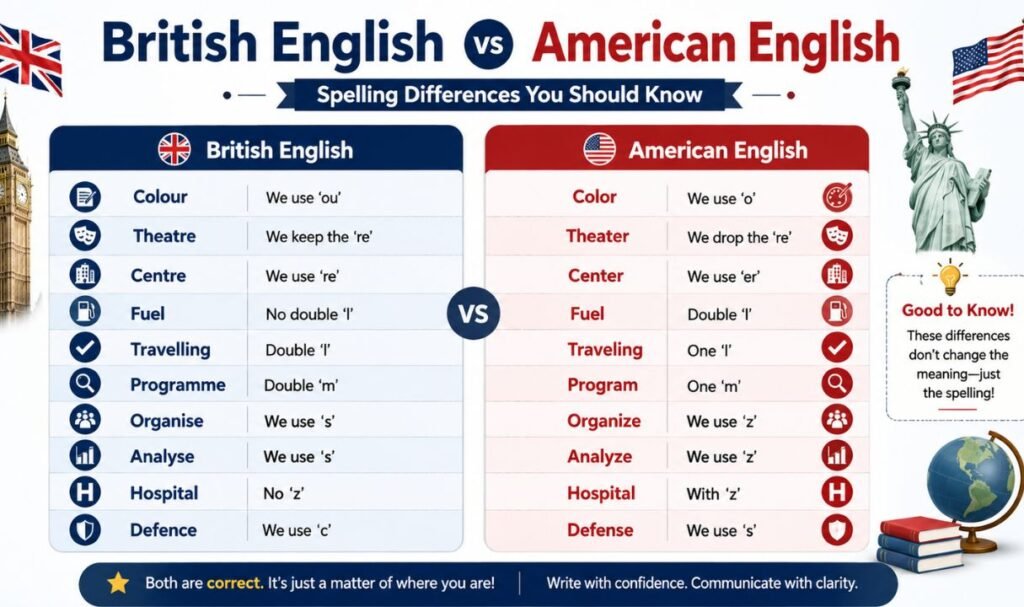
🇬🇧🇺🇸
Regional preference plays a real role here, and it’s one of the most common reasons people search for this topic in the first place.
📌 Key Point:
British English writing tends to stick with time frame as two words, especially in newspapers, official documents, and academic publishing. American English is more relaxed about it — both spellings appear regularly, but timeframe as one word has become noticeably more common in US business and tech writing over the past two decades.
📊 Comparison Table:
| Region | Preferred Form | Common In |
|---|---|---|
| British English (UK) | Time frame (two words) | News, government documents, academic writing |
| American English (US) | Timeframe (one word) or Time frame | Business emails, software, marketing, blogs |
| Australian/Canadian English | Time frame (two words), leaning traditional | Formal writing, education |
| Global business English | Either, but consistency matters | Contracts, reports, presentations |
If you’re writing for a UK audience or a formal international readership, time frame is the safer bet. If you’re writing for a US tech or business audience, timeframe won’t raise any eyebrows.
Timeframe vs Time Frame: Key Difference Explained 📊⚖️
Beyond region, the real difference comes down to formality and context. Neither word is grammatically “more correct” — the gap is about tone and convention, not rules.
📊 Comparison Table:
| Feature | Time Frame | Timeframe |
|---|---|---|
| Word count | Two words | One word |
| Formality | More formal, traditional | Less formal, modern |
| Common setting | Academic, legal, government writing | Business, tech, casual writing |
| Dictionary status | Original, widely listed | Accepted variant in most dictionaries |
| Best for | Reports, contracts, essays | Emails, apps, blog posts, social content |
📌 Example:
- Formal: The committee agreed on a time frame of ninety days for the review.
- Casual: We’ll get back to you within a shorter timeframe than usual.
People also search for closely related terms while trying to sort this out, including timeframe or time frame UK usage, timeframe or time frame synonym, timeframe or time frame quiz questions, timeframe or time frame examples for schoolwork, timeframe or time frame US preferences, and timeframe or time frame AP Style guidance. Worth noting: the AP Stylebook, widely used by American journalists, generally favors “time frame” as two words, which surprises a lot of writers who assumed the single-word form had fully taken over.
You May Like: Cognisant or Cognizant: When to Use It?
Which One Should You Use? 🎯📝
The honest answer is that either spelling works in almost any situation. But if you want a rule of thumb rather than a shrug, here’s one.
✔ Use Time Frame When:
- You’re writing something formal — a legal contract, an academic paper, a government form.
- Your audience is primarily British, Australian, or follows AP Style.
- You’re unsure and want the safest, most universally accepted option.
✔ Use Timeframe When:
- You’re writing for a US-based business or tech audience.
- You’re producing digital content — blog posts, app copy, marketing emails.
- Brevity and a modern tone matter more than tradition.
⚖️ Easy Tip
Pick a lane before you start writing, then stay in it. Search-and-replace your document once you’ve chosen, so you don’t end up with both spellings sitting in the same paragraph.
📌 Usage Tip (Very Important) 🧠✨
Consistency beats “correctness” here. A reader is far more likely to notice that you switched spellings halfway through a document than they are to care which spelling you picked in the first place. Set your choice once — in a style guide, a company handbook, or just your own personal habit — and apply it everywhere.
📌 Examples:
- Inconsistent (avoid): The project timeframe is six weeks. We expect the time frame to shift if approvals are delayed.
- Consistent (better): The project timeframe is six weeks. We expect the timeframe to shift if approvals are delayed.
Common Mistakes with Timeframe or Time Frame ❌⚠️
Even confident writers slip up on this one. Here are the mistakes that come up most often.
1. Thinking One Is Wrong
Some writers insist that only “time frame” is correct, or that “timeframe” is some kind of internet-era error. Neither claim holds up. Major dictionaries, including Merriam-Webster and Cambridge, list both forms.
2. Mixing Styles in One Document
Switching between “timeframe” and “time frame” within the same report or article looks careless, even though each individual instance is technically fine. Pick one and run a quick search through your document before you send it.
3. Using Wrong Context
Some writers overcorrect and use “time frame” in casual chat messages or “timeframe” in a formal legal filing, simply out of habit rather than intention. Match the word to the tone of the document.
4. Spelling Confusion
A smaller group of writers accidentally hyphenate it as “time-frame.” This form does appear in a handful of dictionaries as a secondary variant, but it’s rare in modern writing and best avoided unless your house style specifically calls for it.
Time Frame in Everyday Examples 💬📱
Seeing the word in real contexts makes the usage stick better than any rule ever will.
🏠 Daily Life
- We’re hoping to move into the new apartment within a three-month time frame.
- What’s a realistic timeframe for learning to cook five solid meals?
📧 Work
- Please respond within the agreed timeframe outlined in the client contract.
- HR needs a clear time frame for the onboarding process.
📚 School
- Students must submit their essays within the given time frame.
- The teacher set a strict timeframe for the group project.
💼 Business
- Our sales team closed the deal ahead of the projected timeframe.
- The board approved a five-year time frame for the expansion plan.
Timeframe: Google Trends & Usage Data 📊📈
Search behavior tells its own story about which spelling people actually reach for.
🌍 Trends:
Search interest for “timeframe” as one word consistently runs higher than “time frame” in the United States, while the two forms sit much closer together — with “time frame” often ahead — in the UK, Australia, and other English-speaking regions outside North America.
📊 Region Table:
| Region | Higher Search Volume |
|---|---|
| United States | Timeframe |
| United Kingdom | Time frame |
| Canada | Roughly even, slight lean toward time frame |
| Australia | Time frame |
| India | Timeframe |
🔥 Top 10 Searches:
- Timeframe meaning
- Time frame or timeframe grammar
- Timeframe synonym
- Is timeframe one word
- Timeframe vs schedule
- Correct spelling of timeframe
- Time frame example sentence
- Timeframe AP Style
- Timeframe UK spelling
- How to use timeframe in a sentence
Comparison Table 📋⚖️
| Aspect | Time Frame | Timeframe |
|---|---|---|
| Structure | Open compound (two words) | Closed compound (one word) |
| Origin | Older, traditional | Newer, evolved from the two-word form |
| Region preference | UK, Australia, formal English | US, digital and business English |
| Style guide lean | AP Style, many academic guides | Common in tech and marketing style guides |
| Tone | Formal | Neutral to casual |
| Risk of error | Very low | Very low |
Frequently Asked Questions
Is timeframe one word or two?
Timeframe is most commonly written as one word, though the two-word form “time frame” is equally correct and more traditional.
Should time frame be one word?
It doesn’t have to be — “time frame” as two words is the original, dictionary-standard spelling and remains fully correct.
How do you use timeframe in a sentence?
Use it to describe a bounded period, as in: “Please complete the form within the given timeframe.”
Is timeframe or time frame?
Both are correct; the choice comes down to formality, regional preference, and consistency within your writing.
Conclusion
There’s no losing side in the “timeframe or time frame” debate. Both spellings mean the same thing, both appear in respected dictionaries, and both will be understood instantly by any reader. What separates strong writing from sloppy writing isn’t which version you choose — it’s whether you stick with it. Pick “time frame” for formal, traditional, or UK-facing writing. Pick “timeframe” for modern, US-facing, or digital content. Then hold that choice steady from your first sentence to your last, and this small spelling question stops being a question at all.