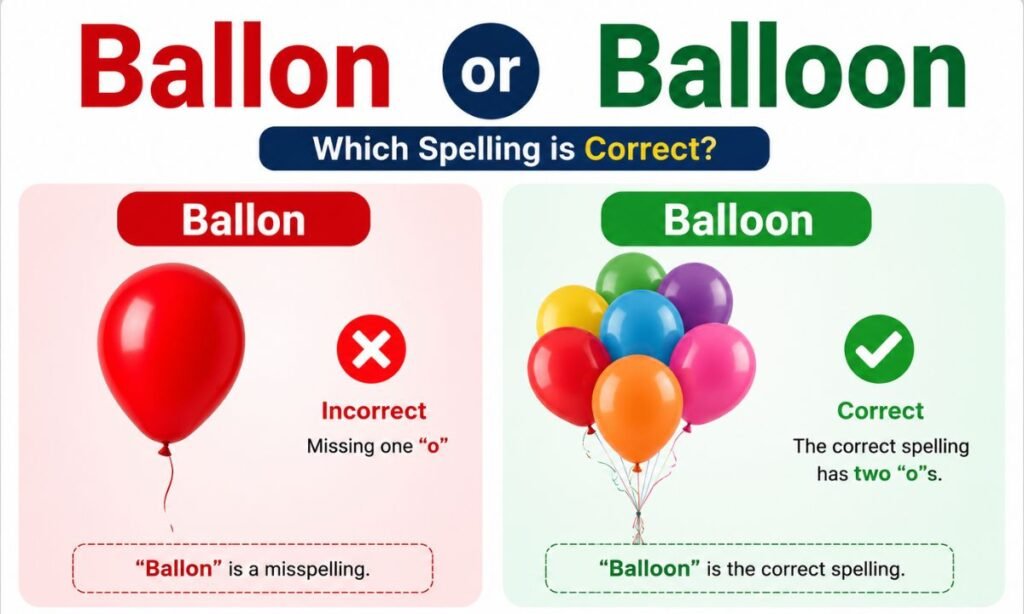

Typing quickly, autocorrect steps in and suddenly you’re staring at “ballon” instead of “balloon.” It looks almost right. It sounds almost right. But one missing letter changes the word entirely.
If you’ve ever paused mid-sentence wondering which spelling belongs in your birthday invitation, your ballet review, or your sports article, you’re not alone. Thousands of people search this exact question every month, and the mix-up is easy to understand once you see why it happens.
This guide breaks down the real difference between ballon and balloon, shows you exactly when to use each one, and clears up related confusions like Ballon d’Or, balloon as a verb, and how the word is actually pronounced.
Comparison Overview
Before diving into definitions, here’s a quick snapshot of how these two words stack up against each other.
| Feature | Ballon | Balloon |
|---|---|---|
| Language origin | French | English (borrowed from French “ballon”) |
| Number of “o”s | One | Two |
| Common meaning | A dancer’s light, sustained jump in ballet; also “ball” in French | An inflatable object filled with air or gas |
| Part of speech | Noun (technical/dance term) | Noun and verb |
| Everyday use | Rare, specialist | Extremely common |
| Correct in standard English? | Only as a name, French loanword, or ballet term | Yes, always |
The table tells the short version. The rest of this article covers the long one.
Definition of Ballon
Ballon is a French word that literally translates to “ball.” English speakers rarely use it on its own outside of two situations.
The first is ballet. In dance terminology, ballon describes the quality of a jump that appears light, buoyant, and almost suspended in the air before landing softly. A dancer with good ballon seems to hang for a moment at the top of a leap rather than dropping straight back down. Choreographers and critics use the term constantly when describing technique, and it’s one of those specialist words that carries real precision within its field.
The second situation is names. Ballon shows up as a surname, a place name in France, and inside compound French terms that English has absorbed wholesale, most famously Ballon d’Or, the football award given each year to the sport’s standout player.
Outside of dance criticism, French phrases, and proper nouns, ballon is not a recognized English word. If you’re writing an everyday sentence about a floating latex object, ballon is not the spelling you want.
You May Like: Eminent vs Imminent: Grammar Rules, Meanings & Usage Guide
Definition of Balloon
Balloon is the word almost everyone actually means to type. It refers to a flexible bag, usually rubber or latex, that can be inflated with air, helium, or another gas. Balloons show up at birthday parties, in hot air balloon rides, and in scientific instruments like weather balloons used to gather atmospheric data.
Balloon isn’t only a noun. It also works as a verb meaning to expand or swell rapidly, often used figuratively. A company’s costs can balloon out of control. A small disagreement can balloon into a full argument. That figurative sense traces directly back to the image of something physically inflating.
This is the standard, dictionary-approved spelling in both American and British English. There’s no regional split here, no “balloon” versus “ballon” depending on which side of the Atlantic you’re on. One spelling, one set of meanings, used everywhere English is written.
Main Differences Between Ballon and Balloon
Spelling
The visual difference comes down to a single letter. Balloon carries a double “o” in the middle, while ballon has just one. That tiny gap is the entire source of the confusion, and it’s also the easiest thing to check if you’re ever unsure.
Meaning
Balloon refers to an inflatable object or, as a verb, to rapid expansion. Ballon refers to a ballet jump technique, the literal French word for “ball,” or a proper noun. The meanings don’t overlap in casual conversation.
Usage
Balloon appears constantly: in children’s books, news headlines, science classrooms, party planning, and finance (“the loan has a balloon payment”). Ballon shows up almost exclusively in dance criticism, French-language contexts, or names borrowed directly from French.
Context
Ask yourself what you’re describing. A physical object that floats or expands calls for balloon. A dancer’s airy jump, a French phrase, or a name calls for ballon. Context decides the spelling far more reliably than sound does, since the two words are pronounced almost identically when spoken aloud.
Why People Confuse Ballon and Balloon
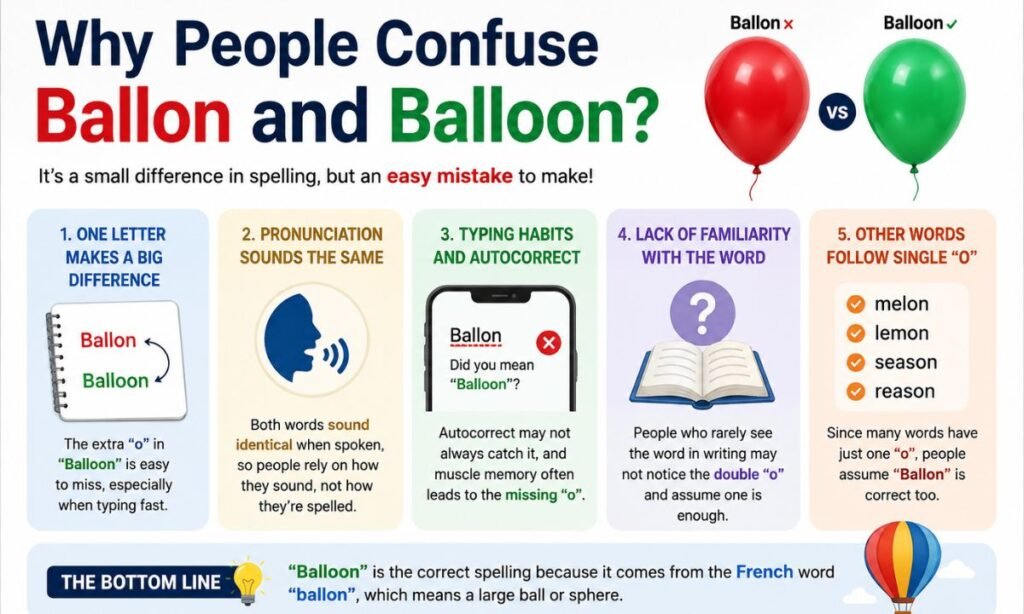
The confusion isn’t really about ignorance. It’s about how closely these two words are built.
Both trace back to the same French root. English absorbed “ballon” centuries ago and added the extra “o,” but the shared ancestry means the words still look like siblings on the page. When you’re typing fast, your brain often reaches for the shorter, French-looking version because it’s visually simpler, even if you meant the English one.
Autocorrect and spell-check tools add another layer. Some systems don’t flag “ballon” as an error because it’s a legitimate word in certain dictionaries, just not the one you probably intended. That silence from spellcheck gives people false confidence that they’ve spelled it correctly.
Search behavior reflects this mix-up constantly. People typing “ballon or balloon meaning,” “ballon or balloon football,” or even “ballon or balloon nfl” are almost always trying to sort out one of two things: either the party balloon versus the ballet term, or the Ballon d’Or football award versus the everyday inflatable object. Neither confusion is unusual, and both are easy to resolve once you know the pattern.
You May Like: What Does Delegate Mean? Definition, Examples & Synonyms
Grammar Guide
How Each Term Is Used in Sentences
Ballon or balloon meaning: If your sentence is about air, helium, or something inflating, you want balloon. If it’s about a dancer’s floating jump or a French phrase, you want ballon.
Ballon or balloon football: Football writing almost always means Ballon d’Or, the French award for the world’s best player, not the party object. The spelling here keeps the French form because it’s a proper name.
Ballon or balloon nfl: American football coverage rarely involves Ballon d’Or, since that award belongs to soccer, called football outside the United States. If you’re searching in an NFL context, you likely want “balloon” for anything inflatable, or you’ve simply landed on the wrong sport.
How to pronounce balloon: Balloon is pronounced buh-LOON, with the stress on the second syllable. Ballon, when used in its French or ballet sense, is closer to bah-LOHN, with a nasal vowel that English speakers often soften.
Ballon d’Or: This compound French term translates to “Golden Ball” and refers specifically to the annual football award presented by France Football magazine since 1956, honoring the sport’s top performer. It keeps its French spelling in English writing because it functions as a proper name, not a regular vocabulary word.
1. Balloon verb meaning: As a verb, balloon means to swell or expand quickly, often used for costs, numbers, or situations spiraling beyond their original size.
2. Balloon synonym: Depending on context, synonyms include inflatable, airship, or blimp for larger flying versions, and swell, expand, or surge for the verb sense.
3. Balloon plural: The plural is balloons, formed the regular way by adding an “s.”
Common Mistakes Learners Make
- Writing “ballon” instead of “balloon” in everyday sentences about parties, gifts, or inflatable objects
- Assuming ballon is simply a British spelling variant, when it isn’t a regional difference at all
- Using ballon in formal or professional writing outside of ballet or French contexts
- Missing the double “o” because the words sound nearly the same when spoken quickly
Simple Rules to Remember
- If you can picture it floating at a party, it’s balloon.
- If you’re discussing a French phrase, a ballet jump, or a name, it’s ballon.
- When spellcheck doesn’t flag “ballon,” don’t assume that means it’s the word you wanted. Check the context yourself.
Quick Tips for Writing and Speaking
A simple memory trick works well here: balloon needs two “o”s because it’s full of air, just like two round shapes sitting side by side. Ballon, by contrast, only needs one “o” because it’s a slimmer, more specialized word reserved for narrower situations.
When to Use Each One
Use balloon when you’re talking about:
- Party decorations, gifts, or celebrations
- Hot air balloons or weather balloons
- Rapidly rising costs, numbers, or tensions (the verb form)
- Any everyday English sentence involving inflation or expansion
Use ballon when you’re talking about:
- Ballet technique and a dancer’s jump quality
- French vocabulary or phrases borrowed directly into English
- A surname, place name, or brand that happens to use this spelling
- Ballon d’Or and related football award terminology
When NOT to Use Each One
Don’t use ballon in:
- General English writing about inflatable objects
- Business or academic writing, unless you’re specifically discussing ballet or citing a French term
- Casual conversation, texts, or social posts about parties or celebrations
Don’t use balloon in:
- Ballet criticism where the technical French term is expected
- Direct references to Ballon d’Or or other French proper nouns
- Formal citations of French phrases where the original spelling matters
Which One to Use (Decision Guide)
Ask yourself these questions in order:
- Am I talking about an inflatable object or something expanding? Use balloon.
- Am I discussing a ballet jump or dance technique? Use ballon.
- Is this a proper noun, brand, surname, or the football award? Use ballon, matching the original spelling.
- Am I unsure? Default to balloon. It covers the overwhelming majority of real-world writing situations.
Real World Practical Examples
Ballon Examples
- The critic praised the dancer’s remarkable ballon during the second act.
- Ballon d’Or nominees are announced every autumn ahead of the ceremony.
- Her surname, Ballon, appears throughout the regional archives.
- In French, ballon simply means “ball,” a word that later shaped English vocabulary.
Balloon Examples
- She tied a red balloon to the mailbox for the birthday party.
- Meteorologists released a weather balloon to track the incoming storm.
- His medical bills began to balloon after the second surgery.
- The children chased balloons across the backyard until sunset.
Self Assessment (Fill in the Blanks)
- The dancer’s ______ made her leap look effortless.
- We bought fifty ______ for the graduation party.
- Housing costs continued to ______ throughout the year.
- The award is officially called ______ d’Or.
- He accidentally spelled it ______ instead of balloon in his essay.
Answers
- Ballon
- Balloons
- Balloon
- Ballon
- Ballon
Frequently Asked Questions
Is it spelled ballon or balloon?
Balloon, with two “o”s, is the correct spelling for the everyday inflatable object. Ballon is reserved for ballet terminology, French phrases, and proper nouns.
What does “ballon” mean?
Ballon means “ball” in French and also describes a dancer’s light, floating jump in ballet technique.
Is it “balloon” or “ballon”?
For any standard English sentence about an inflatable object or rapid expansion, balloon is correct.
Is it le ballon or la ballon?
It’s le ballon, since ballon is a masculine noun in French grammar.
Conclusion
The gap between ballon and balloon is small on the page but significant in meaning. Balloon covers nearly everything you’ll ever write in everyday English: parties, science experiments, rising expenses, and casual conversation. Ballon stays in its lane, reserved for ballet technique, French phrases, and names like Ballon d’Or.
When in doubt, picture the object you mean. If it floats and needs air to exist, reach for the double “o.” If you’re describing grace, elegance, or a French origin, the single “o” is your answer. Keep that distinction in mind, and you’ll never second-guess this spelling again.