

Typing this word out at speed, most people pause for half a second. Does it take one f or two? Is there a second r hiding in there somewhere? The hesitation is common enough that it shows up as a steady stream of searches every month, and the good news is that the answer is short and settled.
This guide walks through the correct spelling, where the word comes from, how it behaves across British and American English, and the exact spelling rule that trips people up once suffixes like -ed and -ing get added.
Refer
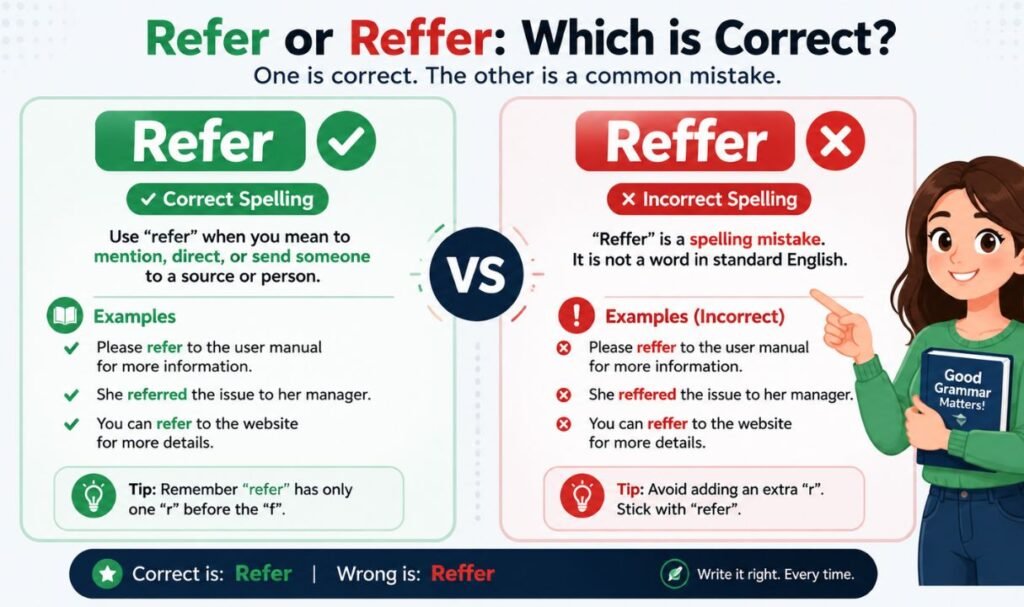
Refer is the correct spelling. It’s a verb meaning to direct someone’s attention to something, to mention a source, or to send a person elsewhere for help or information.
Reffer
Reffer is not a word in standard English. It’s a spelling error, usually produced because the pronunciation of “referred” and “referring” tempts writers into doubling letters that don’t belong in the base verb.
Refer or Reffer: Quick Answer
If you only need one line: write refer, never reffer.
There’s no dialect, region, or formal style where the double-f version is accepted. It won’t appear in a dictionary, it won’t survive a spell-checker, and it won’t show up in edited publications. The confusion almost always comes from what happens to the word once you start conjugating it — “referred” and “referring” both double the final r, and that doubling seems to invite people to double the f as well. It doesn’t; the f stays put in every form of the word.
A short summary table makes the pattern easy to remember:
| Word Form | Correct Spelling | Incorrect Spelling |
|---|---|---|
| Base verb | refer | reffer |
| Past tense | referred | reffered |
| Present participle | referring | reffering |
| Third person singular | refers | refferss / reffers |
| Noun (agent) | referrer | refferrer |
The Origin of Refer or Reffer
The word traces back to the Latin verb referre, built from re- (“back”) and ferre (“to carry” or “to bring”). Put together, the original sense is close to “to carry back” — the idea of returning information, attention, or a request to its source.
That root passed into Old French as referer before settling into Middle English, where it eventually took the form we use today. English spelling has smoothed out a lot over the centuries, but “refer” is one of the words that came through mostly unchanged. There was never a version of the word, at any point in that history, spelled with two f’s. “Reffer” isn’t an old form that fell out of use — it’s simply a modern typing mistake that happens to look plausible.
British English vs American English Spelling
Spelling battles between British and American English are common. Think “colour” versus “color,” or “travelling” versus “traveling.” Given how often British English doubles consonants that American English leaves single, it’s reasonable to wonder if “refer” splits the same way.
It doesn’t. Both varieties of English spell the base word identically:
- United States: refer
- United Kingdom: refer
- Canada, Australia, and other Commonwealth English: refer
Where the two do diverge slightly is in how enthusiastically they double consonants when adding suffixes to other words — “travelling” (UK) versus “traveling” (US) being the classic example. With “refer,” though, both sides of the Atlantic double the final r in the same way for “referred” and “referring,” because the stress falls on the second syllable in both dialects. That’s actually the technical reason the doubling happens at all, and it’s covered in more detail below.
So no matter which style guide you’re following — AP, Chicago, Oxford, or a company’s internal one — “refer” stays “refer,” and “reffer” is wrong everywhere.
You May Like: Myself vs My Self: The Complete Guide to Meaning, Grammar, Identity & Real-World Usage
Which Spelling Should You Use?
Use refer. Every time, in every context: emails, essays, résumés, medical notes, legal writing, casual texts, and social media captions all follow the same rule. There’s no formal-versus-informal distinction here the way there sometimes is with contractions or slang. “Reffer” isn’t an accepted informal variant either — it’s simply incorrect.
People land on this question through a wide range of related searches, and it’s worth addressing a few of them directly since they often carry slightly different intent:
- Refer or reffer synonym — common alternatives to “refer” include mention, cite, allude to, direct, and point to, depending on context.
- Refer or reffer meaning — to mention something, look something up, or send someone to another person or resource.
- Refer me — a shorthand people use, often in job-hunting contexts, asking someone to recommend or refer them for a position.
- I will refer meaning — expresses a future intention to mention, consult, or direct someone/something.
- Refer in a sentence — “Please refer to page twelve for the full instructions.”
- Refer slang — in casual usage, “refer me” or “can you refer me” is shorthand for asking for a job referral, especially on platforms like LinkedIn.
- Refer noun — “refer” itself is not a noun; the related noun is referral or reference.
- Refer me meaning — a request for someone to recommend you, typically for a job or opportunity.
🔹 How to Spell “Refer” Correctly (Common Search Questions)
The base spelling is short and doesn’t change: r-e-f-e-r. One f, two r‘s — one at the start, one at the end. The letter that catches people off guard isn’t the f at all; it’s what happens to that final r once you start adding endings.
What about “refers”?
“Refers” is the third-person singular present tense form, used with he, she, or it. Nothing doubles here — you simply add an s to the base word: refer → refers. “Refferss” or “reffers” are both incorrect, and this is one of the more overlooked mistakes since people tend to focus their attention on “referred” and “referring” instead.
Common Mistakes with Refer
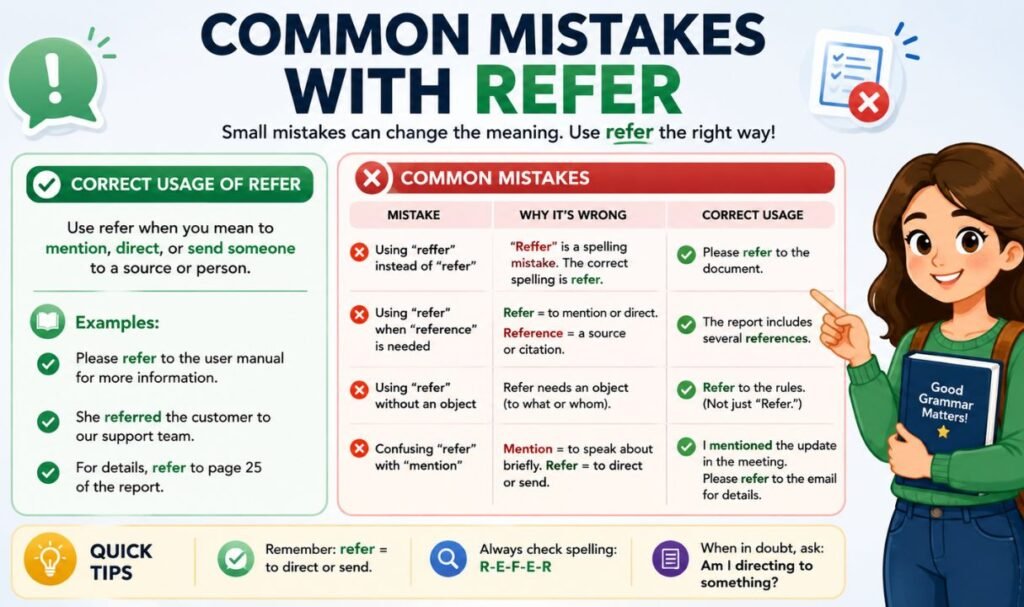
A handful of errors show up again and again in real writing:
- Reffer instead of refer — the most frequent mistake, driven by pronunciation.
- Reffered instead of referred — doubling the wrong letter when forming the past tense.
- Reffering instead of referring — same issue, applied to the present participle.
- Refering instead of referring — this one goes the opposite direction, dropping a needed r entirely.
- Confusing refer with referral — “refer” is a verb; “referral” is the noun describing the act or result of referring someone.
- Confusing refer with reference — “reference” can be a noun or verb, but it usually implies citing a source formally, while “refer” is broader and more conversational.
Grammar checkers and spell-checkers catch most of these automatically, but they’re worth knowing by sight, especially for anyone writing under time pressure — job applications, client emails, or exam answers, where a red squiggly line might not get a second look.
Refer in Everyday Examples
Seeing the word in context makes the spelling and the meaning easier to retain:
- Please refer to the attached document for the full pricing breakdown.
- My doctor referred me to a specialist for further testing.
- She often refers to her notes when she’s unsure of a date.
- Can you refer me for the open position on your team?
- The manual refers to this feature as “quick sync.”
- He is referring to last quarter’s numbers, not this quarter’s.
- The term “stakeholder” refers to anyone with an interest in the project.
Across all of these, the spelling never wavers — only the tense and the sentence role change.
You May Like: Starring or Staring: What’s the Difference?
Refer: Google Trends & Usage Data
Search interest around this word clusters into a few distinct groups. A large share of queries are pure spelling checks — people typing “refer or reffer” or “is it refer or reffer” straight into the search bar because they genuinely aren’t sure. A second cluster is job-related, built around phrases like “refer me” or “can you refer me,” reflecting how common employee referral programs have become on professional networking sites. A third group is grammar-focused, covering verb forms such as “referred vs reffered” or “referring vs reffering.”
Interest in the misspelled form itself — “reffer” — spikes mainly because people are trying to confirm it’s wrong, not because it’s an accepted alternative. That pattern is fairly typical for commonly misspelled English words: the incorrect spelling generates search volume precisely because so many people type it, hesitate, and go looking for confirmation.
Keyword Variations Comparison Table
| Search Phrase | Intent | Correct Answer |
|---|---|---|
| refer or reffer | Spelling confusion | refer |
| referred or reffered | Past tense spelling | referred |
| referring or reffering | Present participle spelling | referring |
| refer me | Job referral request | refer (verb) |
| refer synonym | Looking for alternatives | mention, cite, direct, allude to |
| referral or refferal | Noun spelling confusion | referral |
| refer meaning | Definition lookup | to mention, direct, or consult |
| how do you spell refer | Basic spelling check | r-e-f-e-r |
🔹 Refer, Referring, or Referred: Spelling Rules Explained
English has a well-established rule for one-syllable and stress-final words ending in a single consonant preceded by a single vowel: double that final consonant before adding a vowel suffix like -ed or -ing. “Refer” ends in -fer, with the stress falling on that final syllable, so it follows the doubling pattern — the same pattern you see in words like “occur” → “occurred” or “prefer” → “preferred.”
Correct Forms:
- refer
- refers
- referred
- referring
- referral
- referrer
Incorrect Forms:
- reffer
- refferss
- reffered
- reffering
- refferal
- refering (missing the second r)
Why does the spelling change?
The doubling protects the pronunciation of the word. Without it, “refering” would visually suggest a long e sound, similar to how “refereeing” is pronounced, rather than the short vowel actually used in “referring.” Doubling the r keeps the stressed syllable sounding correct and signals to a reader exactly how the word should be said, even before they hear it out loud.
The f, on the other hand, is never doubled in any form of the word. It sits in an unstressed syllable, and English spelling conventions only double consonants that sit right before a vowel suffix in a stressed syllable. That’s the entire rule in a nutshell, and it’s why “refer” keeps a single f through every conjugation while its final r doubles in specific forms only.
Common search variations covered:
refer or reffer, referred or reffered, referring or reffering, refer meaning, refer synonym, refer me, refer in a sentence, refer noun, referral or refferal, how to spell refer, is reffer a word, refer vs reference.
Frequently Asked Questions
What does refer mean?
It means to direct attention to something, mention a source, or send someone to another person or resource for help.
Which is correct, refer or reffer?
Refer is correct. Reffer is a misspelling and isn’t used in standard English.
What is to refer to someone?
It means to mention them, direct someone’s attention to them, or recommend them, often for a job or service.
Is it referral or refferal?
Referral is correct. Refferal is a common misspelling with no standing in standard English.
Conclusion
The rule behind this word is smaller than the confusion around it suggests. “Refer” keeps one f in every single form. The only letter that ever doubles is the final r, and only when you’re building “referred,” “referring,” “referral,” or “referrer.” Once that distinction sticks, the spelling stops being a guessing game — in a résumé, a client email, or a text asking a coworker for a job referral, “refer” is the version to reach for, every time.