

You type “Thank you for your quick respond” into an email, hit send, and then something nags at you. Was that right?
Millions of people hit this exact wall every day. “Respond” and “response” come from the same Latin root, sound nearly identical in casual speech, and show up in the same sentences constantly. That closeness is precisely what causes the confusion.
The good news: the fix is simple once you see the pattern. One word is an action. The other is a thing. Once that clicks, the mistakes stop.
This guide walks through the grammar, the everyday usage, the medical and psychological contexts, and the small errors that trip up even confident writers. By the end, you’ll pick the right word without pausing to think about it.
What “Response” Actually Means (Noun)
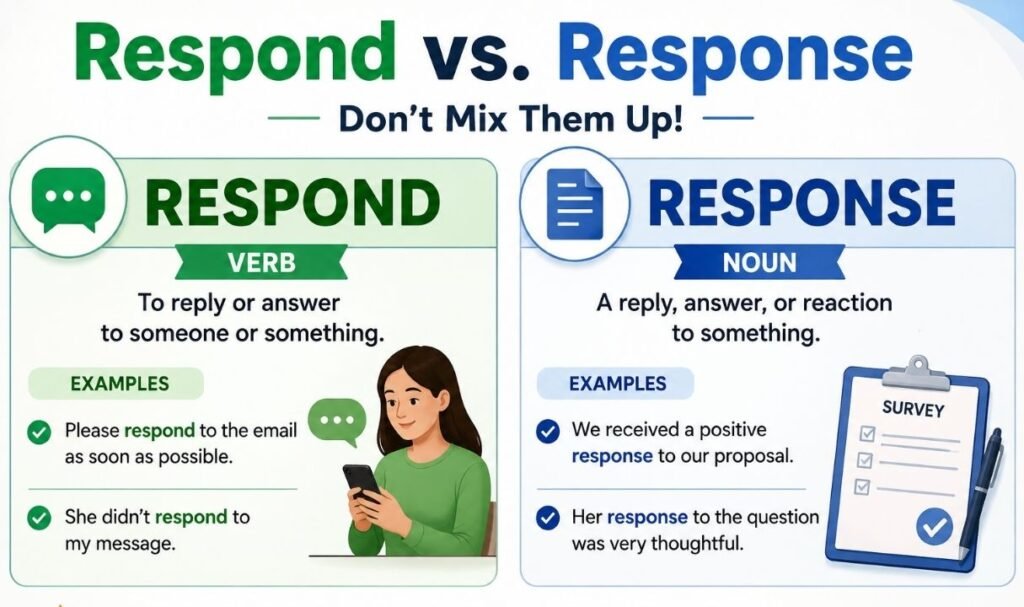
“Response” is a noun. It names the reply, reaction, or result that follows an action. You don’t respond a response; you give one, receive one, or write one.
Think of it as the finished product. Someone asks a question, and the answer they get back is the response.
Core Characteristics of “Response”
- Functions as a noun, never a verb
- Can be singular or plural (response / responses)
- Often paired with verbs like give, get, receive, send, or write
- Frequently follows articles like “a” or “the”
- Appears in phrases such as “in response to”
Examples of Correct Usage
- Her response to the offer was cautious but hopeful.
- We received no response after three follow-up calls.
- His quick response saved the project deadline.
- The survey response rate dropped last quarter.
Quick Table: When “Response” Fits
| Sentence Slot | Example | Why It Works |
|---|---|---|
| After “a” or “the” | “I got the response yesterday” | Nouns follow articles |
| After give/receive/get | “She received a warm response” | These verbs need an object noun |
| As a subject | “The response was overwhelming” | Nouns can be subjects |
| In “in response to” | “In response to your email…” | Fixed noun phrase |
What “Respond” Actually Means (Verb)
“Respond” is a verb. It describes the act of answering, reacting, or replying. If you can swap the word out for “reply” or “react” and the sentence still makes sense, “respond” is the one you need.
Core Characteristics of “Respond”
- Functions as a verb, never a noun
- Conjugates like a regular verb: respond, responds, responded, responding
- Commonly followed by “to” plus an object
- Cannot take an article like “a” or “the” in front of it
- Describes an ongoing or completed action, not a fixed object
Examples of Correct Usage
- Please respond to this message by Friday.
- She responded to the criticism with a calm explanation.
- The team responded quickly during the outage.
- He rarely responds to texts on weekends.
Quick Table: When “Respond” Fits
| Sentence Slot | Example | Why It Works |
|---|---|---|
| After a subject pronoun | “I will respond tomorrow” | Verbs pair directly with subjects |
| Before “to” | “Respond to the invitation” | Standard verb-plus-preposition pattern |
| In imperative sentences | “Respond as soon as you can” | Commands use bare verb forms |
| With auxiliary verbs | “He didn’t respond” | Auxiliaries need a base verb, not a noun |
Response vs Respond Examples
Side by side, the contrast becomes obvious:
- Wrong: “Please give me a respond.” Right: “Please give me a response.”
- Wrong: “I will response soon.” Right: “I will respond soon.”
- Wrong: “Thank you for your respond.” Right: “Thank you for your response.”
- Wrong: “No respond yet.” Right: “No response yet.”
Respond vs Response Psychology
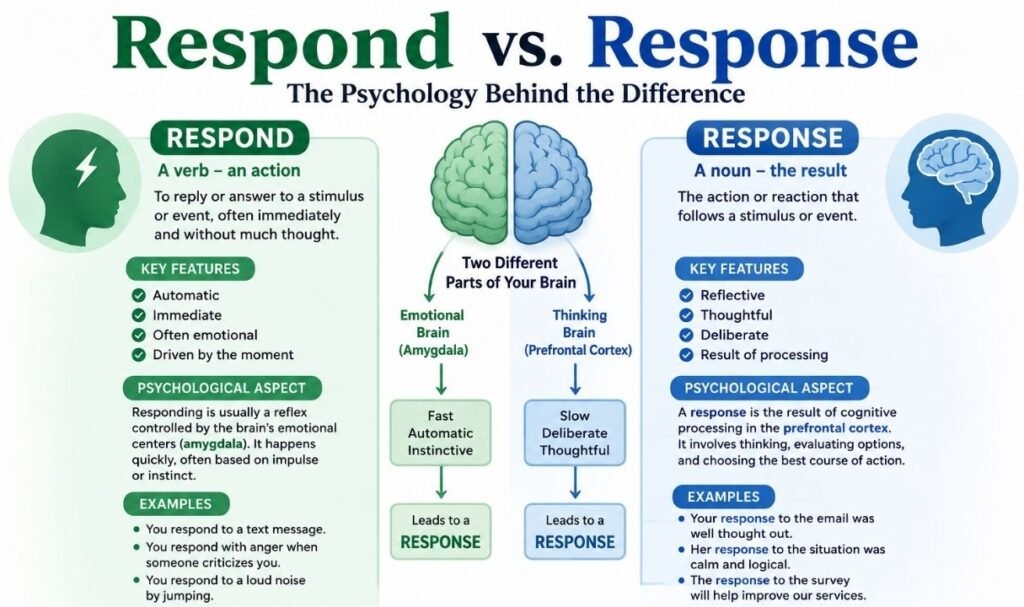
In psychology, “response” describes a measurable reaction, such as a stress response or a conditioned response to a stimulus. “Respond” describes the act itself, as in “the patient responded well to therapy.” Researchers track responses as data points; clinicians describe how a person responds as an ongoing behavior.
Thank You for Your Respond or Response
“Thank you for your response” is correct. You’re thanking someone for the reply itself, a noun, not the act of replying.
Respond or Response to Email
Use “respond to” the email (verb) or “a response to” the email (noun). Both work, depending on whether you’re describing the action or the reply.
Response Plural
The plural form is “responses.” There is no plural form of “respond” since verbs don’t pluralize that way; instead, verbs change with subject and tense (I respond, she responds).
Sorry for the Late Response or Respond
“Sorry for the late response” is correct. You’re apologizing for the delayed reply itself.
No Respond or No Response
- “No response” is correct. “No respond” is a common error because people mentally shorten “there was no response” without realizing the noun is required.
Grammar Essentials: How to Choose the Right One
Quick Rule: Action vs. Result
Ask yourself one question: am I describing something someone does, or something someone has? If it’s an action, use “respond.” If it’s a thing you can hold, count, or receive, use “response.”
Examples
- Action: “She will respond after lunch.”
- Result: “Her response arrived after lunch.”
- Action: “They didn’t respond to the survey.”
- Result: “They didn’t send a response to the survey.”
Sentence Patterns That Require “Respond”
Correct Structures
- Subject + respond + to + object: “He responds to feedback well.”
- Modal verb + respond: “You should respond within 24 hours.”
- Imperative: “Respond immediately.”
Common Mistake
Writers sometimes drop an article in front of “response” and accidentally use “respond” instead, producing sentences like “I need your respond” when they mean “I need your response.”
Sentence Patterns That Require “Response”
Correct Structures
- Article + response: “a response,” “the response”
- Possessive + response: “your response,” “their response”
- Verb + response as object: “send a response,” “await a response”
Common Mistake
The reverse error happens too: dropping the noun form after a possessive, as in “I’m waiting on your respond” instead of “your response.”
“Response” in Real Life: How the Noun Works
Everyday Communication
“Response” shows up constantly in daily language, from customer service tickets to text threads. A missed response can stall a project; a fast response can build trust. In workplaces, response time is often tracked as a performance metric, which is why phrases like “average response time” and “response rate” are so common in business reporting.
Visual Guide: How “Response” Works in a Sentence
Response Placement Table
| Position | Example |
|---|---|
| Subject | “The response surprised the team.” |
| Direct object | “We finally got a response.” |
| Object of preposition | “In response to the news, sales rose.” |
| Possessive phrase | “Your response matters to us.” |
Results & Reactions: Why “Response” Captures Outcomes
“Response” is outcome-focused. It captures what happened after a trigger, whether that trigger was a question, an event, or a stimulus. A company’s response to a crisis, a body’s response to medication, and a reader’s response to a story are all describing the aftermath, not the act of reacting itself.
Medical, Scientific & Emergency Usage of “Response”
Why “Response” Matters in Medicine
Medical language leans heavily on “response” because outcomes need to be measured and recorded. A treatment either produces a response or it doesn’t, and that response gets classified, charted, and compared across patients.
Examples
- The tumor showed a partial response to chemotherapy.
- Doctors monitored the patient’s immune response closely.
- Emergency response teams arrived within minutes.
- The vaccine triggered a strong antibody response.
Case Study: Medical Scenario
Consider a patient starting a new medication. In week one, doctors note “no measurable response.” By week four, the chart reads “moderate response observed, dosage to remain unchanged.” Notice that the verb “respond” never appears in the clinical notes themselves; the noun form dominates because the chart is documenting outcomes, not actions.
“Respond” as a Verb: When Action Matters
Everyday Usage
“Respond” carries the weight of doing. It’s what happens in the moment: a person picks up the phone, types a reply, or reacts to a situation. Because it’s a verb, it can shift tense freely, which makes it flexible for describing past, present, and future actions.
- Past: “She responded within minutes.”
- Present: “He responds calmly under pressure.”
- Future: “We will respond by tomorrow morning.”
Nuanced Meanings of “Respond”
Emotional Responding
People respond emotionally to news, art, or relationships. “She responded with tears” describes an emotional reaction, not a calculated reply.
Intellectual Responding
In academic and professional settings, responding often means engaging with ideas. “He responded to the argument with a counterpoint” shows intellectual engagement rather than a simple reply.
Behavioral Responding
Behavioral science uses “respond” to describe measurable actions triggered by a stimulus, such as how a subject responds to reward or punishment during an experiment.
Environmental Responding
Even nonhuman systems respond. Plants respond to sunlight, ecosystems respond to climate shifts, and markets respond to policy changes. The verb extends naturally beyond human communication.
Interactive Scenarios: When Respond Shows Engagement
Live conversations, debates, and customer support chats all depend on responding in real time. A support agent who responds quickly builds customer confidence, while a debater who responds thoughtfully strengthens their argument. In each case, the verb captures a dynamic, back-and-forth process rather than a static outcome.
Examples from Literature, Media & News
Literature
Authors often use “respond” to show character development, describing how a protagonist responds to conflict as a way of revealing personality. Meanwhile, “response” often appears when narrators summarize a character’s reaction after the fact, such as describing someone’s response to a piece of news.
News & Journalism
Headlines frequently pair both words: a government official might respond to allegations, and journalists later report on the public’s response to that statement. The verb captures the action taken; the noun captures the aftermath reported on.
Psychology & Human Behavior
Behavioral Responses
Psychologists study behavioral responses to understand patterns, such as how people respond to stress, reward, or social pressure. These responses are often measured, charted, and compared across groups.
Physical Responding
The body has automatic ways of responding to stimuli, from the fight-or-flight response to reflexive reactions like blinking. These physical responses happen without conscious thought.
Emotional Contagion: How We Respond to Feelings
Humans tend to mirror the emotions of people around them, a phenomenon researchers call emotional contagion. When someone smiles, others often respond with a smile of their own, almost automatically. The resulting shift in mood becomes the observed response.
Cognitive Responses in Decision Making
Cognitive responses shape how people process information before acting. A shopper’s cognitive response to a discount, for instance, influences whether they respond by making a purchase. This is a case where both words work together naturally in the same sentence.
Quick Comparison Table: Respond vs. Response
| Feature | Respond | Response |
|---|---|---|
| Part of speech | Verb | Noun |
| Describes | An action | A result or reply |
| Conjugates | Yes (respond, responds, responded) | No, but has a plural (responses) |
| Common pairing | “to” | “a,” “the,” “your,” “give,” “receive” |
| Example | “Please respond soon.” | “I got your response.” |
| Root | Latin respondere | Latin respondere |
Common Errors and How to Fix Them
- Using “respond” after an article: “a respond” should be “a response.”
- Using “response” as an action verb: “I will response” should be “I will respond.”
- Dropping “to” after “respond”: “respond the email” should be “respond to the email.”
- Confusing plural forms: “responds” as a plural noun is incorrect; use “responses.”
- Overcorrecting formal writing: some writers avoid “respond” entirely out of caution, even in sentences that clearly call for the verb.
A simple test helps catch most of these errors before you hit send: try replacing the word with “reply” (verb) or “an answer” (noun). If “reply” fits, you need “respond.” If “an answer” fits, you need “response.”
Practice Section: Test Yourself
Try filling in the blank with the correct word:
- Please ______ to my message when you get a chance. (respond)
- Her ______ was clear and direct. (response)
- We haven’t received a ______ from the vendor yet. (response)
- He always ______s quickly to customer complaints. (respond)
- Thank you for your prompt ______. (response)
If most of these felt automatic, the rule has already sunk in.
Frequently Asked Questions
How do you use response?
Use “response” as a noun for the reply or reaction itself, usually after words like “a,” “the,” “your,” or verbs like “give” and “receive.”
Is it waiting for your response or respond?
“Waiting for your response” is correct, since “response” is the noun needed after the possessive “your.”
Is it thank you for your response or reply?
Both are correct and mean nearly the same thing; “response” and “reply” are interchangeable nouns in this phrase.
Which is correct: “I will respond” or “I will response”?
“I will respond” is correct, because “will” needs a base verb, and “respond” is the verb form.
Conclusion
The line between “respond” and “response” comes down to one question: are you describing what someone does, or what someone gives back? Verbs act; nouns name things. Once you hold onto that distinction, emails, reports, and everyday conversations become noticeably cleaner.
Grammar rules like this one aren’t about memorizing lists. They’re about training your ear to catch the small signals, like an article before a noun or “to” after a verb, that tell you which word belongs where. With a little practice, choosing between “respond” and “response” stops being a decision at all.