
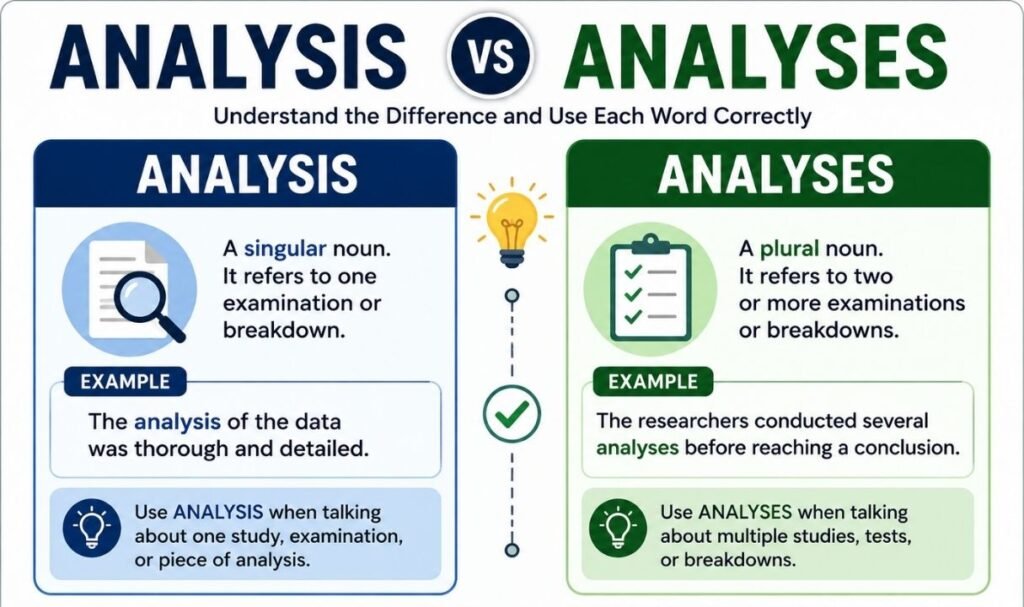

Few word pairs trip up writers as often as analysis and analyses. They look almost identical, they sound close enough to confuse a fast talker, and spellcheck won’t catch the mistake because both words are technically real. Yet mixing them up in a report, an essay, or a research paper can make otherwise polished writing look careless.
This guide breaks down exactly when to use analysis, when to switch to analyses, why the change happens, and how to stop second-guessing yourself every time you write a sentence with either word. You’ll also find pronunciation tips, real examples, a quick-reference table, and answers to the questions people ask most.
Core Definitions
Before getting into grammar rules, it helps to pin down what each word actually means. The short version: one is singular, one is plural, and the difference is a single letter that changes everything.
What “Analysis” Means (Singular)
Analysis refers to one detailed examination of something — a single study, a single report, a single breakdown of data or ideas. If a scientist reviews one dataset and writes up the findings, that’s an analysis. If a student breaks down one poem for a literature class, that’s also an analysis.
Examples:
- The financial analyst completed her analysis of the company’s third-quarter earnings.
- This analysis shows a clear link between sleep and productivity.
- His analysis of the poem focused on tone and imagery.
Notice the verb agreement in each sentence — singular subject, singular verb (“shows,” not “show”).
What “Analyses” Means (Plural)
Analyses is what you get when there’s more than one analysis. Maybe several researchers each ran their own study, or one person conducted multiple rounds of examination on different datasets. Either way, once you’re talking about more than one, the word shifts.
Examples:
- Separate analyses from three universities reached the same conclusion.
- Her analyses of consumer behavior span nearly a decade of data.
- The report combines analyses from five independent labs.
A quick way to spot the plural in writing: it almost always pairs with plural signals like “several,” “multiple,” “various,” or a specific number greater than one.
Grammar Breakdown
The confusion between these two words isn’t really about vocabulary — it’s about an old pluralization pattern that English inherited and never fully naturalized.
Singular vs Plural: The Rule Behind the Change
Most English nouns become plural by adding “-s” or “-es.” Cat becomes cats. Box becomes boxes. Analysis refuses to play by that rule. Instead, the ending “-is” transforms into “-es,” giving you analyses.
| Form | Word | Example Sentence |
|---|---|---|
| Singular | Analysis | The analysis took two weeks to complete. |
| Plural | Analyses | The analyses took two weeks each to complete. |
This pattern isn’t unique to analysis. A whole family of English words borrowed from Greek follows the same “-is” to “-es” swap:
- Crisis → Crises
- Hypothesis → Hypotheses
- Thesis → Theses
- Basis → Bases
- Axis → Axes
- Diagnosis → Diagnoses
Once you recognize the pattern in one word, the rest tend to click into place fairly quickly.
Why “Analysises” Is Never Correct
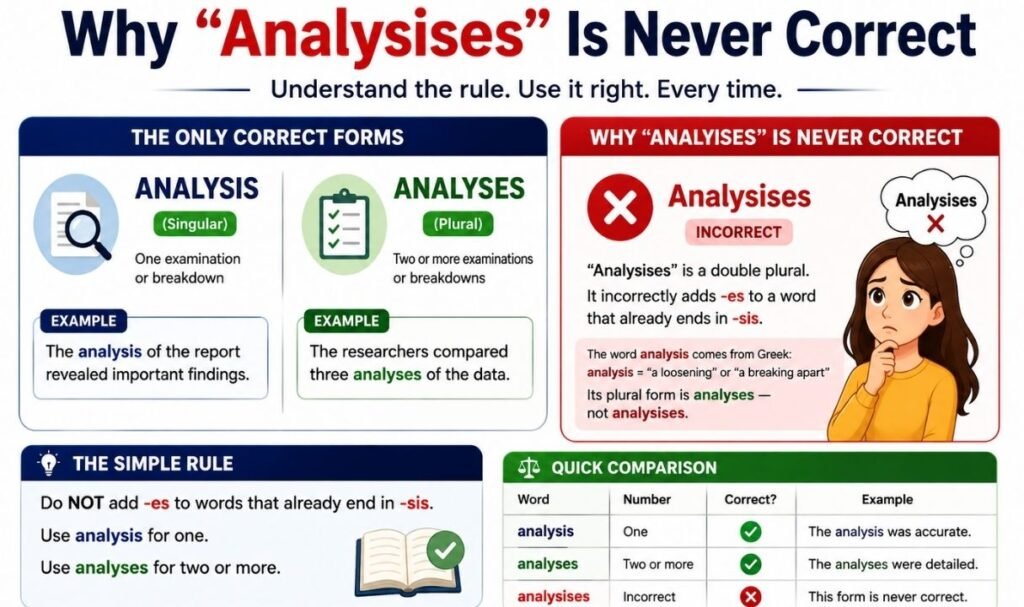
Some learners, applying the regular English rule on autopilot, tack an “-s” onto the end and produce “analysises.” It’s an understandable mistake, but it’s never correct in standard English — spoken or written.
The reason comes down to word origin rather than modern grammar logic. Because analysis kept its Greek-derived ending, English speakers preserved the Greek pluralization habit instead of applying the standard English “-s” rule. That’s why “analysises” doesn’t appear in dictionaries, style guides, or professional writing anywhere.
If you’re ever unsure, remember this shortcut: swap “-is” for “-es,” and nothing else changes.
Greek Origin of the Word “Analysis”
Analysis traces back to the Greek word analusis, built from ana- (meaning “up” or “throughout”) and lusis (meaning “a loosening”). Put together, the original sense was something close to “loosening up” or “breaking apart” — which lines up neatly with how we use the word today: taking something complex and breaking it into smaller, understandable pieces.
English absorbed the word through Latin during the late 16th century, and it carried its Greek plural pattern along with it. That’s the historical root of why analyses doesn’t follow the standard English pluralization rule — it was never meant to.
Many technical and scientific fields borrowed heavily from Greek and Latin during the same period, which is part of why medicine, mathematics, and academic writing are full of these irregular plurals. Words like phenomenon/phenomena, criterion/criteria, and stimulus/stimuli all carry similar borrowed patterns, just from different source languages. English never fully “translated” these words into native pluralization rules, so the original endings stuck around, sometimes for centuries after the words entered everyday use.
Understanding this backstory isn’t just trivia. It explains why dictionaries list analyses as the only accepted plural, and why style guides such as APA, MLA, and Chicago all treat the Greek-based ending as standard rather than optional.
Special Plural Patterns in English
Analysis belongs to a broader category of irregular plurals that English speakers often stumble over. Here’s a wider look at how these patterns show up across the language:
| Category | Singular | Plural |
|---|---|---|
| Greek “-is” words | Analysis | Analyses |
| Greek “-is” words | Hypothesis | Hypotheses |
| Latin “-us” words | Cactus | Cacti |
| Latin “-um” words | Datum | Data |
| Old English vowel change | Mouse | Mice |
| Old English vowel change | Foot | Feet |
| No change at all | Sheep | Sheep |
Recognizing these categories helps explain why English pluralization sometimes feels inconsistent. It isn’t random — it’s layered history from multiple source languages, each contributing its own rules.
American vs British English Usage
Here’s some reassuring news: analysis and analyses work identically in American English and British English. There’s no spelling variant, no regional preference, and no style guide that recommends one over the other based on country.
Where American and British English do split is on the related verb. Americans write analyze, while British (and most Commonwealth) writers use analyse. That verb spelling difference has nothing to do with the noun forms analysis and analyses, which stay the same everywhere English is written.
Related searches people also look up:
- Analyses pronunciation
- Analysis vs analyses pronunciation
- Analysis vs analyses examples
- Analysis vs analyses grammar
- Analysis plural
- Data analysis or analyses
- Analyses verb
On that last point — analyses is not a verb. The verb form is analyze (US) or analyse (UK). “Analyses” only functions as a noun (the plural of analysis) or, less commonly, as the third-person singular verb form: “she analyses the data” in British spelling.
Common Errors and How to Fix Them
Even experienced writers slip up occasionally. Here are the three mistakes that show up most often, along with straightforward fixes.
Error 1: Using “analyses” as a singular
Wrong: The analyses shows a strong correlation. Right: The analysis shows a strong correlation.
If you’re only referring to one study or examination, stick with the singular form — and make sure your verb agrees with it.
Error 2: Using “analysis” to refer to multiple cases
Wrong: We conducted several analysis on the survey responses. Right: We conducted several analyses on the survey responses.
Any time a number greater than one, or a word like “several,” “multiple,” or “various,” appears before the noun, switch to the plural.
Error 3: Pronouncing them the same
Many learners say both words identically, which makes them harder to distinguish in speech. They aren’t pronounced the same:
| Word | Pronunciation | Ending Sound |
|---|---|---|
| Analysis | uh-NAL-uh-sis | “sis” |
| Analyses | uh-NAL-uh-seez | “seez” |
The plural ends on a “z” sound rather than an “s” sound. Practicing that final syllable out loud a few times usually fixes the habit within a day or two.
Practical Usage in Writing
Knowing the rule is one thing; applying it naturally while drafting a paper or report is another. Here’s how each word tends to show up in real writing.
Using “Analysis” in Academic Work
Academic writing leans heavily on the singular form when discussing a single method, paper, or dataset:
- “This paper presents a statistical analysis of employee retention rates.”
- “The analysis reveals a significant gap between predicted and actual outcomes.”
- “A qualitative analysis of interview transcripts formed the basis of Chapter 3.”
Notice how each sentence points to one cohesive examination, even if that examination involved a lot of data.
Using “Analyses” in Research
Research writing shifts to the plural whenever a project draws on more than one method, dataset, or comparison:
- “Comparative analyses of the two treatment groups revealed distinct patterns.”
- “Multiple regression analyses were run to control for confounding variables.”
- “The meta-study synthesized analyses from over forty peer-reviewed papers.”
Graduate students and academic researchers run into this constantly, since most theses and dissertations involve more than one round of data examination.
Why Proper Pluralization Matters in Research
Getting singular and plural right isn’t just a grammar technicality in academic and professional writing — it affects clarity and credibility. A methods section that says “three analysis were conducted” signals to reviewers and readers that the writing wasn’t proofread carefully, which can quietly undercut trust in the actual findings.
Journals, universities, and editors treat this kind of error as a red flag during peer review. Precise language builds confidence that the researcher was equally precise with the data itself. That’s a strong reason to double-check plural forms before submitting any academic or client-facing document.
There’s also a practical search and indexing angle worth mentioning. Databases and citation tools often distinguish between “analysis” and “analyses” when tagging papers by methodology, so using the correct form can even affect how easily your work is found and cross-referenced by other researchers. A misused plural buried in an abstract or a methods section is a small thing on its own, but small things compound across a document, and readers notice patterns of carelessness faster than they notice individual typos.
Tips for ESL Learners
For non-native English speakers, irregular plurals like this one often feel like exceptions designed to cause frustration. A few practical strategies make the pattern stick faster.
Simple Memory Tricks
- One “i,” one item. Analysis has one “i” near the end — think of it as one item, one study.
- “-es” equals extra. When you see “-es” at the end, think “extra” — extra items, meaning more than one.
- Group it with familiar words. If you already know “crisis/crises” or “thesis/theses,” attach “analysis/analyses” to that same mental group.
Visual Cue
Picture a single magnifying glass for analysis and a row of several magnifying glasses for analyses. A quick mental image like this can anchor the singular-plural distinction faster than memorizing a rule on paper.
Pronunciation Trick
Say “sis” for one, “seez” for many. Repeating the pair out loud — “analysis, analyses, analysis, analyses” — a few times before writing tends to make the correct form come out automatically once you sit down to type.
Quick Practice
Try filling in the blanks before checking the answers below:
- Multiple _______ confirmed the same trend.
- Her _______ disagrees with earlier research.
- The professor asked us to submit one _______ per student.
- Three separate _______ were needed to rule out bias.
Answers: 1. analyses 2. analysis 3. analysis 4. analyses
Frequently Asked Questions
Is there a plural for analysis?
Yes. The plural of analysis is analyses, formed by changing the ending “-is” to “-es.”
What does “analyses” mean?
It means more than one analysis — multiple studies, reports, or examinations of something.
How do you spell “analyses” in the US?
The same way it’s spelled everywhere: a-n-a-l-y-s-e-s. Spelling doesn’t change between American and British English.
Do Americans use analyze or analyse?
Americans use “analyze” with a “z.” British English uses “analyse” with an “s.” Both mean the same thing.
Conclusion
The difference between analysis and analyses comes down to one simple test: are you talking about one examination or more than one? Once that question is answered, the correct word follows automatically. Add in the Greek-rooted spelling pattern, a distinct pronunciation for each form, and a bit of practice, and this word pair stops being a source of hesitation in your writing.