

You are filling out a form, writing an invitation, or typing a date into an email. You reach the 23rd of the month and stop. Does the ending look right? Should it be “rd” or “th”? You are not the only one who pauses here. The question gets asked every day by students, office workers, event planners and plenty of native English speakers.
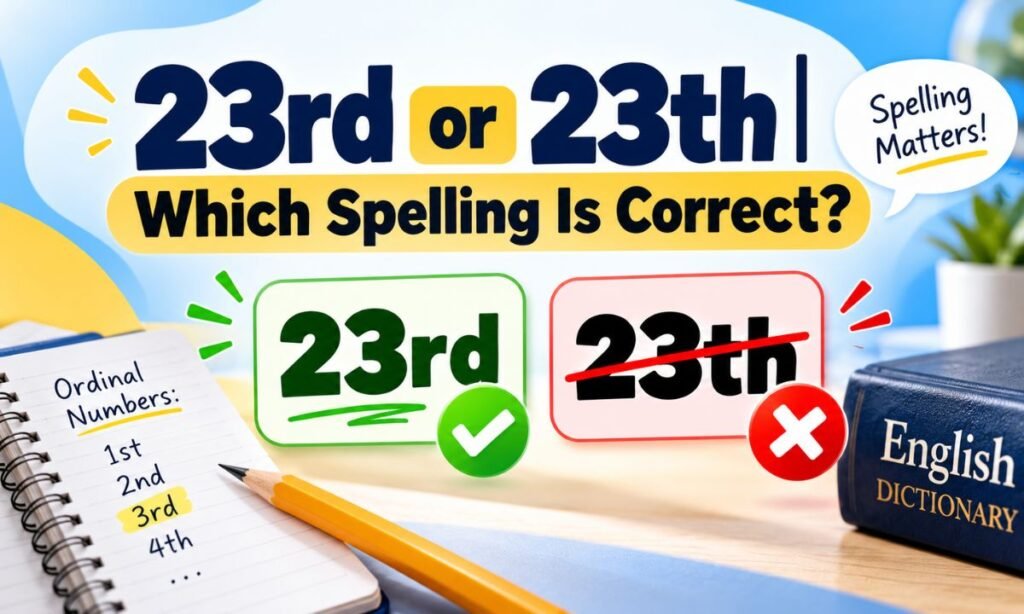
The short answer is simple. The correct spelling is 23rd. The form “23th” is a typo, and it does not appear in standard English. This guide explains why, shows you the rule behind it, and gives you plenty of examples so you never second-guess yourself again.
23rd or 23th – Which Spelling Is Correct?
23rd is correct. 23th is wrong.
That is the whole answer in four words. Here is the quick version for anyone in a hurry:
| Form | Correct? | Reads as | Example |
|---|---|---|---|
| 23rd | Yes | twenty-third | “Her 23rd birthday is on Friday.” |
| 23th | No | not a real word form | |
| 23st | No | not a real word form | |
| 23nd | No | not a real word form |
The reason comes down to the last word in the spoken form. We say “twenty-third.” The word ends in “-rd” when abbreviated, so the written form takes the same ending. Take the digits 23, add “rd,” and you get 23rd.
If you remember only one thing from this article, remember this: the suffix follows the last digit, and a final 3 almost always takes “rd.”
The One-Line Rule
Any number ending in 3 uses “rd,” unless it ends in 13. That means 3rd, 23rd, 33rd, 43rd, 103rd and 223rd all follow the same pattern. The only exceptions are 13th, 113th and similar numbers, which take “th” because of the “teen” ending.
23rd
What Does 23rd Mean?
“23rd” is the written shorthand for twenty-third. It is an ordinal number. Ordinal numbers tell you the position or order of something in a series, while cardinal numbers tell you how many of something exist.
- Cardinal: 23 (twenty-three), as in “23 students”
- Ordinal: 23rd (twenty-third), as in “the 23rd student in line”
When you say “the 23rd,” you are pointing to one specific place in a sequence. It could be a day in a month, a floor in a building, a year of marriage, or a spot in a race.
How the Ending “rd” Is Formed
English builds ordinals from two parts: the number itself and a short ending that echoes the sound of the spoken word.
The word “third” is one of the oldest ordinals in the language. It comes from Old English and Germanic roots, and it has been irregular for centuries. Most ordinals simply add “th” to the cardinal (four becomes fourth, six becomes sixth). But the first three numbers took their own special forms: first, second and third.
Those special forms carry over to every larger number that ends in the same digit. Look at the pattern:
| Last digit | Ending | Examples |
|---|---|---|
| 1 | st | 1st, 21st, 31st, 101st |
| 2 | nd | 2nd, 22nd, 32nd, 102nd |
| 3 | rd | 3rd, 23rd, 33rd, 103rd |
| 4 to 9, and 0 | th | 4th, 15th, 24th, 100th |
| 11, 12, 13 | th | 11th, 12th, 13th, 111th |
So 23 sits in the same family as 3. When you say “twenty-third,” you are really saying “twenty” plus “third.” The “third” part decides the ending.
How to Say 23rd Out Loud
Say it as “twenty-third.” In dates, people often add “the” before it and “of” after it:
- “The twenty-third of May”
- “May twenty-third”
Both versions are natural. The first is common in British English, and the second is more common in American English.
Correct Examples of 23rd in a Sentence
Seeing the word in context helps it stick. Here are examples from everyday situations:
- Dates: “The conference begins on the 23rd of September.”
- Birthdays: “We are throwing a surprise party for his 23rd birthday.”
- Anniversaries: “They celebrated their 23rd wedding anniversary in Lisbon.”
- Floors: “Our office is on the 23rd floor, so the lift ride is long.”
- Rankings: “She finished 23rd out of 140 runners.”
- Streets: “Meet me at the corner of 23rd Street.”
- Anniversaries of events: “The company marks its 23rd year in business this spring.”
Famous Uses of 23rd
The term turns up in plenty of well-known places, which is part of why people see it so often:
- The 23rd Amendment: This amendment to the US Constitution, ratified in 1961, gave residents of Washington, D.C. the right to vote for president.
- 23rd Street: Several American cities have a street with this name, including a busy one in Manhattan.
- The 23rd Psalm: One of the most widely recited passages in the Bible.
- The 23rd of the month: An ordinary date, but one that appears on calendars twelve times a year.
Each of these uses “rd,” never “th.”
23th
Is 23th a Real Word?
No. “23th” does not exist as a standard ordinal. You will not find it in any major dictionary, grammar guide or style manual. Spell checkers flag it, and editors correct it.
If you see “23th” in print, you are looking at a mistake.
Why Do People Write 23th?
The error is easy to understand once you see how the mind works. Several things push writers toward “th”:
- The “th” default. Most ordinals end in “th” (4th through 20th, then 24th through 30th, and so on). The brain learns that “th” is the usual ending and applies it automatically.
- Pattern copying from nearby numbers. After typing 20th, 21st or 22nd, a writer might type 23th on autopilot.
- Spoken-language influence. In fast speech, “twenty-third” can blur together. Some speakers hear a “th” sound at the end and write it down.
- Learners applying a simple rule. Many English learners are taught “add th to the number.” That rule works for most numbers, but it breaks at 1, 2 and 3.
- Typing speed. On a keyboard, “t” and “h” sit close together, and “r” and “d” feel less automatic than “th” does.
None of these reasons make the spelling acceptable. They only explain why the mistake keeps popping up.
The Hidden Logic: Why “th” Fails Here
Try reading “23th” aloud according to its own spelling. You would say “twenty-three-th.” That is not how anyone speaks. The actual spoken word is “twenty-third,” and the written abbreviation must match the sound of that word.
Here is a helpful test. Spell the ordinal out in full, then look at its last two letters:
- twenty-third → 23rd
- twenty-fourth → 24th
- twenty-first → 21st
- twenty-second → 22nd
Take the last two letters of the spelled-out word and attach them to the digits. This trick works every time.
Related Mistakes to Avoid
“23th” is not the only slip people make with this number. Here are the other versions you may run across:
| Wrong | Why people write it | Correct |
|---|---|---|
| 23th | Default “th” ending | 23rd |
| 23st | Confusing it with 21st | 23rd |
| 23nd | Confusing it with 22nd | 23rd |
| 23d | Shortened form, used in some older or legal writing | 23rd |
| 23rd. | Stray punctuation after the suffix | 23rd |
| 23’rd | Unnecessary apostrophe | 23rd |
A quick note on “23d.” Some style guides, especially older legal and military styles, do use “d” in place of “rd” (2d, 3d, 23d). It is a recognized variant in those specific contexts. For ordinary writing, stick to “23rd.”
Which Is Used the Most?
23rd is used far more often than 23th, and by a wide margin.
Published books, newspapers, government websites, academic papers and dictionaries all use “23rd.” The form “23th” shows up mostly in casual online posts, text messages, comment sections and the writing of people who are still learning English.
Where You Will See Each Form
| Source type | 23rd | 23th |
|---|---|---|
| Books and news articles | Standard | Almost never, and treated as a typo |
| Official documents and legal papers | Standard | Not accepted |
| Academic writing | Standard | Not accepted |
| Social media and chat | Common | Occasional, usually accidental |
| Search queries | Common | Often typed by people checking spelling |
| Product labels and invitations | Standard | Appears as an error on poorly proofed items |
Why People Search “23th” at All
Search engines show many people typing “23th” into the search bar. Most of them are not defending the spelling. They want to confirm which one is right. That is exactly why you are reading this page, and it is a perfectly smart habit. Checking beats guessing.
Does Usage Ever Make a Wrong Form Right?
Sometimes language changes because enough people use a form. But that has not happened here. The ordinal system is highly regular and strongly taught. Every grammar reference, school curriculum and style guide lists “23rd,” and none of them list “23th.” There is no sign that this will change.
How Ordinal Numbers Work: A Quick Refresher
Understanding the full system makes the 23rd question disappear. Once you know the logic, you can write any ordinal number correctly without looking it up.
The Three Steps for Any Ordinal
- Look at the last digit of the number.
- Check whether the last two digits are 11, 12 or 13. If yes, use “th.”
- Otherwise, match the last digit: 1 takes “st,” 2 takes “nd,” 3 takes “rd,” and everything else takes “th.”
Apply this to 23. The last two digits are 23, not 11, 12 or 13, so you move on. The last digit is 3. The ending is “rd.” Done.
Ordinals From 1st to 31st
Since dates are the most common place to use this number, here is a full list of day-of-month ordinals:
| 1st | 2nd | 3rd | 4th |
| 5th | 6th | 7th | 8th |
| 9th | 10th | 11th | 12th |
| 13th | 14th | 15th | 16th |
| 17th | 18th | 19th | 20th |
| 21st | 22nd | 23rd | 24th |
| 25th | 26th | 27th | 28th |
| 29th | 30th | 31st |
Notice the pattern repeating. The “st, nd, rd” endings appear at the start (1st, 2nd, 3rd), return at 21, 22 and 23, and show up once more at 31. Everything else is “th.”
Why 11, 12 and 13 Break the Pattern
The numbers 11, 12 and 13 look like they should end in “st,” “nd” and “rd.” They do not. They are 11th, 12th and 13th.
The reason is historical. In English, the numbers from 11 to 19 form a special group called the “teens,” and every one of them takes “th.” This is also why 111th, 112th and 113th follow the same rule. It is the single exception writers need to remember.
Larger Numbers That Follow the 23rd Pattern
The same logic covers big numbers. If you ever need to write one, use the rule above:
- 43rd, 53rd, 63rd and 73rd
- 123rd and 223rd
- 1,023rd
- 10,003rd
All end in 3 without the 13 ending, so all take “rd.”
How to Write 23rd in Dates
Dates are where most people actually use this word. The rules depend on your region and your style guide.
American Style
In the US, the month usually comes first. You can write the date with or without the ordinal ending:
- October 23 (clean and common in news writing)
- October 23rd (common in invitations and casual writing)
- 10/23/2026 (numeric format)
British Style
In the UK and many other countries, the day comes first:
- 23 October 2026 (modern standard)
- 23rd October 2026 (also common)
- 23/10/2026 (numeric format)
The ordinal ending is optional in most formal writing. If you do include it, make sure it reads “rd.”
What the Major Style Guides Say
Different style manuals handle ordinals in dates slightly differently:
- AP Style generally drops the ordinal in a date that includes a month. You would write “Oct. 23,” not “Oct. 23rd.”
- Chicago Manual of Style also favors the plain numeral for month-and-day dates (“October 23”), and uses ordinals for a day when the month is left out (“on the 23rd”).
- Many business and government guides accept both forms but ask for consistency across a document.
The takeaway: leaving off the ending is often cleaner, but if you add one, it must be “rd.”
Should You Superscript the Ending?
Word processors often turn the “rd” into a raised, smaller font (23<sup>rd</sup>) automatically. Both versions are acceptable. Many style guides prefer the regular, same-size version for simplicity, especially in digital text. Whichever you choose, apply it the same way throughout your document.
Common Date Phrases With 23rd
- “On the 23rd of every month”
- “No later than the 23rd”
- “The 23rd falls on a Friday this year”
- “Payments are due on the 23rd”
- “Save the date: December 23rd”
23rd in Everyday Situations
The same ending applies no matter what you are counting. Let us walk through the situations people ask about most.
23rd Birthday
A person turning twenty-three celebrates their 23rd birthday. Cards, banners and cake decorations should all say “23rd.”
- “Happy 23rd birthday!”
- “Join us to celebrate Maya’s 23rd.”
- “My 23rd birthday is next week.”
Writing “23th birthday” on a cake is the kind of error people remember for years, so a quick check before ordering is worth the effort.
23rd Anniversary
Couples, companies and organizations all mark anniversaries. A twenty-third year is a 23rd anniversary.
- “Congratulations on your 23rd wedding anniversary.”
- “Our firm celebrates its 23rd anniversary this autumn.”
23rd Floor
In a building, the twenty-third level is the 23rd floor.
- “The restaurant is on the 23rd floor.”
- “Take the elevator to the 23rd floor and turn left.”
A small tip for travelers. Floor numbering differs between countries. In the US, the “first floor” is usually the ground level. In the UK and much of Europe, the “ground floor” comes first and the “first floor” sits above it. That means the 23rd floor in London may sit one level higher than in New York. The spelling stays the same, but the actual height may differ.
23rd Street, Avenue or Address
Street names built on numbers follow the same ordinal rule. You will see “23rd Street,” “23rd Avenue” and “West 23rd Street” on maps and signs across the US.
23rd Place in a Competition
Race results, ranking lists and contests all use ordinals.
- “He placed 23rd in the national rankings.”
- “The team slipped to 23rd after the loss.”
23rd Century and Other Time Spans
People also use the term for long time spans. “The 23rd century” refers to the years 2201 through 2300. Science fiction writers love it, but the spelling rule is the same.
Quick Reference: Phrase Checker
| Phrase | Correct version |
|---|---|
| 23th birthday | 23rd birthday |
| 23th floor | 23rd floor |
| 23th of June | 23rd of June |
| 23th anniversary | 23rd anniversary |
| 23th street | 23rd Street |
| 23th place | 23rd place |
| 23th century | 23rd century |
Tricks to Remember 23rd Every Time
If you want a memory aid that actually sticks, try one of these.
The “Say It Out Loud” Method
Speak the number as a word: “twenty-third.” Your ear will catch the “rd” sound. This works well because the spoken word is the thing the written ending is trying to represent.
The “Twenty-Third” Spell Check
Write the full word, then copy its last two letters. Twenty-third gives you “rd.” This takes three seconds and is nearly foolproof.
The “Family” Trick
Think of 3, 23, 33 and 43 as relatives. They share one last digit, and so they share one ending. Once you know 3rd, you know all the rest.
The Proofreading Habit
Search your document for “th” next to digits. Scan every instance of 1th, 2th and 3th, since those are always wrong. A quick find-and-replace pass catches mistakes before readers do.
Use Software, but Do Not Rely on It
Most word processors fix ordinals automatically and flag obvious errors. That is useful, but it is not perfect. Autocorrect can miss mistakes inside names, titles, images or text you pasted from elsewhere. Read the final version once with your own eyes.
Mistakes to Watch For Beyond 23th
Once you master 23rd, you can apply the same thinking to other ordinal slip-ups.
- Writing 1th, 2th or 3th. Always 1st, 2nd and 3rd.
- Writing 11st, 12nd or 13rd. Always 11th, 12th and 13th.
- Mixing styles in one document. Do not write “23rd” in one line and “twenty-third” in the next without a reason.
- Adding an extra apostrophe. The form “23’rd” is incorrect.
- Using ordinals where cardinals belong. “The 23 students” refers to a group, not a position.
- Forgetting the “the.” In most date phrases, you need it: “the 23rd of April.”
Numerals or Words?
A final style point. Should you write “23rd” or “twenty-third”?
- Use numerals (23rd) in dates, addresses, rankings and anywhere space is tight.
- Use words (twenty-third) in formal prose, speeches and when the number begins a sentence.
Many writers also spell out ordinals under one hundred in literary writing, and use numerals for larger ones. Follow whichever style your publication or school requires.
Practice: Test Yourself
Fill in the blanks with the correct ending. Answers appear below.
- Her ___ birthday is next Tuesday. (23)
- We moved to the ___ floor. (23)
- It happened on the ___ of March. (21)
- He came in ___ place. (22)
- The ___ amendment passed in 1961. (23)
- Our meeting is on the ___ of every month. (13)
- It is their ___ anniversary. (33)
Answers: 1. 23rd. 2. 23rd. 3. 21st. 4. 22nd. 5. 23rd. 6. 13th. 7. 33rd.
If you got all seven right, you have the system down.
Frequently Asked Questions
Is it 23rd or 23th in date?
It is 23rd. Write “the 23rd of May” or “May 23rd.” Never “23th.”
Is it 23rd or 23st?
It is 23rd. The “st” ending only goes with numbers ending in 1, like 21st and 31st.
Is it “23rd” or “23th” birthday?
It is “23rd” birthday. Say “twenty-third birthday,” and write it as 23rd.
Is it 23rd floor or 23th floor?
It is 23rd floor. “23th floor” is a spelling error, and signs, forms and addresses should always say 23rd.
Conclusion
The debate between 23rd and 23th has a clear winner. 23rd is the only correct form. It matches the spoken word “twenty-third,” follows the same pattern as 3rd, 33rd and 103rd, and is the version used in books, news, law, education and daily life.