
If you’ve ever typed a sentence and stopped halfway through to wonder whether it’s “hassle” or “hastle,” you’re in good company. This is one of the most searched spelling mix-ups in English, and it shows up everywhere — emails, resumes, product reviews, even news articles that skipped a proofread.
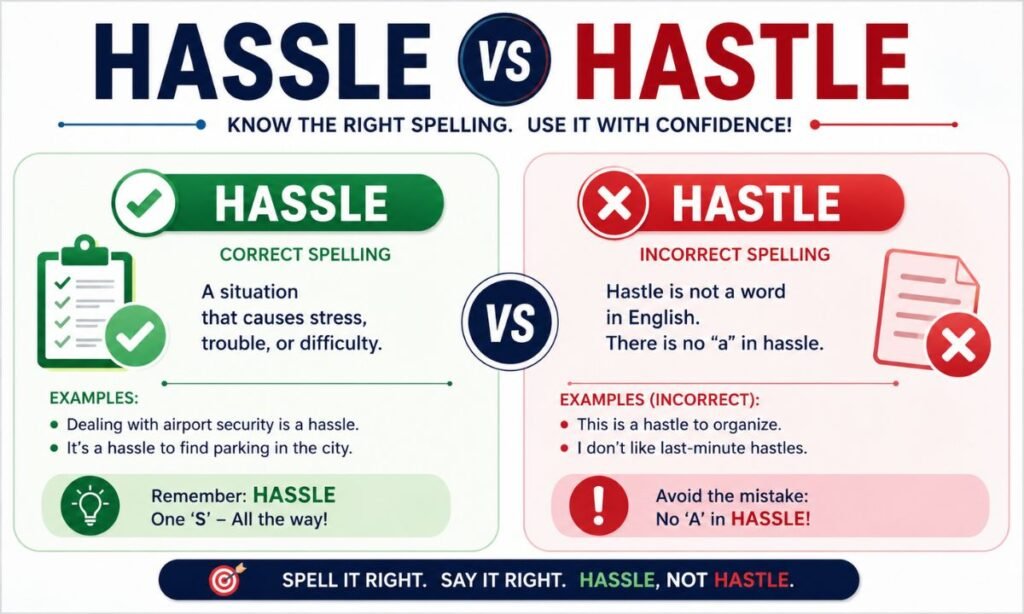
Here’s the short answer before we go any further: hassle is correct. Hastle is not a word. But knowing that isn’t enough if you want to actually understand the term, use it with confidence, and stop second-guessing yourself every time you write it. That’s what this guide covers — the meaning, the grammar, the history, the memory tricks, and every real-world scenario where “hassle” fits naturally.
What Is the Correct Spelling: Hassle vs Hastle?
There’s no debate here, and there’s no regional exception either.
- ✅ Hassle — correct in American English, British English, and every other standard variety.
- ❌ Hastle — incorrect in all contexts, formal or informal.
“Hassle” is built from a double S, no T, and it functions as both a noun and a verb. It means trouble, inconvenience, or the act of pestering someone repeatedly. “Hastle” doesn’t appear in Merriam-Webster, Oxford, Cambridge, or Collins. It’s simply a spelling slip that has spread because it sounds close enough to the real word when spoken quickly.
Here’s a quick side-by-side so the difference is impossible to miss:
| Feature | Hassle ✅ | Hastle ❌ |
|---|---|---|
| Dictionary status | Recognized in all major dictionaries | Not recognized anywhere |
| Pronunciation | /ˈhæs.əl/ | Not a standard pronunciation |
| Part of speech | Noun and verb | None — not a real word |
| Formal writing | Acceptable | Always incorrect |
| Common cause | N/A | Typing speed, mishearing, autocorrect |
If you remember nothing else from this article, remember this: two S’s, zero T’s.
Why People Mistype “Hassle” as “Hastle”
The mix-up isn’t random. It happens for a handful of predictable reasons, and once you see them laid out, the pattern becomes obvious.
1. Phonetic Confusion
When “hassle” is spoken at a normal conversational pace, the middle sound blurs. Listeners sometimes register a faint “t” sound that isn’t actually there, especially if the speaker has a particular accent or is talking fast.
2. Double-Letter Mistakes
English is full of double letters that don’t always feel intuitive — “necessary,” “embarrass,” “occurrence.” Writers rushing through a sentence sometimes drop one of the S’s without noticing, and their brain autocorrects the gap with a T instead.
3. Typing Errors
On a standard keyboard, fast typing can produce all kinds of small slips. Muscle memory from other “-stle” words can bleed into “hassle” without the writer consciously deciding to add a T.
4. Auto-Correct Interference
Ironically, spellcheck tools sometimes make things worse. If a writer types quickly and the software doesn’t flag the error immediately, “hastle” can slip through, especially on mobile keyboards with smaller keys and more prediction guesswork.
5. Bad Online Examples
Once a misspelling appears in a comment thread, a forum post, or a low-quality blog, it can get copied by other people who assume it must be right. Search engines are smart enough to recognize the intent behind “hastle” and usually redirect results toward “hassle,” but that convenience masks how often the error actually happens.
What the Word “Hassle” Actually Means
At its core, “hassle” describes anything that creates friction — a task that takes more effort than it should, a situation loaded with small annoyances, or a person who won’t stop pestering someone else.
It can describe:
- A minor inconvenience (waiting in a long line)
- A repeated annoyance (someone constantly asking for the same thing)
- An argument or scuffle, in slightly older or more casual usage
- The act of bothering, pressuring, or nagging someone
The word carries a slightly informal tone. It’s common in everyday speech, marketing copy, and business writing, but it sits a notch below strictly formal vocabulary like “inconvenience” or “administrative burden.”
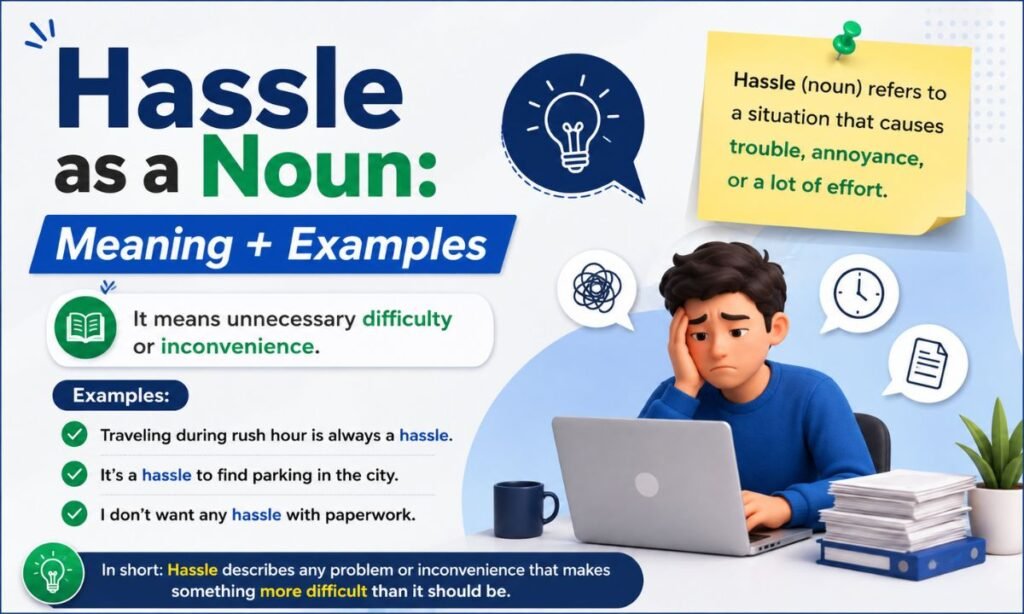
Hassle as a Noun: Meaning + Examples
Definition
As a noun, a hassle is a problem, inconvenience, or source of stress — usually something that isn’t a major crisis but still eats up time and patience.
Examples
- Renewing a passport at the last minute is always a hassle.
- She avoided the hassle of moving furniture by hiring a small crew.
- Dealing with a canceled flight is one of the biggest travel hassles.
- There’s no hassle involved in returning this product.
Common Situations Where “Hassle” Works Well
- Customer service complaints and refund processes
- Travel delays, rebookings, and lost luggage
- Paperwork, applications, and bureaucratic red tape
- Home repairs or appliance troubleshooting
- Any repeated back-and-forth that drains time or energy
Hassle as a Verb: Meaning + Examples
Definition
As a verb, “to hassle” someone means to bother them repeatedly, often by nagging, pressuring, or pestering until they respond or comply.
Examples
- Stop hassling your brother about the dishes; he’ll get to it.
- The salesman kept hassling customers as they walked past his stand.
- I don’t want to hassle you, but the deadline is tomorrow.
- She was hassled by reporters outside the courthouse.
- Hassle vs hastle examples: “It’s a hassle to reschedule” is correct; “It’s a hastle to reschedule” is not a real sentence in standard English.
- Hassle meaning: trouble, inconvenience, or the act of repeatedly bothering someone.
- Hassle-free meaning: a process or experience with no complications, delays, or annoying steps involved.
- Hassle or hustle meaning: these two are often confused because they sound alike, but they’re unrelated. “Hassle” means trouble or annoyance; “hustle” means energetic effort, hard work, or moving quickly toward a goal.
- Hassle synonym: trouble, bother, inconvenience, nuisance, ordeal, or aggravation, depending on context.
- Hassle pronunciation: /ˈhæs.əl/ — two syllables, with the stress on the first one and a soft “s” sound in the middle.
How “Hassle” Is Used in Daily Life
Common Daily Uses
People reach for “hassle” constantly in casual speech because it captures small, everyday frustrations without sounding dramatic. Waiting for a delayed bus, untangling a printer jam, or arguing about parking — all of these count.
Business & Professional Uses
Companies lean on the word heavily in marketing. “Hassle-free returns,” “no-hassle warranty,” and “zero-hassle setup” are staples of advertising because they promise relief from friction. Customer service teams also use it internally when describing pain points in a process.
Casual Conversational Uses
Among friends and family, “hassle” softens complaints. Saying “it’s a hassle” sounds less intense than “it’s a nightmare,” which makes it a go-to word for venting about minor irritations without overselling the problem.
Etymology: Where the Word “Hassle” Comes From
Possible Origins
The exact roots of “hassle” aren’t fully settled, but most language historians trace it to American English slang from the early-to-mid 20th century. Some theories link it to a blend of “haggle” and “tussle,” two older words that both involve friction and disagreement. That blend theory would explain why “hassle” carries a bit of both meanings — negotiation-style annoyance and physical or verbal conflict.
Meaning Evolution
Originally, “hassle” leaned more toward describing an actual argument, scuffle, or heated exchange. Over the decades, its meaning softened and broadened. By the later part of the 20th century, it had settled into the sense most people use today — general trouble, inconvenience, or pestering — rather than something necessarily confrontational.
Interesting Fact
Despite its informal beginnings, “hassle” is now fully accepted in professional and even academic writing. Few slang words make that transition so cleanly, which says something about how useful and precise the term turned out to be.
Why the Confusion? Why People Think It’s Spelled “Hastle”
1. English Word Patterns Are Inconsistent
Words like “castle,” “whistle,” and “bustle” all end in “-stle” with a silent T. It’s an easy — and understandable — leap to assume “hassle” follows the same pattern, even though it doesn’t.
2. Misheard in Conversation
Spoken English moves fast, and consonant clusters often blur together. Someone who has only ever heard the word, never read it, has a real chance of guessing the spelling wrong.
3. Memory Errors
Spelling memory is fragile for words that aren’t used constantly in written form. If a person mostly hears “hassle” rather than reads it, their brain may reconstruct the spelling based on similar-sounding words instead of the actual letters.
How to Remember the Correct Spelling of “Hassle”
1. Think of “Less Hassle = Less Stress”
Both words share a double S. If you can spell “stress” correctly, you already have the pattern you need for “hassle.”
2. Remember the Pair
Hassle has no T, and neither does “puzzle” or “muscle” in the same troublesome way people assume. Pairing it mentally with S-heavy words helps the spelling stick.
3. Visual Trick
Picture the two S’s as a pair of snakes hissing at each other — a small, annoying standoff, which is exactly what a hassle feels like.
4. Use a Quick Mnemonic
“Hassle Has Solid Spelling” — the phrase itself reinforces the double S and reminds you there’s no T anywhere in the word.
5. Think of Customer Service Phrases
Brands repeat “hassle-free” so often in ads and emails that the correct spelling becomes familiar through sheer repetition. Next time you see it in a return policy or warranty page, take note of the spelling.
Hassle in Pop Culture & Media
Common Pop-Culture Uses
“Hassle” shows up frequently in movie dialogue, song lyrics, sitcom scripts, and advertising slogans. It has a relaxed, conversational rhythm that fits naturally into dialogue without sounding stiff.
Why It’s Popular
The word is short, expressive, and instantly understood. Writers and marketers like it because it communicates frustration or friction in a single syllable pair, without needing a longer or more formal alternative.
Case Studies: Real-Life Examples of When “Hassle” Applies
Case Study 1: Customer Service Hassle
A customer orders a product online, and it arrives damaged. She contacts support, gets transferred three times, and has to repeat her order number at every step. By the time she finally gets a replacement approved, she describes the entire process as “a total hassle” — a fitting summary of repeated, low-grade friction rather than one single big problem.
Case Study 2: Travel Hassle
A traveler’s connecting flight gets delayed, forcing a scramble to rebook, find a new gate, and locate checked luggage that may or may not have made the transfer. None of these problems is catastrophic on its own, but stacked together they create exactly the kind of drawn-out inconvenience the word “hassle” was made for.
Case Study 3: Workplace Hassle
An employee needs sign-off from three different managers just to submit a simple expense report. Each approval takes a day or two, and the employee has to follow up repeatedly. Coworkers commiserate, calling the approval chain “such a hassle” — a phrase that captures bureaucratic friction without sounding like a formal complaint.
Sentence Examples Using “Hassle” Correctly
Noun Examples
- Finding parking downtown is always a hassle on weekends.
- I appreciate that this app removes the hassle of manual data entry.
- The whole visa process turned into a bigger hassle than expected.
Verb Examples
- Please don’t hassle the new intern about small mistakes.
- Reporters hassled the candidate for a comment outside the building.
- He hassled his roommate until she finally agreed to split the bill.
Common Mistakes People Make With “Hassle”
- Writing “hastle” instead of “hassle” in emails, essays, and social posts
- Confusing “hassle” with “hustle,” which has a completely different meaning
- Using “hassle” in extremely formal documents where “inconvenience” or “difficulty” reads more appropriately
- Forgetting the double S when typing quickly
- Assuming “hastle” is an informal or slang variant that’s still acceptable — it isn’t
Hassle: Quick Facts
| Fact | Detail |
|---|---|
| Correct spelling | Hassle |
| Incorrect spelling | Hastle |
| Word type | Noun and verb |
| Pronunciation | /ˈhæs.əl/ |
| Tone | Informal to neutral |
| Common phrases | Hassle-free, no hassle, without the hassle |
| Likely origin | Blend of “haggle” and “tussle,” American slang |
| Dictionary status of “hastle” | Not recognized |
Frequently Asked Questions
What does hastle mean?
Nothing — “hastle” isn’t a real word. It’s a common misspelling of “hassle,” which means trouble, inconvenience, or the act of repeatedly bothering someone.
What is a better word for hassle?
Depending on context, you can swap in “inconvenience,” “trouble,” “nuisance,” or “ordeal” for a slightly more formal tone.
What does “hassle” mean in slang?
In casual or slang use, “hassle” usually refers to unnecessary drama, pestering, or a situation that’s more trouble than it’s worth.
What does hassel mean?
“Hassel” is another misspelling of “hassle” and carries no separate meaning of its own — it’s most often just a typo or the surname of unrelated people and places.
Conclusion
The rule really is this simple: hassle is correct, hastle is not, and no amount of fast typing or mishearing changes that. Once you connect the double S to words like “stress,” the spelling stops being something you have to think twice about. Whether you’re writing a customer email, a travel review, or a quick text to a friend, using “hassle” correctly is a small detail that quietly signals careful, confident writing — and now you’ve got the meaning, the history, and the memory tricks to never question it again.