
“Sounds good” slips out of most of us dozens of times a week. It’s quick, it’s friendly, and it gets the job done in a group chat or a quick reply to a coworker. But if you’ve ever typed it for the fifth time in one email thread, you already know the problem: it starts to feel flat. Worse, in a formal email or a client-facing message, it can read as a little too casual for the room.
This guide walks through what the phrase actually means, when it fits and when it doesn’t, and more than a dozen alternatives you can swap in depending on the tone you’re going for. You’ll also find a comparison table, real example sentences, and answers to the questions people search most often about this phrase.
What Does “Sounds Good” Mean?
Simple Definition
“Sounds good” is a short way of saying you agree with something, accept a plan, or have no objections to what someone just proposed. If a colleague says “Let’s push the meeting to 3 PM,” replying “Sounds good” tells them you’re fine with the change and there’s nothing more to discuss.
It’s an idiom built around approval. You’re not literally commenting on how something “sounds” — you’re signaling agreement in a relaxed, conversational way.
Grammar Explanation
Structurally, “sounds good” is an elliptical sentence. The full version would be “That sounds good to me,” but English speakers drop the subject and the trailing phrase because the meaning is obvious from context.
- Sounds — verb (third-person singular of “sound,” used here to mean “seems” or “appears”)
- Good — adjective describing the quality of the idea, plan, or statement
Because the subject “that” is implied rather than stated, the phrase reads as informal. This is part of why it works so well in texts and Slack messages, and why it can feel underdressed in a formal letter or a message to senior leadership.
When to Use “Sounds Good”
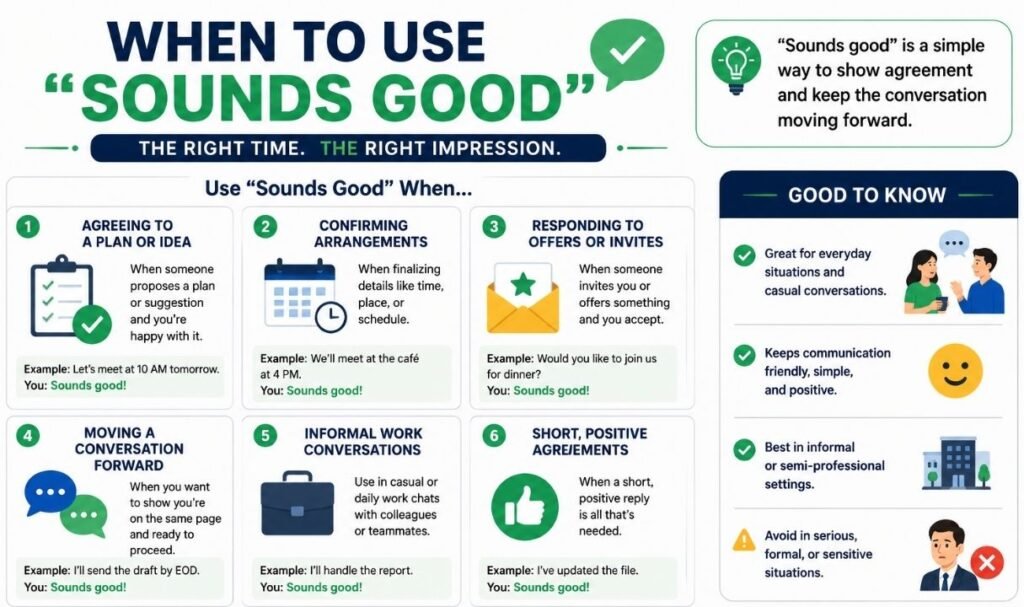
Common Contexts
“Sounds good” fits naturally in:
- Text messages and instant messaging apps
- Casual emails between coworkers who know each other well
- Quick replies confirming a time, date, or small task
- Conversations with friends or family
- Internal team chats where the tone is already relaxed
It’s less suited to first-time client emails, formal proposals, messages to executives you don’t know well, or any situation where precision and polish matter more than speed.
Examples
Here’s how the phrase shows up in everyday exchanges:
- “Can we move lunch to 1 PM?” — “Sounds good, see you then.”
- “I’ll send the invoice by Friday.” — “Sounds good, thanks.”
- “Let’s regroup after the demo.” — “Sounds good to me.”
- Sounds good synonym: People often search for a plain synonym when they want variety without overthinking tone — options like “works for me,” “that’s fine,” or “agreed” all cover the same ground.
- Sounds good synonym professional: In a work context, phrases such as “that works for me,” “I’m on board,” or “this looks good to me” carry the same meaning with a more polished edge.
- Sounds good meaning in chat: In texting or messaging apps, “sounds good” (often shortened to “sg” or paired with a 👍) simply means “okay, agreed, no changes needed.”
- Sounds good reply: A typical reply to “sounds good” is another short confirmation, like “Great, talk soon” or “Perfect, see you there” — there’s rarely a need to say more once agreement is established.
Sounds good in French: The closest natural equivalent is “Ça marche” (literally “that works”) or “D’accord” (meaning “agreed” or “okay”).
Sounds good Synonym slang: In casual slang, people say “bet,” “say less,” “cool cool,” or “for sure” to mean the same thing.
How to say sounds good professionally in email: Swap it for phrases like “That works for me,” “This looks good to me,” or “I’m happy to move forward with this” to keep the tone polished while still expressing agreement.
Is It Professional or Polite to Say “Sounds Good”?
It depends entirely on who you’re talking to and how well you know them. Among teammates, “sounds good” is perfectly polite — it’s brief, positive, and easy to read. Between two people who email each other daily, nobody will think twice about it.
The trouble starts in more formal settings. A message to a new client, a note to a hiring manager, or a reply to a senior executive can benefit from something with a bit more structure. It’s not that “sounds good” is rude; it just doesn’t carry the same weight as a phrase like “That works well for me” or “I’m glad to confirm this plan.”
A good rule of thumb: match your phrase to the formality of the message you received. If someone wrote you three careful paragraphs, a one-line “sounds good” can feel dismissive, even if that’s not your intent.
Pros and Cons of Using “Sounds Good”
Pros
- Quick to type and quick to read
- Universally understood across English-speaking workplaces
- Friendly without being overly familiar
- Works well for confirming small logistics like times, dates, or minor tasks
Cons
- Can feel repetitive if used constantly in the same thread
- May come across as too casual for formal or first-contact emails
- Doesn’t add any detail, warmth, or specificity to your response
- Overuse can make your writing sound generic or low-effort
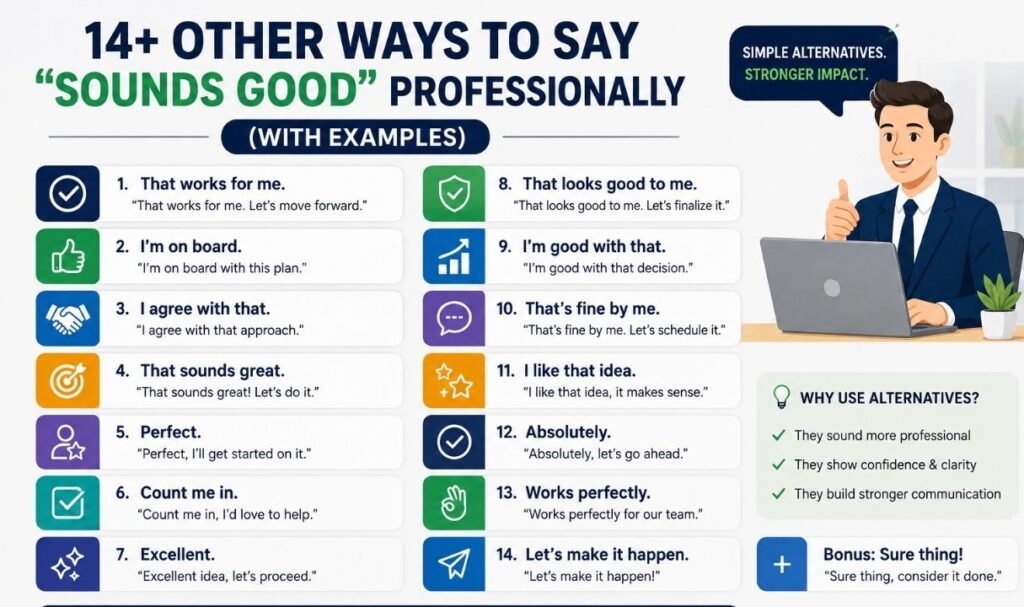
14+ Other Ways to Say “Sounds Good” Professionally
Below are fourteen alternatives, each with a short explanation of when to use it and an example sentence so you can see it in context.
Phrase: That works for me
Meaning: You’re confirming that a proposed time, plan, or arrangement fits your schedule or expectations. Explanation: This is one of the safest, most widely used professional substitutes. It’s neutral enough for almost any workplace and slightly more concrete than “sounds good.” Example Sentence: “Can we push the call to 4 PM?” — “That works for me.”
Phrase: That sounds great
Meaning: You agree with genuine enthusiasm, not just neutral acceptance. Explanation: Compared to a flat “sounds good,” this version adds a touch of warmth. It suits messages to colleagues or clients where you want to sound supportive and upbeat. Example Sentence: “We’re planning a team lunch on Friday.” — “That sounds great, count me in.”
Phrase: That sounds perfect
Meaning: The plan meets your expectations exactly, with nothing left to adjust. Explanation: Use this when a suggestion solves a problem cleanly or lines up with what you were hoping for. It’s a step above “great” in terms of enthusiasm. Example Sentence: “Let’s meet at the downtown office instead.” — “That sounds perfect.”
Phrase: I agree with this
Meaning: A direct, unembellished statement of agreement. Explanation: This phrase sounds neutral and professional. It’s a good pick when you want to confirm agreement without adding extra tone or emotion, particularly in written approvals or formal replies. Example Sentence: “We should adopt a new training program.” — “I agree with this.”
Phrase: That seems like a good plan
Meaning: You approve of the overall direction someone has proposed. Explanation: This works well when responding to a multi-step idea rather than a single fact or time. It signals that you’ve thought about the plan as a whole, not just a small detail. Example Sentence: “We’ll launch the campaign in two phases.” — “That seems like a good plan.”
Phrase: That works well
Meaning: Similar to “that works for me,” but slightly more formal and less personal. Explanation: Dropping “for me” makes the sentence sound a touch more objective, which can be useful in group emails or when you’re speaking on behalf of a team. Example Sentence: “We’ll schedule the review for next Tuesday.” — “That works well.”
Phrase: I’m happy with that
Meaning: You’re satisfied with the outcome or decision that’s been proposed. Explanation: This phrase adds a small emotional signal without going overboard. It’s suited to conversations where your satisfaction matters, such as project sign-offs or negotiations. Example Sentence: “We’ve adjusted the budget as requested.” — “I’m happy with that.”
Phrase: That makes sense
Meaning: You understand and accept the reasoning behind a decision. Explanation: Use this when someone explains their logic and you want to acknowledge that the explanation is clear and reasonable, not just that you agree with the outcome. Example Sentence: “We’re delaying the launch to fix a bug first.” — “That makes sense.”
Phrase: I support this idea
Meaning: You back a proposal, often in a group or decision-making setting. Explanation: This phrase sounds strong and professional. It’s a solid choice in meetings, votes, or written approvals where your endorsement carries some weight. Example Sentence: “The team should adopt a new training program.” — “I support this idea.”
Phrase: This looks good to me
Meaning: You approve after reviewing something, such as a document or design. Explanation: Often used when reviewing documents or designs. It’s specific to situations where you’ve actually looked something over, rather than just heard a verbal suggestion. Example Sentence: “Here is the final draft of the presentation.” — “This looks good to me.”
Phrase: I’m on board with this
Meaning: You fully support the plan and are ready to move forward with it. Explanation: Common in team discussions and collaboration. It works especially well when a project needs buy-in from multiple people before it can proceed. Example Sentence: “We should expand into new markets next year.” — “I’m on board with this.”
Phrase: That’s acceptable
Meaning: The idea meets the requirements, even if it isn’t the most exciting option on the table. Explanation: This phrase sounds neutral and professional, and it’s useful when you want to confirm something without expressing strong enthusiasm either way. Example Sentence: “We’ll deliver the report on Monday.” — “That’s acceptable.”
Phrase: Understood, let’s proceed
Meaning: You’ve registered the information and are ready to move ahead. Explanation: This is a good fit for instructions or updates rather than casual suggestions. It signals both comprehension and readiness to act, which suits project management contexts. Example Sentence: “The client approved the mockups.” — “Understood, let’s proceed.”
Phrase: Consider it done
Meaning: You’re accepting a task or request and confirming it will be handled. Explanation: Use this when someone hands you an action item rather than a suggestion. It shifts the tone from passive agreement to active commitment. Example Sentence: “Can you send the updated file by end of day?” — “Consider it done.”
Comparison Table of Top Alternatives
| Phrase | Tone | Best Used In |
|---|---|---|
| That works for me | Neutral, friendly | Scheduling, quick confirmations |
| That sounds great | Warm, enthusiastic | Team updates, informal client emails |
| That sounds perfect | Very positive | Confirming an ideal solution |
| I agree with this | Formal, direct | Approvals, written sign-offs |
| That seems like a good plan | Thoughtful, measured | Multi-step proposals |
| That works well | Formal, objective | Group emails, official replies |
| I’m happy with that | Warm, personal | Project outcomes, negotiations |
| That makes sense | Understanding, calm | Explaining or accepting reasoning |
| I support this idea | Strong, confident | Meetings, votes, endorsements |
| This looks good to me | Reviewing, specific | Document or design feedback |
| I’m on board with this | Collaborative | Team decisions, buy-in requests |
| That’s acceptable | Neutral, formal | Confirming minimum requirements |
| Understood, let’s proceed | Direct, action-oriented | Instructions, project updates |
| Consider it done | Confident, committed | Task assignments |
Frequently Asked Questions
What is meant by “sounds good”?
It’s an informal way of saying you agree with or accept a plan, suggestion, or statement someone has just made.
What can I say instead of “sounds good”?
You can say “that works for me,” “I agree with this,” “that makes sense,” or “this looks good to me,” depending on the tone you need.
Is “sounds good” a good reply?
Yes, in casual or semi-formal settings it’s a perfectly acceptable and widely used reply, though it can feel too informal for very formal correspondence.
Is it correct to say “sounds good”?
Yes, it’s grammatically correct as a shortened form of “that sounds good to me,” and it’s commonly used in both spoken and written English.
Conclusion
“Sounds good” isn’t wrong, and you don’t need to retire it from your vocabulary. It’s a useful, friendly phrase for casual exchanges and quick confirmations. But when the setting calls for a more polished tone, whether that’s a client email, a formal approval, or a message to someone you’re meeting for the first time, having a handful of alternatives ready makes a real difference.