
If you’ve ever typed the number 14 as a word and paused halfway through, wondering whether it’s “fourteen” or “forteen,” you’re not alone. This is one of the most searched spelling questions in English, right up there with “forty or fourty.” The confusion makes sense once you say the word out loud — it sounds clipped, almost like the “u” isn’t there at all. But sound and spelling don’t always agree in English, and this is one of those cases.
This guide settles the question for good. You’ll get the correct spelling, the reason behind it, how British and American English treat the word, common mistakes people make, and real examples from emails, news, and everyday writing.
Fourteen
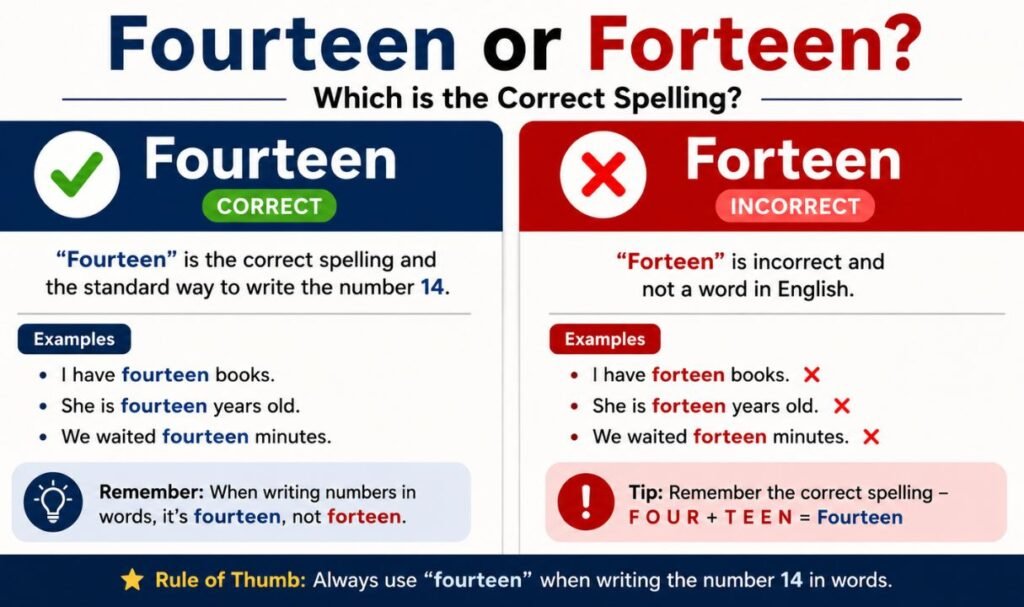
“Fourteen” is the only correct spelling of the number 14 in English. It’s built from “four” plus the suffix “-teen,” the same pattern used for thirteen, fifteen, sixteen, and the rest of the teen numbers. Every major dictionary — Oxford, Cambridge, Merriam-Webster — lists “fourteen” as the standard spelling, with no regional variant.
Forteen
“Forteen” is not a word. It has no dictionary entry, no accepted usage, and no meaning of its own. People write it because the spoken word “fourteen” often gets swallowed in casual speech, and the “u” disappears in pronunciation even though it stays in the spelling. Seeing “forteen” in a document is a clear sign of a typo or a spelling gap, not a valid alternative form.
Fourteen or Forteen: Quick Answer
Correct:
- Fourteen
- She turned fourteen last week.
- The invoice lists fourteen items.
Incorrect:
- Forteen
- She turned forteen last week. ❌
- The invoice lists forteen items. ❌
There’s no situation — formal, informal, British, American, spoken, written — where “forteen” is acceptable. If you remember one thing from this article, remember that.
Fourteen or Forteen: Which One Is Correct in English?
English numbers follow patterns that mostly make sense, and “fourteen” is a good example of the pattern working the way it should. The word is a direct combination of “four” and “teen,” the same suffix used to build thirteen through nineteen. Since “four” keeps its “u,” so does “fourteen.”
Compare that to a word like “forty,” which drops the “u” for reasons nobody fully agrees on. That inconsistency is likely where the confusion around “fourteen” comes from — if forty loses the “u,” writers sometimes assume fourteen should too. It doesn’t. The rule for the teen numbers is simpler and more predictable than the rule for the tens, and fourteen sits firmly on the predictable side.
A short way to check yourself: if you can spell “four,” you already know how to spell “fourteen.” Just add “teen” to the end. No letters change, nothing gets dropped.
You May Like: Is It Color or Colour? Never Make This Mistake Again
The Origin of Fourteen or Forteen
The word traces back to Old English “feowertyne,” itself built from “feower” (four) and “tyne,” an early form of “ten.” Over centuries of sound shifts and spelling standardization, “feowertyne” settled into the modern “fourteen.” Throughout that evolution, the connection to “four” never broke — the spelling stayed anchored to the root number even as pronunciation drifted.
“Forteen” was never part of that history. It isn’t an old spelling that fell out of use, and it isn’t a regional variant that survived in some dialect. It’s simply a phonetic guess — someone hears “for-teen” and writes what they hear, the same way people occasionally write “recieve” instead of “receive.” The mistake comes from sound, not from any real linguistic branch point.
This matters because it separates fourteen from words like “forty,” which genuinely did lose a letter over time through documented spelling change. Fourteen never went through that process, so there’s no historical basis for “forteen” at all — not in old manuscripts, not in regional English, not anywhere.
British English vs American English Spelling
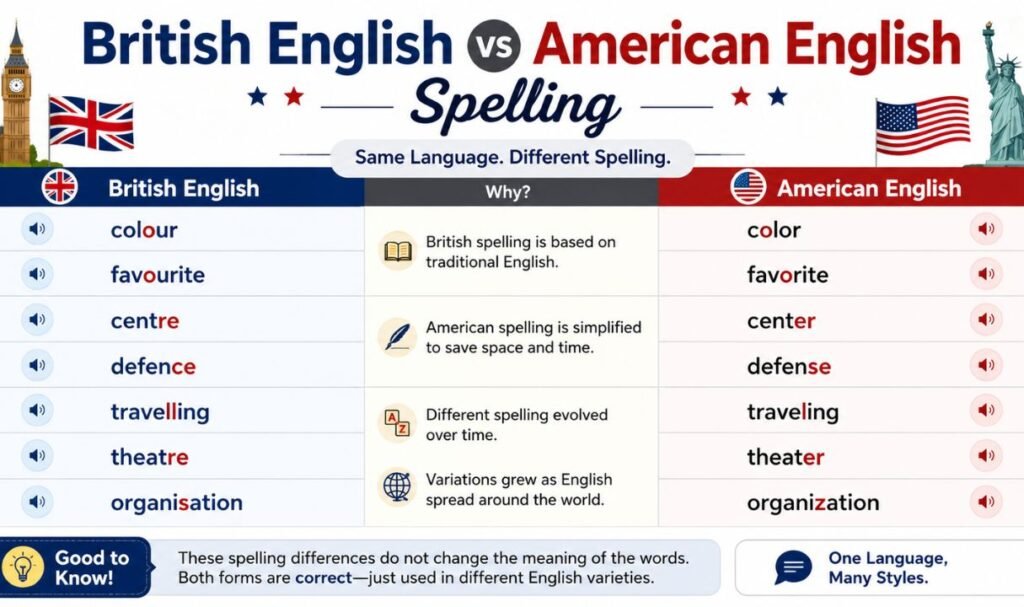
Here’s the good news: this is one of the rare number words where British and American English don’t disagree. Both varieties spell it exactly the same way.
| Spelling | British English | American English |
| Fourteen | ✅ Correct | ✅ Correct |
| Forteen | ❌ Incorrect | ❌ Incorrect |
Compare that to words like “colour/color” or “organise/organize,” where the Atlantic genuinely splits opinion. Fourteen isn’t one of those words. Whether you’re writing for a UK audience, a US audience, or anyone in between, “fourteen” is the only spelling you need.
A few related search terms worth clearing up while we’re here:
- Fourteen or forteen quiz — if you’re testing yourself or students, the answer key is simple: fourteen is always right, forteen is always wrong, in every question format.
- Fourteen or forteen thousand — the same rule scales up. It’s “fourteen thousand,” never “forteen thousand.” The base word doesn’t change just because you add a larger unit after it.
- Fourteen or forteen Oxford Dictionary — Oxford lists only “fourteen.” There is no Oxford entry for “forteen” because it isn’t a recognized word.
- Forteen or fourteen in cheque — when writing a cheque, always spell out “fourteen.” Cheques are one place where a misspelled number can cause real confusion or even processing delays, so accuracy matters more than usual here.
- Fourteen in number — as a numeral, fourteen is written 14. As a word, it’s spelled fourteen.
- Fourteen thousand — written as one word plus “thousand”: 14,000 becomes “fourteen thousand.”
Comparison Table
| Term | Status | Notes |
| Fourteen | Correct | Standard spelling, all English varieties |
| Forteen | Incorrect | Common misspelling based on pronunciation |
| Fourteen thousand | Correct | 14,000 written in words |
| Forteen thousand | Incorrect | Same error carried into larger numbers |
| 14 (numeral) | Correct | Standard digit form |
Which Spelling Should You Use?
There’s only one answer here, but it’s worth breaking down by audience so you can see why consistency matters everywhere, not just in formal writing.
Based on audience:
- Students and exam writers: Always use “fourteen.” Spelling errors on numbers can cost marks in essays, comprehension answers, and written exams.
- Business and professional writers: Use “fourteen” in emails, reports, invoices, and contracts. A misspelled number can look careless in a document meant to build trust.
- Casual writers and social media users: Even in relaxed writing, “fourteen” is the version people expect to see. “Forteen” tends to stand out as a mistake rather than a stylistic choice.
- Non-native English speakers: Learning the four + teen pattern early makes the whole “teen” number family easier — thirteen, fourteen, fifteen, and so on all follow the same logic.
No audience, tone, or platform changes the answer. The only variable is how much a mistake will cost you, and in formal contexts, that cost is higher.
Common Mistakes with Fourteen or Forteen
1. Writing “forteen”
This is the most frequent error, and it almost always comes from typing based on how the word sounds rather than how it’s built. Reading the word aloud slowly — four, teen — helps catch it before hitting send.
2. Dropping the “u”
Some writers know the word starts with “four” but still drop the “u” out of habit, especially if they’re used to writing “forty” without one. Treating fourteen and forty as separate rules, rather than assuming they behave the same way, prevents this slip.
3. Mixing with “forty”
Because forty and fourteen look and sound similar, it’s easy to type one when you mean the other, especially when working quickly. Double-checking numbers in emails, invoices, and contracts is a small habit that avoids a costly mix-up — the difference between 14 and 40 is significant in almost any context involving money, dates, or quantities.
Fourteen or Forteen in Everyday Examples
Emails
“Please confirm your availability for the fourteen o’clock meeting” isn’t quite right either (that’s a 24-hour clock mismatch), but “The shipment includes fourteen units” is a clean, correct example you’ll see constantly in business correspondence.
News
Headlines and articles use the word regularly: “Fourteen people were evacuated after the storm” or “The company reported fourteen new store openings this quarter.” News writing leans on correct, standard spelling because errors get noticed fast and damage credibility.
Social Media
Even in short-form, casual posts, “fourteen” holds up: “Just hit fourteen years at this job today 🎉” reads naturally, while “forteen years” would look like a typo to most readers, breaking the flow of an otherwise casual sentence.
Formal Writing
Academic papers, legal documents, and official records almost always spell out numbers under a certain threshold (often twenty or one hundred, depending on the style guide), which means “fourteen” shows up often and needs to be exact every time.
You May Like: Ballon or Balloon: What Is the Difference & Which Is Correct?
Fourteen or Forteen: Google Trends & Usage Data
Search interest in this exact question spikes around specific moments — back-to-school periods, exam seasons, and whenever people are drafting formal documents like cheques or official letters. The pattern suggests most searchers already suspect “forteen” might be wrong and are looking for confirmation rather than a genuine coin flip.
By country:
- English-speaking countries with strong formal-education search patterns (India, the Philippines, Nigeria, and similar regions with large ESL populations) show consistently higher search volume for this comparison, likely tied to classroom spelling practice and competitive exams.
- US and UK searches tend to cluster around business writing — cheques, invoices, and workplace documents.
By context:
- Education and exam preparation drive a large share of searches.
- Business and finance writing (especially cheque-writing) accounts for another significant chunk.
- Casual curiosity — people simply unsure mid-sentence — makes up the rest.
Comparison Table: Fourteen vs Forteen
| Feature | Fourteen | Forteen |
| Dictionary status | Listed in all major dictionaries | Not listed anywhere |
| Grammatical correctness | Correct in all contexts | Incorrect in all contexts |
| Regional variation | None — same in US and UK English | None — wrong everywhere |
| Common in | Formal and informal writing | Typos and casual mistakes only |
| Root structure | Four + teen | No valid root structure |
| Recommended use | Always | Never |
How to Spell Fourteen With Examples and Common Uses
Spelling fourteen correctly comes down to one habit: build it from “four,” not from how it sounds. Once that clicks, the mistake tends to disappear for good.
A few natural sentence examples:
- Fourteen students signed up for the workshop.
- The recipe takes fourteen minutes to bake.
- He’s lived in the city for fourteen years.
- There were fourteen candidates on the shortlist.
- The contract runs for fourteen months.
Fourteen also appears as part of related words and phrases worth knowing:
- Fourteenth — the ordinal form, as in “the fourteenth of March.”
- Fourteen-hour — used as a compound adjective, like “a fourteen-hour flight.”
- Fourteen-year-old — a common compound describing age.
In each case, the spelling never shifts. Whether it’s standing alone, forming an ordinal, or joining another word in a compound, “fourteen” keeps its full form.
Frequently Asked Questions
Is 14 spelled as “forteen” or “fourteen”?
It’s spelled “fourteen.” “Forteen” is a common misspelling with no dictionary recognition.
Is fourty or forty correct?
“Forty” is correct. Unlike fourteen, forty dropped its “u” over time and no longer includes one.
What is the spelling of 14?
The number 14 is spelled “fourteen” in both British and American English.
Is “forteen” or “fourty” the correct spelling?
Neither is correct. The right spellings are “fourteen” (14) and “forty” (40).
Conclusion
The rule here is about as clean as English spelling gets: “fourteen” is correct, “forteen” is not, and that holds true across British English, American English, formal writing, and casual conversation. The confusion comes from pronunciation, not from any real grammatical gray area — the spoken word hides the “u” that the written word keeps.