
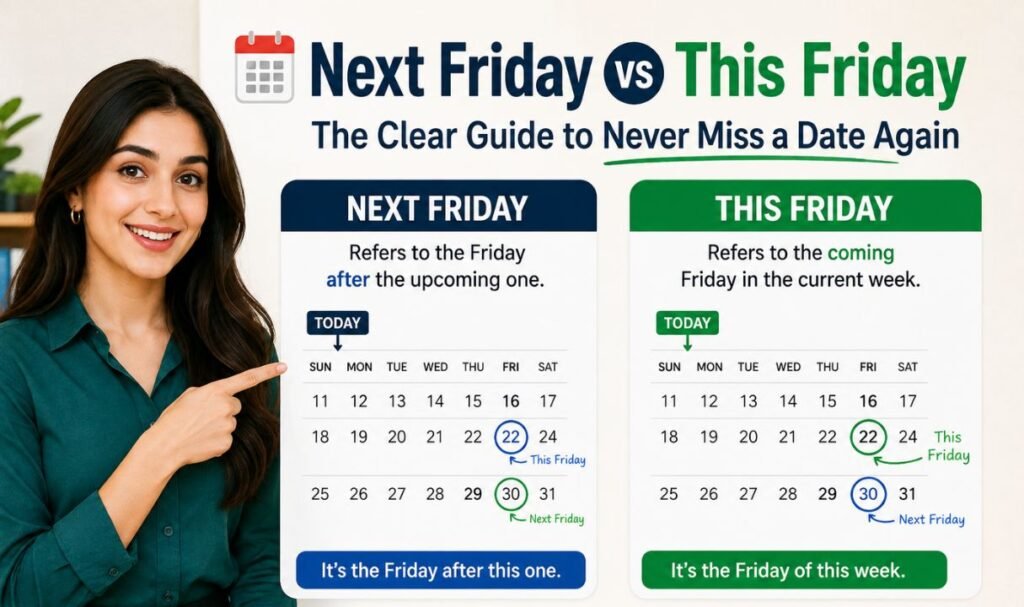

Someone types “let’s meet next Friday” in a group chat, and within seconds three different people picture three different dates. One assumes it’s the Friday coming up in two days. Another assumes it’s a full nine days out. A third just guesses and hopes for the best.
This mix-up happens constantly, in offices, classrooms, and family group chats. The phrases “this Friday” and “next Friday” sound simple, but they shift meaning depending on the day you say them, who you’re talking to, and even where you live. This guide breaks down exactly what each phrase means, when confusion tends to happen, and how to phrase your plans so nobody shows up on the wrong day.
Why “Next Friday” and “This Friday” Cause So Much Confusion
English handles time in a strange way. Words like “this” and “next” don’t point to a fixed date. They point to a date relative to right now, and that reference point keeps moving.
If you say “this Friday” on a Monday, your listener has a full week to work with. Say the same phrase on a Saturday, and the picture changes completely because the week has already reset in most people’s minds.
Add to that the fact that not everyone agrees on when a week actually starts. Some people mentally begin their week on Monday. Others start counting from Sunday. That single difference alone can shift what “this Friday” or “next Friday” means to two people having the exact same conversation.
The Core Difference Between “This Friday” and “Next Friday”
At the most basic level, here’s the distinction most English speakers rely on:
| Phrase | General Meaning |
|---|---|
| This Friday | The Friday coming up in the current week |
| Next Friday | The Friday in the following week |
That’s the textbook answer, and it holds true most of the time, especially early in the week. But the moment Thursday or Friday rolls around, or the weekend begins, that clean rule starts to bend. We’ll walk through exactly where and why.
How the Structure of the Week Shapes Meaning
Think of a calendar as a container. Early in the week, that container feels full, so “this Friday” naturally points to the Friday still inside it. By Thursday or Friday, the container feels almost empty, and people start reaching past it toward the next one.
This is why the same two words can point to different dates depending purely on timing. It isn’t sloppy language. It’s how humans naturally track time relative to where they stand in the week.
What “This Friday” Actually Means
In everyday use, “this Friday” almost always refers to the closest upcoming Friday on the calendar, the one you can point to without skipping over another Friday first.
Using “This Friday” Earlier in the Week
Say it’s Monday, Tuesday, or Wednesday. “This Friday” is unambiguous here. It’s the Friday that ends the current workweek, typically two to four days away. Almost nobody misreads it in this window, which is why most confusion complaints trace back to conversations that happen later in the week.
Using “This Friday” on Friday Itself
Here’s where it gets interesting. If someone says “this Friday” on a Friday, they usually mean today. “Are we still on for this Friday?” asked at 9 a.m. on a Friday is really just asking about today’s plan.
Late in the evening, though, some speakers mentally treat the day as already winding down and start referring to the following Friday instead. It’s inconsistent, and it’s one of the few genuine gray areas in this whole topic.
What “Next Friday” Really Means
This is the phrase that actually causes most of the arguments. Unlike “this Friday,” which usually behaves predictably, “next Friday” splits speakers into two camps.
The Calendar-Based Interpretation
Under the stricter, more traditional interpretation, “next Friday” skips the upcoming Friday entirely and points to the Friday of the following week. If today is Tuesday, “next Friday” under this rule lands ten days out, not three.
This interpretation is common in professional and academic writing, and it’s the version grammar guides tend to defend, since “next” technically implies “the one after this one.”
The Conversational Interpretation
In casual speech, plenty of people use “next Friday” to mean the very next Friday on the calendar, treating it as interchangeable with “this Friday.” Someone texting a friend on a Tuesday might say “let’s grab dinner next Friday” and simply mean three days from now.
Neither interpretation is technically wrong. They’re just different habits, shaped by region, workplace culture, and personal upbringing. That’s exactly why so many scheduling mix-ups trace back to this one phrase.
The Biggest Misconceptions People Make
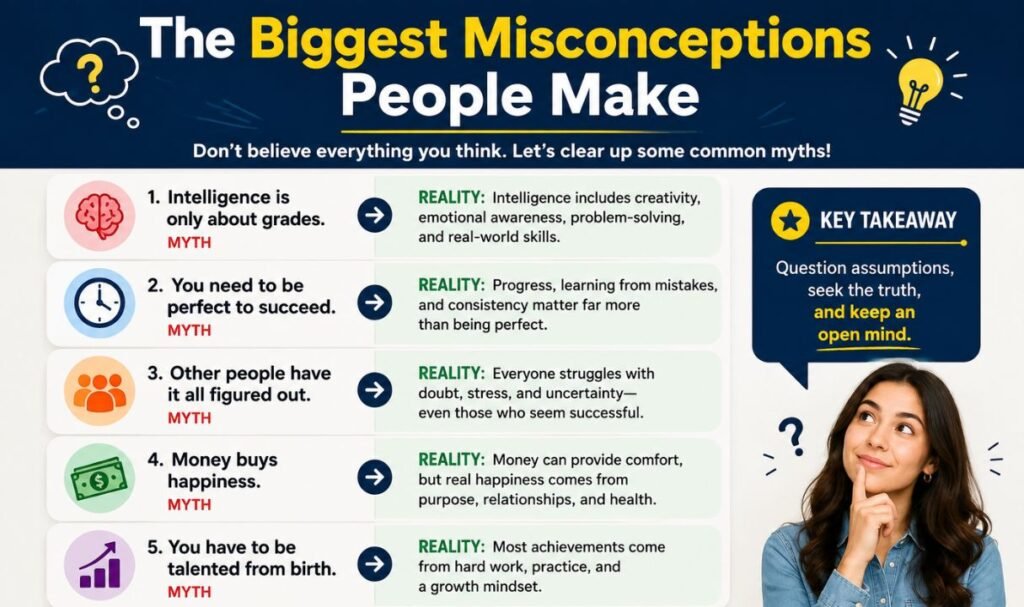
A few false assumptions keep this confusion alive.
Assuming Everyone Uses the Same Rule
The most common mistake is assuming your own interpretation is universal. Someone raised using the calendar-based rule will confidently plan around it, not realizing the person they’re texting grew up using the casual version.
Believing Grammar Alone Decides Meaning
Grammar books can tell you what “next” is supposed to mean structurally, but real-world usage doesn’t always follow the textbook. Language evolves through habit, not just rules, and enough people use “next Friday” loosely that dictionaries now note both meanings as valid.
Ignoring Timing in the Conversation
People also forget that the day the conversation happens matters as much as the words themselves. A message sent on a Monday reads differently than the same message sent on a Thursday night, even though the wording is identical.
Real-Life Scenarios: “This Friday” in Context
Seeing the phrase in action makes the pattern much easier to remember.
Work deadlines
A manager says on a Tuesday, “Please have the report ready by this Friday.” Almost every employee reads this the same way: the report is due at the end of the current week, roughly three days out. Low risk of confusion here.
Social plans
A friend texts on Wednesday, “Movie night this Friday?” Again, this reads clearly as the Friday just two days away. Casual plans made early in the week rarely get misread.
School or training schedules
A teacher announcing “the quiz is this Friday” on a Monday gives students a predictable four-day runway. Academic settings tend to favor the stricter, calendar-anchored reading of “this,” which keeps confusion low.
Real-Life Scenarios: “Next Friday” in Context
This is where things get messier, and where clarification habits genuinely pay off.
Project timelines
A project manager writes, “Let’s push the launch to next Friday.” Depending on which interpretation the team uses, the launch date could land anywhere from four days out to eleven days out. On real projects, that gap has caused missed vendor bookings and rescheduled client calls.
Appointments and bookings
Someone calling a clinic to reschedule and saying “can we do next Friday instead” risks the same problem. Front-desk staff trained to use the calendar-based rule may book a date the caller never intended.
Conversations late in the week
Said on a Thursday or Friday, “next Friday” almost always shifts toward the calendar-based meaning, the Friday of the following week. At this point in the week, both casual and formal speakers tend to agree, since the current week’s Friday is either happening or already gone.
What Happens When the Weekend Starts
Once Saturday hits, the mental “reset” most people rely on kicks in, and both phrases start behaving differently.
Friday night usage
Late Friday evening sits in a strange zone. Some speakers still treat “this Friday” as today, since it technically hasn’t ended. Others already treat the day as over and mentally shift to referring to next week’s Friday instead.
Saturday and Sunday usage
This is where the split becomes most noticeable, and it directly answers a few common questions people search for.
- What does “next Friday” mean on Saturday? Once Saturday arrives, most speakers treat the upcoming Friday, the one just five or six days away, as “next Friday,” since the previous Friday has already passed.
- What does “next Friday” mean on Sunday? The pattern holds. On Sunday, “next Friday” typically points to the closest Friday ahead, not the one after it.
- What does “next Friday” mean on Monday? Here the stricter rule tends to return. On Monday, many speakers go back to treating “next Friday” as the Friday of the following week rather than the immediate one, since the new week has just started and “this Friday” already covers the closer date.
So when is “this Friday” exactly? The short answer: it’s whichever Friday sits closest ahead of you on the calendar, unless the current Friday has already passed, in which case some speakers loosely apply it to the one just gone.
And a quick note on spelling, since it comes up often in searches: the correct phrase is “this Friday,” not “these Friday.” “These” is plural and doesn’t pair with a single day name.
Regional and Cultural Differences in Usage
Usage doesn’t stay consistent across borders either.
Workplace vs casual speech
Professional settings, especially in writing, lean toward the stricter, calendar-based meaning of “next Friday” because ambiguity in business communication carries real costs. Casual speech, especially over text, leans looser and more proximity-based.
Global teams
British English speakers sometimes use “next Friday” to mean the immediate upcoming Friday more often than American speakers do, who more frequently default to the following-week interpretation. Teams working across the US, UK, and other English-speaking regions run into this constantly during remote scheduling, which is exactly why so many companies now default to full dates in calendar invites rather than relying on the phrase at all.
How to Avoid Confusion Completely
The good news is that avoiding this entire problem takes very little effort.
Use specific dates
Instead of “next Friday,” say “Friday, the 21st.” It costs an extra few words and removes all ambiguity instantly.
Use clarifying phrases
Phrases like “this coming Friday” or “Friday of next week” carry far less room for misreading than the bare word “next” on its own.
Confirm when stakes are high
For anything involving money, travel, or client commitments, a quick confirmation message such as “just to check, you mean the 14th, right?” takes ten seconds and prevents an entire day of cleanup later.
Professional Communication: Why Clarity Matters
In a work setting, a misunderstood date isn’t just awkward, it’s expensive. Missed submission windows, rebooked flights, and rescheduled client meetings all trace back to language that felt clear in the moment but wasn’t. Teams that build a habit of pairing day names with actual dates in emails, calendar invites, and project tools quietly avoid an entire category of scheduling errors. It’s a small habit with an outsized payoff.
Quick Decision Guide: Which One Should You Use?
| Situation | Recommended Phrase |
|---|---|
| Talking about the Friday in the current week | “This Friday” |
| Talking about the Friday of the following week | “Next Friday” or “Friday of next week” |
| Speaking on Thursday or Friday about the near future | Use the actual date to avoid confusion |
| Writing a work email or invite | Always include the date alongside the day name |
| Talking to someone in a different country or time zone | Use the date, not the phrase |
Frequently Asked Questions
Do you say next Friday or this Friday?
It depends on which Friday you mean. Use “this Friday” for the Friday in the current week and “next Friday” for the Friday in the following week.
What does “next Friday” mean?
Most commonly, it refers to the Friday of the week after the upcoming one, though some speakers use it casually to mean the very next Friday.
Should I say this Monday or next Monday?
The same logic applies as with Friday. “This Monday” means the Monday in the current week, and “next Monday” typically means the Monday of the following week.
Do you say this Thursday or next Thursday?
Yes, the identical rule carries over to every day of the week, not just Friday. “This Thursday” is the closest upcoming Thursday, while “next Thursday” usually points to the one after that.
Conclusion
“This Friday” and “next Friday” seem like small, throwaway phrases, but they carry just enough ambiguity to derail a meeting, a flight booking, or a project deadline. The safest habit isn’t memorizing a rigid rule, since even native speakers disagree on one. It’s pairing the phrase with an actual date whenever the plan matters. A few extra words now save a lot of confusion later, and nobody ends up showing up on the wrong Friday again.