

Two extra letters. That’s all that separates “loosing” from “losing,” yet mixing them up is one of the most common spelling slips in English writing. One word is about setting something free. The other is about no longer having something. Confuse them in an email, an essay, or a social media caption, and the meaning of your sentence can flip entirely.
This guide breaks down both words in plain terms: what they mean, how they’re used, the grammar rules behind them, and simple tricks to keep them straight for good. By the end, you won’t need to second-guess yourself the next time your fingers want to type an extra “o.”
Comparison Overview
Before digging into definitions, here’s a quick side-by-side look at how these two words differ.
| Feature | Loosing | Losing |
|---|---|---|
| Base verb | Loose | Lose |
| Meaning | To release, untie, or set free | To fail to keep, win, or find something |
| Pronunciation | Rhymes with “goose” | Rhymes with “fuzzing” |
| Number of “o”s | Two | One |
| Frequency in modern English | Rare | Very common |
| Typical context | Archery, sailing, restraints, historical or literary text | Sports, emotions, relationships, money, objects |
| Example sentence | The archer is loosing an arrow. | She is losing her patience. |
Losing wins in almost every everyday context. Loosing survives mostly in specialized or old-fashioned writing. Keep that imbalance in mind, because it explains why so many people default to “losing” without thinking twice — and why “loosing” so often turns out to be a typo rather than an intentional word choice.
Definition of Loosing
Loosing is the present participle of the verb “loose.” As a verb, “loose” means to release, untie, unfasten, or let go of something that was being held, restrained, or tied down.
Think of the double “o” as a visual clue. Loose things are, well, loose — not tight, not fastened, not held in place. When you turn that adjective into a verb and add “-ing,” you get “loosing,” describing the act of releasing something in real time.
Common contexts where “loosing” actually shows up:
- Archery: an archer loosing an arrow from a bow
- Sailing and knots: sailors loosing a rope or loosing the sails
- Animals or restraints: loosing a dog from its leash, loosing hounds during a hunt
- Figurative or literary use: loosing one’s grip, loosing a flood of emotion
Outside of these fairly narrow situations, “loosing” rarely appears in modern writing. If you’re drafting a business email, a school essay, or a casual text message, there’s a good chance you don’t need this word at all.
Definition of Losing
Losing is the present participle of the verb “lose.” It describes the ongoing action of no longer having, failing to win, or being unable to find something.
This is the word almost everyone means when they type quickly and accidentally add that extra “o.” Losing covers an enormous range of everyday situations: misplacing your keys, falling behind in a game, running low on money, or struggling to hold onto your temper.
Typical uses include:
- Competition: The team is losing the match.
- Possessions: He keeps losing his phone charger.
- Emotions and mental state: I’m losing my patience with this project.
- Health and body: She’s losing weight after changing her diet.
- Abstract things: The company is losing customers to a competitor.
Because “losing” applies to so many parts of daily life — sports, relationships, finances, memory, focus — it shows up constantly in speech and writing. That frequency is exactly why it’s the word you should default to unless you have a specific reason to think otherwise.
Main Differences Between Loosing and Losing
The two words trace back to entirely different root verbs, and that root is the real key to telling them apart.
| Aspect | Loosing | Losing |
|---|---|---|
| Root verb | Loose (to release) | Lose (to fail to keep) |
| Core idea | Freedom, release, untying | Absence, failure, disappearance |
| Spelling clue | Two “o”s, like “loose” | One “o,” like “lose” |
| Common usage today | Rare, mostly literary or technical | Extremely common in daily speech |
| Grammatical form | Present participle of “loose” | Present participle of “lose” |
| Related noun | Looseness | Loss |
Notice the pattern in that last row. “Losing” pairs with “loss,” and both have one “o.” “Loosing” pairs with “loose,” and both have two. Once that connection clicks, the spelling stops feeling arbitrary.
Grammar Guide
How each term is used in sentences
Both words function as present participles, meaning they can act as part of a continuous verb tense (“is losing,” “was loosing”) or as a gerund/adjective in certain constructions.
Loosing in a sentence:
- The falconer is loosing the bird from its perch.
- By loosing the ropes, the sailors let the boat drift free.
Losing in a sentence:
- I am losing track of time.
- The store is losing money every month it stays open.
In both cases, the “-ing” form attaches to a base verb (“loose” or “lose”) the same way it would with any other English verb — think “choosing” from “choose” or “using” from “use.”
Common mistakes learners make
Learners and native speakers alike tend to make the same handful of errors:
- Typing “loosing” when they mean “losing” a game, an item, or a feeling.
- Writing “loosing weight” instead of “losing weight.”
- Confusing “loose” and “lose” as adjectives and verbs, which then carries over into the “-ing” forms.
- Assuming the words are interchangeable spellings of the same idea, rather than two separate verbs.
The most frequent slip by far is autocorrect or muscle memory adding that second “o” into a sentence about failure or disappearance. Spell-checkers often miss it too, since “loosing” is a real word — just usually the wrong one for the sentence.
Simple rules to remember
- If the sentence is about failure, defeat, or disappearance, use “losing.”
- If the sentence is about releasing or untying something, use “loosing.”
- Match the number of “o”s to the related word: “loss” has one “o,” so does “losing.” “Loose” has two, so does “loosing.”
- When in doubt, ask yourself: could I replace this word with “failing to keep” or “unable to find”? If yes, use “losing.”
Quick tips for writing and speaking
- Read your sentence back and swap in the base verb: “lose” or “loose.” Whichever one fits the meaning tells you the correct spelling of the “-ing” form.
- If you’re writing about sports, money, objects, or emotions, “losing” is almost certainly correct.
- Save “loosing” for archery, sailing, restraints, or clearly historical or literary contexts.
- When speaking, the pronunciation differs too: “losing” has a soft “z” sound, while “loosing” has a harder “s” sound, closer to “goose.” Saying the sentence aloud can help you catch the right word before you write it.
When to Use Each One
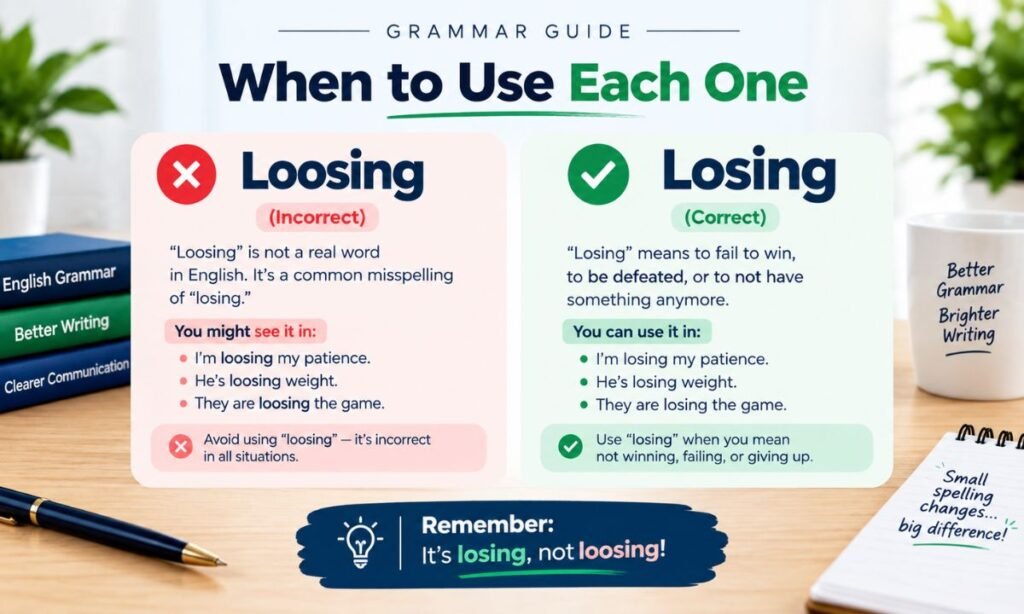
Use losing when your sentence involves:
- Sports, games, or competitions
- Money, business performance, or financial loss
- Emotional states like patience, focus, or motivation
- Physical health topics, such as weight or strength
- Misplacing objects or forgetting information
- Relationships weakening or ending
Use loosing when your sentence involves:
- Releasing an arrow, rope, or knot
- Freeing an animal from a leash or cage
- Untying or unfastening something physically restrained
- Literary, historical, or poetic descriptions of release
When NOT to Use Each One
Do not use “loosing” when you mean defeat, failure, or misplacement. Writing “I’m loosing my mind” or “the team is loosing” is incorrect in standard English, even though it’s a surprisingly common typo.
Do not use “losing” when describing a physical release or untying action. “He was losing the ropes to free the horse” doesn’t work grammatically — the correct word there is “loosing,” since the sentence is about setting something free, not failing to keep it.
Which One to Use (Decision Guide)
Still unsure which word fits your sentence? Walk through this short checklist:
- Ask what the sentence is really about. Is something disappearing, failing, or being defeated? Or is something being released, untied, or set free?
- Swap in the base verb. Try “lose” and “loose” in place of the “-ing” word. Whichever makes sense in context tells you which spelling to use.
- Count the “o”s in your intended meaning. Loss-related ideas get one “o.” Release-related ideas get two.
- Consider the setting. Everyday writing, business communication, and casual conversation almost always call for “losing.” Archery, sailing, or older literary text may call for “loosing.”
- When still stuck, default to “losing.” Statistically, it’s the correct choice in the overwhelming majority of real-world sentences.
Real-World Practical Examples
Loosing Examples
- The archer stood still before loosing her arrow at the target.
- Sailors spent the morning loosing the sails ahead of departure.
- The trainer began loosing the falcon from its tether.
- In the old tale, the knight was loosing the chains that bound the prisoner.
- Loosing his grip on the branch, he nearly fell.
Losing Examples
- Our team keeps losing close games in the final minutes.
- I hate losing my train of thought during meetings.
- She’s losing weight steadily through diet and exercise.
- The startup is losing money faster than expected this quarter.
- He’s terrified of losing touch with old friends after moving away.
Self-Assessment (Fill in the Blanks)
Test yourself before checking the answers below.
- He is _______ his temper over small things lately.
- The archer practiced _______ arrows all afternoon.
- Are you _______ weight from the new workout plan?
- The sailors began _______ the ropes as the ship left port.
- I keep _______ my umbrella every time it rains.
- She was _______ the dog’s leash so it could run in the park.
- The company is _______ market share to newer competitors.
- By _______ his hold on the rope, he let the swing go free.
Answers
- losing
- loosing
- losing
- loosing
- losing
- loosing
- losing
- loosing
Frequently Asked Questions
Is it loosing or losing someone?
t’s “losing someone.” You lose a person through death, separation, or a fading relationship, so the correct word relates to “lose,” not “loose.”
Is it losing or loosing weight?
It’s “losing weight.” Weight loss relates to the verb “lose,” so “losing” is always the correct spelling here.
Is it loosing or losing my mind?
It’s “losing my mind.” This common expression means feeling overwhelmed or out of control, which ties back to “lose,” not “loose.”
Is it loosing me or losing me?
It’s “losing me.” This phrase means someone is failing to keep your attention, interest, or affection, so it follows the same “lose” root as the other examples.
Conclusion
The gap between “loosing” and “losing” comes down to one letter and two completely different root verbs. “Losing” — the word you’ll use constantly — comes from “lose” and covers everything from misplaced keys to lost games. “Loosing” comes from “loose” and shows up mainly when something physical is being released or untied.
A fast way to lock this in for good: picture “loss” next to “losing,” both with a single “o,” and picture “loose” next to “loosing,” both with a double “o.” That small visual match will keep you from second-guessing yourself the next time you’re typing quickly and your fingers reach for one extra letter.