
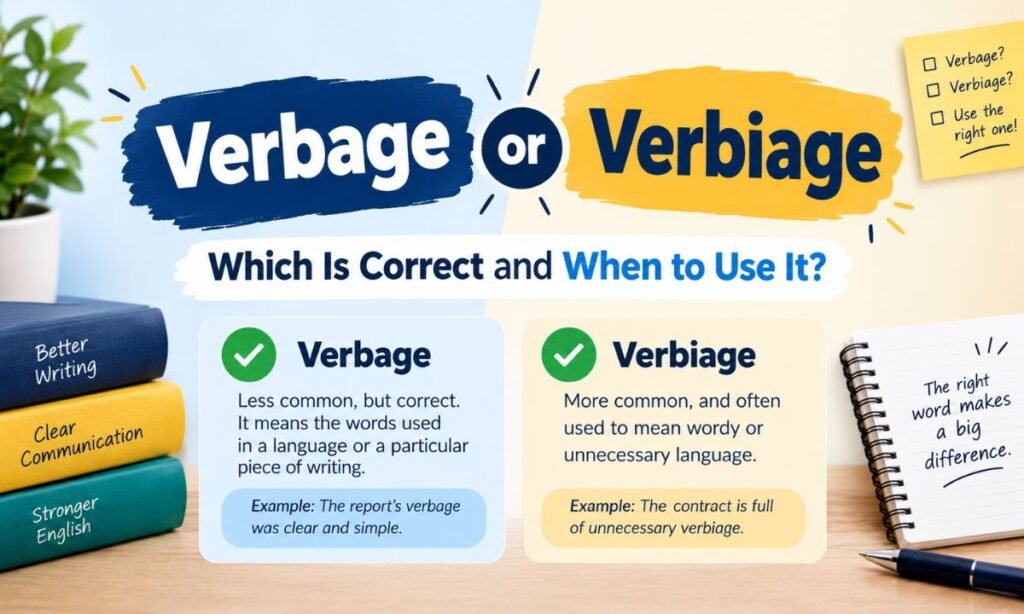

Verbiage is the correct spelling. “Verbage” is a common misspelling that mainstream dictionaries don’t list as standard English, so when you’re torn between verbage or verbiage, pick the one with the extra “i.”
This guide explains what the word means, where it came from, and how US and UK writers handle it. You’ll also get examples, memory tricks, and quick answers to the questions people ask most.
Verbiage (Correct Word)
It’s the standard spelling in American and British English alike. It’s a noun, and you say it in three syllables: VUR-bee-ij. Dictionaries list it as the main entry, with two related senses: wordiness, and the specific wording of a text. You’ll bump into both in daily reading, sometimes inside the same email thread.
Because it’s a noun, it’s rarely used with a plural. Most writers treat it like “information” or “language,” a mass term for a stretch of text.
Example: The manager cut half the verbiage from the report, and suddenly everyone understood it.
Verbage (Incorrect or Nonstandard)
It’s a nonstandard spelling, and most editors will mark it wrong. You’ll spot it in texts, quick posts, and voice-to-text slips. People write it because they say the word fast and swallow the middle syllable. The spelling follows the sloppy sound instead of the real word, which is why the slip is so easy to make.
Example: Wrong: The contract verbage confused me. Right: The contract verbiage confused me.
Key Difference
The gap is one letter, but that letter decides whether your spelling is standard. The right form has three syllables and a middle “i,” while the other has two and drops it. There’s no difference in meaning, either. One is the word, and the other is a typo that stuck around because it sounds close enough. That’s why proofreaders treat it as a pure spelling error, not a style choice. Nobody gets to argue that the shorter form is “just another way to write it.”
Example: Type verbage into any word processor and a red underline shows up within a second.
Verbage or Verbiage – Quick Answer
Use “verbiage.” It’s correct in every major variety of English, and no style guide treats the shorter form as a preferred option. There’s no gray area here. If you can’t point to the “i” in what you’ve typed, you’ve probably typed the wrong spelling, and a quick dictionary check will confirm it in seconds.
Example: Please review the wording on the signup page before we publish it.
What Does Verbiage Mean?
It means wording, especially wording that’s longer or more tangled than it needs to be. People also use it neutrally to describe the exact language of a document.
The first sense is older and a little critical, as if the writer padded things out. Think of a long paragraph that could’ve been a single sentence. The second shows up constantly at work, in phrases like “the policy wording.” Some editors still prefer plain “wording” for that neutral meaning, but dictionaries recognize both.
Writers in business, law, and tech lean on the neutral sense most. Think of app screens, contracts, and help pages where every line has to be approved.
Context usually tells you which one a writer intends. If the sentence complains about length, it’s the critical sense; if it talks about approving or editing text, it’s the neutral one.
Example: (Critical) Strip out the verbiage and the point gets clearer. (Neutral) The lawyer approved the final wording this morning.
The Origin of Verbage or Verbiage
The word was borrowed into English from French in the early 1700s, where the root idea was chattering or empty talk. Its deeper ancestor is the Latin verbum, meaning “word.”
That same root gives us verbal, verbose, and proverb. Each one keeps the “verb” start and a full vowel after it, so the spelling pattern is consistent across the whole family.
English speakers have used the word for roughly three centuries, and it has kept the same basic spelling the whole time. That stability is a good sign you’re looking at the standard form.
The shorter form has no comparable history. It’s best explained as a pronunciation slip, not an old variant with its own pedigree, and that’s one reason dictionary editors leave it out.
Example: If verbose feels natural to spell, verbiage should too, because they come from the same family tree.
British English vs American English Spelling
The word is spelled the same in British and American English. That makes it unusual, since plenty of other words split across the Atlantic. You don’t need to adjust anything for your audience. Pick the correct form once, and you’re covered in both places. That’s handy if you edit for international clients. One less word to track means one less spelling toggle in your style sheet.
Example: A London editor and a New York editor would both write verbiage.
Examples of Differences:
British and American spellings usually part ways in a few predictable patterns: -or/-our, -er/-re, and -ize/-ise. Our word doesn’t follow any of them.
- color (US) / colour (UK)
- center (US) / centre (UK)
- organize (US) / organise (UK)
- defense (US) / defence (UK)
Knowing these patterns helps you stay consistent across a document. It also shows you why a word with no regional split deserves one fixed spelling.
Example: Writers swap colour and color depending on the audience, but this word never changes.
Verbiage Comparison:
Side by side, the comparison is simple: both regions use the same standard spelling, and neither accepts the shorter one.
- US English: standard
- UK English: standard
- The shorter variant: nonstandard in both
If a style guide or editor in either country asks you to “correct the spelling,” they mean the middle “i” should be there. Nothing else about the word shifts.
Example: A British contract and an American one can both say, “the verbiage was updated.”
Which Spelling Should You Use?
Always use the standard spelling, no matter where your readers live. Regional rules only matter for words that actually have regional forms, and this one doesn’t.
The three audiences below show how that plays out in practice. Each one gets the same spelling, with a small note about tone.If you manage a team of writers, put this in your style guide once. It stops the same correction from showing up in every review.
Example: Whether you’re writing a UK blog or a US memo, the spelling stays the same.
US audience:
Use the full spelling. Editors working from standard American dictionaries will usually correct the shorter form on sight.
In the US, the word often sounds a little corporate. That’s a tone point, not a spelling one, so decide whether it fits your voice. Plenty of American editors prefer plainer words in public-facing copy.
Example: The HR team’s wording around remote work was updated, and it’s now much shorter.
UK/Commonwealth:
Use the same spelling here. Oxford and Cambridge references carry the identical form.
British readers sometimes hear the word as mildly dismissive, as if the text is padded. Choose it deliberately, especially in formal or official writing. In a report to a council or a board, a precise noun usually carries more weight.
Example: The council’s verbiage hid a very simple decision.
Global writing:
Stick with the standard spelling, but think about who’s reading. Non-native speakers may find “wording” or “language” easier to parse.
If your audience is international, plain vocabulary usually beats a fancy word. Clarity wins over cleverness every time.
Translation tools also handle everyday words better than rarer ones. That’s one more reason to keep things simple on global pages.
Example: On a global help page, “the wording” may land better than a heavier term.
Common Mistakes with Verbage or Verbiage
The most common mistake is dropping the middle “i.” A few smaller slips travel with it.
- Dropping the “i.” Typing the shorter form because it sounds like two syllables.
- Trusting voice dictation. Speech tools can produce the wrong spelling, so proofread.
- Using it for a single word. The word describes a body of text, not one term.
- Overdoing it in formal work. Heavy use can sound stuffy and vague.
- Treating it as a compliment. It often carries a hint of “too many words.”
Autocorrect can also work against you. Some tools won’t flag the shorter spelling at all if it’s been added to a personal dictionary by accident.
Most of these vanish with one careful proofreading pass. Reading the sentence aloud, slowly, usually catches the problem before anyone else does.
Example: Wrong: “That one verbage is confusing.” Right: “That sentence’s verbiage is confusing.”
Easy Ways to Remember the Right Spelling
Here’s the simplest trick: it’s a wordy word, so it gets a wordy spelling with an extra “i.” If it looks a little padded, you’ve got it right.
Here are a few more hooks you can try:
- Spot the “verb” at the start, then add “i” and “age.”
- Count the syllables on your fingers: ver-bi-age, three.
- Link it to verbose, which keeps its full vowel too.
Another habit that helps: every time you catch the slip in someone else’s draft, say the right spelling out loud once. Hearing it three syllables long trains your ear.
Pick whichever one sticks. Within a week or two, the right spelling will feel automatic.
Example: Think “verb + i + age” and you’ll land on the correct spelling every time.
Verbage or Verbiage in Everyday Examples
You’ll meet this word mostly in workplaces, newsrooms, and online feeds. The correct spelling looks the same in all of them.
Below are four everyday settings with sample lines you can borrow. Notice how the tone shifts from relaxed to formal, while the spelling stays put.
Example: “Can you tighten the wording before we send this?”
Emails
In emails, the word usually refers to the wording of a request, policy, or subject line. Keep it light and specific.
A short message with clear wording gets answered faster than a long one that circles the point. Busy readers reward brevity.
If you’re editing a team message, ask one question: does each sentence earn its place? Cut the ones that don’t.
Example: “I’ve updated the wording in section two. Let me know if it reads clearly.”
News Writing
News writers use it when quoting official language or describing a bill, rule, or statement. Editors often prefer concrete nouns, though.
When it does appear, it’s spelled the standard way, and reporters usually pair it with the document it refers to. That context keeps the meaning crisp.
Example: “Lawmakers disagreed over the verbiage of the amendment.”
Social Media
On social platforms, the shorter spelling turns up more often, mostly because people type quickly. It’s still a misspelling, even in a casual post.
A relaxed tone doesn’t change the spelling. A one-second glance can spare you an easy correction in the replies.
Brands especially should double-check. A public typo in a caption tends to get screenshotted faster than the actual message.
Example: “Love the new app, but the wording on the buttons is confusing.”
Formal Writing
In formal documents, the word is acceptable but not always ideal. Many careful writers swap in “language” or “wording” for precision.
If you do use it, make sure the spelling is exact. Typos stand out more in reports, proposals, and official letters.
Example: “The committee reviewed the language of the proposed bylaw.”
Better Alternatives to Verbiage
When the word sounds heavy, wording, phrasing, language, text, or copy usually does the job better. The right pick depends on what you’re describing.
- Wording: the exact words used in a sentence or document
- Phrasing: how an idea is put together
- Language: a general, formal term for how something is written
- Copy: marketing or web text
- Terminology: specialized terms in a field
Match the substitute to the job. If you’re talking about a slogan, “copy” fits; if you’re discussing a legal clause, “language” or “wording” is safer.
A precise alternative often sharpens the sentence. It also lets you save the original word for moments when you truly mean “too many words.”
Example: Instead of “Fix the verbiage,” try “Fix the phrasing in the second line.”
Verbage or Verbiage – Google Trends & Usage Data
Spelling pairs like this tend to follow one pattern in search data: the correct form dominates, and the misspelling holds a smaller share that rises when people check their spelling.
Exact numbers change by country and date, so check them yourself instead of trusting a stale figure. Open Google Trends, enter both spellings, and switch the region to compare the US, the UK, or worldwide.
Treat the results as relative interest, not raw search counts. That’s the right way to read any Trends chart.
It’s also worth watching for seasonal bumps. Spelling questions often rise during school terms and busy writing periods at work, then settle down again.
Example: Search “verbiage” next to its misspelling, then change the region and watch how the gap shifts.
Comparison Table: Verbage vs Verbiage
Here’s the quick reference. The first column is the correct word, and the second is the nonstandard spelling.
| Feature | Verbiage | Verbage |
|---|---|---|
| Status | Standard spelling | Nonstandard misspelling |
| Syllables | Three (VUR-bee-ij) | Two |
| US usage | Accepted | Marked as an error |
| UK usage | Accepted | Marked as an error |
| Dictionary listing | Yes | Not in mainstream entries |
| Safe for formal writing | Yes | No |
Use the table as a checklist during editing. If your draft matches the right-hand column, fix it.
It works well pinned beside your style guide or pasted into a team wiki, where quick answers save the most time.
Example: “The verbiage was cleaned up” passes any proofread, while the shorter spelling doesn’t.
Frequently Asked Questions
1. Is “verbage” ever correct?
No. It isn’t accepted as standard in mainstream dictionaries, so when the choice is verbage or verbiage, the longer spelling wins every time.
You might see the shorter form in casual writing, but frequent use doesn’t make it correct. Editors and dictionary publishers judge spelling by standard references, not by how often a typo appears.
Example: “That verbage is wrong” needs an “i” in the middle to be right.
2. What does “verbiage” mean?
It means wording, often wording that’s wordier than necessary. It can also refer to the specific language used in a document. Context tells you which sense is intended. Complaints about length point to the first meaning, while talk of approving or editing text points to the second.
Example: “Trim the verbiage” (too many words) versus “approve the wording” (the exact text).
3. Is “verbiage” formal or informal?
It’s neutral to mildly formal. It fits workplace writing, but it can sound stiff in casual conversation. Tone depends on the sentence around it, so a plain sentence keeps it from sounding pompous.
If you want a lighter tone, “wording” is easier. In a casual chat with friends, most people would simply say “the way it’s written.”
Example: “The language in the policy needs review” sounds natural in an office setting.
4. Why do people write “verbage”?
Because that’s how many people say it: quickly, with the middle syllable blurred. The spelling follows the sound. The confusion between verbage or verbiage lasts because the correct form looks longer than it sounds.
Example: Someone who hears “ver-bij” in speech may type the shorter version without thinking.
5. Is there a British spelling of “verbiage”?
No. British and American English use the same spelling, so there’s nothing to change for UK readers. If a UK editor flags the word, they’re asking about style, not spelling.
Example: A UK newspaper and a US newspaper would both print the same spelling.
Conclusion
Verbiage is the spelling to use, and the shorter form is the one to skip. The whole verbage or verbiage question comes down to a single letter sitting in the middle of the word. Keep the “verb” at the start, remember the extra “i,” and proofread once before you hit send. Do that and the spelling takes care of itself.