
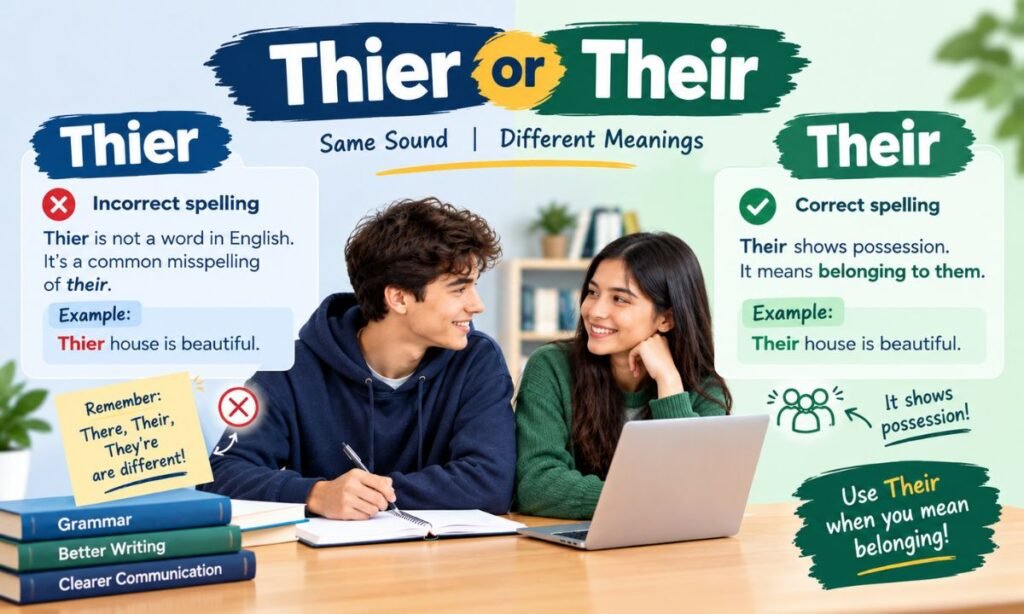

Thier or their? “Their” is the correct spelling, and “thier” is always a typo. There isn’t a single sentence where the second version works. I checked dictionaries, style guides, and everyday writing to back that up. Below, you’ll find simple rules, 100+ examples, and memory tricks that actually stick.
My Quick Answer
“Their” is correct. “Thier” isn’t a word in English, and no dictionary lists it as a variant. So when you’re stuck on thier or their, spell it t-h-e-i-r. Put the E before the I, and move on.
Example: The neighbors repainted their fence last weekend.
Why I Found “Their” Is the Only Correct Spelling
Every major dictionary, including Merriam-Webster, Oxford, and Cambridge, lists “their” and nothing else. “Thier” shows up nowhere as an accepted form. Your spell checker agrees. Type the wrong version into any word processor and you’ll get a red underline almost instantly. Autocorrect usually fixes it before you notice.
That’s the thing about thier or their: it’s not a style choice or a regional quirk. It’s a plain spelling mistake with one right answer.
Example: Wrong: “The team packed thier bags.” Right: “The team packed their bags.”
The “i Before e” Rule Myth
The “i before e” rule doesn’t help here. “Their” breaks it, which is exactly why so many people flip the letters.
You probably learned “i before e, except after c.” Sounds tidy. But English ignores it all the time: weird, seize, neither, and foreign all go the other way. So don’t trust the rhyme for this word. Treat “their” as one of the exceptions you simply memorize.
Example: Neither of their neighbors noticed the weird noise.
My Definition and Meaning Analysis
“Their” is a possessive determiner. It means “belonging to or connected with them.”
Merriam-Webster defines it as the possessive form of “they,” and that’s the easiest way to think about it. If “they” owns it, it’s their something.
I found four main uses, and they cover nearly everything you’ll write.
Example: They love their new apartment.
1. Showing Ownership
Use “their” when a group owns or holds something. It’s the most common job the word does.
Example: The twins sold their bikes to pay for the trip.
2. Showing Association
“Their” also links people to places, roles, or relationships, even when nothing is literally owned.
You don’t own your hometown or your teacher, but you still say “their hometown” and “their teacher.”
Example: The students waved goodbye to their teacher.
3. Singular “Their”
“Their” can refer to one person when the gender is unknown or irrelevant. It’s been used this way for centuries.
Example: Someone left their umbrella in the lobby.
4. With Titles and Roles
“Their” attaches to job titles, ranks, and formal honorifics. Capitalize it only when it begins a formal title.
In everyday writing, it’s just “their manager” or “their coach.” Formal royal titles are the one place you’ll see a capital T.
Example: The interns thanked their supervisor, and Their Majesties arrived shortly after.
Why “Thier” Is Always Wrong
“Thier” is wrong in every context: casual texts, essays, emails, and legal papers. It has no meaning, no history, and no valid use.
The only time you’ll see it is inside someone’s name or in a deliberate quote that preserves a typo. Otherwise, it’s a slip.
Example: A resume line that says “I improved thier workflow” reads as careless. “I improved their workflow” reads as clean.
100+ Real-World Examples I Collected
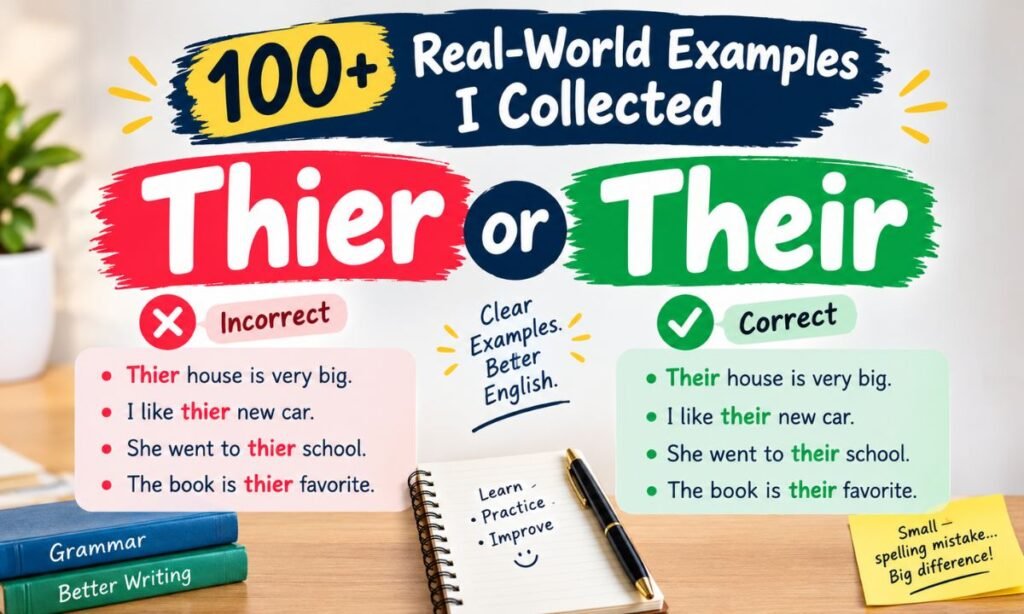
I grouped the examples by where you’ll actually use the word. Every correct sentence uses “their,” and the last two groups show what to avoid.
Example: The groups below start with plain conversation and end with the exact mistakes to catch.
Everyday Conversation Examples
“Their” shows up in casual talk more than anywhere else. These sentences sound the way people really speak.
Example:
- They forgot their keys again.
- The kids are building their own fort.
- My cousins love their new puppy.
- Everyone grabbed their coats and left.
- The neighbors are proud of their garden.
- They said their flight got delayed.
- The band played their best song first.
- My parents sold their old car.
- Both girls finished their homework early.
- The waiters wiped their tables clean.
- People posted their photos online.
- The cats knocked over their water bowl.
- They invited us to their place for dinner.
- The couple renewed their vows in Lisbon.
- Nobody wanted to share their secret.
Business and Professional Examples
At work, “their” usually points to clients, teams, or companies. Clear writing here builds trust fast.
Example:
- The clients approved their budget on Monday.
- Our partners shared their quarterly results.
- The sales team hit their targets early.
- Vendors must submit their invoices by Friday.
- The board reviewed their strategy together.
- Each manager presented their department’s goals.
- Competitors changed their pricing last month.
- The startup raised their seed round in March.
- Employees can update their details in the portal.
- The auditors delivered their report on time.
- Investors withdrew their offer after the call.
- Suppliers confirmed their delivery dates.
- The consultants explained their recommendations clearly.
- Both firms signed their agreement yesterday.
- Customers love their new return policy.
Academic and Educational Examples
In school and research writing, a wrong spelling can cost marks. These examples cover essays, labs, and classrooms.
Example:
- The researchers published their findings in June.
- Students must cite their sources properly.
- The professor praised their thesis statements.
- Authors often explain their methods in the abstract.
- The class submitted their essays online.
- Scientists tested their hypothesis twice.
- The graduates received their diplomas outdoors.
- Teachers adjusted their lesson plans after the quiz.
- The panel defended their conclusions confidently.
- Each student read their paragraph aloud.
- The historians disputed their earlier timeline.
- Undergraduates chose their majors in second year.
- The committee shared their feedback in writing.
- Writers revise their drafts before submitting.
- The lab group recorded their results carefully.
Technology and Digital Examples
Tech writing leans on “their” when talking about users, apps, and devices. It’s everywhere in help docs.
Example:
- Users can reset their passwords anytime.
- The developers fixed their bug before launch.
- Apps often track their users’ habits.
- Gamers upgraded their graphics cards.
- The company updated their privacy settings.
- Subscribers can cancel their plans online.
- Bloggers promote their posts on social media.
- Hackers exploited their outdated software.
- Streamers announced their schedule on Sunday.
- Teams store their files in the cloud.
- Customers rated their support experience.
- The engineers documented their code well.
- Viewers shared their reactions in the comments.
- Phone makers revealed their latest models.
- Admins reviewed their access logs.
Sports and Athletics Examples
Sports commentary uses “their” nonstop, since teams and players are plural subjects.
Example:
- The team celebrated their championship win.
- Runners checked their pace every mile.
- The goalkeepers practiced their dives.
- Fans cheered for their favorite club.
- The swimmers broke their personal records.
- Coaches changed their lineup at halftime.
- The cyclists climbed their final hill.
- Players thanked their supporters afterward.
- The rivals shook hands after their match.
- Both squads wore their away kits.
- The gymnasts stuck their landings perfectly.
- Cricketers adjusted their helmets before batting.
Family and Relationships Examples
Family talk is full of ownership words, so this group gets heavy use.
Example:
- My grandparents celebrated their anniversary.
- The siblings cleaned their rooms together.
- Her friends brought their guitars.
- The twins wore their matching jackets.
- Aunts and uncles shared their old photos.
- The kids hugged their mother tightly.
- Both brothers love their grandfather’s stories.
- The parents packed their children’s lunches.
- My cousins finished their wedding plans.
- The newlyweds thanked their families.
- Roommates split their rent evenly.
- The teens argued about their curfew.
Common Mistakes I Found
Most errors aren’t “thier.” They’re the mix-ups between “their,” “there,” and “they’re.” Here are the ones I saw most often, with fixes.
Example:
- Wrong: “Put it over their.” Right: “Put it over there.”
- Wrong: “There going to be late.” Right: “They’re going to be late.”
- Wrong: “They’re car broke down.” Right: “Their car broke down.”
- Wrong: “Their is a problem.” Right: “There is a problem.”
- Wrong: “The dog wagged it’s tail, their happy.” Right: “The dog wagged its tail. They’re happy.”
- Wrong: “Is this book their’s?” Right: “Is this book theirs?”
- Wrong: “Their going home.” Right: “They’re going home.”
- Wrong: “Leave you’re shoes over their.” Right: “Leave your shoes over there.”
Incorrect Spelling Examples
These show the actual “thier” typo in action. Each one has a quick fix.
Example:
- Wrong: thier house. Right: their house.
- Wrong: thier friends. Right: their friends.
- Wrong: thier decision. Right: their decision.
- Wrong: thier own way. Right: their own way.
- Wrong: thier team. Right: their team.
- Wrong: thier idea. Right: their idea.
- Wrong: thier money. Right: their money.
- Wrong: thier choice. Right: their choice.
- Wrong: thier best work. Right: their best work.
- Wrong: thier future. Right: their future.
Thier vs Their: My Complete Comparison Table
The table says it all: “their” is a real word with real uses, and “thier” is a typo with none. Use it as a quick reference.
| Feature | Their | Thier |
|---|---|---|
| Correct spelling? | Yes | No |
| Part of speech | Possessive determiner | None |
| Meaning | Belonging to them | No meaning |
| In dictionaries? | Yes | No |
| Spell checker | Passes | Flagged |
| Fix needed | None | Swap to “their” |
Example: “Thier coach called a timeout” becomes “Their coach called a timeout.”
My Memory Tricks and Tips
The best fix for thier vs their is a trick you’ll actually remember. I tested four, and each one works for a different kind of learner.
Example: If tip one doesn’t stick, tip two probably will.
Tip #1: The E-I Order Rule
Remember that “their” has E before I, just like the order in “heir.” The letters sit in alphabetical order: E, then I.
That’s a handy pattern. E comes before I in the alphabet, and E comes before I in “their.”
Example: Spell the word out loud once: t-h-e-i-r, their keys.
Tip #2: The “He” Connection
Look inside the word and you’ll find “he” and “heir.” An heir is someone who inherits things, which is ownership in a nutshell.
Example: The heirs claimed their inheritance.
Tip #3: The Rhyme Method
A tiny rhyme can lock the order into your head. Here’s one I use: “E comes first when things belong; put the I first and you’re wrong.”
Example: The campers packed their tents, E first, no wrong.
Tip #4: The Word Association
Link “their” to “they.” Both start with “the,” and “their” is simply the possessive of “they.”
Example: They won, and their fans cheered.
Understanding Possessive Pronouns
Possessive pronouns and determiners show who owns something. English has a matching pair for each person: my/mine, your/yours, her/hers, our/ours, and their/theirs.
The first word in each pair comes before a noun. The second one stands alone, so it never needs a noun after it.
Example: That’s their house, and the blue one is theirs.
Their vs Theirs
“Their” goes before a noun, and “theirs” replaces the noun entirely. Neither one takes an apostrophe.
A quick test: if there’s a noun right after the word, use “their.” If the sentence ends or pauses, use “theirs.”
Example: Their dog is friendly, but ours is shy, and the red leash is theirs.
Their vs There vs They’re: The Difference That Trips Everyone Up
“Their” shows ownership, “there” points to a place, and “they’re” means “they are.” They sound identical, so the ear won’t help.
Try these swaps. Replace the word with “they are.” If it fits, use “they’re.” Replace it with “here.” If it fits, use “there.” Otherwise, you want “their.”
Most thier or their confusion actually starts here, because people already treat these three as interchangeable.
Example: They’re parking their car over there.
Singular “Their” – Modern Usage
Yes, you can use “their” for one person. It’s been in English since at least the 1300s, and today’s major style guides accept it.
Merriam-Webster named “they” its 2019 Word of the Year, partly for this singular use. The APA and Chicago style guides both endorse it, and the AP Stylebook has accepted it too.
Example: Each guest should bring their own chair.
Why This Matters
Singular “their” lets you avoid clunky phrasing like “his or her.” It keeps sentences smooth and writing inclusive.
Example: A good writer knows their audience.
Common Phrases with “Their”
Certain phrases pair with “their” so often they’re nearly fixed. Knowing them helps both spelling and flow.
Example: The twins did it their way.
On their own
This phrase means independently or without help. Example: The teens decided to travel on their own.
In their way
It means blocking someone’s path, literally or figuratively.
Example: Nothing stood in their way after the permit came through.
Of their own
It points to something that belongs to the subject alone, often with a personal touch.
Example: The kittens now have a bed of their own.
To their name
This one describes what someone has achieved or owns. It’s popular in sports and business writing.
Example: The club has five titles to their name.
By themselves
Here the word shifts to “themselves,” the reflexive form. It means alone or without help, and it’s the cousin of “their” you’ll often swap in.
Example: The kids built the shelf by themselves.
For their sake
It means for the benefit of those people. The phrase carries a caring tone.
Example: We moved closer for their sake.
Where “Their” Comes From (Quick History)
“Their” came into English from Old Norse “þeirra,” and it began to replace the older English forms around the 13th century. Vikings brought it over, and it stuck.
Before that, English speakers used forms like “hira” and “heora” for the same job. Spelling stayed loose through Middle English, with versions like “theyr” and “thair” popping up in manuscripts.
Printing and standardized dictionaries eventually settled the form we use now. That history helps explain why “thier” feels plausible, even though it never was.
Example: A medieval scribe might write “theyr,” but nobody ever wrote “thier” as the standard.
Why This Mistake Is So Common
Most people type “thier” because their fingers swap two letters. It’s a transposition error, not a lack of knowledge.
Add in the misleading “i before e” rule and the three-way homophone problem, and the slip becomes almost predictable.
Example: Someone who knows the spelling perfectly can still type “thier” at 80 words per minute.
My Research Finding
What I kept noticing was simple: the mistake looks like muscle memory, not ignorance. People type the same wrong order repeatedly because their hands have learned it.
Example: After two weeks of the rhyme method, a writer I know stopped making the swap entirely.
Professional Context Examples
In professional writing, one tiny typo can undermine an otherwise strong document. Here’s how “their” appears in four formal settings.
Example: Reliable writing starts with spelling their correctly every time.
Legal Documents
Legal writing needs exact wording, so “their” must be spelled right and used with a clear antecedent. Vague pronouns can cause real disputes.
Example: The tenants shall return their keys to the landlord by the end of the lease.
Medical Records
Clinical notes use “their” often, especially for patients whose gender isn’t specified. Accuracy keeps records clean and professional.
Example: The patient reported that their symptoms improved after treatment.
Business Communications
Emails, proposals, and reports all rely on “their” to refer to clients and teams. A wrong spelling here hurts credibility.
Example: Please confirm that the clients have received their contracts.
Academic Writing
Papers and theses call for a careful, consistent tone. Proofreading for homophones is essential before submission.
Example: The authors acknowledged their funding sources in the final section.
Frequently Asked Questions
Is it “thier” or “their”?
It’s “their.” “Thier” is always a misspelling. Whenever you’re unsure about thier or their, go with E before I.
Example: The players left their gear on the bench.
Why is it spelled “their” not “thier”?
Because the word came from Old Norse and settled into English with E before I. There’s no spelling rule behind it, just usage and history.
Example: English spelling is full of oddities, and their is one of them.
What does “their” mean?
“Their” means belonging to or associated with them. It’s the possessive form of “they” and works for both plural and singular subjects.
Example: The students handed in their papers.
Is “thier” ever a correct spelling?
No. It’s not a recognized word, and no style guide treats it as acceptable. The only exceptions are names or direct quotes that keep an original typo.
Example: “Their proposal was approved,” not “thier proposal.”
How do I remember to spell “their” correctly?
Use a quick trick. Remember the “heir” hiding inside the word, or repeat the rhyme: E first when things belong.
Example: The heir kept their promise.
Why do people misspell “their” as “thier”?
Mostly because of fast typing and letter swaps. The “i before e” rule adds confusion, and the sound-alike words “there” and “they’re” don’t help.
Example: A tired typist may write “thier” even when they know the right spelling.
What’s the difference between their, there, and they’re?
“Their” shows ownership, “there” shows place, and “they’re” is short for “they are.” Swapping in “they are” or “here” is the fastest test.
Example: They’re leaving their bags over there.
Wrapping Up: Their Wins Every Time
Thier or their isn’t a real debate. “Their” is the only correct spelling, and the other version is always a typo. Keep the E before I, lean on the “heir” trick, and check your homophones before you hit send. That’s all it takes.