
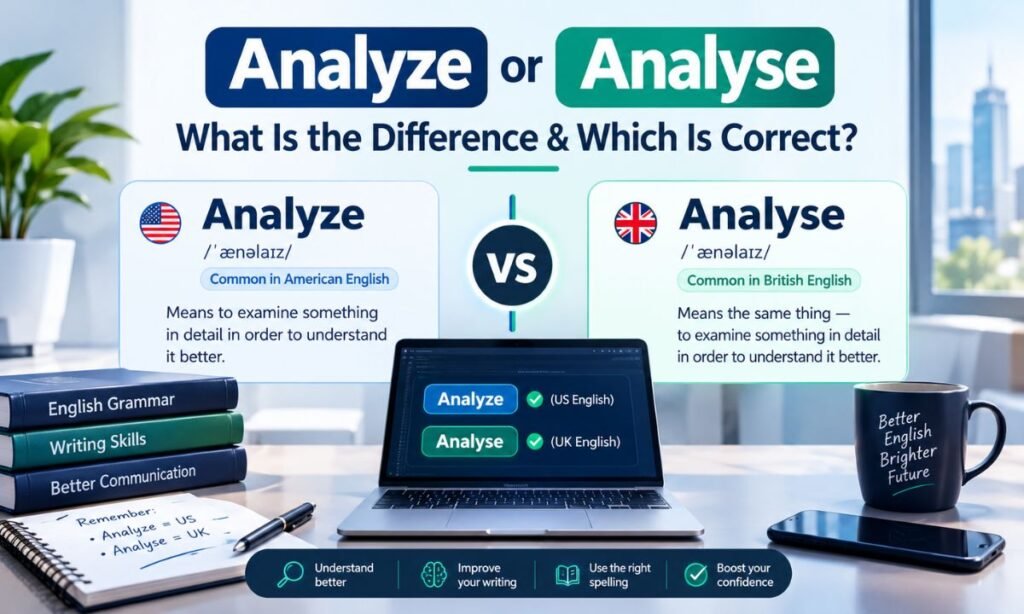

Analyze is the American spelling, and analyse is the British one. Both mean exactly the same thing, so neither is wrong. The real choice depends on who’s reading your work. This guide shows you how to pick between analyze or analyse, with clear rules, real examples, and a short quiz at the end.
Comparison Overview
Analyze and analyse are two spellings of one verb, and only the region changes. Americans and Canadians write analyze, while the UK, Australia, India and Pakistan write analyse.
| Feature | Analyze | Analyse |
|---|---|---|
| Dialect | American, Canadian | British, Commonwealth |
| Meaning | Examine in detail | Examine in detail |
| Verb forms | analyzes, analyzed, analyzing | analyses, analysed, analysing |
| Tool or device | analyzer | analyser |
| Noun | analysis | analysis |
Pronunciation doesn’t change either. Both are said AN-uh-lyze, so this is purely a spelling question.
That’s good news for learners. You don’t need two vocabularies, only one habit: decide on a spelling and carry it through the page.
Example: “Please analyze the data” in Chicago becomes “Please analyse the data” in Manchester. Same request, one letter swapped.
Definition of Analyze
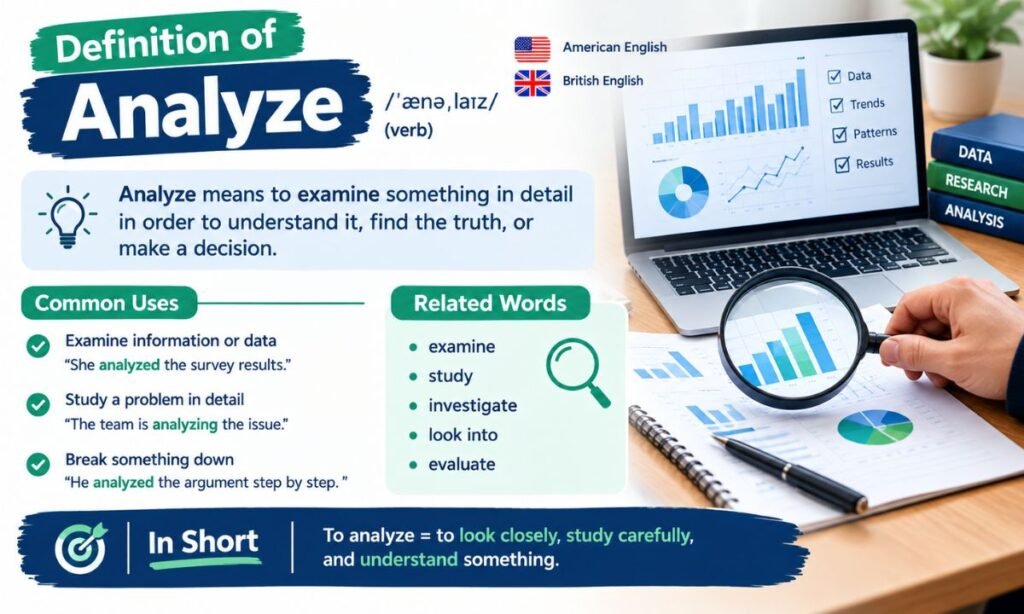
Analyze means to break something into parts so you can understand how it works. It’s the standard spelling in American and Canadian English.
The word comes from the Greek analusis, meaning “a loosening”. Picture untying a knot to see how it was tied. That’s what scientists, editors and marketers do when they analyze samples, sentences or sales figures.
Merriam-Webster lists analyze as the main entry and treats analyse as the British variant.
The verb travels well across fields. Chemists analyze compounds, psychologists analyze behavior, and coaches analyze game footage. The sense stays the same: take it apart, then explain it.
Example: Our marketing team will analyze last quarter’s email results on Monday.
Definition of Analyse
Analyse is the same verb, spelled the British way. You’ll see it across the UK, Australia, New Zealand, Ireland, South Africa, India and Pakistan.
Cambridge Dictionary labels analyse as the UK form and analyze as the US form. The spelling keeps its “s”, so it sits neatly beside the noun analysis. For many writers, that visual link makes analyse feel natural.
It’s also the form you’ll meet in most Commonwealth schools, so students in Delhi, Dhaka and Nairobi usually learn it first.
Example: The inspector will analyse the bridge’s load records before signing off.
Main Differences Between Analyze and Analyse
The only real difference is one letter: z in American spelling, s in British. Meaning, grammar and pronunciation stay identical.
What shifts is the reader’s reaction. A British reader may take “analyzed” for a typo, and an American reader may flag “analysed” the same way. Neither reaction is fair, but both happen, and first impressions count in formal writing.
The split runs through every related form: analyzes/analyses, analyzed/analysed, analyzing/analysing. The noun analysis stays untouched.
The same split shows up in a small family of verbs that share the Greek lysis root. Americans write paralyze, catalyze and dialyze, while British writers use paralyse, catalyse and dialyse. Once you notice the pattern, you only have to remember it once.
Example: American: “She analyzed the contract.” British: “She analysed the contract.”
Analyze vs Analyse by Country
The United States and Canada use analyze. The UK, Australia, India and Pakistan use analyse.
- United States: analyze
- Canada: analyze
- United Kingdom: analyse
- Australia: analyse
- India: analyse (American forms appear in tech writing)
- Pakistan: analyse (same pattern as India)
Canada catches people off guard. Canadian English keeps British spellings like “colour” but uses -ize verbs, so analyze is standard there.
India and Pakistan inherited British spelling through their education systems, so analyse dominates textbooks, newspapers and exam papers. New Zealand, Ireland and South Africa lean the same way.
Example: A student in Islamabad writing a thesis would normally type “we analysed the results,” while a student in Boston would type “we analyzed the results.”
Grammar Guide
Grammar works the same in both spellings. Analyze and analyse are regular transitive verbs, which means they need an object: you analyze something.
Both follow the standard -ed and -ing patterns, so once you choose a spelling, the rest of the word family follows.
They also pair with the same everyday partners. People analyze data, trends, results, texts and risks, and the matching noun phrase is always “analysis of” something.
Example: “We analyse prices” works. “We analyse” alone sounds unfinished.
How each term is used in sentences
Both verbs follow the pattern subject + verb + object. You can add a purpose or method afterwards, like “for errors” or “using Excel”.
They also work in the passive voice and in questions. You’ll often see them followed by “how”, “why” or “whether”.
Example: Engineers analyse how the bridge responds to wind, and the results are analysed twice before publication.
Word forms: analysis, analyst, analyzing/analysing, analyzed/analysed
Only the verb forms change by region. Analysis, analyst and analytical are spelled the same everywhere.
Watch the plural noun analyses. It’s said “uh-NAL-uh-seez”, yet it also happens to be the British third-person verb (she analyses), which is said differently. Context makes the meaning clear. The device noun splits too: analyzer in the US, analyser in the UK.
Example: “Two analyses support the claim” uses the noun, while “She analyses claims for a living” uses the verb.
Analisa atau analisis in Indonesia

Bentuk baku yang benar adalah analisis, bukan analisa. Menurut Kamus Besar Bahasa Indonesia (KBBI), analisis adalah kata baku, sedangkan analisa dianggap tidak baku meski sangat sering dipakai.
Banyak orang mencari “analisa atau analisis, mana yang benar?” karena keduanya terdengar wajar. Dalam percakapan sehari-hari, analisa memang lebih sering terdengar, tetapi untuk tulisan resmi, pilih analisis.
Pertanyaan lain yang sering dicari biasanya seputar kata turunannya. Tabel berikut merangkum bentuk yang tepat:
| Kurang tepat | Baku |
|---|---|
| analisa data | analisis data |
| menganalisa | menganalisis |
| dianalisa | dianalisis |
| analisa SWOT | analisis SWOT |
| analisa saham | analisis saham |
Untuk orang yang melakukan pekerjaan ini, kata yang benar adalah analis (misalnya analis keuangan). Kata sifatnya adalah analitis, seperti dalam “berpikir analitis”.
Ada trik mudah untuk mengingatnya. Kata serapan dari bahasa Yunani yang berakhiran -sis selalu mempertahankan akhiran itu: analisis, sintesis, hipotesis, diagnosis, tesis. Jadi, analisis sejajar dengan semuanya.
Satu kesalahan penulisan yang juga sering muncul adalah memisahkan awalan “di”. Tulis “dianalisis”, bukan “di analisis”, karena “di-” di sini adalah awalan pembentuk kata kerja pasif.
Gunakan analisis untuk skripsi, tesis, jurnal, laporan kerja, dan surat resmi. Analisa masih bisa muncul dalam obrolan santai atau media sosial, tetapi hindari di tulisan formal.
Perbandingannya dengan bahasa Inggris menarik. Di sana, analyze dan analyse sama-sama benar di wilayah yang berbeda. Di Indonesia, hanya satu bentuk yang baku. Karena analisis mirip dengan kata Inggris analysis, bentuk ini juga mudah diingat.
Contoh: Mahasiswa itu menganalisis data penelitian selama dua minggu, lalu hasil analisisnya dipresentasikan di depan dosen. (“The student examined the research data for two weeks, then presented the results to the lecturer.”)
Common mistakes learners make
Mixing spellings and misspelling the noun are the two big ones. Here’s what shows up most often:
- Using both spellings in one document, like “analyzed” in paragraph one and “analysing” in paragraph four.
- Writing “analize” or “analyce”. The “y” is easy to drop.
- Using “analyse” as a noun. The noun is analysis, and “analysys” is a common typo.
- Assuming every British -ise rule applies. Oxford style uses -ize elsewhere but still keeps analyse.
- Trusting a spell-checker that’s set to the wrong language.
- Reading “analyses” as a plural noun every time. In British writing it can also be a verb.
Example: Wrong: “We finished an analyse of the data.” Right: “We finished an analysis of the data.”
Simple rules to remember
Match the spelling to your reader, then stay consistent. That’s the whole rulebook.
- American or Canadian reader: use analyze.
- British or Commonwealth reader: use analyse.
- A style guide or teacher says otherwise: follow it.
- The noun is always analysis.
Example: Writing for a Toronto magazine? Go with analyze. Writing for a Sydney newspaper? Go with analyse.
Quick tips for writing and speaking
When you speak, you don’t need to choose, because both spellings sound the same. When you write, set your tools up before you type.
Switch your word processor to English (US) or English (UK). Run a find-and-replace before you submit. If you’re unsure, check a recent article from your target audience and match its spelling.
Phone keyboards deserve a mention. Autocorrect often follows your device’s region, so it may quietly flip your spelling halfway through a message.
For speaking, stress the first syllable: AN-uh-lyze.
Example: Before sending a report, search the file for “yze” and “yse” to catch stray spellings.
When to Use Each One
Use analyze for American and Canadian audiences, and analyse for British and Commonwealth ones. Your reader’s region decides.
Reach for analyze in these cases:
- US university papers and journals, including APA-style work
- Canadian business and government writing
- Software with the language set to English (US)
- Content aimed at an American audience
Reach for analyse in these cases:
- UK, Australian and New Zealand academic writing
- Dissertations at Commonwealth universities, including those in India and Pakistan
- British news and publishing
- Content for a UK or South Asian readership
Writing for readers in several countries at once? Choose the spelling that matches your own English and keep it steady. Readers forgive a regional choice far more easily than an inconsistent one.
Example: A Pakistani business school’s case study would typically say “analyse,” while a US management journal would print “analyze.”
When NOT to Use Each One
Don’t use analyze where British spelling is expected, and don’t use analyse where American spelling is required. A mismatch rarely breaks meaning, but it can cost marks or credibility.
Don’t change the spelling inside direct quotes, book titles or brand names either. Keep them as the source wrote them. And never use either spelling as a noun, because that job belongs to analysis.
Example: If a UK writer quotes an American source that says “analyzed,” the quote keeps its z even inside a British article.
Which One to Use (Decision Guide)
Choose the spelling your reader or institution expects. If nobody has told you, pick your own region’s spelling and stick with it.
- Check for a style guide, rubric or instructor. Follow it.
- If there isn’t one, look at your audience’s country.
- Writing for a mixed global audience? Pick the spelling you know best.
- Set your spell-checker to match.
- Do a final find-and-replace.
Don’t agonize over it. Consistency beats the choice itself. Whether you land on analyse or analyze, the winning move is to decide once and apply it everywhere.
If a client asks for “international English,” ask which spelling they mean. The phrase has no fixed standard, so a quick question saves a round of edits.
Example: A freelancer in Lahore writing for a Texas startup should use analyze, because the readers are American.
Real-World Practical Examples
You’ll spot these spellings in business reports, lab notes, exam questions and news stories. The sentences below are grouped by spelling, so you can compare them side by side and borrow the patterns for your own writing.
Example: A job post in London might ask applicants to “analyse market trends,” while one in Denver says “analyze market trends.”
Analyze Examples
American and Canadian writing uses analyze in business, science, school and tech settings. Here are four.
- Business: “The finance team will analyze churn every quarter.”
- Science: “Researchers analyzed 400 blood samples.”
- Education: “Students must analyze the poem’s tone.”
- Technology: “The tool analyzes page speed in seconds.”
Example: “Please analyze the attached spreadsheet and send me three takeaways by noon.”
Analyse Examples
British and Commonwealth writing uses analyse across the same kinds of settings. Here are four more.
- Government: “Officials will analyse the figures before the budget is announced.”
- Health: “Doctors analysed the test results overnight.”
- Education: “Candidates are asked to analyse the author’s argument.”
- Marketing: “We’ll analyse your website traffic and suggest fixes.”
Example: “Please analyse the attached spreadsheet and send me three takeaways by noon.”
Self-Assessment (Fill in the Blanks)
Fill each blank with the right word for the audience described. Answers follow in the next section.
- A New York agency will ______ campaign data on Friday. (American)
- A London law firm will ______ the contract clause by clause. (British)
- Our Sydney team ______ customer feedback every week. (British, present tense)
- A Toronto researcher ______ the survey results last month. (Canadian, past tense)
- In this chapter of a Pakistani university thesis, we ______ the interview data. (British convention)
- The ______ of the results took a full week. (noun)
Example: A Denver startup will ______ user feedback. The answer is analyze.
Answers
Here’s the key, with a short reason for each one. Check your own answers before reading the explanations.
- analyze: American spelling.
- analyse: British spelling.
- analyses: British third-person verb form.
- analyzed: Canadian English uses the -yze pattern.
- analyse: British convention in Pakistani academic writing.
- analysis: the noun is the same in every variety.
Five or six right means you’ve got it. Fewer? Re-read the simple rules above and try again.
Example: If you picked “analysed” for number four, remember that Canada follows the American pattern.
Frequently Asked Questions
What is the difference between analyze and analyse?
The only difference is spelling: analyze is American, analyse is British. Meaning and pronunciation are identical. If you’re torn between analyze or analyse, let your audience’s country decide.
Example: “Analyze the graph” in the US and “Analyse the graph” in the UK ask for exactly the same thing.
Is analyze correct in British English, and is analyse correct in American English?
Not as the standard form in either case. Each spelling will be understood, but it can look like an error outside its home region.
Most UK publications use analyse, and most American ones use analyze.
Example: A US teacher might circle “analysed” in an essay, and a UK teacher might circle “analyzed.”
Do analyze and analyse have the same meaning?
Yes. Both mean to examine something closely by breaking it into parts. Grammar and pronunciation match too.
You can swap in near-synonyms like examine, evaluate, study or break down, but none of them replace the exact sense of taking something apart to see how it works.
Example: “The doctor will analyze the results” and “The doctor will analyse the results” describe one action.
Why do British and American English spell it differently?
The word came into English from Greek analusis by way of French. Writers later respelled it with -yze, modelling it on verbs that end in -ize, and American dictionaries standardized that form. British writers kept -yse.
That’s also why Oxford style, which prefers -ize in words like organize, still writes analyse. The Greek root is lysis, not the -izo ending.
Example: Oxford style writes “organize” but “analyse,” “paralyse” and “catalyse.”
Which spelling should I use in exams?
Follow the exam’s own instructions first. IELTS accepts either British or American spelling as long as you stay consistent. For school and university papers, use whatever your institution teaches.
Example: An IELTS candidate who writes “analyse” in Task 1 should keep British spellings like “colour” and “behaviour” in Task 2.
Can I mix analyze and analyse in one document?
No. Pick one and keep it throughout, because mixed spelling looks careless. The only exceptions are direct quotes, titles and names.
If you collaborate with writers from other countries, agree on one spelling at the start. Otherwise, run a final pass and fix every instance so the whole file matches.
Example: A report with “analyzed” on page one and “analysing” on page five will look inconsistent to an editor.
How can I remember the correct spelling easily?
Link the verb to the noun. Analysis keeps its s in every country, so analyse is its closest cousin, and Americans swapped in the z for the verb only.
The noun is analysis in both varieties. Online, analyze tends to appear more often because of the size of the US audience, but analyse dominates in the UK, Australia and South Asia. Audience should decide, not frequency.
Example: Analysis, analyse: same s, same family.
Conclusion
Analyze or analyse? Both are correct, and the difference comes down to geography. Use analyze for American and Canadian readers, and analyse for British and Commonwealth ones. Pick a spelling, set your spell-checker, and stay consistent from the first line to the last. That habit matters more than which side you choose.