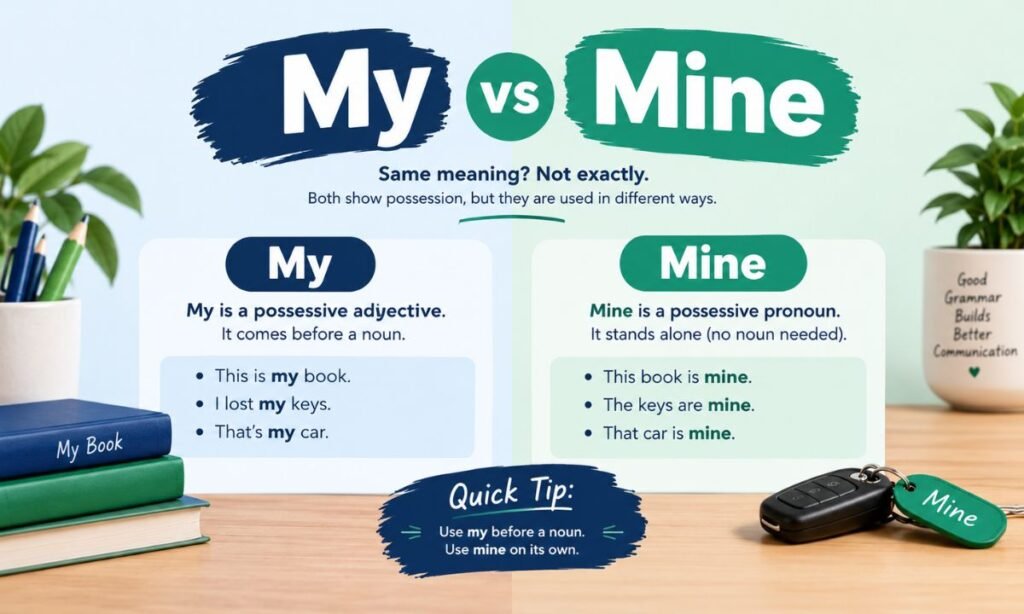

Read these two lines: “This is my pen.” “This pen is mine.” Both are correct, and both tell the listener the pen belongs to you. Swap the words, though, and you get “This is mine pen” or “This pen is my.” Something sounds wrong straight away.
The difference between my and mine comes down to one question: is there a noun after the word? If a noun follows, use my. If nothing follows, use mine. That one test solves most cases. This guide shows how it works, where people slip, and how to practise until it feels automatic.
You will find a comparison table, clear definitions, grammar rules, common errors, a decision guide, real examples, a short quiz with answers, and a FAQ section. It suits English learners, teachers, and anyone polishing an email.
Comparison Overview
Both words are first person singular possessives. They show that something belongs to “I”, meaning the speaker or writer. They just do different jobs in a sentence.
| Feature | My | Mine |
|---|---|---|
| Part of speech | Possessive adjective (determiner) | Possessive pronoun |
| Needs a noun after it? | Yes | No |
| Typical position | Before a noun | After a verb or preposition, or as a subject on its own |
| Example | This is my house. | This house is mine. |
| Can stand alone? | No | Yes |
| Matching form for “you” | your | yours |
Quick memory line: My needs a noun. Mine does not.
Definition of My
My is a possessive adjective. Many modern grammar books call it a possessive determiner, because it works like the or a. It introduces a noun and tells us which one is meant.
Its job is simple. It sits directly in front of a noun or noun phrase and shows that the noun belongs to, or is linked with, the speaker.
- my phone (ownership)
- my sister (relationship)
- my opinion (a view the speaker holds)
- my flight (something assigned to the speaker)
So my does not always mean legal ownership. You can have “my teacher” without owning her. The word only signals a connection.
My works before singular nouns (my dog), plural nouns (my keys), and uncountable nouns (my luggage). It can also come before an adjective: “my new laptop.” Add own for emphasis: “my own idea.”
One firm rule applies. My cannot stand by itself. “That bag is my” feels unfinished because the listener is waiting for a noun.
Definition of Mine
Mine is a possessive pronoun, sometimes called an independent possessive. It takes the place of “my plus a noun,” so you don’t have to repeat the noun.
“Your idea is good, but my idea is better” becomes “Your idea is good, but mine is better.” The noun idea is already understood, so it drops out.
Mine can act as:
- a subject: “Mine arrived first.”
- an object: “You can borrow mine.”
- a complement after a linking verb: “The blue one is mine.”
- the object of a preposition: “She sat next to mine.”
It also appears in the double possessive: “a friend of mine,” “a neighbour of mine.” This pattern is fully standard. “A friend of my” is the error.
Two side notes. First, mine has an unrelated meaning as a noun and verb: a coal mine, a land mine, to mine for gold. Context tells you which one you are reading. Second, older English put mine before vowels, as in “mine eyes” or “mine own.” You will still meet that in poetry and hymns, but modern usage sticks with my.
Main Differences Between My and Mine
| Point | My | Mine |
|---|---|---|
| Word class | Possessive adjective / determiner | Possessive pronoun |
| Function | Specifies a noun | Replaces a noun phrase |
| Position | Always before a noun | Never before a noun |
| Standalone use | Not possible | Possible |
| As a sentence opener | “My bike is new.” | “Mine is new.” |
| At the end of a sentence | No | Yes: “That seat is mine.” |
| Parallel forms | your, her, our, their | yours, hers, ours, theirs |
| Apostrophe | Never | Never |
The last two rows matter. Neither word takes an apostrophe, and each has a partner in the other persons. If you know your and yours, you already know the pattern for my and mine.
Why Do People Confuse My and Mine?
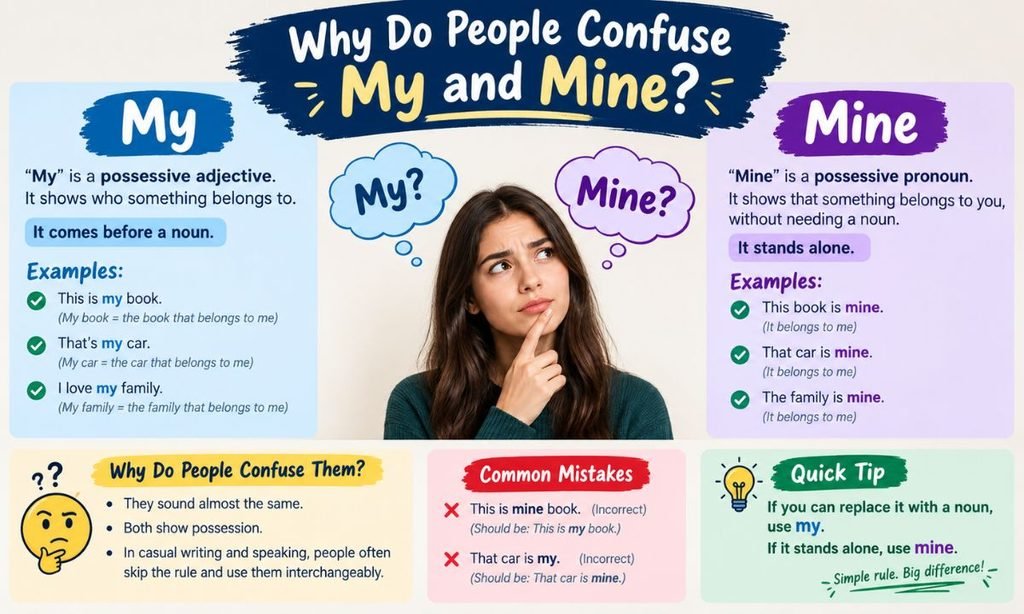
The confusion is understandable. The two words carry the same meaning, look alike, and turn up in similar sentences. A few specific things make it worse.
- The spelling pattern breaks. Most possessive pronouns just add an s to the adjective: your becomes yours, our becomes ours. My changes into mine instead, so the rule doesn’t carry over.
- Other languages work differently. Hindi and Urdu use one form for both jobs: meri kitab (my book) and kitab meri hai (the book is mine). Learners from these languages often carry the habit into English.
- Speech trails off. In casual talk, people leave sentences unfinished, so “It’s my…” sounds natural until you have to write it down.
- Some online guides get it wrong. A few pages claim mine can never start a sentence, or that it only works with singular nouns. Neither is true. “Mine are on the shelf” is perfectly good English.
Once you see where the mix-up starts, the fix is easier to remember.
Grammar Guide
How Each Term Is Used in Sentences
Here is how possessive adjectives and pronouns line up across all persons:
| Person | Possessive adjective | Possessive pronoun |
|---|---|---|
| I | my | mine |
| you | your | yours |
| he | his | his |
| she | her | hers |
| it | its | (rarely used) |
| we | our | ours |
| they | their | theirs |
Now the sentence patterns. My always leads into a noun:
- My train leaves at nine.
- I lost my wallet.
- My older brother works nights.
Mine usually closes a thought or answers a question:
- Take mine.
- Her handwriting is neater than mine.
- Your seat is by the window. Mine is at the back.
- Is this coat yours or mine?
Notice the last group. Each mine stands in for a noun the reader has already met (handwriting, seat, coat), which is exactly why the noun can be dropped.
Common Mistakes Learners Make
- Using mine before a noun. ✗ Mine book is on the desk. ✓ My book is on the desk.
- Leaving my hanging at the end. ✗ The winning ticket is my. ✓ The winning ticket is mine.
- Adding an apostrophe. ✗ The last slice is mine’s. ✓ The last slice is mine.
- Mixing the two in a pair. ✗ My and yours plans are different. ✓ My plan and yours are different.
- Using my in a double possessive. ✗ A friend of my called. ✓ A friend of mine called.
- Thinking mine can’t open a sentence. ✗ “Never start with mine.” ✓ “Mine is the red folder” is correct.
- Thinking mine is only singular. ✗ Mine can’t be plural. ✓ “Mine are in the drawer” works fine.
Simple Rules to Remember
- The noun test. If a noun comes right after, use my. If not, use mine.
- The swap test. If your fits the gap, use my. If yours fits, use mine.
- The ending test. A sentence can end on mine but never on my.
- No apostrophes. Neither word ever takes one.
- Double possessive. After of, always use mine: “a cousin of mine.”
Quick Tips for Writing and Speaking
- When you proofread, search your draft for “mine” and check the next word. If it’s a noun, fix it.
- Read the sentence aloud and finish it. If it sounds like something is missing after my, you may need mine.
- Use mine to avoid repeating yourself. “My presentation is longer than your presentation” reads better as “…longer than yours.”
- In speech, finish the thought before you speak. Most my versus mine slips happen when the sentence changes direction halfway.
- If you teach children, have them hold an object. “It’s my ball” and “The ball is mine” feel clearer when the ball is in their hands.
- In formal writing, don’t stack my in every sentence. Vary the structure and let mine do some of the work.
When to Use Each One
Use my when:
- A noun follows directly: my car, my ideas, my two cousins.
- You describe a relationship: my manager, my neighbour.
- You want emphasis with own: my own decision.
- You begin a sentence with the owned thing: “My flight was delayed.”
- You address someone in an affectionate phrase: “my dear friend.”
Use mine when:
- The noun has already been named and you don’t want to repeat it.
- You answer a question about ownership: “Whose jacket is this?” “It’s mine.”
- You compare your item with someone else’s: “Yours is faster than mine.”
- You use the double possessive: “a friend of mine.”
- You want a short, direct claim: “Mine!”
When NOT to Use Each One
Avoid my when:
- No noun follows. “Is this seat yours or my?” is wrong.
- You end a sentence on the word. “That car is my” is incomplete.
- You follow of. Use “of mine,” not “of my.”
Avoid mine when:
- A noun follows it. “Mine laptop” should be “my laptop.”
- You mean the digging sense, unless you actually mean a mine. Don’t write “the mine idea” for “my idea.”
- You are writing modern, everyday English and tempted by the old-style “mine eyes.” Keep that for deliberate poetic effect.
Which One to Use (Decision Guide)
Run through these steps whenever you feel unsure:
- Look at the word that comes right after the gap.
- If it is a noun (or an adjective plus a noun), write my.
- If the sentence ends, or the next word is a verb or a conjunction, write mine.
- Still stuck? Try replacing the gap with your or yours. Whichever version sounds right tells you the answer.
| What you see | Choose | Example |
|---|---|---|
| Gap + noun | my | ___ backpack is heavy → My backpack is heavy. |
| Gap + adjective + noun | my | ___ new shoes are tight → My new shoes are tight. |
| Gap + end of sentence | mine | The red one is ___. → The red one is mine. |
| Gap + verb | mine | ___ is arriving soon. → Mine is arriving soon. |
| “of” + gap | mine | a colleague of ___ → a colleague of mine |
| “than” + gap (a thing you own) | mine | Her bag is bigger than ___. → Her bag is bigger than mine. |
One small trap: mine replaces a possessed thing, never the person themselves. For people, use me: “She is taller than me.”
Real-World Practical Examples
My Examples
- At home: “I left my keys on the counter.” “My mother makes the best soup.”
- At work: “Please review my report before Friday.” “My manager approved the budget.”
- At school: “My teacher gave us extra time.” “I forgot my notebook.”
- In messages: “My bad, I missed your call.” “Send it to my personal email.”
- In daily talk: “My back hurts after the long drive.” “My favourite season is autumn.”
Mine Examples
- At home: “Which mug is yours?” “The chipped one is mine.”
- At work: “Your desk is tidy, but mine is a mess.” “The last slide is mine.”
- At school: “Her essay was longer than mine.” “Those pencils are mine.”
- In messages: “That parcel is mine, thanks for holding it.” “Mine arrives on Tuesday.”
- In daily talk: “A cousin of mine lives in Toronto.” “The choice is yours, and the blame is mine.”
Self-Assessment (Fill in the Blanks)
Choose my or mine for each gap. Cover the answers below first.
- This is ___ umbrella.
- The umbrella on the chair is ___.
- Your coffee is hot, but ___ is cold.
- She borrowed ___ charger.
- A colleague of ___ recommended this book.
- Is this pen yours or ___?
- ___ flight lands at six.
- Their house is bigger than ___.
- I forgot ___ keys at home.
- You take your bags. I’ll take ___.
- ___ is the red folder.
- Please check ___ answers before you submit.
Answers
- my: a noun (umbrella) follows.
- mine: the sentence ends, and the noun is already known.
- mine: it replaces “my coffee.”
- my: followed by the noun charger.
- mine: double possessive after of.
- mine: it stands in for “my pen.”
- My: followed by the noun flight.
- mine: it replaces “my house.”
- my: followed by the noun keys.
- mine: it replaces “my bags.”
- Mine: it works as a subject on its own.
- my: followed by the noun answers.
Ten or more correct means you have the rule. Eight or fewer? Re-read the noun test and try again tomorrow.
Frequently Asked Questions
What is the difference between mine and my?
My is a possessive adjective placed before a noun. Mine is a possessive pronoun that stands alone in place of the noun.
Is it correct to say mine?
Yes, when it replaces a noun, as in “That seat is mine.” It is wrong before a noun, so “mine seat” should be “my seat.”
Is it correct to say “my and yours” or “mine and yours”?
“Mine and yours” is correct because both are pronouns. “My and yours” mixes an adjective with a pronoun, so avoid it; before a noun, “my and your goals” works.
Where can we use mine?
Use it after linking verbs, as a subject or object with no noun after it, after of (“a friend of mine”), and in comparisons (“better than mine”).
Conclusion
My and mine both say something belongs to you, but they never swap places. My is an adjective that needs a noun. Mine is a pronoun that replaces one. Keep the noun test, the swap test, and the ending test close by, and you can settle nearly any doubt in a couple of seconds.
The other habits worth keeping are also small. Skip apostrophes, say “a friend of mine,” and remember that mine is fine as a sentence opener. Practise with the quiz above, then check your next email or essay for slips. Within a week or two, the choice will feel automatic.