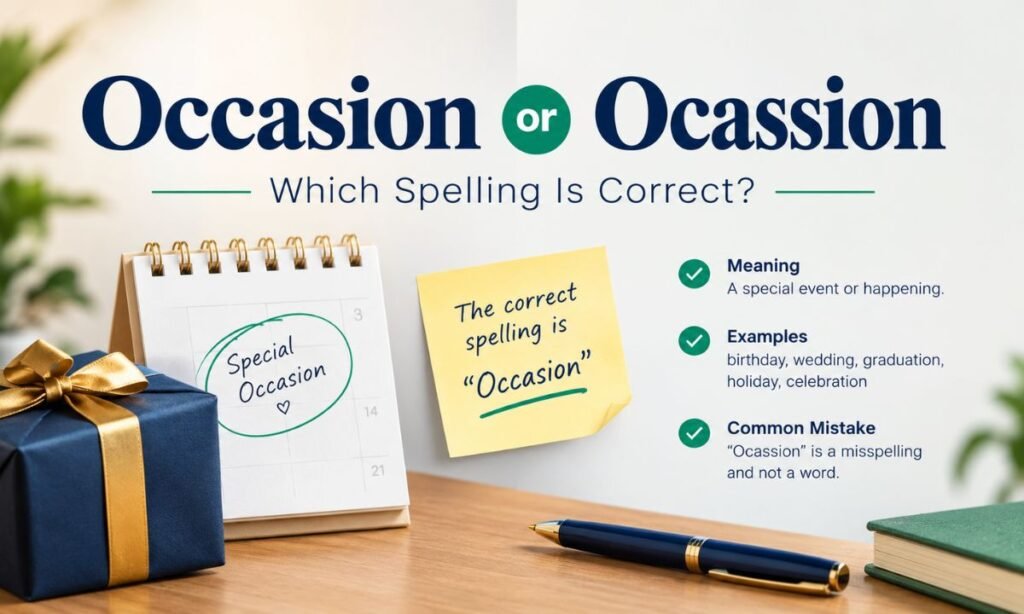

“Occasion” is the correct spelling. “Ocassion” is a typo, and no standard dictionary lists it as a word. The two look almost identical, which is why the mistake keeps appearing in emails, school essays, and wedding invitations. The letters are the same. Only the doubled letter moves.
Quick answer: Write occasion, spelled o-c-c-a-s-i-o-n. It has two c’s and one s. Never write “ocassion.”
This guide shows why the double c matters, what the word means, how it works in a sentence, and how to stop making the error for good. You will also find a short quiz at the end, so you can test yourself.
Comparison Overview
Here is the whole story in one table. Scan it first, then read the sections below for the details.
| Feature | Occasion | Ocassion |
|---|---|---|
| Correct spelling? | Yes | No |
| Letter pattern | oc-ca-sion (two c’s, one s) | o-cas-sion (one c, two s’s) |
| Listed in dictionaries? | Yes | No |
| Part of speech | Noun; also a verb | None, because it is a misspelling |
| Pronunciation | uh-KAY-zhuhn | Sounds the same if spoken |
| Safe for formal writing? | Yes | Never |
| Origin | Latin occasio | No origin; a spelling slip |
The spoken forms are identical, and that is the trap. Your ears cannot tell you which one is right. Only the spelling rule can.
Definition of Occasion
Meaning
Occasion is a noun that names a particular time when something happens. Dictionaries such as Dictionary.com and Collins list several related senses:
- A specific time or instance: “They met on three occasions.”
- A special event or celebration: a wedding, a graduation, a birthday dinner.
- A good chance or opportunity: a suitable moment to act.
- A cause or reason (formal): “There was no occasion for alarm.”
It also works as a verb, though this use is less common and fairly formal. To occasion something means to cause it, usually as a side effect. A late train might occasion a missed meeting.
The word has a neat history. It comes from the Latin occasio, built from ob (“toward”) and cadere (“to fall”). The idea was a moment that “falls” into your path. It reached English in the 14th century through Old French. The sense of a chance moment survives today in phrases like “seize the occasion.”
Examples
- The company held a small dinner to mark the occasion.
- She has visited Lahore on several occasions.
- This is not the occasion for a long speech.
- He wore a navy suit for the occasion.
- On occasion, the bus arrives ten minutes early.
- The storm occasioned a two-day delay.
- If the occasion arises, call me right away.
Definition of Ocassion
Meaning
Ocassion has no meaning. It is not a variant, a regional spelling, or an older form. It is simply a mistake that happens when writers spell by sound and get the doubled letters wrong.
Spelling checkers flag it. Editors circle it. Exam boards use it as a trap. A 2026 English question from the MAH-CET exam, for instance, listed “ocassion” as a wrong option next to the correct spelling. Its explanation pointed to the same rule you will learn below: two c’s, one s.
Examples
These sentences show the error in action. Do not copy them.
OcassionOccasion: “It was a happy ocassion for the whole family.”OcassionOccasion: “Please dress well for the ocassion.”OcassionsOccasions: “We meet only on special ocassions.”OcassionOccasion: “Is this the right ocassion to ask for a raise?”
Each corrected version simply swaps the letters into their proper places.
Main Differences Between Occasion and Ocassion
| Point of comparison | Occasion | Ocassion |
|---|---|---|
| Status | A real English word | A misspelling |
| Doubled letters | cc | ss |
| Dictionary entry | Yes | None |
| Can be used in a sentence | Yes | Only as an error to be fixed |
| Accepted by editors and teachers | Yes | No |
| Related words | occasional, occasionally, occasioned | None |
Key Difference
The difference is not one of meaning. It is a difference between a word and a typo. “Occasion” exists. “Ocassion” does not. If you type the second version, the reader will still understand you, but they will also notice the slip, and that can weaken an otherwise strong piece of writing.
Common Contexts Where Occasion Is Used
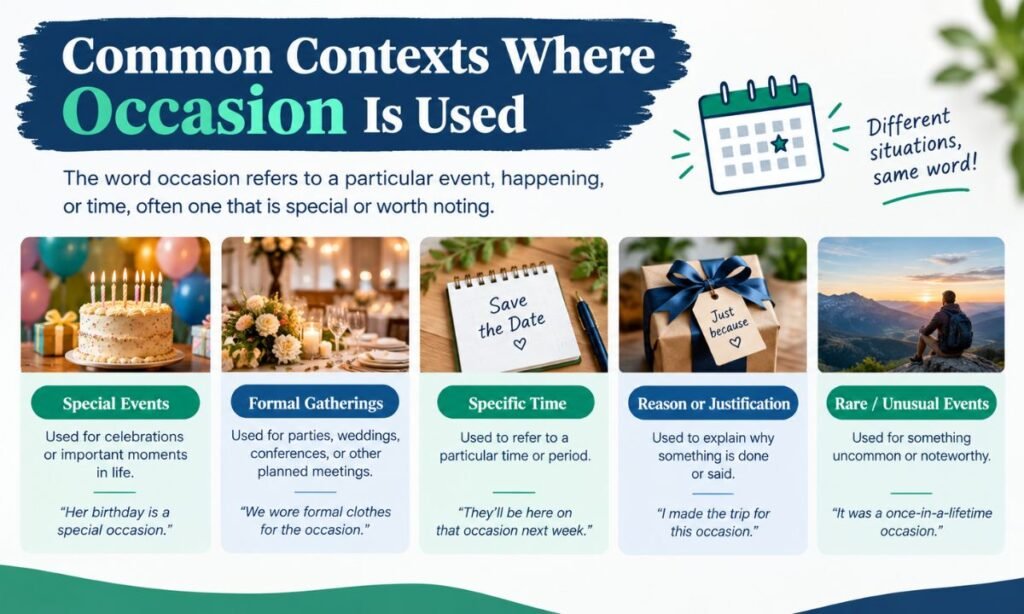
The word shows up in more places than most people expect. It helps to group the uses.
Special Events
This is the everyday meaning. An occasion is a moment that matters to someone: a wedding, a farewell party, a graduation, or a national holiday.
- “Eid is a joyful occasion for our family.”
- “The hotel offers packages for every special occasion.”
- “She saved the good tea set for the occasion.”
Shops and websites use this sense constantly. “Occasion wear” and “occasion cakes” are common search terms in retail, and they always carry the correct spelling.
Particular Times
Here the word simply points to a moment or an instance. It carries no party atmosphere at all.
- “On this occasion, the results were different.”
- “I have seen him angry on more than one occasion.”
- “We only write by hand on rare occasions.”
Notice the fixed phrases: on occasion, on this occasion, on several occasions. They are common in reports, news writing, and academic papers.
Reasons or Opportunities
The third use is more formal. It means a cause, a ground for doing something, or a fitting chance.
- “There was no occasion to complain.”
- “I had occasion to review the contract last spring.”
- “If the occasion arises, we will change the plan.”
One caution: many learners overuse occasion when they mean opportunity. A learner’s dictionary from Cambridge gives a helpful correction: you should “not waste this opportunity,” and occasion would sound odd there.
Spelling Pattern Breakdown
Let’s slow the word down. Say it in syllables: oc-ca-sion. Three syllables, and the middle one begins with the second c.
Why two c’s? The answer sits in the word’s history. The Latin prefix ob- changed to oc- when it met a word beginning with c. The root cas- (from cadere, “to fall”) then followed. Put them together and you get oc + cas, which means two c’s in a row. The single s that follows is part of the -ion ending.
A few memory aids help:
- Count the c’s first. Two. Then add one s.
- Use a silly line: “An occasion needs a couple of c’s and a solo s.”
- Split it: oc + ca + sion. Write it in that order.
Words that look alike often cause the confusion, so here is a comparison table.
| Word | Doubled letter | Correct spelling |
|---|---|---|
| occasion | c | occasion |
| occasionally | c and l | occasionally |
| occurrence | c and r | occurrence |
| necessary | s | necessary |
| accommodation | c and m | accommodation |
| success | c and s | success |
Many English words carry a double c, a double s, or both, so writers guess. The safest habit is to fix the pattern for each word in your memory instead of relying on a general rule.
Other wrong forms that turn up often include occassion (both doubled), ocasion (single c, single s), and occaision (an extra vowel). All of them are incorrect.
Grammar Guide
Part of Speech
Occasion is mainly a noun. It can be countable (“three occasions”) or uncountable in some formal phrases (“there is no occasion for concern”). It can also be a transitive verb, meaning to cause something.
Related forms are all spelled with the same double c:
- occasional (adjective): “an occasional visitor”
- occasionally (adverb): “We eat out occasionally.”
- occasioned (verb form): “The delay occasioned a complaint.”
Ocassion has no part of speech. Grammar tables cannot label something that is not a word.
How Each Term Is Used in Sentences
Occasion
The noun follows familiar patterns. It often takes a preposition or a fixed phrase.
- on + occasion: “On occasion, we work late.”
- for + the occasion: “He bought a new tie for the occasion.”
- occasion + for/of: “It was the occasion for a long-overdue talk.”
- rise to the occasion: “The young team rose to the occasion.”
- special occasion: “Use the good plates for special occasions.”
As a verb, it takes an object: “Heavy traffic occasioned the delay.”
Ocassion
There is nothing to teach here, and that is the point. If you see “ocassion” in a draft, replace it with “occasion” and move on. In a spelling lesson, you may quote it in quotation marks as an example of an error. In any other setting, it should not appear.
Common Mistakes Learners Make
Mistake 1
Writing one c and two s’s (ocassion). This is the most common slip. Writers hear the “s” sound in the middle and add a second one by habit. The fix: remember that the double letter is c, not s.
Mistake 2
Doubling both letters (occassion). This happens when a writer knows there is a double somewhere and simply doubles everything. Count again: two c’s, one s.
Mistake 3
Carrying the error into related words. People who misspell occasion tend to misspell occasionally too, giving ocassionally, occassionally, or even occasionaly with one l. The correct form has a double c, a single s, and a double l. Fix the root and the family follows.
Simple Rules to Remember
- Occasion has two c’s and one s.
- The second c starts the middle syllable: oc-ca-sion.
- Every word in the family (occasional, occasionally) keeps that pattern.
- If a spell checker underlines the word, do not guess. Retype it from the rule above.
- “Ocassion” is never correct, in any dialect.
Quick Tips for Writing and Speaking
For writing
- Proofread once just for spelling. Read backward, word by word, so your brain does not skim.
- Add “occasion” to your personal dictionary so autocorrect helps you next time.
- When you find one error, search the whole document for the same word. Mistakes tend to repeat.
For speaking
- Stress the second syllable: uh-KAY-zhuhn.
- The middle sound is “zh,” like the s in vision. It is not “sh” and not “z.”
- British and American speakers say it almost identically. Dictionary listings for both use the same pronunciation symbols.
When to Use Each One
Use Occasion When
Use occasion every time you mean any of the following:
- a special event or celebration
- a specific time or instance
- a suitable moment or chance to act
- a reason or ground for something (formal)
- the verb sense of “to cause”
It suits emails, essays, legal text, invitations, product pages, speeches, and casual texts alike.
Use Ocassion When
Almost never. The only fair use is inside a sentence about spelling, where you are naming the wrong form on purpose. For example: “Students often write ‘ocassion’ when they mean ‘occasion.'” Put the wrong spelling in quotation marks and mark it clearly, so readers know it is an example and not a choice.
When NOT to Use Each One
Do Not Use Occasion Incorrectly
The spelling is safe, but the word can still be misused. Watch for these cases:
- Do not swap it for “opportunity” automatically. “Do not waste this occasion” sounds wrong. Say “opportunity.”
- Do not confuse it with “occurrence.” An occurrence is something that happens. An occasion is the time or event around it.
- Do not write “occasion” when you need “occasional.” “An occasional treat” is an adjective use. “An occasion treat” is not English.
- Do not overuse the formal “reason” sense in casual chat. “There was no occasion to call” sounds stiff between friends.
Do Not Use Ocassion
Skip it in every draft, title, caption, and message. Do not use it in a resume, a cover letter, a school submission, or a client email. Search engines and readers both treat it as an error. If your writing tool suggests a correction, accept it.
Which One to Use (Decision Guide)
Answer these questions in order.
- Are you writing about an event, a time, a chance, or a cause? Use occasion.
- Are you writing about something that happens now and then? Use occasional or occasionally, still with a double c.
- Are you teaching spelling and quoting the wrong form? Put “ocassion” in quotation marks and label it as incorrect.
- Is it anything else? Use occasion, or pick a different word.
| Situation | Correct choice |
|---|---|
| Wedding invitation | occasion |
| Business email about a past meeting | occasion |
| Adjective meaning “now and then” | occasional |
| Adverb meaning “now and then” | occasionally |
| Spelling worksheet showing an error | “ocassion” (in quotes, marked wrong) |
The decision almost always ends the same way: occasion.
Real-World Practical Examples
Occasion Examples
Education
- “The teacher marked the occasion with a short assembly.”
- “The exam paper asked students to pick the correctly spelt word: occasion.”
Daily Life
- “We baked a cake for the occasion.”
- “She only wears that necklace on special occasions.”
Science
- “On one occasion, the sample turned green after heating.”
- “The researcher noted the occasion of each reading in the log.”
Business
- “The firm hosted a dinner to mark the occasion of its tenth anniversary.”
- “On this occasion, the client chose the cheaper plan.”
Writing
- “The editor wrote, ‘Use occasion for events and opportunity for chances.'”
- “An essay should use each formal word on the right occasion.”
Technology
- “The app crashed on three separate occasions last week.”
- “The developer had occasion to rewrite the login screen.”
Conversation
- “Is this a formal occasion, or can I wear jeans?”
- “I only see my cousins on holidays and other big occasions.”
Ocassion Examples
These are wrong forms. The table shows what to fix.
| Incorrect | Correct |
|---|---|
| It was a lovely ocassion. | It was a lovely occasion. |
| Dress up for the ocassion. | Dress up for the occasion. |
| We met on several ocassions. | We met on several occasions. |
| An ocasion to remember. | An occasion to remember. |
| We ocassionally visit. | We occasionally visit. |
Self-Assessment (Fill in the Blanks)
Choose the correct spelling for each blank. Cover the answers below before you begin.
- The whole family gathered for the joyful ______.
- She has been late on several ______.
- Which is right: “occasion,” “ocassion,” or “occassion”? ______
- We go hiking ______, usually once a month.
- There was no ______ to raise your voice.
- Save the good dishes for a special ______.
- The heavy rain ______ a delay. (verb form)
- Choose one: “ocasion” / “occasion” ______
- He is an ______ visitor, not a regular one.
- Fix the error: “Wear something nice for the ocassion.” ______
Answers
- occasion
- occasions
- occasion
- occasionally
- occasion
- occasion
- occasioned
- occasion
- occasional
- “Wear something nice for the occasion.”
Score check: 9 or 10 correct means you have the pattern. Fewer than 7? Reread the Spelling Pattern Breakdown and try again tomorrow.
Frequently Asked Questions
How should ocasion be spelled?
The correct spelling is “occasion,” with two c’s and one s. “Ocasion” is a misspelling.
How do you spell “occasion” correctly?
Spell it o-c-c-a-s-i-o-n: two c’s, then a single s. Split it as oc-ca-sion to remember.
How do British people say occasion?
British speakers say uh-KAY-zhuhn, the same as most American speakers, with stress on the second syllable.
Which is the correct spelling: “occasionally” or “occasionally”?
The two spellings in that question are identical, and both are correct. The right form has a double c, a single s, and a double l. Common wrong versions are “ocassionally,” “occassionally,” and “occasionaly.”
Conclusion
The debate between occasion and ocassion has a clear winner. Occasion is the real word, with two c’s and one s. Ocassion is only a slip of the fingers or of memory, and it never belongs in polished writing.Remember the small pattern: oc-ca-sion. Check the whole family too, since occasional and occasionally follow the same double c. If you find yourself unsure again, come back to the decision guide or retake the quiz above.