

You’re writing an email, typing up a school assignment, or drafting notes for a wedding toast, and suddenly you stop. Is it “speech” or “speach”? Your fingers hover over the keyboard because both versions look weirdly plausible.
You’re not alone. This is one of the most commonly misspelled words in English, and there’s a clear reason why people trip over it. Below, we’ll settle the confusion for good, explain where it comes from, and give you a trick so you never second-guess yourself again.
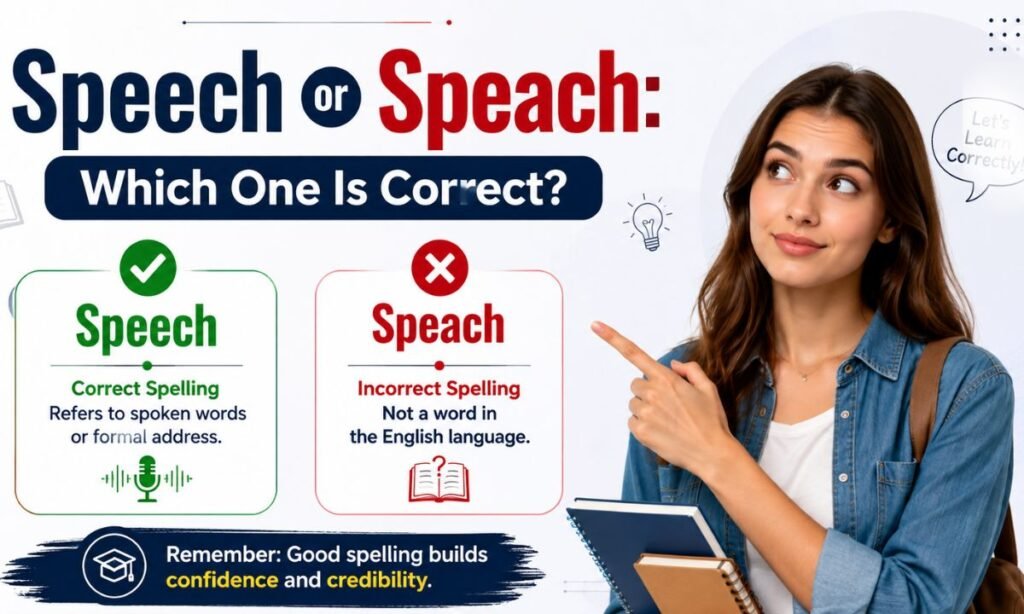
Speech
“Speech” is the correct, dictionary-recognized spelling. It refers to spoken words, the ability to talk, or a formal address given to an audience. You’ll find it in every English dictionary, every grammar textbook, and every professional style guide.
Speach
“Speach” is not a word. It doesn’t appear in Merriam-Webster, Oxford, Cambridge, or any recognized dictionary. It’s simply a misspelling that happens because of how the word sounds and how similar words are spelled.
Speech or Speach: Quick Answer ✅⚡
If you only came here for the short version, here it is: use speech. Always.
✔ Main Difference:
“Speech” is spelled with a double E (“ee”), while “speach” incorrectly swaps in “ea.” Only one of these exists in real English — and it’s speech.
📌 Examples:
- Correct: She gave an inspiring speech at graduation.
- Incorrect: She gave an inspiring speach at graduation.
- Correct: Freedom of speech is protected by law.
- Incorrect: Freedom of speach is protected by law.
Definitions with Examples 📖✍️
🟢 Speech (Definition)
Speech is a noun that describes the act of speaking, the ability to communicate through spoken words, or a formal talk delivered to a group. It can refer to everyday talking or to a prepared, structured presentation given in front of an audience.
📌 Examples:
- The mayor’s speech addressed the city’s new housing plan.
- Losing his voice meant he temporarily lost the power of speech.
- Her speech was slow and deliberate, as if every word mattered.
- The best man’s speech had the whole room laughing within a minute.
🔵 Speach (Definition)
There is no definition to give here, because speach carries no accepted meaning in English. It’s a spelling error, plain and simple — usually one that slips out because “speak” has an “ea” and writers assume “speech” should follow the same pattern.
📌 Examples:
- Incorrect: He practiced his speach for hours.
- Incorrect: The speach teacher gave useful feedback.
- Incorrect: I forgot my speach notes at home.
Each of these should read “speech.” None of them work as written.
🟡 Simple Meaning
In plain terms: speech is talking, or the words someone says out loud to an audience. That’s it. No hidden complexity, no second definition to memorize — just make sure you spell it right.
The Origin of Speech 📜⏳
📚 Historical Background:
The word traces back to Old English spæc or spræc, related to the verb sprecan, meaning “to speak.” Over centuries, English spelling shifted and settled, and the noun form landed on “speech” with a double E, even though its parent verb, “speak,” kept the “ea.” English does this constantly — related words don’t always share the same vowel pattern, because they evolved along separate paths through Middle English and beyond.
This is exactly why so many people guess “speach.” It feels logical to match the spelling of “speak.” Logic, unfortunately, isn’t how English spelling works.
You May Like: Challenge or Challange: What is the Difference & Which is Correct?
🗣️ Modern Use:
Today, “speech” shows up everywhere: courtrooms, classrooms, political debates, wedding receptions, TED talks, and casual conversation. It’s used constantly in phrases like “freedom of speech,” “public speech,” “speech therapy,” and “opening speech.” Its spelling hasn’t budged in modern English, and it isn’t likely to.
Speech vs Speach: Key Difference Explained 🌍
🔍 Important Point:
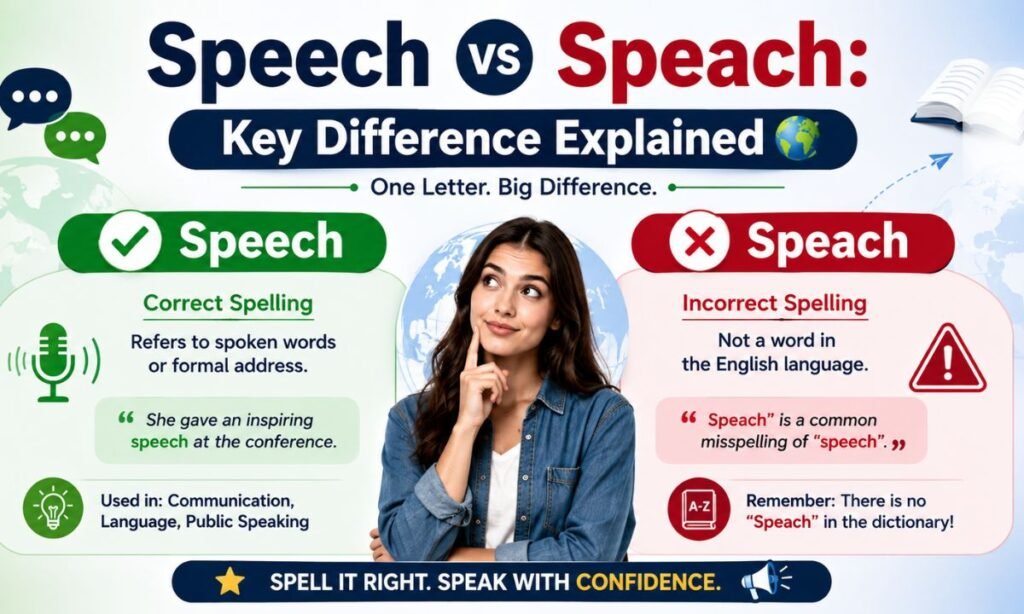
There’s really only one point worth remembering: speech exists, speach doesn’t. There’s no context — formal, informal, academic, or casual — where “speach” becomes acceptable.
People commonly search variations of this question because the confusion shows up in different situations. Here are a few of the most common:
- Speech or speach for students
- Speech or speach examples
- Speech or speach grammar
- Is speach a word
- Giving a speech or speach
- Speach or speech for students in English
- Speech or pitch
That last one is a slightly different question. A “pitch” is a persuasive presentation, often used in business or sales, while a “speech” is broader and can be informative, ceremonial, or persuasive. They overlap but aren’t identical — a sales pitch is a type of speech, but not every speech is a pitch.
📊 Comparison Table:
| Feature | Speech ✅ | Speach ❌ |
|---|---|---|
| Dictionary status | Recognized word | Not a real word |
| Spelling pattern | Double E (“ee”) | Incorrect “ea” |
| Usage in writing | Correct in all contexts | Never correct |
| Origin | Old English spæc | No linguistic origin |
| Appears in exams/essays | Yes, expected | No, marked wrong |
📌 Example:
Correct sentence: “The professor’s closing speech summarized the entire semester in five minutes.”
Incorrect sentence: “The professor’s closing speach summarized the entire semester in five minutes.”
Which Spelling Should You Use? 🎯📝
✔ Always Use:
Use “speech” in every single situation — emails, essays, exams, resumes, presentations, social media captions, and casual texting. There is no exception.
📚 In Exams
Spelling mistakes like “speach” can cost marks in school and college assignments, especially in English, communication, and language exams. Teachers and examiners treat it as a basic spelling error, not a stylistic choice.
📧 In Emails & Writing
Professional writing is judged partly on polish. A misspelled word like “speach” in a work email or cover letter can quietly undercut your credibility, even if the rest of the message is well written.
⚖️ Easy Trick to Remember
Try this: think of the phrase “sweet speech.” Both words share that double E sound, and pairing them in your head makes the correct spelling stick. Another option — remember that “speech” rhymes with “teach,” “reach,” and “beach,” all of which use “ea”… except speech doesn’t. That’s exactly the trap. So instead, lock onto this: speech has two E’s, just like “meet” and “greet.” If you can spell “meeting,” you can spell “speech.”
Common Mistakes with Speech
1. Writing “Speach”
By far the most frequent error, driven by the influence of “speak” and “teach.”
2. Pronunciation Confusion
Because “speech” and “speach” would sound identical if spoken, some writers assume both spellings are valid. They’re not — pronunciation doesn’t confirm spelling.
3. Typing Fast
Quick messages and social media posts are where “speach” sneaks in most often, simply because people aren’t slowing down to check.
4. Ignoring Spell Check
Most spell-checkers will flag “speach” instantly, yet plenty of writers dismiss the red underline without reading the suggestion.
5. Copying Wrong Spelling
Once someone sees “speach” written somewhere — a forum post, a text from a friend — they sometimes assume it’s correct and repeat the mistake themselves.
You May Like: Ballon or Balloon: What Is the Difference & Which Is Correct?
Speech in Everyday Examples 💬📱
🎤 Public Speaking
Politicians, wedding hosts, and conference keynote speakers all deliver a speech — a structured set of spoken words aimed at informing, persuading, or celebrating.
📚 School
Students write and deliver speeches for debate class, graduation ceremonies, and oral presentations. Speech therapy is also a common term in educational and medical settings, referring to help with pronunciation, fluency, or language development.
📱 Social Media
Captions like “Freedom of speech matters” or “That speech gave me chills” circulate constantly online, making correct spelling visible to a wide audience.
🏢 Workplace
Business meetings often include a short speech from a manager, and presentations frequently open with a few spoken remarks before the slides even start.
Speech: Google Trends & Usage Data 📊
🌍 Trends:
Search interest in spelling questions like “speech or speach” tends to spike around graduation season, exam periods, and whenever a major public address — a presidential speech, for instance — draws widespread attention.
📊 Region Based Usage:
English-speaking regions with large numbers of second-language learners, including parts of South Asia, Southeast Asia, and Africa, show consistently high search volume for this spelling comparison, largely because English spelling doesn’t always match pronunciation in predictable ways.
🔥 High Search Queries:
Beyond “speech or speach,” related high-volume searches include “is speach a word,” “speech vs speach difference,” “how to spell speech,” and “speech meaning in English.”
Comparison Table: Speech vs Speach 📋⚖️
| Category | Speech | Speach |
|---|---|---|
| Correct spelling | Yes | No |
| Found in dictionaries | Yes | No |
| Safe for exams and formal writing | Yes | No |
| Root origin | Old English spæc | None |
| Recommended usage | Always | Never |
Frequently Asked Questions
What is correct, speech or speach?
“Speech” is correct. “Speach” is a common misspelling with no dictionary entry.
Why is it speech and not speach?
Because the noun form evolved from Old English spæc with a double-E spelling, even though the related verb “speak” uses “ea.”
Is it freedom of speech or speach?
It’s “freedom of speech.” This is a fixed legal and everyday phrase, and “speach” is never correct in it.
What does “speaches” mean?
Nothing — it’s an incorrect spelling of “speeches,” the plural form of “speech.”
Conclusion
The rule here isn’t complicated: speech is correct, speach isn’t, and there’s no gray area to navigate. The confusion makes sense — “speak” has an “ea,” so it’s a natural guess that “speech” would follow suit. But English spelling doesn’t always play fair, and this is one of those cases where you simply have to remember the exception.
Next time you’re drafting a wedding toast, prepping for a debate, or firing off a quick work email, trust the double E. Write “speech,” and you’ll never have to second-guess yourself again.