
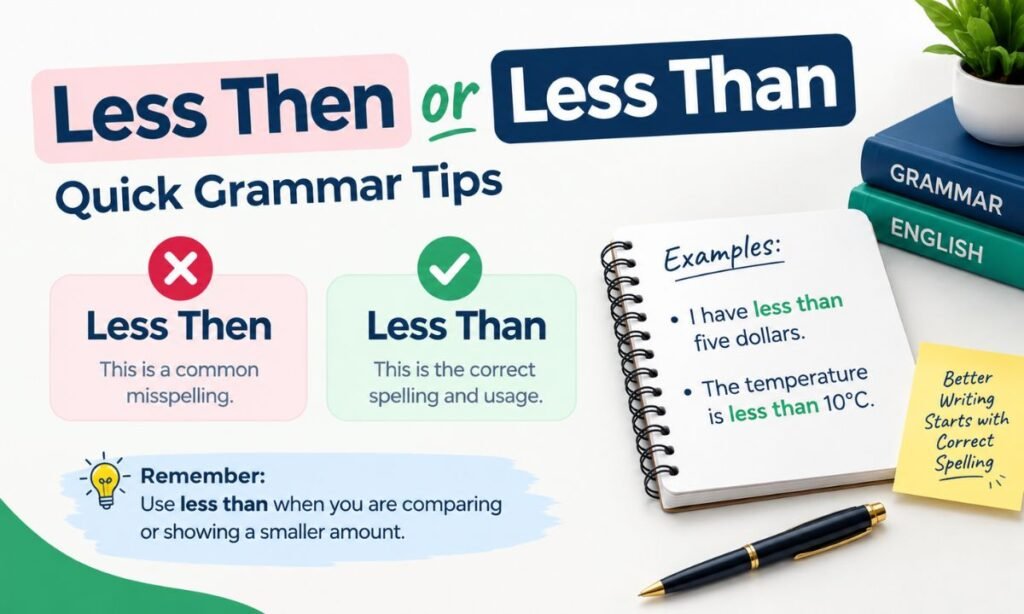

Less than is the correct phrase. Use it whenever you compare amounts, sizes, ages, prices or any other measurable thing. “Less then” is a typo in nearly every sentence where people write it, because comparisons need the word than, not then. The two words can sit side by side only when then is a separate word about time or sequence, as in “Spend less, then save the difference.”
This guide explains why the mix-up happens, how to spot it in your own writing and how to fix it for good. You will find clear definitions, comparison tables, grammar rules, a decision guide, real examples, a short quiz and quick answers to the questions people search for most.
Comparison Overview
Here is the short version before the details. Read this table first if you only have a minute.
| Feature | Less Than | Less Then |
|---|---|---|
| Is it a fixed phrase? | Yes | No |
| Is it correct for comparisons? | Yes | No |
| Part of speech of the second word | Conjunction (sometimes a preposition) | Adverb |
| What the second word signals | Comparison | Time or sequence |
| Typical use | “She has less than ten dollars.” | “Do less, then rest.” (two separate ideas) |
| Common in formal writing? | Very common | Rare, and only as two separate words |
| Verdict | Correct | Usually a typo |
Than introduces the thing you are measuring against. Then tells the reader when something happens or what comes next.
Definition of Less Then
“Less then” is not an established phrase in English. No dictionary lists it as a unit, and no style guide recommends it. When you see it written, one of two things is going on.
Case one: a typo. Most of the time, the writer meant less than and typed the wrong word. The sentence “I have less then five minutes” is a good example. It compares a quantity of time to five minutes, so it needs than.
Case two: two words that happen to be neighbors. Occasionally less ends one clause and then starts the next. The words belong to different parts of the sentence. Think of “You should eat less, then exercise more.” The comma matters here, and so does the meaning. Then means “after that.” It has nothing to do with comparing.
Here less stands on its own, and then is an adverb of time. They are not partners. They are strangers seated at the same table.
Definition of Less Than
“Less than” is a standard comparative phrase. It means “smaller in amount, degree, size or value than something else.” The word less is the comparative form of little, and than introduces the item being compared against.
In grammar terms, than works as a conjunction when it links two clauses (“She runs less than he does”) and as a preposition in many everyday sentences (“She runs less than him”). Both forms are accepted, and usage guides treat the choice as one of style and formality.
Here is what less than usually does:
- It compares two amounts: “The new phone costs less than the old one.”
- It sets an upper limit: “The meeting will take less than an hour.”
- It describes a lower quality or degree: “He was less than thrilled.”
- It appears in math as the symbol <, as in 3 < 8.
That third use is worth noticing. “Less than thrilled” is a mild way to say someone was unhappy. The phrase still carries the idea of comparison, because the person fell below the level of thrilled.
Less than also pairs with other comparison words. You will see “no less than,” “nothing less than,” “less than or equal to” and “much less than.” In every one of them, than stays put.
Main Differences Between Less Then and Less Than
The two spellings look almost the same, but they do different jobs. The table below sets out the main differences.
| Point of difference | Less Than | Less Then |
|---|---|---|
| Meaning | One thing is smaller or lower than another | Less followed by a separate idea of “next” or “at that time” |
| Grammar role of the last word | Conjunction or preposition | Adverb of time |
| Needs a second item to compare? | Yes | No |
| Works with numbers and measurements? | Yes | No |
| Appears in math? | Yes (<) | No |
| Acceptable as a single phrase? | Yes | No |
| Spell-checker response | Usually fine | May not flag it, since then is a real word |
That last row explains a lot. Spell-checkers look for misspelled words, and then is spelled correctly. The tool sees nothing wrong, so the error slips through. Grammar checkers catch it more often, but not every time.
Why This Confusion Happens
Several things push people toward the wrong spelling, and none of them mean you are bad at English. Native speakers make this error all the time.
The words look nearly identical. They differ by a single letter in the middle. The eye skims past one swapped vowel with ease.
They sound alike in casual speech. In many regions, people pronounce both words with the same weak vowel. If you say them the same way, you have nothing in your ear to tell you which spelling to pick.
They share a history. Than and then were once the same word in Middle English. They split into two words with two jobs over several centuries. The old overlap still lingers in how our brains file them.
Autocorrect and typing speed. Fast typists hit the wrong key, and predictive text sometimes offers then after less.
The fix is to stop relying on the ear and start asking one question about meaning: is this a comparison or a sequence?
Grammar Guide
This section gives you the working rules. Read the examples out loud, and notice how each sentence behaves.
How each term is used in sentences
Less than sits between the thing being measured and the thing it is measured against.
- “Her score was less than mine.”
- “We have less than two weeks.”
- “The tickets cost less than I expected.”
- “It weighs less than a kilogram.”
Notice that each sentence has a measuring stick on the right side of than. Mine, two weeks, what I expected and a kilogram are all reference points.
Then (in a sequence that includes less) starts a new step or consequence.
- “If the engine uses less fuel, then the trip will cost less.”
Here the word then answers the question “what happens next?” or “what follows from that?” You could replace it with next or after that and keep the meaning.
A tip for “if… then” sentences. In a conditional sentence, then introduces the result. Because less can appear in either half, you may see “if less” and “then” close together. Keep them apart in your mind: less describes an amount, and then marks the result.
Common mistakes learners make
These errors show up again and again in student essays, emails and social media posts.
- Writing “less then” in a plain comparison. Wrong: “He earns less then his brother.” Right: “He earns less than his brother.”
- Using “then” after other comparison words. The same error shows up with “more then,” “better then,” “older then” and “rather then.” Every one of them needs than.
- Using “than” for sequence. Wrong: “First chop the onions, than add the garlic.” Right: “First chop the onions, then add the garlic.”
- Using “lesser than” in place of “less than.” Lesser is an adjective that means “smaller in importance,” as in “the lesser of two evils.” For measuring, use less than.
- Mixing up “less” and “fewer.” Traditional usage prefers fewer for things you can count one by one (“fewer cars”) and less for amounts you measure (“less traffic”). The less than phrase itself stays the same either way, and it is perfectly normal with numbers and units of time or money, such as “less than ten minutes.”
Simple rules to remember
Keep these in your pocket. They are short on purpose.
- Rule 1: If you are comparing, write than.
- Rule 2: If you are talking about time, order or a result, write then.
- Rule 3: The word less signals a comparison coming up. Expect than right after it.
- Rule 4: If you can replace the word with “next” or “at that time,” use then.
- Rule 5: If you can replace it with “compared to,” use than.
Two memory tricks also help. The word than has an a, like comparison. The word then has an e, like time or sequence. A second trick: then rhymes with when, and both are about time.
Quick tips for writing and speaking
For writing:
- Search your draft for “less then.” Every hit deserves a second look. In most cases you will change it to less than.
- Read the sentence aloud and put the word “compared to” in place of the choice. If it sounds right, use than.
For speaking:
- Slow down on comparisons. A quick pause before the second half of the sentence keeps you aware of what you are comparing.
When to Use Each One
Use less than when:
- You compare two amounts, sizes or degrees: “This bag is less than half the price.”
- You state a limit or threshold: “Applicants must be less than 30 years old.”
- You describe something falling short: “The result was less than satisfactory.”
- You write inequalities in math or code: “if x < 10.”
- You use phrases like “no less than,” “nothing less than” or “less than or equal to.”
Use less, then (as two separate words) when:
- You give a step-by-step instruction and less ends one step: “Add less salt, then taste the soup.”
- You describe a result in an if-statement: “If demand drops and we sell less, then profits shrink.”
- You tell a story in order: “He spoke less each year, then fell silent.”
In each of these, a comma or a natural pause separates the two words. That pause is your clue that they belong to different parts of the sentence.
When NOT to Use Each One
Do not use less than when:
- You mean “next” or “after that.” A sentence like “Mix the eggs, less than add the flour” is wrong. The word you need is then.
- You want to say something matters less. “Lesser than” is off. Say “less important than” instead.
Do not use less then when:
- You are comparing anything at all. This covers prices, ages, distances, speeds, scores and quantities.
- You are writing a math or coding statement. The comparison operator is “less than,” never “less then.”
- You are writing a headline, title or search-friendly phrase. Search engines handle the typo, but readers will notice.
If you cannot decide, rewrite the sentence so that the comparison is obvious. “He is smaller than I am” is clearer than a sentence that hides the comparison.
Which One to Use (Decision Guide)
Ask these questions in order. Stop at the first “yes.”
- Does the sentence compare two things? Use than. Write less than.
- Does it set a limit or a threshold, such as an age, price or time cap? Use than. Write less than.
- Does it describe what happens next or what follows from a condition? Use then. Keep less and then apart, usually with a comma.
- Can you replace the word with “next,” “after that” or “at that time”? Use then.
- Can you replace it with “compared to”? Use than.
For a fast visual, use this table.
| If your sentence says… | Write | Example |
|---|---|---|
| “smaller/lower/fewer compared to” | less than | “It costs less than a coffee.” |
| “and after that” | less, then | “Eat less, then sleep.” |
| “if X, the result is” | if less, then | “If we spend less, then we save.” |
| A math symbol | less than (<) | “5 is less than 9.” |
Featured snippet answer: Less than is the correct form for comparing amounts, sizes or values. Less then is incorrect unless less and then belong to separate parts of a sentence, where then means “next” or “at that time.”
Real World Practical Examples
Examples make the rule stick. Here are sentences from daily life: emails, recipes, school work, shopping and sports.
Less Then Examples
Since less then is not a real phrase, the examples below split into two groups. The first group shows correct uses where less and then are separate. The second shows typical errors with their fixes.
Correct: less and then are separate words
- “Talk less, then listen to what they say.”
- “If the team scores less, then the coach changes the plan.”
- “Use less sugar this time, then compare the taste with last week’s batch.”
- “She slept less each night, then collapsed on Sunday.”
- “Spend less on takeout, then put the savings into your trip fund.”
Incorrect: typos that should be less than
| Incorrect | Corrected |
|---|---|
| “I have less then ten dollars.” | “I have less than ten dollars.” |
| “The test took less then an hour.” | “The test took less than an hour.” |
| “He is less then happy with the result.” | “He is less than happy with the result.” |
| “Orders under 5 kg cost less then bulk orders.” | “Orders under 5 kg cost less than bulk orders.” |
| “My commute is less then yours.” | “My commute is less than yours.” |
Notice that every corrected sentence has something being compared or limited. That structure always calls for than.
Less Than Examples
Everyday life
- “I slept less than six hours last night.”
- “The bus arrives in less than five minutes.”
- “My phone battery has less than twenty percent left.”
School and work
- “Students who scored less than 50 will retake the exam.”
- “Her salary is less than what the market offers.”
Shopping and cooking
- “This brand has less sugar than that one.”
- “Add less than a teaspoon of salt.”
- “The sale price is less than half the original.”
Math and technology
- “If x is less than y, the function returns true.”
- “File sizes must be less than 5 MB.”
Self-Assessment (Fill in the Blanks)
Choose the correct word for each blank: than or then. Cover the answer section before you start.
- My brother is taller ______ I am.
- Wash the rice, ______ boil it for ten minutes.
- The hike took less ______ two hours.
- If it rains, ______ we will stay inside.
- She earns less ______ her manager.
- Spend less now, ______ treat yourself later.
- This laptop weighs less ______ my old one.
- We lived in a small town back ______.
- Anything less ______ full effort will not pass.
- Drink less coffee in the afternoon, ______ you will sleep better.
- The queue was shorter ______ I feared.
- First read the instructions, ______ start the test.
Answers
- than. It compares two heights.
- then. It shows the next step.
- than. It sets a time limit, a comparison to two hours.
- then. It gives the result of a condition.
- than. It compares two incomes.
- then. It marks the order of two actions.
- than. It compares the weight of two laptops.
- then. It points to a past time.
- than. It sets a threshold: full effort.
- then. It introduces a result. Here less coffee and then belong to different clauses.
- than. It compares the real queue with the one the speaker feared.
- then. It shows sequence.
Scoring: 11 to 12 correct means you have the rule down. 8 to 10 means you are close, so reread the decision guide. Below 8, go back to the memory tricks and try the quiz again tomorrow.
Frequently Asked Questions
What is correct less then or less than?
Less than is correct. Less then is a spelling error unless then starts a new part of the sentence about time or sequence.
Why is less then wrong?
Because comparisons need than, and then is an adverb about time. Using then in a comparison breaks the grammar.
When should I use less than?
Use it to compare amounts, set limits or describe something that falls short, as in “less than ten minutes” or “less than perfect.”
Is less then ever correct?
Only when the words are separate, such as “Eat less, then rest.” The word then there means “next,” not “compared to.”
What is difference between then and than?
Then refers to time, order or result (“first this, then that”). Than introduces a comparison (“taller than me”).
Conclusion
The question “less then or less than” has a simple answer. Less than is the correct way to compare, to set a limit or to say something fell short. Less then is a slip, and it only works when the two words are separate and then means “next.”